
Hollymount’s Freshwater Interval30870 BCE
Around 30,870 BCE, Ireland has no recoverable political or human history, only fragmentary Late Pleistocene environmental evidence. At Derryvree and Hollymount, County Fermanagh, freshwater sediments between glacial tills show a temporary ice-free wetland, with tundra plants, insects and cold-season conditions, during MIS 3. Castlepook Cave, County Cork, preserved fauna including reindeer, mammoth, giant deer and predators. A cut-marked reindeer bone may indicate human butchery around 31,000 BC, but lacks associated tools, hearths or settlement evidence. Growing, shifting ice sheets later reshaped and erased landscapes. These archives reveal unstable habitats and possible brief visits, not continuous occupation or securely identifiable societies.
Dateline
30,870 BCE is a modern chronological label, not a date that can be recovered from an Irish historical record. No written source, settlement sequence or securely dated human event permits a narrative for one calendar year this far back. In archaeological convention, the label lies roughly 32,819 years before AD 1950, within the Late Pleistocene and Marine Isotope Stage 3 (MIS 3), a climatically unstable part of the last Ice Age. Radiocarbon determinations of this antiquity must be calibrated and normally produce broad probability ranges, not a known year, season or generation. The most responsible account is therefore about evidence from a wider interval encompassing this nominal point.
Ireland at this depth of time was not a country of peoples, polities or borders in any recoverable sense. Its later coastline, vegetation and patterns of settlement did not exist. What survives are scattered environmental archives: sediments preserved beneath glacial deposits, animal remains from caves, and landforms made or remodelled by ice. Together they show a landscape capable, at least locally and intermittently, of sustaining freshwater life, open vegetation and large mammals. They do not establish a permanent human population.
Dating a Landscape, Not a Year
The best Irish evidence close to this period comes from Derryvree, near Maguiresbridge in County Fermanagh, and from the nearby Hollymount sequence. Roadworks exposed a drumlin containing freshwater silts and fine sands enclosed between two thick, distinct layers of till: the unsorted debris deposited by glacier ice. The basic order is secure. Ice had occupied the locality and left the lower till; a later non-glacial interval allowed waterborne sediment and organic remains to build up; then renewed ice advance buried the deposit beneath upper till. That is an unusually valuable record of environmental change, even if it is not a diary of events.
Organic material from the Derryvree freshwater series produced the conventional radiocarbon determination BIRM-166, 30,500 years BP, with a substantial uncertainty of +1,170/−1,030 years. Modern calibration places the evidence broadly within a long late-MIS 3 range, conventionally cited at about 36,900–31,700 calibrated years BP. The retrospective label 30,870 BCE falls within that wide span, but it cannot be matched to a particular sediment layer, animal movement or moment at the pool. The interval is the point: it shows that this part of Fermanagh was locally free of glacier ice long enough for a wetland ecosystem to form before being overwhelmed and sealed by later glaciation.
Cold Water and Open Ground
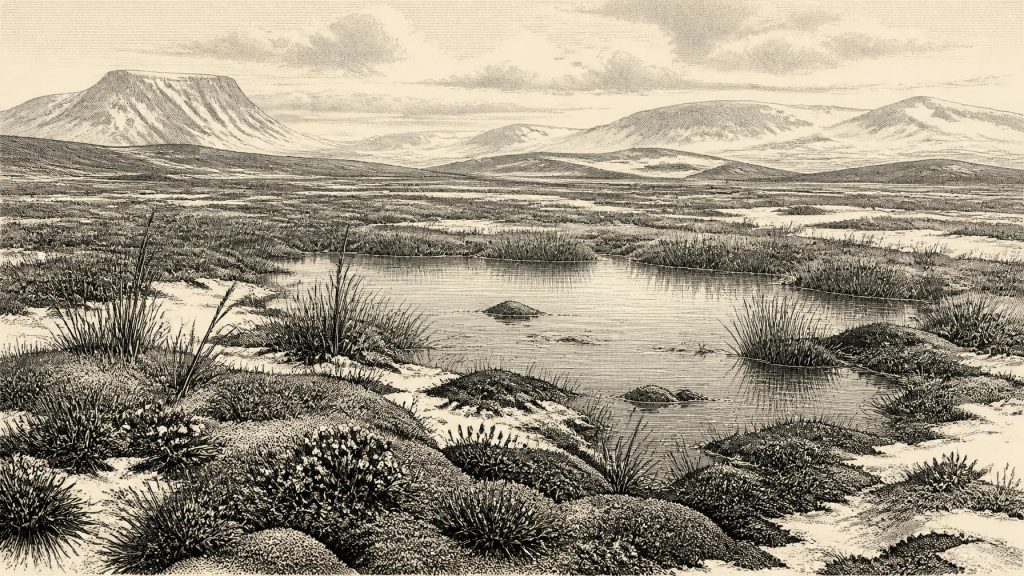
The Derryvree evidence is environmental rather than political. Its plant and animal remains indicate open tundra vegetation and a periglacial regime: ground subject to severe cold and seasonal freezing, but not a featureless sheet of permanent ice. Mosses, sedges and herbaceous plants, together with aquatic or wet-ground species, point to shallow water, saturated margins and low vegetation. Fossil insects reinforce the picture of cold northern conditions. The most defensible reconstruction is a patchwork of pools, wet hollows, mossy ground and exposed mineral soil, with sparse shrubs or herbs rather than forest.
This was not necessarily the same landscape everywhere in Ireland. Derryvree is a local archive preserved by unusual geological luck. It demonstrates an ice-free freshwater environment at one locality during the broader period; it does not prove that the whole island was simultaneously open, nor that every modern valley or upland looked alike. Glacial ice had repeatedly altered drainage and relief, while later advances destroyed or concealed much of the older evidence. In this respect the great absence of evidence is itself historically important: landscapes conducive to occupation or preserving camps may have been removed by ice, but erosion cannot be used as proof that people were present.
Cork’s Cave Fauna
Far to the south, Castlepook Cave near Doneraile in County Cork offers another, very different window. Cave deposits there have yielded a striking late-Pleistocene fauna: reindeer, woolly mammoth, giant deer, brown bear, wolf, foxes, mountain hare, lemmings and spotted hyaena. Such animals belong to open and cold environments, though the cave was a complex accumulating place rather than a neatly stratified snapshot of one season. Carnivores could drag bones into sheltered passages; old excavations recovered material from deposits whose precise relationships are difficult to reconstruct. Species listed from the cave must not automatically be imagined standing together in one herd or year.
Castlepook matters especially because a reindeer femur has a mark interpreted by zooarchaeologist Ruth Carden as having been made on fresh bone by a sharp stone implement. County Cork’s heritage service presents it as evidence of Palaeolithic reindeer butchery at about 31,000 BC. If that diagnosis and association are upheld, it may record a brief human encounter with a carcass in Ireland far earlier than the long-established late Upper Palaeolithic evidence. Yet the proper conclusion remains narrow. The cave has not produced a securely associated hearth, stone-tool assemblage, dwelling surface, burial or repeated processing floor of this age. A modified bone would demonstrate an action, not a settlement, a community or unbroken occupation.
This caution is more than academic. The National Museum of Ireland still describes the Palaeolithic human record as lacking clear evidence, while the new Castlepook interpretation has opened a serious research question rather than closed it. The contrast reflects the difference between an exceptional, potentially transformative object and the higher evidential standard required to demonstrate a settled human presence. Fresh excavation, direct dating of further material, microscopic analysis and secure stratigraphic context are needed before the earliest human history of Ireland can be rewritten with confidence.
People Beyond the Evidence
Accordingly, there can be no responsible account of political affairs, diplomacy, warfare or leadership for Ireland in 30,870 BCE. There are no named groups, territories, weapons caches, fortifications or monuments. Nor is there direct Irish evidence for ritual, art, formal learning, language or burial practice at this date. It would be misleading to transfer the rich cave art, burial customs or named archaeological cultures of continental Europe directly onto Ireland merely because broad climatic conditions were comparable.
If people did visit the island during the wider period represented by Castlepook, the most cautious inference is a small, mobile Upper Palaeolithic party rather than a settled population. Elsewhere in north-west Europe, hunter-gatherers could exploit meat, marrow, hides, sinew, antler and bone from large herbivores. Those possibilities explain why a reindeer carcass might have been valuable, but Ireland has not yielded the accompanying evidence needed to identify particular hunting methods, seasonal routes, exchange networks or social organisation. “Economy” here is best understood first as an ecosystem: wetland plants growing, insects breeding, herbivores grazing or browsing, and predators or scavengers taking advantage of carcasses.
Approaching the Ice-Sheet Maximum
The wider climatic trajectory gives this interval its gravity. The British–Irish Ice Sheet was growing and reorganising during the last glacial cycle, although its exact configuration around 32,819 years before present remains less securely resolved than its later maximum and retreat. The major BRITICE-CHRONO reconstruction is explicitly focused on 31,000–15,000 years ago, a span beginning after this nominal year. It establishes that Ireland’s ice history was dynamic and regionally varied, rather than a simple story of an island instantaneously buried beneath ice.
Later, extensive ice cover reshaped much of the island and its surrounding shelf. The freshwater beds at Derryvree survived precisely because they became trapped between tills, while Castlepook’s mixed cave deposits survived through a different combination of shelter, sedimentation and chance. These archives preserve a fleeting impression of biological possibility before harsher glacial conditions became more dominant. They also explain why the evidence is so fragmentary: the physical processes that made the Ice Age landscape repeatedly erased its earlier surfaces.
An Irish History of Limits
The principal development around 30,870 BCE was therefore environmental, not political: Ireland occupied a precarious zone of cold, shifting habitats and advancing or retreating ice. In Fermanagh, a freshwater wetland formed between glacial episodes; in Cork, cave deposits preserve animals adapted to open cold country and a contested possible trace of human carcass processing. These discoveries make Ireland relevant to the wider Upper Palaeolithic world, but they do not yet justify calling it continuously inhabited.
That restraint is the real historical lesson. The evidence can illuminate water, plants, insects, mammals, carnivores, sediment and ice. It can suggest opportunities that mobile people might have recognised. It cannot supply kings, tribes, beliefs, battles or a dated national origin. For this notional year, Ireland is best encountered through the buried freshwater of Fermanagh and the difficult bones of Castlepook: archives of a living but profoundly unstable Ice-Age land.
Primary Sources
- A Middle Midlandian Freshwater Series at Derryvree, Maguiresbridge, County Fermanagh, Northern Ireland
- Field Guide No. 16: The Quaternary of Northern Ireland
- An Inter-Till Fresh-Water Deposit at Hollymount, Maguiresbridge, Co. Fermanagh
- A Reconsideration of the Radiocarbon Dating of the Marine Isotope Stage 3 Fauna from Southern Ireland
- The Irish Quaternary Fauna Project
- Pleistocene Vertebrates in the British Isles
- Heritage Artefacts of County Cork
- Archaeology Research Excavation Grant 2022: Final Report
- Castlepook Cave, Co. Cork, 2022
- Prehistoric Details: Stone Age Collections
- Ice Age Ireland
- The Mesolithic in Ireland: When Was It?
- The IntCal20 Northern Hemisphere Radiocarbon Age Calibration Curve (0–55 cal kBP)
- Growth and Retreat of the Last British–Irish Ice Sheet, 31,000 to 15,000 Years Ago: the BRITICE-CHRONO Reconstruction
- The Timing and Magnitude of the British–Irish Ice Sheet Between Marine Isotope Stages 5d and 2
- Trimlines, Blockfields and the Vertical Extent of the Last Ice Sheet in Southern Ireland
- Radiocarbon Constraints on the Age of the Maximum Advance of the British–Irish Ice Sheet in the Celtic Sea
- Dimensions and Chronology of the Last Ice Sheet in Western Ireland
- Response of the Irish Ice Sheet to Abrupt Climate Change During the Last Deglaciation
- The Deglaciation of the Western Sector of the Irish Ice Sheet from the Inner Continental Shelf to its Terrestrial Margin
- Geology of Ireland
- Quaternary Geology Data and Maps
- New Insights on the Fauna of Ireland’s Younger Dryas