Doneraile’s Incised Reindeer30869 BCE
Around 30,869 BCE, Ireland was in the later Marine Isotope Stage 3, a period reconstructed through geological and palaeontological evidence rather than annual history. Derryvree, County Fermanagh, preserves freshwater sediments between glacial tills, indicating an ice-free, treeless, cold wetland with tundra vegetation. Castlepook Cave, County Cork, yielded cold-stage fauna, including mammoth, reindeer, giant deer and predators, though remains accumulated over time. An incised reindeer femur may record human butchery, suggesting possible transient Upper Palaeolithic visitors. However, no settlement, tools, hearths or social institutions are evidenced. Later glaciation transformed landscapes and erased most traces, requiring cautious interpretation of deep Irish prehistory.
Dateline
30,869 BCE is not a date to which Ireland’s past can be fixed year by year. No calendar, written record, named community or securely dated occupation layer can identify an event in that particular modern calendar year. It is a retrospective label, approximately 32,819 years before AD 1950, the conventional “present” of radiocarbon dating. The responsible historical frame is the later part of Marine Isotope Stage 3 (MIS 3), within the Midlandian cold stage of the Late Pleistocene. The evidence is geological and palaeontological: layers of sediment, fossil plants and insects, cave fauna, and a very limited possible trace of human activity. It supports broad calibrated ranges and local reconstructions, not an annual chronicle.
A Date Within Deep Time
The closest Irish chronological anchor is the Derryvree freshwater sequence near Maguiresbridge, County Fermanagh. Road works in 1969 cut through a drumlin and revealed silts and fine sands rich in organic material, enclosed between two distinct tills: unsorted debris left by moving glacier ice. Its order is secure. Ice deposited the lower till; an interval without glacier cover at that locality allowed freshwater sediments, plants and insects to accumulate; then a later ice advance laid down the upper till and sealed the deposit.
Organic material from the Derryvree series returned a conventional radiocarbon age of 30,500 +1,170/−1,030 radiocarbon years BP. Calibration produces a much broader approximate span of 36,900–31,700 calibrated years BP, or about 34,950–29,750 BCE. The modern label 30,869 BCE lies within that range, but this does not mean that every part of the organic bed formed in that year, nor that conditions in Fermanagh describe the whole island at once. It is a valuable local window, rather than a national snapshot.
The date falls before the Last Glacial Maximum, when the British–Irish Ice Sheet later grew to much greater dimensions, broadly after 30,000 years ago and especially during the later twenties and early twenties millennia BP. Ireland’s ice history was episodic and regionally variable. The Derryvree strata demonstrate that this part of Fermanagh was ice-free for a time between glacial episodes. They do not prove that every Irish region was simultaneously open, inhabitable or connected by easy routes to Britain or continental Europe.
Fermanagh’s Cold Wetland
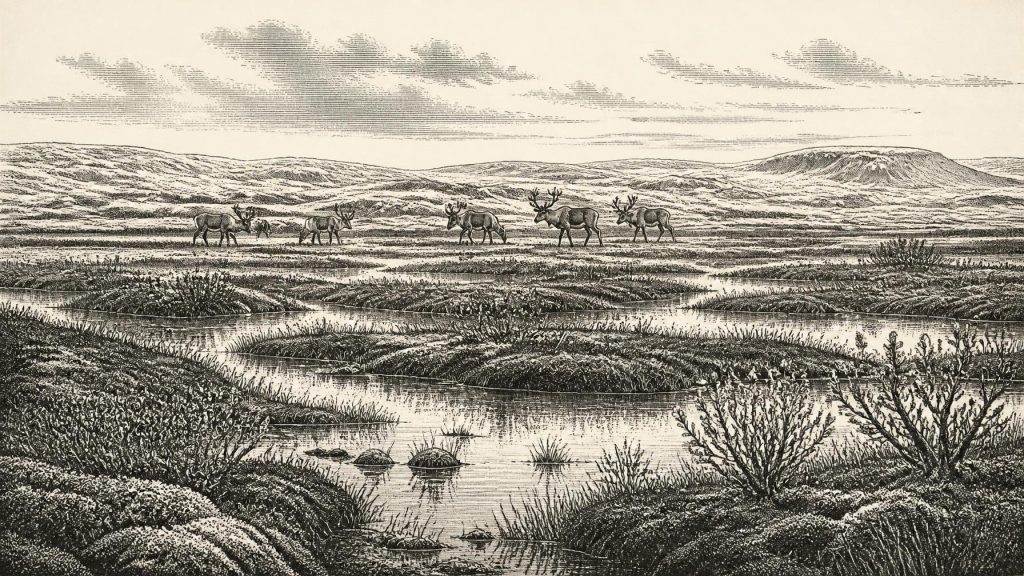
Derryvree is the best guide to the everyday environment near this notional date. The freshwater silts preserved pollen, plant remains and an insect fauna characteristic of cold northern conditions. The landscape was not an ancestral version of wooded modern Ireland. It was largely treeless, open and periglacial: ground shaped by frost, short growing seasons and seasonal thaw. Mosses, sedges, dwarf willow, mountain-avens, lesser clubmoss and bogbean point to a mixture of wet ground, shallow pools and tundra-like vegetation.
That botanical evidence deserves careful reading. A bogbean seed or dwarf-willow remain is direct evidence that a plant grew in, or was transported into, the depositional basin. Together with the sediment and insect record, it supports an interpretation of freshwater marshes and pools amid cold open country. It does not provide a complete inventory of all Irish habitats or temperatures. Nearby slopes, exposed ridges, river corridors and areas nearer ice margins may have offered very different conditions. Yet the contrast with later Ireland is unmistakable: no evidence here suggests broad oak woodland, cultivated fields, enclosed pasture or a settled agricultural landscape.
Water was especially important. In a cold landscape, an unfrozen or seasonally renewed wetland could support aquatic plants, invertebrates and birds, while sedges and herbs fed herbivores. Such places also trapped pollen, leaves, seeds and the small remains through which palaeoecologists reconstruct vanished environments. Derryvree’s significance rests precisely on this accidental preservation. Most open ground of the period has been eroded, buried or rearranged by later ice. A buried wetland beneath a drumlin is therefore an unusually eloquent survivor.
Animals in the Open Country
County Cork provides a complementary, though more complicated, record. Castlepook Cave, also called Mammoth Cave, near Doneraile, produced Ireland’s most important assemblage of pre-Last Glacial Maximum vertebrate remains. Its caves yielded bones of woolly mammoth, giant deer, reindeer, brown bear, wolf, Arctic fox, mountain hare, collared and Norwegian lemmings, and spotted hyaena. The National Museum of Ireland holds, among other material, a Castlepook spotted-hyaena skull recovered during early twentieth-century excavation.
These animals indicate that Ireland was at times part of a wider north-west European cold-stage ecological zone. Reindeer and lemmings fit open, cold habitats; mammoth and giant deer imply extensive grazing country; wolves, hyaenas and bears show that large carnivores could use the same broader landscape. But a cave bone assemblage is not a photograph of one living herd. Caves may gather animals over long intervals through carnivore activity, natural deaths, water movement and earlier excavation disturbance. The fauna establishes a changing regional animal world, not a claim that every listed species shared one valley in 30,869 BCE.
Recent redating has made this caution more important. Improved methods of extracting and treating bone collagen have shown that some older Irish cave radiocarbon results were too young. Research on Castlepook and other southern caves places important parts of the fauna within MIS 3 and indicates that some species, including giant deer and spotted hyaena, may have disappeared locally before the Last Glacial Maximum. The evidence therefore suggests repeated opportunities for animals to enter, survive in and leave Ireland as climate, ice and sea level changed, rather than a stable Ice Age fauna persisting unchanged for millennia.
The Reindeer Femur Question
One Castlepook object brings people into the discussion, but only conditionally. A fragment of reindeer femur has been presented by zooarchaeologist Ruth Carden and County Cork heritage material as carrying a deep mark made by a sharp stone tool while the bone was fresh. The specimen has been publicly assigned broadly to around 31,000 BCE. If the mark is correctly identified as a human butchery trace and is contemporary with the animal’s death, it may be Ireland’s earliest evidence that people handled an animal.
This is a remarkable possibility, but it is not proof of a settled Palaeolithic population. The bone derives from an old cave collection rather than a recently excavated, sealed occupation floor. Castlepook has not yet yielded a securely associated stone-tool assemblage, hearth, shelter floor, burial, human bone or repeatedly used food-processing area of the same age. A radiocarbon date establishes when the animal lived; it does not independently date the incision, name its maker or establish where the carcass was killed and processed. Carnivores may also have carried parts of a carcass into the cave after human activity elsewhere.
The strongest interpretation is consequently modest: short visits by mobile Upper Palaeolithic hunter-gatherers are possible and perhaps increasingly plausible, particularly if people moved through the same wider landscapes as reindeer. A permanent settlement, continuous occupation or identifiable population cannot be demonstrated. Nor can such possible visitors responsibly be called “Irish” in an ethnic, linguistic or political sense. Ireland here is a geographical term for a changing Ice Age landmass and its surrounding seas, not a society with a recorded name.
Society Beyond the Evidence
No evidence supports kingdoms, chieftaincies, laws, diplomacy, warfare, borders or formal political institutions in Ireland at this date. There is likewise no Irish evidence for farming, herding, cereal cultivation, permanent houses, pottery, metallurgy, monuments, writing or organised long-distance trade. The sparse record cannot establish kinship systems, language, religious beliefs, ritual practice or artistic traditions. Upper Palaeolithic communities elsewhere in Europe made sophisticated stone tools, ornaments and cave art, but those continental and British comparisons are context, not proof that equivalent practices occurred in Ireland.
If people did visit, their economy would have depended on knowledge of season, terrain, animals and raw materials, rather than farming or commerce. A reindeer carcass could supply meat, marrow, hide, sinew and bone, but the Castlepook find cannot tell whether the animal was hunted, scavenged or merely processed. The safest conclusion is that Ireland offered intermittent ecological possibilities amid severe climatic risk: freshwater refuges, grazing ground and animal movement during ice-free phases, followed by renewed glaciation capable of closing routes, transforming terrain and destroying traces of human presence.
What This Year Can Mean
For 30,869 BCE, Ireland’s history is principally environmental history. At Derryvree, cold freshwater wetlands formed between episodes of glaciation; at Castlepook, animals associated with open Ice Age country left a complex cave archive; and one marked reindeer bone raises, without settling, the possibility of human contact. The eventual growth of the later ice sheet would reshape much of the land and heavily reduce the chances that camps, tracks or organic settlements survived.
That scarcity is itself historically important. It explains why the period should not be populated with imagined tribes, dramatic hunts or named events. The evidence gives something more fragile but more reliable: a landscape of frost, sedge pools, low plants, large herbivores and predators, in which a human presence remains possible but unproven as settlement. Modern calendar precision ends at the edge of that evidence; calibrated ranges, stratigraphy and careful uncertainty are the proper means of approaching Ireland at this depth of time.
Primary Sources
- A Middle Midlandian Freshwater Series at Derryvree, Maguiresbridge, County Fermanagh, Northern Ireland
- Early Midlandian–Middle Midlandian, Pleistocene, Northern Ireland
- The Subdivision of the Quaternary Period in Ireland
- Freshwater Organic Deposits and Stratified Sediments Between Early and Late Midlandian (Devensian) Till Sheets, at Aghnadarragh, County Antrim, Northern Ireland
- A Reconsideration of the Radiocarbon Dating of the Marine Isotope Stage 3 Fauna from Southern Ireland
- The Irish Quaternary Fauna Project
- Occurrence of Mammalia Relicts at Site Castlepook Cave
- The Exploration of Castlepook Cave, Co. Cork
- Spotted Hyena Skull
- Heritage Artefacts of County Cork
- New Insights on the Fauna of Ireland’s Younger Dryas and Early Holocene from Alice & Gwendoline Cave
- Sedimentary and Foraminiferal Records of Late Quaternary Environmental Change West of Ireland and Implications for the Last British–Irish Ice Sheet
- The Timing and Magnitude of the British–Irish Ice Sheet Between Marine Isotope Stages 5d and 2
- Dimensions and Chronology of the Last Ice Sheet in Western Ireland
- Late Pleistocene Chronostratigraphy and Ice Sheet Limits, Southern Ireland
- Early Deglaciation of Western Ireland: Implications for the Location, Extent and Timing of the Western Irish Ice Sheet
- Exploring Controls of the Early and Stepped Deglaciation on the Western Margin of the British Irish Ice Sheet
- The IntCal20 Northern Hemisphere Radiocarbon Age Calibration Curve (0–55 cal kBP)
- Marine Isotope Stage 3 in Northern North Atlantic: A Review of Ice-Core, Marine-Core and Terrestrial Records
- High-Resolution Record of Northern Hemisphere Climate Extending into the Last Interglacial Period
- A 57,000-Year Record of Northern Hemisphere Climate from Greenland Ice Cores
- A Pliocene–Pleistocene Stack of 57 Globally Distributed Benthic δ18O Records