
Doneraile’s Cut-Marked Reindeer30827 BCE
30,827 BCE is a label, not an identifiable Irish event. During Marine Isotope Stage 3, Ireland contained variable ice, permafrost and open tundra wetlands. Derryvree, County Fermanagh, preserves freshwater sediments dated broadly to 36,900–31,700 years before present, indicating cold, treeless, harsh conditions before later glaciation. Castlepook Cave, County Cork, contains Late Pleistocene fauna, including reindeer. A reindeer femur, roughly 33,000 years old, bears a possible stone-tool butchery mark, suggesting a brief human visit. However, no associated tools, hearths, settlements or burials prove occupation. Changing coasts and ice complicated access, while later ice destroyed evidence. Ireland remained a volatile European frontier.
Dateline
“30,827 BCE” is a useful modern filing label, not a date at which an event in Ireland can be identified. There was no calendar, writing or year-by-year historical record, and the surviving evidence cannot be resolved to a single season, let alone a single year. In terms of the radiocarbon convention of years before 1950, the label falls roughly 32,800 years ago, within the Late Pleistocene and Marine Isotope Stage 3. The responsible approach is therefore to examine calibrated ranges and environmental sequences that overlap this broad interval, while keeping the difference between physical evidence and historical interpretation firmly in view.
A Landscape Before the Ice Sheet’s Maximum
Ireland was entering a severe phase of the last glacial cycle, but it had not yet reached the Last Glacial Maximum. The fullest extent of the British–Irish Ice Sheet came later, broadly between about 27,000 and 23,000 calibrated years before present. Around the notional date used here, ice margins, local glaciers, permafrost and open ground probably varied greatly between regions and over comparatively short spans of time. It is misleading to picture one uniform white blanket covering the whole island, yet equally misleading to imagine a familiar green Ireland. This was an unstable northern landscape in which advancing ice, freezing ground, sparse vegetation and exposed sediment could rapidly alter the possibilities for plants, animals and any human visitors.
The best directly relevant environmental sequence comes from Derryvree near Maguiresbridge in County Fermanagh. Roadworks in 1969 exposed organic silts and fine sands trapped between two thick tills within a drumlin. The deposit yielded a conventional radiocarbon age of 30,500 years BP, with a substantial uncertainty. Calibrated estimates place it broadly between about 36,900 and 31,700 years before present. That range overlaps the general vicinity of 30,827 BCE, but does not date the deposit, a landscape or an occupation to that numbered year. What it securely demonstrates is that, before later ice overrode the ground, a freshwater and wetland environment existed in north-central Ireland during this part of the glacial cycle.
Derryvree’s Cold Wetland
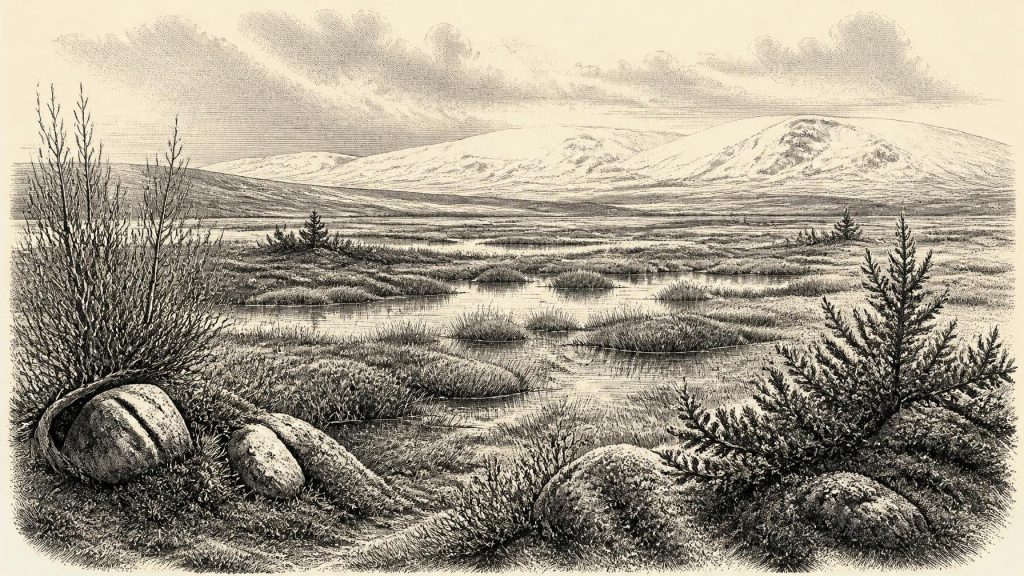
Plant macrofossils, pollen, mosses and insect remains from Derryvree provide an unusually detailed glimpse of that environment. The evidence indicates an open, treeless tundra or muskeg-like setting: wet ground and shallow pools among mosses, sedges, grasses, herbs and hardy shrubs, rather than forest. Mountain avens, dwarf willow, juniper and other cold-tolerant plants have been identified in the sequence. Aquatic species, including water-milfoil and bogbean, point to standing or slow-moving freshwater. Beetles and other small invertebrates add to the picture of saturated, plant-rich ground with open water nearby.
Such evidence supports a cold, strongly seasonal climate with long winters and short summers, not an exact reconstruction of temperature, rainfall or snow depth. “Tundra” is an ecological shorthand, not a claim that every part of Ireland looked alike. The Derryvree deposits capture one local basin at one part of a long interval. Nevertheless, their great importance is chronological as well as ecological: they show that areas later buried beneath glacial deposits had sustained non-glacial environments. The drumlin enclosing the sediments is itself a reminder that this wetland world was eventually replaced and obscured by ice-sheet activity.
Castlepook and the Animal Record
Far to the south, Castlepook Cave near Doneraile in County Cork is Ireland’s principal archive for Late Pleistocene large mammals of broadly comparable age. Its deposits and historic bone collections include reindeer, woolly mammoth, spotted hyaena, wolf, fox, hare, giant deer and small mammals. They confirm that Ireland was reached, at different times in the Late Pleistocene, by an assemblage of animals adapted to open country and cold climates. Reindeer are particularly evocative, but the cave should not be treated as a neatly dated snapshot of a single herd crossing the Cork landscape. Cave deposits accumulated through repeated processes: carnivores used caves and dragged in carcass parts; water, frost and collapse disturbed material; and early excavations did not record deposits to modern standards.
Radiocarbon redating has made the Castlepook collection more valuable and more complicated. Earlier dates for some specimens needed reassessment because advances in pretreatment and accelerator mass spectrometry can reveal contamination or improve precision. Mammoth and hyaena remains have been associated with the middle part of the last glacial cycle, while a reindeer specimen is of special significance to the question of people. The archaeological story of Ireland at this date hinges not on a settlement, monument or burial, but on one modified animal bone and the limits of what it can prove.
The Reindeer Femur Question
A reindeer femur from Castlepook, held in the National Museum of Ireland’s natural-history collection, has been dated to roughly 33,000 years ago and bears a deep mark interpreted by zooarchaeologist Ruth Carden as damage made by a sharp stone tool during butchery. County Cork heritage material presents it as evidence that Stone Age hunters processed a reindeer in the Doneraile area around 31,000 BC. If that interpretation is sustained, it would be Ireland’s earliest known indication of human activity by a very large margin and would place a human visit in the orbit of Upper Palaeolithic populations elsewhere in north-west Europe.
It remains a narrow, important and provisional inference rather than proof of permanent settlement. A date on the bone identifies the age of the animal, not necessarily the precise moment when its surface was marked. Nor does one possible butchery mark establish where a carcass was killed, how many people were present, whether they sheltered in the cave, or whether they returned. No securely associated stone-tool assemblage, hearth, dwelling floor, human remains or stratified camp has yet been recovered for Ireland at this age. Recent Castlepook research and geophysical survey are directed precisely towards finding undisturbed deposits that could test these possibilities. Until then, the fairest conclusion is that a brief human encounter with a reindeer is plausible, but an enduring Irish population is unproven.
Society Beyond the Evidence
There is no evidence from Ireland around this broad date for political authority, territorial kingdoms, diplomacy, formal institutions, warfare or organised trade. There are no identified settlements from which to reconstruct households, social ranks, gender roles, language or routine food preparation. It would be irresponsible to supply imagined chiefs, tribal boundaries or conflicts merely because these are familiar features of later history. If people did reach Ireland, they were likely highly mobile hunter-gatherers operating in a demanding and sparsely productive environment, probably as part of wider movement across the north-west European world. That is a reasonable archaeological comparison, not a documented description of an Irish community.
The same restraint applies to religion and culture. People living elsewhere in Upper Palaeolithic Europe produced sophisticated objects, images, ornaments and practices, but no comparable artefact, image or burial can presently be assigned to Ireland around 30,827 BCE. The absence of such evidence does not mean that visitors lacked beliefs, stories, skills or social bonds. It means that Ireland’s surviving record cannot reveal them. Nor can trade be demonstrated. The movements of mammals and the possibility of human travel show that Ireland was not ecologically isolated in an absolute sense, but they do not establish exchange networks, routes or regular contact.
Routes, Coasts and Change
Sea level was much lower than today because vast volumes of water were stored in continental ice sheets. Coastlines and shallow seas around Ireland therefore differed markedly from modern maps. Yet low sea level did not automatically provide an easy land route. The Irish Sea basin, regional ice cover and changing shorelines made access contingent on time and route; the evidence does not permit a confident statement that people simply walked into Ireland at this date. A small visiting party could have travelled across a changing coastal world, but archaeology has not identified its route, technology or origin.
The central development was environmental change. Derryvree records a cold freshwater refuge, while Castlepook preserves traces of cold-stage animals and a possible moment of carcass processing. Later expansion of the Irish ice sheet would erase, bury or redeposit much of the evidence that might once have existed on open ground. This helps explain why the record is so fragmentary. Around 30,827 BCE, Ireland was neither a blank nor a known human homeland: it was a climatically volatile edge of the European world, where tundra wetlands and roaming fauna are demonstrable, and a single marked reindeer bone keeps open the possibility of a very early human presence.
Primary Sources
- A Middle Midlandian Freshwater Series at Derryvree, Maguiresbridge, County Fermanagh, Northern Ireland
- A Reconsideration of the Radiocarbon Dating of the Marine Isotope Stage 3 Fauna from Southern Ireland
- Archaeology Research Excavation Grant 2022
- Archaeology Research Excavation Grant Report: Castlepook Caves Project
- Heritage Artefacts of County Cork
- Figure 6.— The Subdivision of the Quaternary Period in Ireland
- Trimlines, Blockfields and the Vertical Extent of the Last Ice Sheet in Southern Ireland
- Growth and Retreat of the Last British–Irish Ice Sheet, 31,000 to 15,000 Years Ago: The BRITICE-CHRONO Reconstruction
- Pattern and Timing of Retreat of the Last British-Irish Ice Sheet
- Reconstructing the Last Irish Ice Sheet 2: A Geomorphologically-Driven Model of Ice Sheet Growth, Retreat and Dynamics
- Late Pleistocene Chronostratigraphy and Ice Sheet Limits, Southern Ireland
- New Data for the Last Glacial Maximum in Great Britain and Ireland
- Ireland: Submerged Prehistoric Sites and Landscapes
- Early Deglaciation of the British-Irish Ice Sheet on the Atlantic Shelf Northwest of Ireland Driven by Glacioisostatic Depression and High Relative Sea Level
- Character of Advance and Retreat of the Southwest Sector of the British-Irish Ice Sheet During the Last Glaciation
- Stratigraphic and Palaeo-Geomorphological Evidence for the Glacial-Deglacial History of the Last British-Irish Ice Sheet in the North-Western Irish Sea
- Timing and Pace of Ice-Sheet Withdrawal Across the Marine–Terrestrial Transition West of Ireland During the Last Glaciation
- A 10Be-Dated Record of Glacial Retreat in Connemara, Ireland, Following the Last Glacial Maximum and Implications for Regional Climate
- The Mesolithic in Ireland: When Was It?
- Irish Quaternary Association: Field Guides