Castlepook’s Mammoth-Steppe Fauna30828 BCE
30,828 BCE is a modern label, not a recoverable Irish historical year. During climatically unstable Marine Isotope Stage 3, Ireland experienced shifting ice advances and exposed cold landscapes. Derryvree, County Fermanagh, preserves sediments indicating an ice-free freshwater tundra with sedges, dwarf shrubs, aquatic plants and insects during a broadly comparable interval. Castlepook Cave, County Cork, yielded Late Pleistocene remains including reindeer, mammoth, giant deer, predators and small cold-adapted mammals, though not necessarily contemporaries. A marked reindeer femur may indicate human carcass processing, but lacks secure context. Evidence supports a biologically active Pleistocene frontier, not settled society or continuous human occupation.
Dateline
The label 30,828 BCE is a modern chronological convenience, not a year that can be recovered from an Irish record. No calendar, written testimony, settlement sequence or securely dated human episode permits events in Ireland to be assigned to this particular year. In archaeological terms it falls about 32,777 years before AD 1950 and within Marine Isotope Stage 3 (MIS 3), a climatically unstable part of the Late Pleistocene. The responsible approach is therefore to examine dated ranges and environmental evidence from broadly comparable centuries and millennia, while keeping firm distinctions between what deposits demonstrate and what historians may reasonably infer.
Ireland at this depth of time was not the settled island of later prehistory. There were no farms, villages, monuments, named peoples, political communities or diplomatic relations that can be identified in the evidence. Nor is there a reliable basis for reconstructing a continuous human population. What survives instead is a thin, hard-won record of sediment, pollen, plant macrofossils, insects, animal bone and glacial landforms. Those fragments show that parts of the landmass which later became Ireland could, during MIS 3, support cold-adapted life between episodes of glaciation.
Dating an Uncertain Landscape
It is important not to convert a BCE label mechanically into an archaeological event. Radiocarbon determinations are commonly reported in radiocarbon years before present (BP), where “present” is AD 1950; they must then be calibrated against changing atmospheric carbon levels to estimate calendar ages. The resulting ranges can be broad, especially at this age. A date from an animal bone establishes when the animal died, within stated uncertainty; it does not automatically date a scratch on that bone, prove human contact, or establish the date of a cave deposit containing it.
At 30,828 BCE, climatic change was also operating on a scale that defeats year-by-year narrative. The British–Irish Ice Sheet was developing through the later part of MIS 3, but its extent, thickness and timing varied greatly by region and remain subjects of active research. Ice had advanced and retreated repeatedly in the wider Irish landscape. Some areas were glaciated; others were exposed as cold, treeless terrain; still others may be known only through deposits later overridden, mixed or buried by ice. Modern coastlines, moreover, are misleading guides: lower global sea level exposed large areas of continental shelf, but the actual accessibility of routes depended on shifting sea, ice and terrain. No particular crossing route into Ireland can be demonstrated for this date.
Derryvree Between the Ice Advances
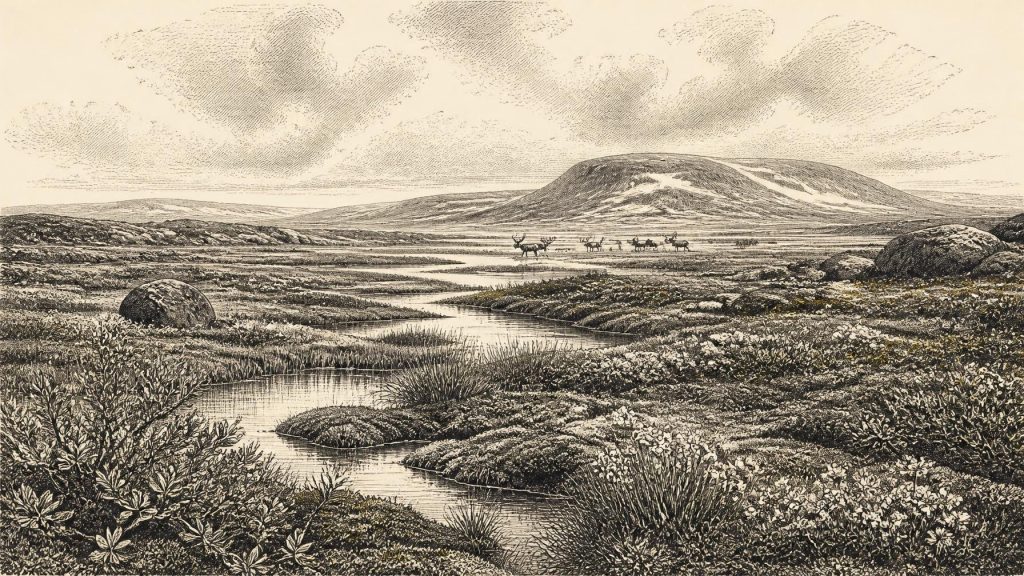
The clearest environmental guide to this broad period comes from Derryvree near Maguiresbridge, County Fermanagh. Road works in 1969 exposed freshwater silts and fine sands lying between two till deposits, the unsorted material left by glacier ice. This sequence is unusually informative. It establishes that ice had affected the locality, that an ice-free freshwater and wet-ground environment subsequently existed there, and that later glacial activity sealed the organic evidence beneath further sediment. It is not a continuous climate record, nor can it be treated as a snapshot of the whole island, but it is a rare Irish window onto a Pleistocene landscape.
The Derryvree organic sediments produced a conventional radiocarbon age of 30,500 BP, with a substantial published uncertainty. Calibration places the deposit broadly in the mid- to high-30,000s calendar years BP, rather than at the article’s exact nominal year. It is thus best used as evidence for the environmental character of the wider Middle Midlandian cold-stage world, not as proof that a particular pool, plant or animal existed in Fermanagh in 30,828 BCE.
Its biological contents point to open tundra or muskeg: a wet, cold, largely treeless mosaic of shallow water, sedge and grass margins, mosses, low herbs and dwarf shrubs. Pollen and plant remains include taxa associated with northern, exposed ground, while aquatic and wetland fossils show that fresh water persisted locally despite a severe climate. Mountain-avens, dwarf willow, juniper, clubmosses, sedges and bogbean help convey the sort of vegetation represented, though every species need not have occupied precisely the same microhabitat or moment. Insect evidence further supports cold, open conditions with wet ground and plant-rich pools.
This is evidence against two equally misleading pictures: an Ireland entirely entombed beneath permanent ice, and a familiar green island merely made colder. The Derryvree landscape was biologically active but precarious. Short growing seasons, frozen or waterlogged ground and sparse cover would have constrained plants and grazing animals alike. Wind-blown pollen can derive from beyond a local basin, and fossil assemblages mix species from slightly different niches and times. Even so, the combined sediments and fossils securely demonstrate that at least part of Fermanagh sustained a freshwater tundra ecosystem during an interval between ice incursions.
Castlepook and the Animal World
In southern Ireland, Castlepook Cave near Doneraile in County Cork preserves a different kind of archive. Cave deposits and nineteenth- and twentieth-century collections have yielded remains attributed to a striking Late Pleistocene fauna: reindeer, mammoth, giant deer, brown bear, wolf, Arctic fox, hare, lemmings and spotted hyaena. Such animals should not be imagined as one neatly contemporaneous herd gathered outside the cave. A cave is a complex accumulator. Carnivores, deaths in or near the entrance, water movement, sediment disturbance and early collecting practices can combine material from different dates and places.
Nevertheless, the assemblage establishes a major historical point. The Ireland of broad MIS 3 time belonged, at intervals, to a north-west European cold-environment zone capable of supporting mammals now absent from the island. Reindeer and horse imply open grazing country; lemmings and Arctic fox indicate severe northern conditions; hyaena and wolf show that predators ranged through at least some of this world. Mammoth remains connect the island to the wider mammoth-steppe ecological province, although they do not prove a uniform grassland, a stable local mammoth population, or the precise condition of Cork at the nominal year.
Radiocarbon reassessment has complicated earlier confidence in the chronology of southern Irish cave fauna. Improved pretreatment methods have shown that some older determinations may be unreliable, and individual specimens need individual scrutiny. Published dates for Castlepook material span a wide portion of the Late Pleistocene. The prudent conclusion is not that every named animal lived together around 30,828 BCE, but that the cave preserves evidence of a richer, climatically variable pre-Last Glacial Maximum fauna than later Irish history might suggest.
The Reindeer Femur Question
One Castlepook reindeer femur has particular significance because it has been reported to bear a possible stone-tool cut mark. Public interpretation has associated the specimen with an age of roughly 31,000 BCE, and its reported radiocarbon age is broadly close enough to make it relevant to this article’s period. If the incision were conclusively shown to be a fresh-bone cut made by a stone edge, it could represent remarkably early human processing of a reindeer in Ireland, far earlier than the well-supported Late Upper Palaeolithic evidence from Alice and Gwendoline Cave in County Clare.
That possibility must not be inflated into a settled history of occupation. The radiocarbon determination dates the bone’s death, not necessarily the making of the mark. Nor has Castlepook produced a securely associated hearth, stone-tool assemblage, dwelling floor, burial, food store or repeated occupation surface of comparable age. A single modified bone, particularly one from an old cave collection, cannot identify the maker, demonstrate a resident group, reveal language or establish whether people stayed for hours, days or seasons. The best description is that Castlepook raises a serious and important question about a human visit or carcass-processing episode; it does not yet establish an Ice Age Irish society.
People, Power and Belief
Accordingly, political affairs, warfare, diplomacy, religion, formal learning and trade cannot be narrated for Ireland in this year. There is no evidence for chiefs, territorial rule, alliances, conflict between communities, ritual places or exchange networks. It would be equally unwarranted to assign the possible visitors at Castlepook a specific Upper Palaeolithic cultural identity merely because contemporaries elsewhere in Europe made distinctive tools, ornaments and art. Similarity in date or ecology is not proof of direct contact.
If people did reach Ireland during this broad interval, they would have been mobile foragers operating in a demanding seasonal environment, probably making decisions around shelter, fuel, weather, animal movements and safe travel. This is a reasoned inference from Upper Palaeolithic lifeways elsewhere, not direct evidence from an Irish camp. A reindeer carcass could have supplied meat, fat, hide, sinew and bone; yet there is no securely dated Irish assemblage from which to reconstruct the division of labour, diet, technologies or social relations of those hypothetical visitors.
There is likewise no evidence for an economy in the later sense of cultivation, herding, permanent production or commercial trade. Farming lay tens of millennia in the future. The relevant economy, if human activity occurred at all, was one of immediate landscape use: hunting or scavenging, gathering available plant foods, and moving through an exposed country whose resources were unevenly distributed. The absence of proof of enduring settlement matters. Ireland’s archaeological record does not presently show continuity from such possible MIS 3 encounters to the much later, demonstrable settlement of the island.
A History Written in Fragments
The significance of 30,828 BCE lies less in a recoverable event than in the disciplined limits of knowledge. Derryvree shows an ice-free Fermanagh wetland and open tundra during a broadly relevant cold-stage interval. Castlepook shows that a varied Ice Age fauna, including reindeer and mammoth, reached southern Ireland at different times before the Last Glacial Maximum. The marked reindeer femur holds out the possibility of an early human presence, but remains a proposition requiring further contextual, microscopic and chronological testing.
For this point in Irish history, the most truthful narrative is therefore environmental rather than political. The land was changing under the pressure of ice, cold, water and low vegetation; mammals and predators occupied portions of it; and any human trace is fleeting, contested and exceptionally valuable. The silts of Derryvree and bones of Castlepook do not yield a calendar year. They do, however, reveal an Ireland that was neither empty of life nor securely peopled: a difficult Pleistocene frontier whose surviving evidence must be read with care.
Primary Sources
- A Middle Midlandian Freshwater Series at Derryvree, Maguiresbridge, County Fermanagh, Northern Ireland
- Palaeoecology: Irish Quaternary Association Field Guide No. 16
- A Reconsideration of the Radiocarbon Dating of the Marine Isotope Stage 3 Fauna from Southern Ireland
- The Irish Quaternary Fauna Project
- Irish Pleistocene Biostratigraphy
- The Geology of Ireland
- Growth and Retreat of the Last British–Irish Ice Sheet, 31,000 to 15,000 Years Ago: The BRITICE-CHRONO Reconstruction
- Dating Constraints on the Last British-Irish Ice Sheet: A Map and Database
- Variations in Esker Morphology and Internal Architecture Record Time-Transgressive Ice-Margin Retreat during Last Glacial Cycle Deglaciation in Northern Ireland
- Discrepancies in Dating the Expansion of European Glaciers during the Last Glacial Cycle
- Marine Isotope Stage 4 (71–57 ka) on the Western European Margin: Insights to the Drainage and Dynamics of the Western European Ice Sheet
- Introduction to the Late Quaternary and Holocene of Northern Ireland
- Quaternary Data and Maps
- Geology of Ireland
- Ireland Through Geological Time
- Heritage Artefacts of County Cork
- Ireland's Palaeolithic Archaeology – Fleeting Footprints in a Frozen Land
- Prehistoric Details: Stone Age Collections
- The Mesolithic in Ireland: When Was It?
- First Evidence of a Late Upper Palaeolithic Human Presence in Ireland
- New Insights on the Fauna of Ireland’s Younger Dryas and Early Holocene from Alice & Gwendoline Cave
- BSBI: Menyanthes trifoliata
- BSBI: Dryas octopetala
- Pleistocene Vertebrates in the British Isles