
Elephant Hall’s Bone Corridor30826 BCE
Around 30,826 BCE, Ireland formed part of an unstable MIS 3 Pleistocene environment, not a precisely datable historical year. Derryvree deposits in Fermanagh preserve evidence of cold, open tundra-steppe wetlands, while Castlepook Cave in Cork yielded diverse pre-Last Glacial Maximum fauna, including mammoth, reindeer, giant deer, hyaena and Arctic fox. Cave deposits were disturbed, limiting interpretation. A marked reindeer femur may indicate Upper Palaeolithic butchery and a brief human incursion, but proves neither settlement nor regular occupation. No social, economic or political structures are recoverable. Episodic warming, advancing ice and shifting habitats shaped an intermittently habitable island dominated by animals.
Dateline
Modern calendar-year precision cannot be applied to Ireland in 30,826 BCE. No written calendar, dated event or identifiable community permits history at the scale of a single year. The number is best used as a point within a much wider archaeological and climatic interval: roughly 32,800 years before 1950, in the later part of the Pleistocene and broadly within Marine Isotope Stage 3 (MIS 3). The evidence is a mixture of radiocarbon ranges, cave deposits, animal bones, plant remains and glacial sediments. It can illuminate conditions across centuries or millennia, but it cannot tell us what happened in one particular twelve-month span.
A Cold-Stage Ireland
Ireland at this point lay in the long descent towards the Last Glacial Maximum, when ice would later cover much of the island. That maximum lay in the future: the most extensive phase of the last Irish Ice Sheet is generally placed between about 26,000 and 20,000 years ago. Around 30,826 BCE, however, conditions were neither uniformly frozen nor stable. MIS 3 was marked by abrupt climatic shifts, with relatively milder interstadial episodes interrupted by severe cold phases. Ireland’s landscape changed with them.
The closest securely relevant environmental sequence comes from Derryvree near Maguiresbridge, County Fermanagh. There, road-cut deposits revealed organic-rich freshwater silts trapped between two glacial tills. Their calibrated radiocarbon range, approximately 36,900–31,700 cal BP, encompasses the broad period represented by 30,826 BCE. The range is more meaningful than an apparent exact date: it indicates that, before a later ice advance buried the evidence, there was a freshwater setting in the Fermanagh lowlands during a cold but not lifeless phase of the last glaciation.
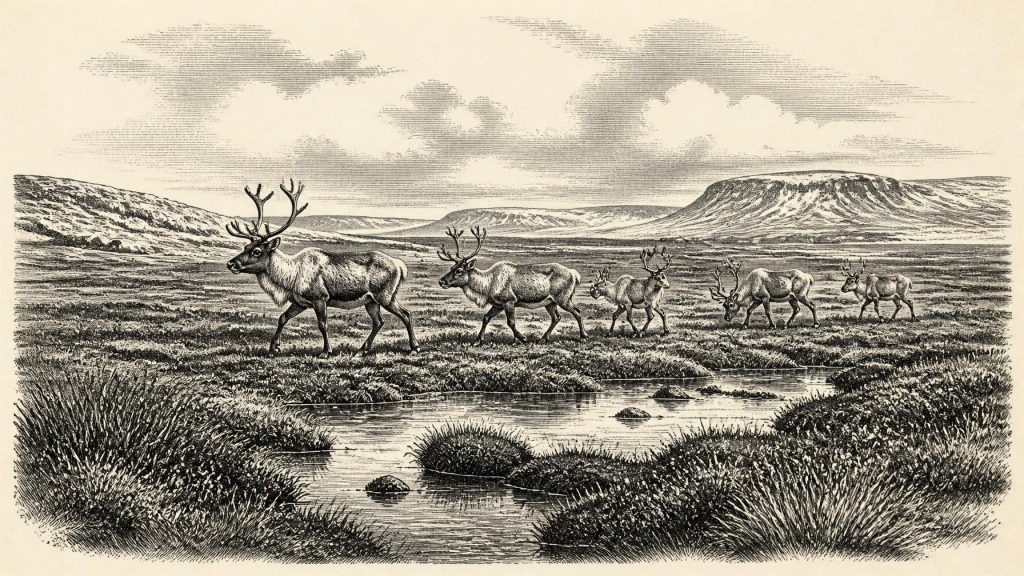
Derryvree was not a village, a camp or a lake shore occupied by known people. It is an environmental archive. Plant remains, mosses, aquatic species and insects indicate open tundra or tundra-steppe country, with wet ground, pools and sedge-rich margins rather than closed forest. Dwarf shrubs and cold-adapted herbaceous plants could survive where soils permitted; mossy, waterlogged patches supported freshwater life. The insect evidence has been interpreted as consistent with a muskeg-like wetland: plant-rich ground with open water nearby. Such evidence gives a vivid, though local, picture of northern Ireland’s habitats at an interval close to this date.
The Castlepook Faunal Record
In southern Ireland, Castlepook Cave near Doneraile in north County Cork provides the most important complementary record. Its galleries include Elephant Hall, Hyenahall and other evocatively named chambers, but these names belong to modern exploration rather than prehistoric memory. The cave is Ireland’s richest known source for vertebrate remains dating to the period before the Last Glacial Maximum. More than 2,000 bones have been recovered, although many came from excavations conducted between 1904 and 1918, before modern recording standards. Their original positions and associations are therefore often uncertain.
That limitation matters. Castlepook is not a single frozen moment, nor can its bones simply be treated as the animals seen together on one day. Water, cave collapse, carnivores and early excavation disturbed the deposits. Modern radiocarbon re-dating has also shown that several earlier determinations were substantially too young, demonstrating why old cave collections need continued reassessment. Even so, the combined evidence establishes that a varied large-mammal fauna reached Ireland during MIS 3. At Castlepook this included woolly mammoth, reindeer, giant deer, brown bear, wolf, Arctic fox, spotted hyaena and lemmings.
The fauna suggests an open landscape capable of sustaining grazers and their predators, not a uniformly ice-smothered island. Reindeer and lemmings point to cold, open habitats; mammoth and giant deer add to the impression of extensive grass- and herb-rich country. Spotted hyaenas are especially revealing. Their presence at Castlepook shows that the cave system could function, at least at times, as a carnivore den or a place into which scavenged bone was carried. Tooth marks, breakage and the mixture of species must therefore be considered before any bone is taken as proof of hunting or human occupation.
The animal assemblage does not justify imagining a permanent “mammoth-steppe” of precisely continental form across all Ireland. Coastal weather, rainfall, relief, soils and advancing ice made the island regionally varied. Yet the contrast with modern Ireland is striking. There were no familiar Atlantic woodlands, enclosed fields, livestock or settlements. Much of the habitable ground was exposed, cold and seasonally demanding, with vegetation shaped by frost, wind, short growing seasons and changing meltwater.
The Reindeer Femur Question
The most tantalising possible human evidence close to this date is a reindeer femur from Castlepook. The bone has been presented by palaeozoologist Ruth Carden and in County Cork heritage interpretation as bearing a deep mark made with a sharp stone tool during carcass processing; it has been popularly dated to about 33,000 years ago, or around 31,000 BCE. If that interpretation is sustained, it would push a human presence in Ireland far earlier than the well-established post-glacial record and suggest that Upper Palaeolithic people handled a reindeer carcass on the island during MIS 3.
It is important, however, to distinguish evidence from interpretation. The bone is a remarkable clue, not a documented settlement. It derives from an old cave collection rather than a newly excavated, sealed occupation floor. The radiocarbon determination dates the animal’s death, while identifying the surface mark as a human-made cut is a separate taphonomic judgement. No securely associated hearth, stone-tool assemblage, dwelling, burial, human bone or repeated concentration of butchered remains has been recovered from the same context. Nor does one marked bone establish whether people killed the animal, butchered it outdoors, visited the cave, stayed briefly, or returned regularly.
Accordingly, 30,826 BCE cannot responsibly be described as the year of Ireland’s first settlement. The strongest conclusion is narrower: the Castlepook evidence raises the serious possibility of a very early, perhaps brief human incursion during the Upper Palaeolithic. Any such visitors would have been mobile foragers, exploiting a landscape in which reindeer and other large animals offered food, hides, sinew, bone and antler. That is an inference from European hunter-gatherer practice and the local fauna, not direct proof of Irish households, hunting parties or social organisation.
Society Beyond Recovery
There is no evidence from this period for political communities, rulers, territories, diplomacy, warfare or formal institutions in Ireland. To assign tribal names or boundaries would be invention. If humans were present, they left no recoverable evidence for population size, language, kinship, leadership, ritual or artistic traditions. The absence is partly archaeological: later glaciation eroded landscapes, sea-level change transformed coasts, and cave deposits were often disturbed. It may also reflect the reality that visits were sparse and seasonal rather than the beginning of continuous occupation.
For the same reason, there is no demonstrable economy of farming, trade or seaborne exchange. There were no crops, domestic animals, pottery, metalwork or built monuments. A human group capable of reaching Ireland would have needed knowledge, equipment and co-operation, particularly if water crossings were involved, but the material record cannot show its route. Lower glacial sea levels altered the surrounding geography and narrowed some sea passages, yet they do not themselves prove a land bridge or a particular crossing. The relationship between Ireland, Britain and continental Europe remains an important question rather than a resolved itinerary.
Ice, Water and Survival
The principal historical development around this point was environmental instability. Derryvree shows that freshwater wetlands could exist in a cold Irish landscape; Castlepook shows that large mammals and carnivores entered or occupied parts of the island over a long pre-maximum interval. Speleothem studies at Crag Cave in County Kerry add another perspective: cave calcite grew episodically during warmer phases of MIS 3, because liquid water and mean annual temperatures above freezing were required. These records do not all date to one moment, but together they show that Ireland’s Ice Age climate pulsed between harsher and relatively ameliorated conditions.
For later Irish history, this remote interval matters because it overturns the older image of an entirely empty pre-glacial island. It does not replace that image with a populated prehistoric nation. Instead, it reveals a difficult, intermittently habitable world of wetlands, limestone caves, grazers, predators and moving ice margins. The archaeological task is to preserve that distinction: the bones and sediments are real; the precise human story remains incomplete. Around 30,826 BCE, Ireland was a changing Pleistocene landscape whose most securely known inhabitants were animals, while the possibility of an exceptionally early human encounter remains one of its most compelling questions.
Primary Sources
- A Reconsideration of the Radiocarbon Dating of the Marine Isotope Stage 3 Fauna from Southern Ireland
- The Irish Quaternary Fauna Project
- A Middle Midlandian Freshwater Series at Derryvree, Maguiresbridge, County Fermanagh, Northern Ireland
- Episodic Speleothem Deposition Tracks the Terrestrial Impact of Millennial-Scale Last Glacial Climate Variability in SW Ireland
- Castlepook Cave: Cork County Geological Site Report
- The Exploration of Castlepook Cave, Co. Cork. With 3 Plates
- 2022:564 – Castlepook Cave, Castlepook South, Cork
- Heritage Artefacts of County Cork
- Our Ancient Landscapes: Hunter-Gatherers in Ireland
- New Insights on the Fauna of Ireland's Younger Dryas and Early Holocene from Alice & Gwendoline Cave
- Maximum Extent and Readvance Dynamics of the Irish Sea Ice Stream and Irish Sea Glacier Since the Last Glacial Maximum
- Last Glacial Maximum Cirque Glaciation in Ireland and Implications for Reconstructions of the Irish Ice Sheet
- Trimlines, Blockfields and the Vertical Extent of the Last Ice Sheet in Southern Ireland
- Timing and Pace of Ice-Sheet Withdrawal Across the Marine–Terrestrial Transition West of Ireland During the Last Glaciation
- Character of Advance and Retreat of the Southwest Sector of the British-Irish Ice Sheet During the Last Glaciation
- Ireland's Earliest Settlers: Evidence for an Irish Palaeolithic
- Occurrence of Mammalia Relicts at Site Castlepook Cave
- Mammoth Cave, County Cork
- Geological Heritage Audit Report: County Cork
- Pleistocene Vertebrates in the British Isles