
Awbeg Valley Bone Archive30780 BCE
At 30,780 BCE, Ireland lay within the unstable late Pleistocene climate of Marine Isotope Stage 3, not a datable historical year. Derryvree, County Fermanagh, preserves freshwater sediments between glacial tills, indicating intervals of tundra vegetation, wetlands and ice-free ground before renewed glaciation. Castlepook Cave, County Cork, contains a long, disturbed archive of mammoth, reindeer, giant deer, bear, hyaena and other fauna, demonstrating varied cold-adapted animal presence over millennia. A marked reindeer femur may indicate stone-tool butchery and brief human contact, but lacks secure context. No evidence establishes settlement, society, routes, beliefs or sustained occupation; environmental change remains the clearest record.
Dateline
A Date Without a Dated Event
30,780 BCE is not a year to which Irish prehistory can attach an event, a ruler, a battle or an individual life. It is a modern calendar label applied to a time far beyond written records and beyond the resolution of the surviving archaeological evidence. No annual chronicle exists; nor can any excavation identify what happened in Ireland in that particular year. The responsible frame is the later Pleistocene, during Marine Isotope Stage 3 (MIS 3), a markedly unstable portion of the last Ice Age.
In scientific practice, dates for this period are normally expressed as radiocarbon years before present (where “present” is AD 1950) and, after calibration, as ranges of calendar years before present. The numerical label 30,780 BCE falls approximately 32,730 calendar years before AD 1950, but that arithmetic is not itself a measurement. The relevant Irish deposits generally span centuries or millennia. What can be said is that this point lies within a broad late-MIS-3 interval in which Ireland held cold-adapted animal communities, exposed ground and shifting ice margins, while the evidence for people remains exceptionally slight and contested.
Fermanagh’s Buried Landscape
The clearest Irish environmental evidence close to this broad timeframe comes from Derryvree, near Maguiresbridge in County Fermanagh. Road cutting through a drumlin in 1969 revealed freshwater silts and fine sands containing organic material between two layers of glacial till. That sequence is important because it records a local order of events: ice deposited the lower till; an ice-free depression later held water and accumulated sediment; and a renewed ice advance buried the small wetland beneath the upper till.
An organic sample from the deposit, known as Birm-166, produced a conventional radiocarbon determination of 30,500 +1,170/−1,030 BP. Calibration converts such a result into a broad calendar interval rather than a single point; published discussion places it approximately within 36,900–31,700 calibrated years BP, or roughly 34,950–29,750 BCE. Thus 30,780 BCE belongs within the possible age range of the Derryvree evidence, but it cannot be pinned to a particular layer, season or episode there.
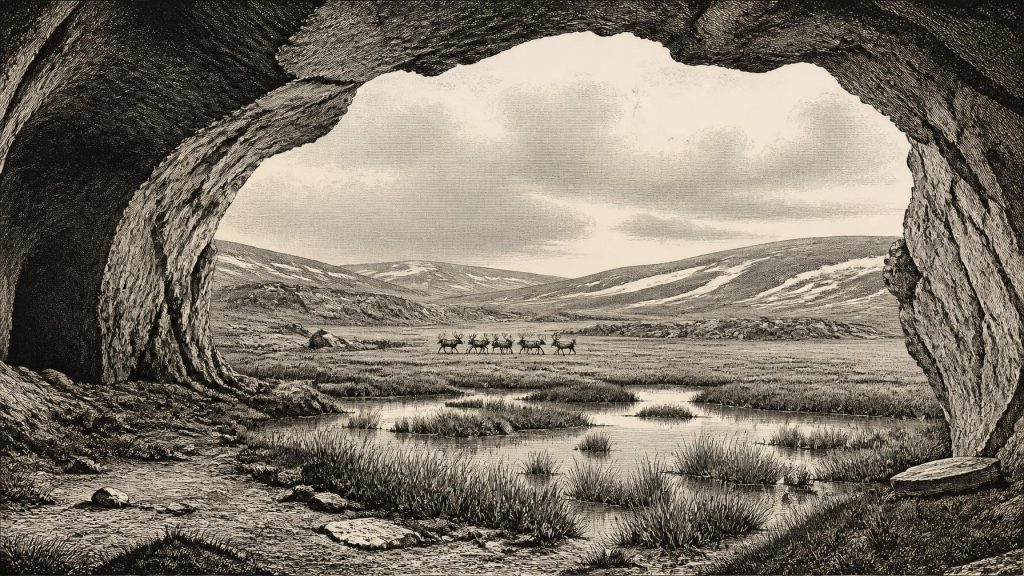
The fossils are evidence for a freshwater, periglacial setting. Pollen was poorly preserved, but plant macrofossils and mosses demonstrate vegetation capable of surviving in and beside cold water. They include taxa associated with open tundra conditions, rather than woodland. This was not the familiar green Ireland of later millennia: trees, enclosed fields, peat bogs and the modern patchwork of farms lay unimaginably far in the future. Nor was it a uniformly sterile sheet of ice. At least at intervals, exposed ground supported sparse herbaceous vegetation, wet hollows and shallow pools.
Cold Ground, Moving Ice
The wider physical setting was dynamic. Research on the British–Irish Ice Sheet shows that its advance was neither a simple, island-wide switch from ice-free country to complete cover nor a process with the same chronology in every region. Evidence increasingly indicates growth and advance–retreat activity during MIS 3, while the Irish Sea sector expanded strongly after about 30,000 years ago and towards its later maximum around 26,000 years ago. At the date represented here, glaciers and ice masses were therefore an increasingly powerful force, but local conditions varied greatly.
This matters for interpretation. The Derryvree succession demonstrates an ice-free episode in south Fermanagh before later ice overrode it. It does not prove that every part of Ireland was simultaneously open tundra, nor that a single continuous population of animals occupied the island. Conversely, later glacial erosion destroyed or rearranged many older surfaces. The scarcity of archaeological sites may partly reflect the severe survival problem: campsites on exposed land were vulnerable to ice, frost, erosion and rising or redirected waters.
Lower global sea level altered the surrounding seas, but Ireland’s precise connections with Britain and the continent at this time remain difficult to reconstruct. It would be unsafe to imagine a known land bridge, regular crossings or a mapped migration route. The evidence supports changing coastal and marine geography, not a documented road into Ireland.
Castlepook’s Animal Record
County Cork provides the most vivid record of life on the ground. Castlepook Cave, near Doneraile in the Awbeg Valley and long known as Mammoth Cave, is Ireland’s richest cave archive for vertebrate fauna preceding the Last Glacial Maximum. Excavations undertaken between 1904 and 1918 recovered more than 2,000 bones. Subsequent radiocarbon programmes showed that the assemblage accumulated across a long span, rather than representing one frozen moment: individual bones range broadly from about 45,700 to 19,950 years BP.
Among the animals represented are woolly mammoth, giant deer, reindeer, brown bear and spotted hyaena; later parts of the Ice Age record Arctic fox, wolves and lemmings. This collection establishes that Ireland, at different times in the middle and later Ice Age, supported or received a much richer large-mammal fauna than the island possesses today. Reindeer and mammoth evoke open, cold landscapes, while lemmings and Arctic fox reinforce the northern character of some phases. Hyaenas are especially significant: their presence is consistent with carnivores using caves as dens or places where carcass parts accumulated.
However, Castlepook is a cave bone archive, not an undisturbed view of a single living community. Water disturbance, carnivore activity, early excavation practices and the wide spread of dates all complicate the picture. A mammoth bone and a reindeer bone need not indicate animals grazing together on the same day, or even in the same millennium. The cave tells us securely that these species occurred in Ireland over the relevant broad period; reconstructing a precise local food web remains an interpretation.
The Reindeer Femur Question
The most consequential object for Ireland’s human story is a reindeer femur from Castlepook. A deep mark on it has been identified as consistent with damage from a sharp stone tool during fresh-bone carcass processing. County Cork’s heritage material places the specimen around 31,000 BC, and its implications have rightly attracted attention. If the mark is confirmed as anthropogenic and contemporary with the bone, it would suggest that one or more Upper Palaeolithic people handled a reindeer in Ireland during this broad period.
But this is evidence for a possible brief human act, not for a settled population. There is no securely associated hearth, lithic assemblage, dwelling floor, burial, repeated occupation surface or known camp of comparable age in Ireland. The old cave collection also lacks the tightly controlled excavation context expected of modern fieldwork. A single modified bone cannot reveal the identity, language, number, kinship system or route of any visitors. It cannot prove a hunt, as opposed to the butchery of an animal obtained after death, nor establish a permanent community.
The contrast with north-western Europe is useful but must not be exaggerated. Upper Palaeolithic groups elsewhere possessed sophisticated stone technologies and varied traditions of hunting, processing animal materials, ornament and image-making. Those wider traditions make a stone-tool interpretation at Castlepook plausible. Yet no comparable cultural assemblage has been recovered in Ireland for c. 30,780 BCE. It would therefore be wrong to transfer continental cave art, ritual practices or named archaeological cultures directly onto the island.
Society, Economy and Belief: What Cannot Be Recovered
Political affairs, diplomacy and warfare cannot be described for Ireland at this date. There are no polities, leaders, territories, treaties or conflicts identifiable in the record. Equally, no evidence permits a responsible account of religion, formal learning, artistic traditions, exchange networks or language. The absence is not proof that visiting people had no beliefs, knowledge or social relationships; it means that Irish evidence does not preserve them.
If people did reach the island, the most economical interpretation is a small, mobile party operating in a cold, resource-variable landscape. Reindeer would have offered meat, hide, sinew, marrow and bone, but even that practical inference should remain conditional because it rests on one disputed specimen rather than a camp assemblage. No trade can be demonstrated. Stone tools have not been found, so the sources of raw material and the direction of travel are unknown.
The strongest history for this date is consequently environmental and evidential. Freshwater sediments at Derryvree show a tundra wetland between glacial episodes. The Castlepook fauna shows that large herbivores, predators and scavengers moved through Irish habitats over a long Ice Age interval. The femur offers a provocative possibility of human contact. Together, these records show a changing frontier of water, vegetation, animals and ice—not yet a documented human Ireland.
A Landscape Before Settlement
At 30,780 BCE, then, Ireland was not a society awaiting its first chapter in a written national history. It was a climatically volatile peninsula or island-edge landscape within the north-west European Ice Age world. Its most securely attested inhabitants were plants and animals, preserved by unusual chance in Fermanagh sediments and Cork limestone caves. Any human presence remains a carefully qualified possibility. The lesson of this remote date is not that nothing happened, but that the surviving traces demand humility: calibrated ranges, stratigraphy and bones can illuminate a world, while refusing to yield a single calendar-year story.
Primary Sources
- A reconsideration of the radiocarbon dating of the Marine Isotope Stage 3 fauna from southern Ireland
- The Irish quaternary fauna project
- First evidence of a Late Upper Palaeolithic human presence in Ireland
- New insights on the fauna of Ireland's Younger Dryas and Early Holocene from Alice & Gwendoline Cave
- Castlepook Cave: Cork County Geological Site Report
- Heritage Artefacts of County Cork
- Palaeoecology: IQUA Field Guide
- Quaternary Site Descriptions
- 2022:564 – Castlepook Cave, Castlepook South, Cork
- Spotted Hyena Skull
- 18) Castlepook Caves
- The timing and magnitude of the British–Irish Ice Sheet between Marine Isotope Stages 5d and 2: implications for glacio-isostatic adjustment, high relative sea levels and ‘giant erratic’ emplacement
- Maximum extent and readvance dynamics of the Irish Sea Ice Stream and Irish Sea Glacier since the Last Glacial Maximum
- Advance and retreat of the marine-terminating Irish Sea Ice Stream into the Celtic Sea during the Last Glacial: Timing and maximum extent
- Radiocarbon constraints on the age of the maximum advance of the British-Irish Ice Sheet in the Celtic Sea
- Stratigraphic and palaeo-geomorphological evidence for the glacial-deglacial history of the last British-Irish Ice Sheet in the north-western Irish Sea
- Timing, pace and controls on ice sheet retreat: an introduction to the BRITICE-CHRONO transect reconstructions of the British-Irish Ice Sheet
- Radiocarbon constraints on readvances of the British–Irish Ice Sheet in the northern Irish Sea Basin during the last deglaciation
- AMS C-14 dating of deglacial events in the Irish Sea Basin and other sectors of the British-Irish ice sheet
- Deglaciation chronology of the Donegal Ice Centre, north-west Ireland
- Cosmogenic 10Be chronology of the last deglaciation of western Ireland, and implications for sensitivity of the Irish Ice Sheet to climate change
- Pleistocene vertebrates in the British Isles
- Occurrence of mammalia relicts at site Castlepook Cave