Castlepook’s Femur and Frost30779 BCE
30,779 BCE is a modern label for a broad, uncertain Late Pleistocene horizon rather than a datable Irish event. At Derryvree, County Fermanagh, freshwater sediments between glacial tills indicate a temporary ice-free tundra wetland during MIS 3, approximately 36,900–31,700 calibrated years BP. Plants and insects reveal cold, open, locally varied environments. Castlepook Cave, County Cork, preserves remains of mammoth, reindeer, giant deer and predators, accumulated across different periods rather than as one community. A cut-marked reindeer femur may indicate brief human butchery, but cannot prove settlement. Evidence documents shifting ice, habitats and animal movement, not societies, institutions or an anniversary.
Dateline
“30,779 BCE” is a useful modern label, not a recoverable Irish calendar year. No written record, settlement sequence or dated event permits history at annual precision so deep in the Late Pleistocene. In archaeological convention it lies roughly 32,700 years before AD 1950, within Marine Isotope Stage 3 (MIS 3), a long and climatically unstable part of the last Ice Age. The responsible approach is therefore to describe a broad environmental horizon, using calibrated ranges and stratified evidence, rather than to imagine a particular day, ruler, community or expedition.
A Date Within a Wide Range
The most relevant Irish chronological anchor is not a settlement but a freshwater deposit at Derryvree, near Maguiresbridge in County Fermanagh. Roadworks in 1969 cut through a drumlin and exposed a remarkable sequence: a thick lower till, organic silts and fine sands, then a thick upper till. Till is debris laid down directly by glacier ice. The ordering shows that ice had crossed this locality, that an interval followed in which fresh water, plants and sediment accumulated, and that a later glacial advance buried the evidence.
Organic material from the middle deposit produced the radiocarbon determination BIRM-166, 30,500 radiocarbon years BP, with a substantial laboratory uncertainty of +1,170/−1,030 years. A radiocarbon measurement is not identical to a calendar age, because atmospheric carbon-14 has varied through time. Calibration with modern Northern Hemisphere curves places the deposit broadly in the later part of MIS 3; published treatments place it approximately within 36,900–31,700 calibrated years BP. The nominal year 30,779 BCE falls within this wide horizon, but cannot be assigned to a specific plant, animal, pool or human action at Derryvree.
This limitation matters. Derryvree illuminates a locality in south Fermanagh, not the whole island at one instant. It nevertheless provides exceptionally direct evidence that, during part of this cold stage, a glacier-free freshwater environment existed there between phases of ice occupation. Its survival beneath later till is precisely why it is so valuable: most exposed land surfaces of comparable age were eroded, reworked or concealed by later ice.
Wet Ground in a Cold World
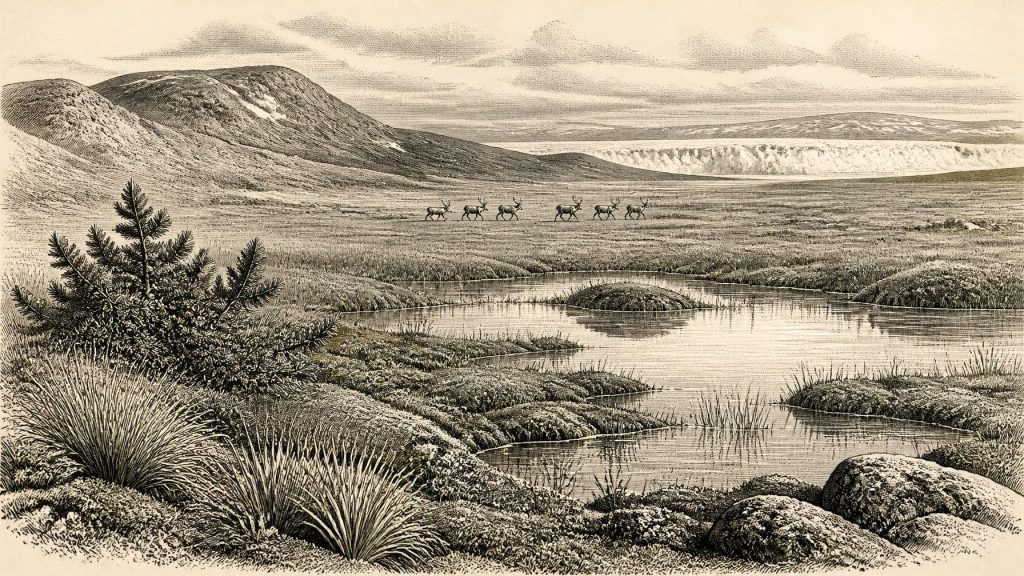
The fossils in the Derryvree silts indicate open tundra or tundra-like country rather than woodland. Pollen, plant macrofossils, mosses and insect remains include grasses, sedges, juniper and cold-adapted herbs, alongside aquatic and wetland plants. Bogbean and alternate water-milfoil are especially telling signs of standing or slow-moving fresh water. Moss-rich margins, shallow pools and waterlogged ground could support life even where the surrounding dry land was sparsely vegetated and exposed to severe winter conditions.
The older description of this setting as a “muskeg” conveys an important point: it was not a blank white wilderness. It was a patchwork of wetland, sedge growth, mosses, pools and open ground. Yet it would have looked profoundly unlike modern Ireland. There is no basis for projecting oak woodland, enclosed fields, bogs of the modern kind, villages or a familiar coastline into this period. The insect evidence points to cold northern conditions, while the plants suggest a short growing season and a landscape in which shelter, moisture and soil conditions made great local differences.
Across Ireland, conditions were unlikely to have been uniform. The island lay on the Atlantic fringe of north-west Europe, where ice masses, sea level, drainage and climate shifted repeatedly. The British–Irish Ice Sheet had a complex pre-Last Glacial Maximum history. Evidence from Ireland, the Irish Sea and western Scotland supports episodes of advance and retreat during MIS 3, but the exact extent of ice at any one point remains debated. Around the broad period represented by this year, the safest conclusion is regional variation: ice may have occupied some uplands or sectors while other areas supported cold, open habitats and freshwater refuges.
The Castlepook Animal Record
County Cork offers a complementary, though different, archive. Castlepook Cave near Doneraile, historically called Mammoth Cave, produced a major assemblage during excavations led by the naturalist Richard Ussher between 1904 and 1913. Its bones show that southern Ireland was reached, at intervals during the late Pleistocene, by a striking cold-stage fauna. Identified material includes woolly mammoth, reindeer, giant deer, horse, wolf, Arctic fox, lemmings, brown bear and spotted hyaena.
That list should not be turned into a single imagined herd. Cave collections accumulated over long spans, and early excavations did not recover the precise stratigraphic information expected today. Modern reassessment and direct radiocarbon dating have also shown that some older determinations require caution. The evidence securely demonstrates that these species, or their remains, reached Ireland during different parts of the Quaternary record; it does not prove that every species stood together outside Castlepook in 30,779 BCE.
Even so, the assemblage changes the scale on which this period must be understood. Ireland was capable, during favourable intervals, of supporting substantial herbivores and their predators. Reindeer imply grazing in open country; mammoth and giant deer point to a productive enough mosaic of vegetation at least seasonally; hyaena, wolf and Arctic fox demonstrate that carnivores also moved through this wider ecosystem. Caves could have served as carnivore dens, traps, shelters or places into which bones were dragged and washed. They are archives of animal movement and accumulation, not straightforward snapshots of an undisturbed landscape.
A Single Marked Bone
Castlepook is also central to the cautious discussion of people. A reindeer femur held in the National Museum of Ireland’s Natural History collections bears a deep linear mark that zooarchaeologist Ruth Carden has interpreted as damage from a sharp stone tool during butchery. County Cork heritage material associates the bone with about 31,000 BCE. If that interpretation and association are sustained, the femur may be Ireland’s earliest known indication that a person handled and processed an animal, perhaps during a brief Upper Palaeolithic visit.
The word may is essential. The specimen was recovered from an old cave collection, not from a newly excavated occupation floor with securely associated tools. No hearth, built shelter, stone-tool workshop, burial, human bone, ornament, art or repeated concentration of butchered carcasses has yet been demonstrated in Ireland for this horizon. The bone’s date concerns the animal’s death, not a precisely known moment at which the mark was made. Nor does one modified bone establish permanent settlement. It is important evidence, but it is not a lost Irish village.
Comparison with Upper Palaeolithic groups elsewhere in north-west Europe makes short, mobile visits plausible. Such groups possessed sophisticated stone-working traditions, clothing, social networks and seasonal knowledge. But those wider facts cannot responsibly supply missing Irish evidence. In Ireland, the material record presently supports only a restricted proposition: people may have entered or reached parts of the island and interacted with a reindeer carcass during the late Pleistocene. Whether they hunted it, scavenged it, travelled in a small party, or remained for days rather than seasons is unknown.
What Cannot Be Written
There were no Irish states, chiefs, diplomacy or wars that archaeology can identify at this date. There is no evidence for farming, livestock keeping, metallurgy, trade routes, monuments, formal religion or literacy. Nor can a cave femur reveal language, kinship, leadership or belief. The absence of evidence does not mean Ice Age people elsewhere lacked rich cultural and spiritual lives; it means that none of those matters is documented for Ireland at this chronological resolution.
The economy that can be responsibly envisaged is ecological rather than institutional. Animals grazed, browsed, hunted and scavenged across a changing cold landscape. If people were present, any subsistence activity would have depended on mobile wild resources and knowledge of seasonal terrain, not fields or stores. Lower global sea levels exposed more of the continental shelf than today, but the practical routes linking Ireland, Britain and continental Europe were altered by glaciers, water bodies and changing coastlines. A simple, permanent “land bridge” should not be assumed.
Evidence, Not Anniversary
The most important development around this notional year is therefore neither political nor biographical. It is the existence of an Irish late-Pleistocene environmental record: freshwater tundra sediments beneath a Fermanagh drumlin, animal remains in Cork caves, and a single reindeer bone that raises the possibility of an exceptionally early human visit. Together they show an island-region repeatedly reshaped by ice, water, vegetation and animal movement. They also demonstrate why precision is a false comfort here. Around 30,779 BCE, Ireland is known through ranges, deposits and probabilities—not through an anniversary in the modern sense.
Primary Sources
- A Middle Midlandian Freshwater Series at Derryvree, Maguiresbridge, County Fermanagh, Northern Ireland
- A Reconsideration of the Radiocarbon Dating of the Marine Isotope Stage 3 Fauna from Southern Ireland
- The Irish Quaternary Fauna Project
- Early Midlandian–Middle Midlandian, Pleistocene, Northern Ireland
- Palaeoecology: Irish Quaternary Association Field Guide
- The IntCal20 Northern Hemisphere Radiocarbon Age Calibration Curve (0–55 cal kBP)
- A Stratigraphic Framework for Abrupt Climatic Changes During the Last Glacial Period Based on Three Synchronized Greenland Ice-Core Records
- Growth and Retreat of the Last British–Irish Ice Sheet, 31,000 to 15,000 Years Ago: the BRITICE-CHRONO Reconstruction
- The Timing and Magnitude of the British–Irish Ice Sheet Between Marine Isotope Stages 5d and 2
- Pattern, Style and Timing of British–Irish Ice Sheet Advance and Retreat Over the Last 45,000 Years: Evidence from NW Scotland and the Adjacent Continental Shelf
- Dimensions and Chronology of the Last Ice Sheet in Western Ireland
- Stratigraphic and Palaeo-Geomorphological Evidence for the Glacial-Deglacial History of the Last British-Irish Ice Sheet in the North-Western Irish Sea
- The Island of Ireland: Drowning the Myth of an Irish Land-Bridge?
- Heritage Artefacts of County Cork
- Sedimentary Ancient DNA Reveals Late Pleistocene Faunal Connectivity Between Ireland and Eurasia
- First Evidence of a Late Upper Palaeolithic Human Presence in Ireland
- New Insights on the Fauna of Ireland’s Younger Dryas and Early Holocene from Alice & Gwendoline Cave
- Middle Midlandian Interstadial Deposits at Greenagho, Near Belcoo, County Fermanagh, Northern Ireland
- Castlepook Cave, Co. Cork, 2022 Excavation Report
- Proceedings of the Royal Irish Academy: Report on the Exploration of Castlepook Cave, Near Doneraile, Co. Cork