
Castlepook’s Two Thousand Bones30955 BCE
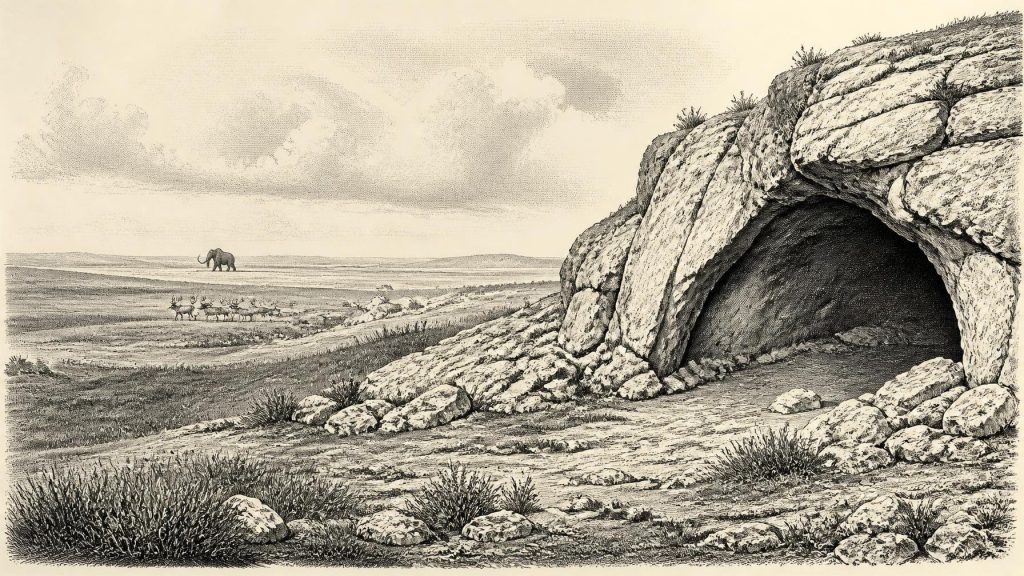
At roughly 30,955 BCE, Ireland lay within the climatically unstable MIS 3 Ice Age, before the Last Glacial Maximum. Changing sea levels, ice margins and coastlines created open, harsh, variable habitats supporting mammoth, reindeer, giant deer, bears and carnivores. Castlepook Cave, near Doneraile, preserves Ireland’s richest known pre-maximum vertebrate archive, although its 2,000 surviving bones accumulated across long periods and were disturbed by water and animals. A cut-marked reindeer femur, tentatively dated around 31,000 BCE, may indicate human butchery. It cannot prove settlement or a resident population. No contemporary Irish evidence attests to communities, farming, politics, religion or Celtic culture.
Dateline
Modern calendar precision cannot be carried back to 30,955 BCE. No written calendar, dated settlement, named individual or identifiable episode allows historians to isolate that single year in Ireland. The number is best treated as a point on a modern chronological scale: roughly 32,900 years before 1950, within the later part of the Pleistocene and broadly within Marine Isotope Stage 3 (MIS 3), a long, climatically unstable phase before the Last Glacial Maximum. What can responsibly be said concerns date ranges, environmental evidence and a small but important body of animal remains, especially from Castlepook Cave near Doneraile in north County Cork.
Ireland at this depth of time was not the familiar island of later history. Sea levels, coastlines, ice margins and connections between Ireland, Britain and continental north-west Europe changed repeatedly as global ice volume rose and fell. The archaeological and geological record is fragmentary, and researchers continue to debate the extent and timing of ice in and around Ireland before the Last Glacial Maximum. Around this broad period, therefore, the safest picture is not of a fixed frozen island but of a northern Atlantic landscape subject to pronounced cold, shifting ice fronts, open habitats and rapid environmental change.
A Date Without an Event
The most relevant chronological framework is radiocarbon dating, expressed in years before present, where “present” conventionally means 1950. Such dates must be calibrated to produce calendar ranges, and the calibration process does not yield a direct, exact equivalent for an invented-looking BCE year. A bone can date an animal’s death; it cannot automatically date a human action on it, an occupation of a cave, or a particular season. This distinction is essential at Castlepook, also known as Mammoth Cave, whose deposits were excavated largely in the early twentieth century and whose bones have been moved, mixed and affected by water and carnivore activity.
Nevertheless, Castlepook is exceptional. Geological Survey Ireland describes it as Ireland’s richest known site for vertebrate fauna in the period leading towards the Last Glacial Maximum. More than 2,000 surviving bones represent a long span of the Ice Age, while earlier excavation removed vastly more. Direct dates and later re-dating show that the cave archive includes animals from well before, during and after the interval represented by this article. The lesson is not that all its creatures lived together in one moment. Rather, Castlepook offers a time-depth record of repeated animal use of a limestone cave system in an increasingly severe Ice Age world.
Cold Country, Changing Ice
MIS 3, extending broadly from about 57,000 to 29,000 years ago, contained abrupt swings between comparatively milder interstadials and colder stadials. At c. 30,955 BCE, Ireland was approaching, but had not yet reached, the most extensive phase of the last British–Irish Ice Sheet, generally placed after about 26,000 calibrated years ago. This matters because the later ice sheet would scour, bury and rearrange much of the earlier land surface, leaving relatively few places where older soils, plants, campsites or animal tracks could survive.
It would be misleading to draw a sharp national boundary around the evidence. The present Irish Sea was a different, lower-sea-level region, and Ireland’s ecological connections depended on changing coastlines and glacial barriers. Some recent research argues for significant ice-sheet activity and high relative sea levels around the Irish and British coasts during MIS 3; other reconstructions stress uncertainty in the evidence before the Last Glacial Maximum. The practical conclusion is cautious: particular districts could have been ice-free, periglacial, seasonally harsh or close to calving ice margins at different times, while conditions changed faster than a single date can express.
Where ground was available, the vegetation was not forest of the later Holocene. The relevant comparison is a mosaic of herb-rich grassland, dwarf-shrub tundra, sparse willow and birch in better intervals, wet ground, exposed mineral soils and rocky shelter. Pollen, plant macrofossils, sediment layers and insect remains elsewhere in Ireland show how sensitive cold-stage landscapes were to moisture, temperature and glacial disturbance. They do not provide a weather report for 30,955 BCE. They do, however, make clear that Ireland possessed habitats capable of supporting large grazing and browsing mammals during parts of the pre-maximum Ice Age.
The Animals of Castlepook
Castlepook’s faunal record gives this period its strongest Irish texture. Its Pleistocene assemblage includes woolly mammoth, reindeer, giant deer, brown bear and spotted hyena; later cold-stage material includes lemmings, Arctic fox and wolf. Not every species belongs to precisely the same date range, and their presence in a cave need not mean the cave was their ordinary habitat. Still, the accumulation demonstrates that southern Ireland formed part of a wider north-west European zone through which cold-adapted and open-country animals moved.
Reindeer are especially informative. Their mobility, grazing and browsing habits suited open, seasonal landscapes. Mammoths evoke the productive but treeless grass-and-herb communities often termed mammoth steppe, though that label should not be allowed to erase local variation in wetness, topography and vegetation. Giant deer, bears and carnivores indicate additional ecological niches. Spotted hyenas are important because caves could function as dens or places to which carnivores dragged prey and scavenged carcasses. A bone in Castlepook may thus record an animal’s death outside the cave, the work of a predator, a fall into a fissure, water movement or later disturbance rather than a single local scene.
That taphonomic caution is central to everyday life in this landscape. There is no evidence for farming, domestic animals, permanent villages, fields, pottery, metalworking or managed woodland. The economy visible in the Irish record is ecological rather than human: wild herds exploiting seasonal plant growth, predators following prey, and caves periodically gathering the remains. Any people present would have encountered a dangerous, resource-rich terrain in which animal movement, shelter, fuel and access to stone mattered more than the territorial patterns familiar from later prehistory.
The Reindeer Femur Question
A reindeer femur from Castlepook has made this interval newly significant for Irish archaeology. County Cork heritage material identifies it as a Palaeolithic bone of about 31,000 BCE and reports a deep linear mark interpreted by zooarchaeologist Ruth Carden as damage made by a sharp stone tool during butchery. If that diagnosis and broad chronology withstand continuing scrutiny, it is potential evidence that people processed reindeer in Ireland far earlier than the securely documented terminal-Pleistocene traces from County Clare.
The claim deserves attention, but not embellishment. The mark is evidence for a possible act of carcass processing, not proof of a settlement at Castlepook, a year-round Irish population, or an established migration route. No securely associated hearth, stone-tool assemblage, dwelling surface, burial, food store or repeated butchery floor has yet been recovered for this age in Ireland. The date belongs to the bone, not necessarily to the incision; early cave excavations also left limited contextual documentation. Re-dating work has shown that some older Irish cave radiocarbon determinations can be thousands of years too young when measured by methods now superseded, reinforcing the need to revisit collections rather than treat inherited dates as final.
The most responsible interpretation is consequently modest but consequential. Ireland may have received small, mobile Upper Palaeolithic parties during favourable windows before the Last Glacial Maximum, perhaps linked to wider hunting landscapes extending through Britain and north-west Europe. Such visitors would not yet constitute a demonstrable resident society. Their presence is plausible from the faunal and geographic context, while the Castlepook femur provides a specific, still limited archaeological lead. It should be described as potential early evidence of human activity, not as an established founding moment.
No Polities, No Recorded Beliefs
Political affairs, diplomacy and organised warfare cannot be recovered for Ireland in this period. There were no Irish kingdoms, tribes with recorded names, borders, laws or diplomatic institutions. Likewise, there is no Irish evidence from around this date for formal shrines, burials, art or ritual that could identify beliefs or learning. Projecting Celtic languages, Gaelic society or later ideas of sacred landscape backwards by tens of millennia would be an anachronism.
That silence is evidence in its own right. It marks the gulf between a Pleistocene environment known mainly through geology and animal remains, and the later human histories of Ireland. If visitors did cross into the Irish landscape, their knowledge was practical and social: reading weather and ground conditions, remembering routes, sharing food, maintaining tools and responding to the movements of animals. Such capacities are reasonable inferences from Upper Palaeolithic lifeways elsewhere, but they are not directly documented as a distinct Irish culture at 30,955 BCE.
An Archive Rather Than a Chronicle
The principal development illuminated by this date is therefore environmental and evidential. Ireland was part of a volatile Ice Age world inhabited, at different times, by mammoths, reindeer, giant deer, bears and formidable carnivores. Castlepook Cave preserves an unusually rich archive of that world, while its marked reindeer femur raises the prospect of a human encounter with it. The cave does not yet give Ireland a securely mapped Palaeolithic community. It gives something more scientifically valuable: a testable question, preserved in bone, sediment and chronology, about how far people and animals ranged across the changing north-western edge of Europe before the great ice advance.
Primary Sources
- A reconsideration of the radiocarbon dating of the Marine Isotope Stage 3 fauna from southern Ireland
- The Irish Quaternary Fauna Project
- Castlepook Cave, County Geological Site Report
- Heritage Artefacts of County Cork
- New insights on the fauna of Ireland’s Younger Dryas and Early Holocene from Alice & Gwendoline Cave
- Reconstructing the Last Irish Ice Sheet 2: a geomorphologically-driven model of ice sheet growth, retreat and dynamics
- Maximum extent and dynamic behaviour of the last British–Irish Ice Sheet west of Ireland
- Early deglaciation of the British-Irish Ice Sheet on the Atlantic shelf northwest of Ireland driven by glacioisostatic depression and high relative sea level
- The timing and magnitude of the British–Irish Ice Sheet between Marine Isotope Stages 5d and 2
- Dimensions and chronology of the last ice sheet in Western Ireland
- New data for the Last Glacial Maximum in Great Britain and Ireland
- Radiocarbon constraints on the age of the maximum advance of the British–Irish Ice Sheet in the Celtic Sea
- Stratigraphic and palaeo-geomorphological evidence for the glacial-deglacial history of the last British-Irish Ice Sheet in the north-western Irish Sea
- New age constraints for the maximum extent of the last British-Irish Ice Sheet (NW sector)
- Growth, dynamics and deglaciation of the last British-Irish ice sheet: the deep-sea ice-rafted detritus record
- Irish Quaternary Association Guide No. 16: The Quaternary of Fermanagh
- The Stratigraphic Position and Age of the Gortian
- Irish Caves Database: Mammoth Cave
- An Island World? Hunter-Gatherers in Ireland
- Irish Quaternary Association