
Castlepook and the Growing Ice30633 BCE
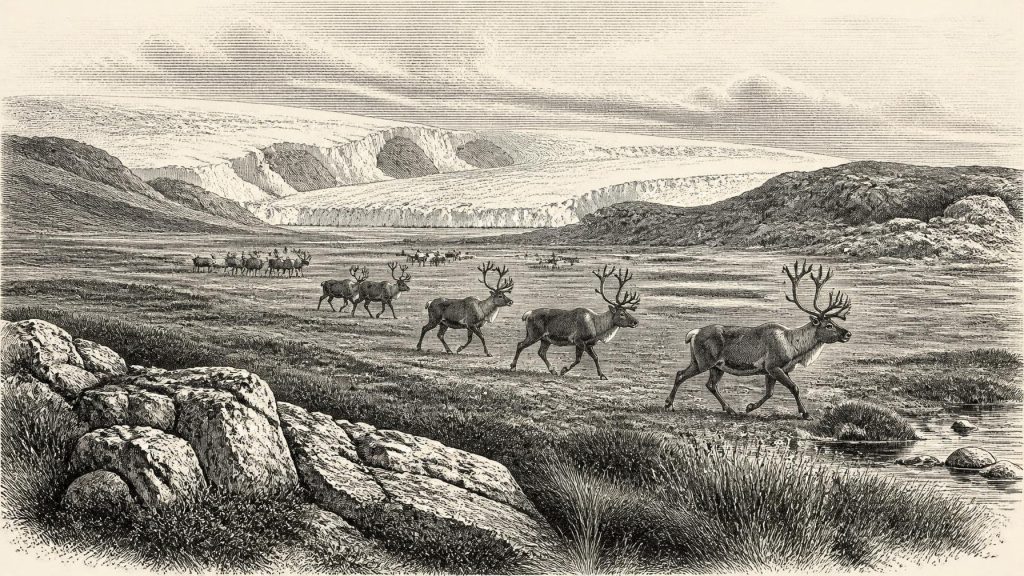
Around 30,633 BCE, Ireland lay within the climatically unstable Marine Isotope Stage 3, as the British–Irish Ice Sheet expanded unevenly before the Last Glacial Maximum. No evidence permits annual precision or a uniform description of conditions. Glacial erosion, changing sea levels and shifting ice created variable habitats. Castlepook Cave preserves remains of mammoth, reindeer, giant deer, predators and cold-adapted mammals, indicating intermittent food webs, while Derryvree records treeless wetlands between glacial advances. A possibly cut-marked reindeer bone suggests, but does not prove, brief Upper Palaeolithic human activity. No evidence supports settled communities, politics or culture. Environmental change defines this period.
Dateline
“30,633 BCE” is a modern calendar label, not a date that can be recovered from the Irish Ice Age record with annual precision. It falls roughly 32,600 calendar years before the 1950 baseline used for “cal BP”, within the later part of Marine Isotope Stage 3, a long and climatically unstable phase of the Pleistocene. No surviving Irish deposit can responsibly be assigned to that individual year. Radiocarbon dates have statistical uncertainty; their conversion into calendar ranges depends on calibration curves; and cave sediments, glacial deposits and fossil assemblages commonly represent accumulated or disturbed material rather than a single season. The sound historical question is therefore what evidence can illuminate Ireland in the broad interval around the early thirty-third millennium BCE.
A Landscape Before Maximum Glaciation
At this point Ireland stood within a changing north-west European glacial world. It was not yet at the global Last Glacial Maximum, generally placed around 26,500–19,000 years ago, but the British–Irish Ice Sheet was developing rapidly and unevenly. The BRITICE-CHRONO reconstruction demonstrates that ice expansion was already under way across parts of the wider British–Irish region around 31,000 years ago, while the timing and extent of earlier ice in Marine Isotope Stage 3 remain less securely resolved. That distinction matters. It is unsafe to describe all Ireland in 30,633 BCE as either entirely ice-covered or entirely open tundra.
The island’s physical geography was being remade by ice, frost, meltwater and fluctuating sea level. Later glacial erosion removed or buried much older ground surface, while ice streams crossed shelves now beneath the Atlantic and Irish Sea. The modern coastline is consequently a poor guide to the coasts, valleys and habitats available at the time. In some sectors, advancing ice may have occupied uplands and lowlands; elsewhere, cold, exposed terrain and short-lived ice-free areas could have existed. These were not settled national regions, nor a stable “Ireland” in the social sense, but shifting environmental zones within a larger ice-sheet system.
Research on Irish ice-sheet history has transformed older, simpler maps of a uniformly advancing glacier. Cosmogenic exposure dating, offshore sediment cores, seabed landforms and luminescence dating show that different sectors behaved differently. Even for the better-dated period after about 31,000 years ago, reconstructions are expressed in millennial steps, not years. Around the notional date used here, the most responsible picture is one of a cold landscape approaching major glacial growth, with its local conditions still debated.
Cold Country, Not Empty Country
“Cold” did not mean lifeless. Ireland’s best evidence for the animal communities of this broad age comes from cave deposits, above all Castlepook Cave near Doneraile in north County Cork, historically known as Mammoth Cave. Its collections include remains attributed to woolly mammoth, reindeer, giant deer, brown bear, wolf, Arctic fox, lemmings and spotted hyaena. Improved radiocarbon work has shown that some Castlepook fauna is substantially older than early measurements suggested and belongs to Marine Isotope Stage 3. Spotted hyaena and giant deer may have disappeared locally before the later glacial maximum.
That list evokes a mosaic rather than a uniform white wilderness. Reindeer and lemmings indicate cold-adapted environments; large grazers and their predators point to enough seasonal vegetation and accessible ground to support food chains. Mammoth, reindeer and giant deer should not be imagined as standing together in a single herd, however. Castlepook’s bones were accumulated over long intervals and its caves could have been used by carnivores, received water-borne material, or preserved remains introduced at different times. The assemblage establishes that such animals occurred in Ireland during parts of the period; it does not furnish a census for 30,633 BCE.
Plant evidence is rarer and often less securely dated, but it is equally important. The celebrated Derryvree sequence near Maguiresbridge, County Fermanagh, contained organic silts and sands sealed between two tills. Its pollen, seeds and other organic remains document a treeless freshwater and wetland environment during an ice-free interval, including plants suited to cold conditions. The site demonstrates that organic habitats could develop between glacial advances in northern Ireland. Its stratigraphy should not be turned into an annual weather report or assumed to describe County Cork at the same moment. It is evidence for environmental change and regional variability, not a map of the entire island.
Castlepook’s Human Question
The most arresting possible evidence for people is also the most limited. A reindeer femur from Castlepook has been reported as bearing a deep mark interpreted by zooarchaeologist Ruth Carden as damage made by a stone tool during the processing of a carcass. Public accounts have associated the bone with an age of about 33,000 years. If that interpretation and chronology are sustained by further study, it would indicate a human visit to Ireland in the Upper Palaeolithic, vastly earlier than the well-established post-glacial settlement record.
Yet this is not proof of a resident population in the year under discussion. The bone comes from an old, complex cave collection, not from a sealed campsite containing hearths, stone tools, structures and repeated occupation surfaces. A cut-marked animal bone, even if confirmed, records a narrow action: somebody used a sharp implement on a carcass. It cannot identify the number of people involved, their language, ancestry, route of arrival, length of stay or the season in which they came. It certainly cannot support a named community, chieftainship or an unbroken line of occupation.
This caution does not diminish the find’s importance. Ireland lies at the north-western edge of Upper Palaeolithic Europe, and contemporary populations elsewhere were highly mobile hunter-gatherers capable of using cold-season landscapes. A brief incursion by a small party following animal movements is conceivable. But possibility is not evidence. The present case for human activity around 33,000 years ago is a research problem centred on Castlepook, not a licence to populate the island with a detailed prehistoric society.
Society Beyond the Evidence
For political affairs, diplomacy and conflict, the evidence is silent. No settlement, burial, weapon assemblage, boundary, meeting place or written source can be assigned to Ireland around 30,633 BCE. There is likewise no basis for describing tribes, leaders, territorial control, alliances or warfare. Animal predation and the advance of ice were real pressures on the landscape, but they were ecological processes, not political events.
Everyday life is knowable only in the most conditional sense. Had people been present, their subsistence would have depended on small, mobile groups, close knowledge of weather, animal behaviour, shelter and fuel, and stone technology comparable to that used by Upper Palaeolithic communities elsewhere. But no Irish hearth, blade industry, dwelling, clothing fragment or food-preparation area of this age has yet provided direct confirmation. A reindeer carcass, if butchered by people, tells us more securely about one task than about a household or a way of life.
The same limits apply to religion, culture and learning. There are no Irish ritual deposits, figurative works, cave paintings securely dated to this period, musical instruments or personal ornaments from which to reconstruct belief or artistic tradition. It would be reasonable to suppose that humans of the wider Upper Palaeolithic world possessed rich social knowledge and symbolic practices; it would not be reasonable to attach any particular practice to Ireland on present evidence. Nor can animal movement be equated with trade. No imported artefact, exchange network or route of commerce is known from Irish contexts of this age.
What This Date Can Mean
30,633 BCE is therefore best understood not as a year of recorded Irish history but as a point within a difficult, dynamic environmental interval. Ireland was approaching the great expansion of the last British–Irish Ice Sheet. Caves in the south preserve traces of cold-stage mammals, while buried organic deposits in the north show that local wetlands and treeless vegetation existed during interludes between glacial episodes. Castlepook raises the serious but unresolved prospect of very early human activity.
The chief development was environmental: ice growth increasingly constrained the country’s habitable ground, altered drainage and coastlines, and repeatedly erased the evidence that archaeologists would most like to find. Against that destructive background, a cave bone and a buried silt bed become unusually valuable historical witnesses. They do not yield an exact day, an Irish polity or a settled community. They reveal instead an island on a climatic frontier, intermittently capable of supporting animals and perhaps occasional people, before advancing ice made the record still harder to preserve.
Primary Sources
- A reconsideration of the radiocarbon dating of the Marine Isotope Stage 3 fauna from southern Ireland
- New insights on the fauna of Ireland's Younger Dryas
- Growth and retreat of the last British–Irish Ice Sheet, 31,000 to 15,000 years ago: the BRITICE-CHRONO reconstruction
- The timing and magnitude of the British–Irish Ice Sheet between Marine Isotope Stages 5d and 2: implications for glacio-isostatic adjustment, high relative sea levels and ‘giant erratic’ emplacement
- Trimlines, blockfields and the vertical extent of the last ice sheet in southern Ireland
- Dimensions and chronology of the last ice sheet in Western Ireland
- Oscillating retreat of the last British-Irish Ice Sheet on the continental shelf offshore Galway Bay, western Ireland
- Stratigraphic and palaeo-geomorphological evidence for the glacial-deglacial history of the last British-Irish Ice Sheet in the north-western Irish Sea
- Pattern and timing of retreat of the last British-Irish Ice Sheet
- New data for the Last Glacial Maximum in Great Britain and Ireland
- The IntCal20 Northern Hemisphere radiocarbon age calibration curve (0–55 cal kBP)
- IntCal Publications
- Reindeer on the move: the genetic structure of Rangifer tarandus from northern Europe during the Late Pleistocene and Early Holocene
- Figure 6.— The subdivision of the Quaternary Period in Ireland
- Outreach and Education Resources
- Archaeology Research Excavation Grant 2022
- 2022:564 – Castlepook Cave, Castlepook South, Cork
- Heritage Artefacts of County Cork
- The Mesolithic in Ireland: when was it?
- The Irish Quaternary Fauna Project