
Domnall Ua Lochlainn’s Accession1083 CE
1083 saw political change and violence across Ireland, chiefly in the north. Domnall Ua Lochlainn became king of Cenél Eógain, beginning a long career, and reinforced his position through a cattle raid into Conaille Muirtheimhne, rewarding allies from its proceeds. Áed Ua Maíl Shechnaill and several regional rulers, heirs and churchmen died or were killed, revealing fragile dynastic authority. Tairdelbach Ua Briain remained the dominant southern king, although no campaign is securely dated. Ecclesiastical obituaries highlighted churches’ learned and economic roles. Dublin’s connected bishopric contrasted with saint-centred institutions. Rural pastoral obligations coexisted with trading towns. Later annalistic claims require caution.
Dateline
The surviving Irish annals present 1083 chiefly as a year of political change in the north, localised violence and the deaths of prominent rulers and churchmen. Their notices are brief, often no more than a sentence, and they rarely explain motives. The strongest evidence comes from entries shared by several chronicles, especially the Annals of Ulster, Annals of Loch Cé, Annals of Tigernach, Chronicon Scotorum and Annals of Inisfallen. Additional details preserved only by the much later Annals of the Four Masters require greater caution. No single event dominated the whole island, but developments in Cenél Eógain announced the emergence of a ruler who would shape Irish politics for nearly four decades.
A New Northern King
The most consequential firmly dated development was Domnall Ua Lochlainn’s assumption of the kingship of Cenél Eógain. This powerful branch of the Northern Uí Néill controlled much of what is now County Tyrone and aspired to the wider overkingship associated with Ailech. Domnall, born about 1048 or 1049, belonged to the Meic Lochlainn lineage and was the son of Ardgar, a former king of Ailech. His accession in 1083 began a long career during which northern power again became a major factor in island-wide affairs.
The chronicles also record the death of Áed Ua Maíl Shechnaill, styled king of Ailech. The entries place his death and Domnall’s rise in the same year, although they do not explicitly state that one directly succeeded the other. Titles such as king of Ailech and king of Cenél Eógain could describe overlapping claims, territories and grades of authority rather than a single office passing through an orderly succession. What is clear is that Domnall moved quickly to demonstrate that his kingship had military substance.
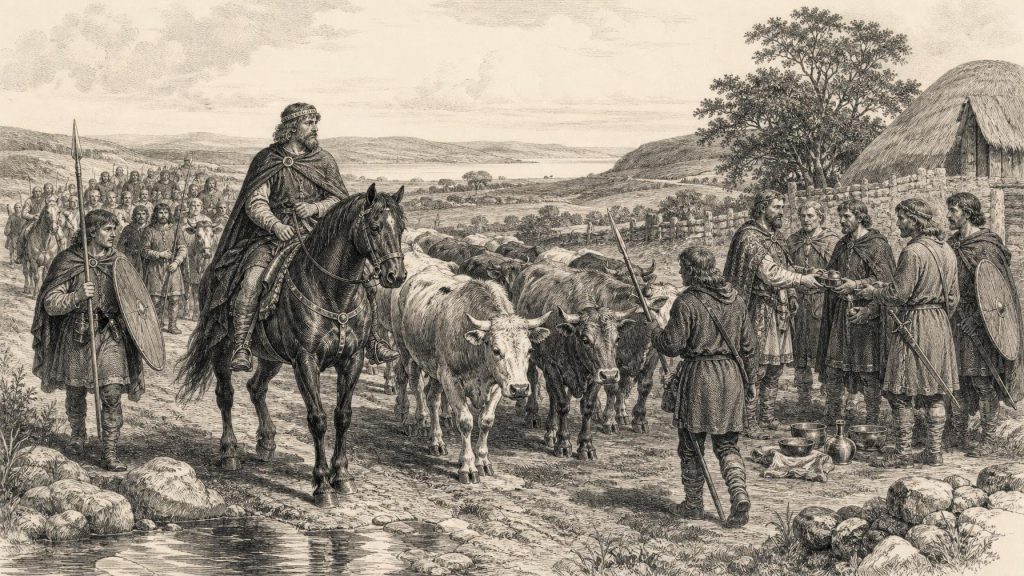
He conducted what the annalists called a king’s raid into Conaille Muirtheimhne, the district around northern County Louth. His forces drove away a large cattle spoil, and men from Fernmagh, broadly corresponding to parts of modern County Monaghan, received payment or stipends from the proceeds. This was more than random plunder. A newly established ruler could use a royal expedition to display leadership, punish resistance, reward allies and bind neighbouring fighting men to his cause. The raid therefore combined warfare, political theatre and the redistribution of wealth.
Violence Within Kingdoms
Elsewhere in the north-west, Domnall Ua Canannáin, king of Cenél Conaill, was killed by his own people. Cenél Conaill dominated much of present-day Donegal and had long competed with Cenél Eógain within the Northern Uí Néill world. The annals give no cause for the killing, so it cannot safely be assigned to a particular feud or conspiracy. Their stark wording nevertheless indicates internal political violence: kings depended upon the support of leading kindreds, and rejection by one’s own people could be fatal.
The Annals of Ulster add that the king of Cenél Énna was killed by Donnchad Ua Maíl Shechnaill, whom the text calls king of Ailech. This notice illustrates the difficulty of reconstructing the northern succession from compressed and sometimes conflicting titles. It can responsibly be treated as evidence of continuing struggles among regional rulers, but not fitted into a precise narrative that the sources themselves do not provide.
The later Four Masters preserve further deaths. Congalach Ua Ciardha, lord of Cairbre, was reportedly killed with many companions by the Conmaicne, while Dúnlaing Ua Lorcáin, described as heir-designate or tánaiste of Leinster, was also slain. These notices suggest unrest extending into the north midlands and Leinster, yet neither the circumstances nor exact locations are supplied. A tánaiste was not automatically an eldest son: Irish royal succession normally drew from an eligible dynastic group, making designated heirs both important political assets and obvious targets.
Munster and Wider Authority
In 1083 the most powerful ruler in southern Ireland remained Tairdelbach Ua Briain, king of Munster and a claimant to authority over much of the island. A grandson of Brian Bóruma, he had secured influence in Dublin and received submissions from rulers beyond Munster. His son Muirchertach had been placed in Dublin in the 1070s and was gaining the political and military experience that would later make him a formidable king.
No major campaign by Tairdelbach can be securely assigned to 1083. His broader dominance should therefore be understood as the political setting rather than a dated event of the year. It rested upon alliances, tribute, hostages, stipends and the strategic use of the Hiberno-Scandinavian towns. It was also incomplete. Connacht, Bréifne, Mide, Leinster and the northern kingdoms retained their own rulers and rival ambitions. Domnall Ua Lochlainn’s accession created the foundations of a northern challenge, although open rivalry between the two great dynastic blocs belongs mainly to subsequent years.
Áed Meránach Ua hEochada, king of Ulaid, drowned at Limerick during the year. Several chronicles identify him clearly, but none explains the accident or why he was so far from his eastern homeland. In 1081 a king of Ulaid had submitted to Tairdelbach Ua Briain by accepting a stipend, so Áed’s presence at Limerick may have been connected with that political relationship. This remains an inference, not a recorded fact. His death nevertheless shows how rulers travelled between courts and how the Shannon port linked Munster with distant Irish kingdoms.
Churchmen and Learning
The year’s obituaries reveal the importance of ecclesiastical communities as centres of worship, landholding, law and scholarship. Muirchertach Ua Cairill, head of the church at Dún, usually identified with Downpatrick, died in 1083. The annalists praise him as eminent in jurisprudence and historical learning. Such a description points to the learned environment in which law, genealogy, saints’ traditions and political memory were preserved and interpreted. His office, rendered as superior or airchinnech, included responsibility for the temporal affairs and property of a major church.
Tadc Ua Taidc, coarb or successor of St Flannán at Killaloe, also died. Killaloe stood near the heartland of the Uí Briain kings and possessed religious as well as political significance. A coarb claimed institutional succession from a founding saint and could oversee a community’s lands, relics and dependants. Tadc’s obituary appears in several independent annalistic traditions, making his death one of the year’s most securely attested ecclesiastical events.
Gilla Moninne, head of the church of Louth, was killed rather than dying peacefully. No assailant or motive is named. His fate is a reminder that sacred status did not insulate church leaders from dynastic disputes, raiding or struggles over valuable ecclesiastical estates. The Four Masters additionally record the death of Mac Raith Ua Baillén, successor of St Crónán at Roscrea. Because this notice is absent from the principal earlier chronicles, it should be accepted more cautiously, though it may derive from material no longer surviving.
Dublin represented a different but connected current in Irish Christianity. Its bishop in 1083 was Patrick, an Irishman trained at Worcester and consecrated by Archbishop Lanfranc in London in 1074. His relationship with Canterbury reflected the international outlook of Dublin’s Hiberno-Scandinavian church and the growing circulation of reforming ideas. Yet the later diocesan reorganisation of the Irish church had not occurred, and no reforming synod can be placed in 1083. Older saint-centred communities and newer urban episcopal institutions continued alongside one another.
Land, Labour and Trade
For most people, the year followed the seasonal demands of mixed farming. Cattle were stores of wealth, measures of status and sources of milk, meat, hides and political tribute; the Conaille raid shows their central place in warfare and royal finance. Sheep, pigs and cereals also mattered, while households produced textiles, leatherwork, wooden vessels and iron tools. Most inhabitants lived in dispersed farmsteads, ringforts, lake settlements and communities clustered around churches or royal places.
Ireland nevertheless possessed an established network of ports. Dublin, Waterford, Wexford, Cork and Limerick had developed from Viking settlements into towns inhabited by increasingly mixed Norse-Gaelic Christian populations. Archaeology reveals timber and wattle houses, crowded lanes and specialist craftworking in wood, leather, textiles and metal. These towns linked Irish rulers and producers to Britain, the Isles and continental markets. Evidence for imported goods from south-western England becomes increasingly visible around the late eleventh century, though individual finds cannot normally be assigned specifically to 1083.
Silver pennies had been struck in Dublin since the late tenth century, and coin remained most useful in ports and long-distance exchange. Across rural Ireland, obligations were still commonly assessed through livestock, food, hospitality, labour and military service. Domnall Ua Lochlainn’s distribution of rewards from captured cattle captures the coexistence of an old pastoral political economy with paid followings and expanding commercial towns.
A Year Carefully Read
No major town, monastery or stone church can be shown to have been founded in this exact year. Its clearest regional change was political: the rise of Domnall Ua Lochlainn gave Cenél Eógain a durable leader and shifted the balance of power in the north. The deaths of kings, heirs and learned churchmen meanwhile exposed the fragility of personal authority.
One entry in the Four Masters assigns to 1083 the death of Somerled son of Gilla Brigte, king of the Isles. Modern scholarship regards this as probably displaced from 1164 by eighty-one years, and it should not be treated as a genuine event of 1083. That caution is essential. Responsibly reconstructed, the year was marked not by a single national crisis but by a northern accession, demonstrative cattle warfare, local dynastic killings and the passing of influential custodians of Ireland’s religious and learned traditions.
Primary Sources
- The Annals of Ulster: Year U1083
- Annals of the Four Masters: Annal M1083
- The Annals of Tigernach: Annal T1083
- Annals of Inisfallen
- Chronicon Scotorum: Annal CS1083
- Annals of Loch Cé: Annal LC1083
- Ua Lochlainn (Mac Lochlainn), Domnall
- Ua Briain, Tairdelbach
- Ua Briain, Muirchertach
- Patrick (Gilla-Pátraic)
- Ua Conchobair, Ruaidrí na Saide Buide
- The Viking Age in Ireland
- 950–1450: Vikings, Normans and Medieval Mints
- Early Medieval Ireland: Archaeological Excavations, 1930–2009
- Landscapes of Kingship in Early Medieval Ireland, AD 400–1150
- The Practice of Irish Kingship in the Central Middle Ages
- Medieval Ireland: Territorial, Political and Economic Divisions
- Medieval Ireland
- Rhetoric and Reality: Irish Engagement with Reform in the Eleventh Century
- The Origins and Ancestry of Somerled
- Am Buadhfhacal Meadhan-Aoiseach Meranach
- Canterbury’s Claim to Primacy over Ireland
- William the Conqueror and Ireland
- The Dublin Region in the Middle Ages: Settlement, Land-use and Economy