Kings, Clergy and Cattle1150 CE
In 1150 Ireland remained divided among competing provincial and lesser kings, with Muirchertach Mac Lochlainn strengthening his high-kingship through hostages, alliances and the partition of Mide. Tairdelbach Ua Conchobair retained Connacht, while Tairdelbach Ua Briain raided Mide, gained Dublin’s submission and campaigned in Leinster. Warfare, cattle raiding, killings and dynastic punishments accompanied short-lived negotiated peace. Clergy at Armagh and Derry legitimised rulers, mediated settlements and collected substantial livestock tribute. Church reform advanced alongside older monastic networks; Bishop Muiredach Ua Dubthaig died. Fires damaged religious settlements. Cattle, horses and urban trade underpinned power, exposing warfare’s burden on ordinary households throughout Ireland.
Dateline
In 1150 Ireland had no single government, capital or uncontested monarch. Instead, provincial rulers and lesser kings competed within an intricate political order held together by kinship, tribute, hostages, military service and negotiated submission. The title of high king expressed supremacy over other rulers, but its practical value depended upon alliances and the ability to campaign. During this year Muirchertach Mac Lochlainn of Cenél nÉogain strengthened his claim to that supremacy, while Tairdelbach Ua Conchobair of Connacht and Tairdelbach Ua Briain of Munster remained formidable competitors.
A Contested High-Kingship
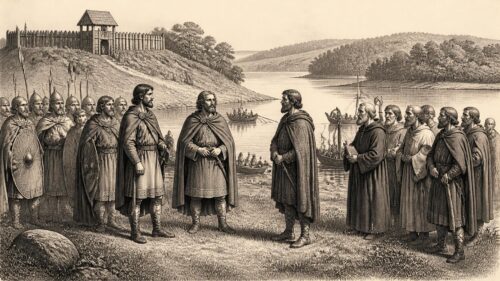
The most consequential political event assigned to 1150 by the Annals of the Four Masters was a royal journey by Mac Lochlainn and the leading men of the north to Inis Mochta, probably Inishmot in the Boyne region. There he met Donnchad Ua Cerbaill, king of Airgialla, and Tigernán Ua Ruairc, king of Bréifne. Hostages from Connacht were delivered to Mac Lochlainn without his having to invade the province. The annalist credited this peaceful submission to the influence of Gilla Meic Liac, the successor of Patrick at Armagh, and his clergy.
The meeting demonstrated how kingship worked through personal encounters, guarantees and hostages. Giving hostages acknowledged an obligation and provided security for future conduct; it did not necessarily mean permanent defeat. Tairdelbach Ua Conchobair continued to rule Connacht and would remain Mac Lochlainn’s chief national rival. Nevertheless, the episode allowed the northern king to present himself as the arbiter of Irish affairs.
Mac Lochlainn then divided Mide into three portions associated with Ua Conchobair, Ua Ruairc and Ua Cerbaill. Murchad Ua Máelshechlainn, the established king of Mide, was expelled. This was not the creation of orderly provinces by a central state. It was a political partition intended to reward allies, restrain opponents and weaken a dynasty whose strategic lands stretched across the central approaches to Dublin. Ua Ruairc and Ua Cerbaill, half-brothers as well as neighbouring rulers, were among the principal beneficiaries.
War Across Mide and Munster
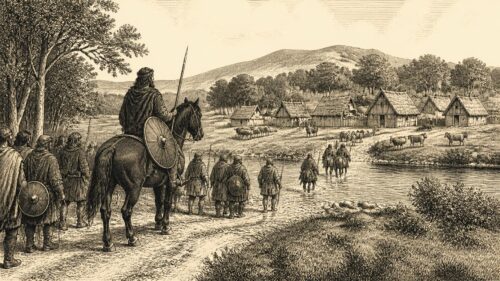
The settlement did not bring tranquillity. The Four Masters record Tairdelbach Ua Briain leading a Munster army into Machaire Gaileng in Mide and plundering Slane. Ua Cerbaill and Ua Ruairc caught the retreating force and killed some of its men. While the Munstermen were away, Ua Conchobair answered by marching into Munster, ravaging its central plain and driving off a large cattle prey. His own army also suffered losses.
Ua Briain subsequently advanced to Dublin, where the town’s Hiberno-Norse inhabitants submitted and received him ceremonially. He then campaigned elsewhere in Leinster and burned Domnach Mór Mic Laithbe. These movements show that Ua Briain, although under pressure at home, could still project authority far beyond Thomond. They also illustrate Dublin’s importance. Its ships, warriors, merchants and access to Irish Sea communications made the town a coveted ally rather than a passive prize.
Mac Lochlainn responded by bringing Cenél nÉogain and Ulaid forces south to support Ua Cerbaill and Ua Ruairc. The Dubliners then helped arrange a peace lasting one year between Leth Cuinn, the northern half of Ireland in political geography, and Leth Moga, the southern half. Medieval truces were practical pauses rather than comprehensive peace treaties. Even so, the intervention reveals that the townspeople of Dublin could act diplomatically between major Irish coalitions.
Local Power and Violence
National rivalries overlapped with numerous local struggles. An Ua Canannáin force raided Fir Luirg and seized cattle, but the inhabitants overtook it and killed many members of the raiding party, including two sons of its leader. Gilla Claen Ua Ciardha, king of Cairbre, was killed by the Uí Fháeláin. Conchobar Mac Ragnaill, lord of Muintir Eolais, fell to Áed, son of Ua Ruairc. Congalach Ua Braín of Bregmaine was killed at Clonmacnoise, reportedly through treachery.
Within Connacht, Tairdelbach Ua Conchobair had Diarmait Mac Branáin, lord of Corca Achlann, blinded. Blinding was a political punishment because bodily wholeness was normally expected of a king. Another Ua Conchobair dynast was killed by Ruaidrí Ua Conchobair, a son of Tairdelbach who would later become king of Connacht and high king. The precise identities vary in translated annalistic traditions, but the entry belongs to the wider history of a ruling family in which succession was contested among eligible adult kinsmen rather than passing automatically to the eldest son.
Churchmen as Political Actors
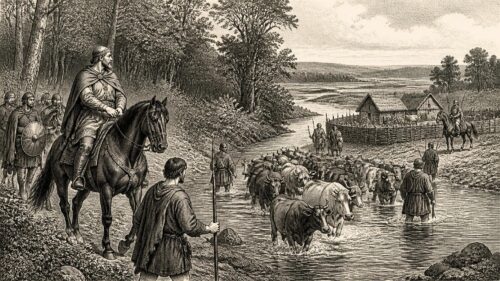
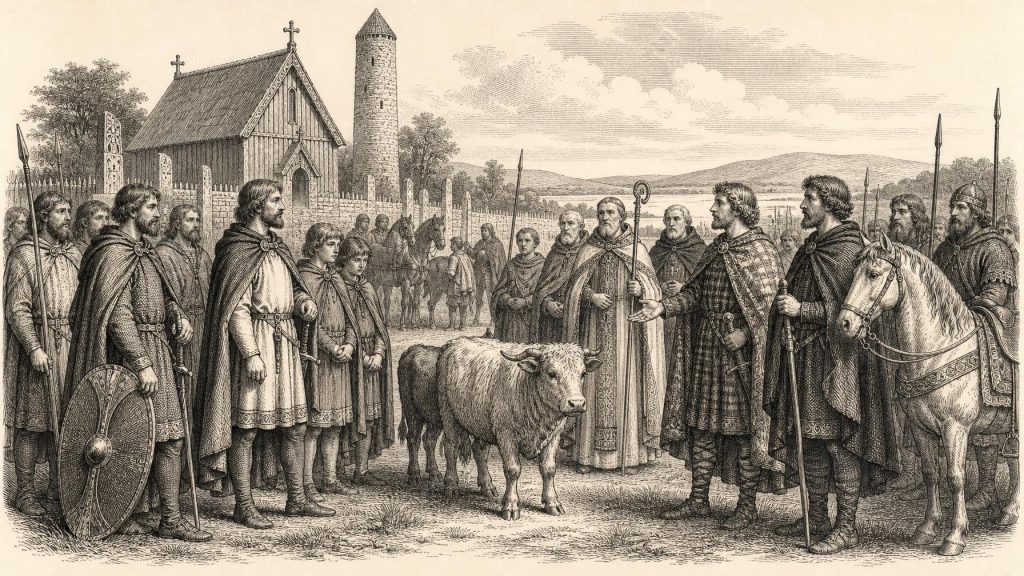
The clergy did not stand outside politics. Armagh’s intervention at Inis Mochta gave sacred authority to Mac Lochlainn’s settlement, while curses and ecclesiastical guarantees reinforced the expulsion of Ua Máelshechlainn. Later annals also record a formal visitation of Tír Eógain by Gilla Meic Liac and the clergy of Patrick. They collected graded contributions: cows from households of recognised status, horses from chieftains and twenty cows from the king.
Flaithbertach Ua Brolcháin, head of the Columban community of Derry, conducted a comparable visitation among Cenél nÉogain. His dues included livestock from several social categories. Mac Lochlainn gave twenty cows, a gold ring weighing five ounces, his horse and his battle clothing. Such gifts combined devotion, taxation and public recognition. By honouring the successors of Patrick and Colum Cille, a king displayed legitimacy; by collecting tribute, the churches demonstrated territorial authority and material independence.
The year also brought the death of Muiredach Ua Dubthaig, the leading bishop of Connacht and a major churchman of his generation. The Four Masters, compiled centuries later from earlier material, place his death at Cong on 16 May, the feast of St Brendan, and give his age as seventy-five. The near-contemporary annalistic tradition confirms the death but is less elaborate. Muiredach had been associated with the ecclesiastical and artistic ambitions of the Ua Conchobair court. He is named in an inscription on the Cross of Cong, the great processional reliquary commissioned under Tairdelbach Ua Conchobair in the 1120s.
Reform and Older Traditions
Ireland in 1150 stood between two landmarks of church reform: the foundation of the first Irish Cistercian abbey at Mellifont in 1142 and the Synod of Kells-Mellifont in 1152. Malachy of Armagh, the principal promoter of reform, had died in 1148, but his allies continued efforts to strengthen diocesan bishops, regularise worship and connect Irish institutions more closely with continental religious orders.
Older monastic federations nevertheless remained powerful. The visitations of the Patrician and Columban successors were rooted in longstanding networks of churches, lands and clients. Clonmacnoise, Cong, Kells, Armagh and Derry were simultaneously sacred centres, schools, landholders and places of political assembly. Reform did not replace this world overnight. In 1150 inherited forms of ecclesiastical lordship coexisted with diocesan organisation and newer communities such as the Cistercians.
Fire and Fragile Settlements
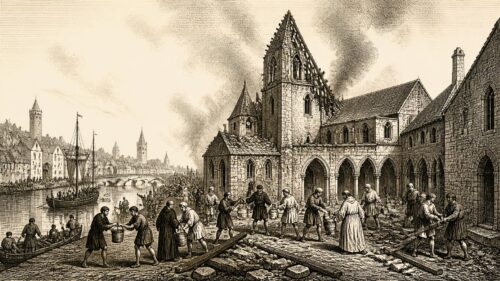
The annals report serious fires at several religious settlements. The northern half of Armagh’s Trian Mór was burned on the night of St Cianán’s feast. Kells, Swords and Kilmore Uí Nialláin were also burned, the last together with its oratory. The sources do not always state whether such fires resulted from warfare, accident or deliberate destruction, so their causes should not be assumed.
Timber buildings, thatch, workshops and closely grouped dwellings made both monastic settlements and Hiberno-Norse towns vulnerable. A church site was rarely an isolated stone building. Major foundations could include wooden churches, guest houses, schools, storehouses, craft areas, mills and the homes of lay dependants. Fire therefore threatened manuscripts, food reserves and livelihoods as well as places of worship.
Wealth and Everyday Life
The year’s records repeatedly measure power in cattle. Herds supplied milk, butter, cheese, meat, hides and draught animals, while movable livestock could be exacted as tribute or carried away by an army. Horses signified mobility and aristocratic standing; gold rings and battle equipment represented portable elite wealth. The detailed church levies also expose social gradations extending from kings and chieftains to free householders, food-providers and dependent cultivators.
Most people remained outside the annals. Their lives centred upon tending animals, growing cereals, maintaining field boundaries, grinding grain, preserving food, spinning fibres and repairing timber buildings. Yet royal warfare reached directly into that routine. A successful cattle raid deprived communities of food, breeding stock and stored value. Armies also required provisions, guides, boats and accommodation. The grand strategies of Mac Lochlainn, Ua Conchobair and Ua Briain were sustained by labour and resources drawn from numerous local households.
Dublin offered a contrasting concentration of crafts and commerce. Archaeology reveals wooden houses, workshops, lanes and waterfront activity in the Hiberno-Norse town, together with objects and raw materials connected to trade across Britain and continental Europe. Its submission to Ua Briain and mediation in the year’s truce underline the close relationship between commercial strength and political survival.
A Year of Negotiated Rule
No ruler achieved lasting mastery in 1150. Mac Lochlainn gained hostages and rearranged Mide, but Ua Conchobair retained Connacht and struck deep into Munster. Ua Briain raided Mide, secured Dublin’s submission and continued to challenge his rivals. Ua Ruairc and Ua Cerbaill expanded their midland influence, while church leaders collected tribute and helped turn military confrontation into negotiated settlements.
The year is therefore best understood not as a simple stage in the rise of one high king, but as an example of Ireland’s competitive political system at work. Warfare, cattle-raiding, sacred guarantees, hostages, tribute and short truces formed parts of the same process. Alongside them, church reform, artistic patronage, monastic learning and urban trade continued to reshape an island that was neither isolated nor politically static on the eve of the transformations of the later twelfth century.
Primary Sources
- Annals of the Four Masters, Part 25: Annal M1150
- The Annals of Tigernach
- Chronicon Scotorum
- Mac Carthaigh’s Book: Miscellaneous Irish Annals, Fragment I
- Annals of Inisfallen
- Exploring the Irish Annals
- Mac Lochlainn, Muirchertach
- Ua Conchobair, Tairdelbach (O’Conor, Turlough)
- Ua Briain, Tairdelbach
- Ua Cerbaill, Donnchad
- Ua Ruairc, Tigernán
- Ua Máelshechlainn, Murchad
- Malachy (Máel-M’áedóc) Ua Morgair
- Mac Murchada, Diarmait (MacMurrough, Dermot)
- The Cross of Cong
- The Cross of Cong: The Inscription
- Early Medieval Collections
- Viking Collections
- High Crosses
- Clonmacnoise Monastic Site
- Religious Orders
- Mellifont Cistercian Abbey
- Old Mellifont Cistercian Abbey Monastic Site
- The Archaeology of Livestock and Cereal Production in Early Medieval Ireland, AD 400–1100
- The Zooarchaeology of Medieval Ireland
- Early Medieval Ireland: Archaeological Excavations, 1930–2009
- Tuam: Irish Historic Towns Atlas, No. 20
- Kells: Irish Historic Towns Atlas, No. 4