
Munster’s Shattered Balance1151 CE
In 1151, Munster’s internal dynastic conflict enabled Tairdelbach Ua Conchobair of Connacht to intervene, supporting rival Uí Briain and Mac Carthaig claimants. His coalition defeated Tairdelbach Ua Briain at Móin Mór, devastating Munster and killing many aristocrats. Ua Conchobair took southern hostages and dominated Munster, but Muirchertach Mac Lochlainn soon compelled submissions from Connacht and Leinster, confirming contested overkingship. Raiding, captivity and treasure redistribution continued. Cardinal Iohannes Paparo arrived to advance church reform before Kells. Ecclesiastical visitations, a new stone church, notable deaths, and a wet winter accompanied warfare’s heavy burdens on ordinary people across much of Ireland that year.
Dateline
Ireland’s political order changed sharply during 1151. The year was dominated by a struggle for Munster, culminating in the Battle of Móin Mór, one of the most destructive encounters recorded in twelfth-century Irish annals. Tairdelbach Ua Conchobair, king of Connacht and claimant to the high-kingship, broke the power of Tairdelbach Ua Briain and extended his influence across the southern half of the island. Yet his victory did not make him an uncontested ruler of Ireland. Muirchertach Mac Lochlainn, king of Ailech, immediately asserted his superior claim by demanding hostages from Connacht and Leinster. Alongside these wars, 1151 witnessed an event of lasting ecclesiastical importance: the arrival of Cardinal Iohannes Paparo, whose mission prepared the way for the Synod of Kells in the following year.
A Kingdom Divided
The crisis in Munster began within the ruling Uí Briain dynasty. The Annals of the Four Masters record that Tadc son of Diarmait Ua Briain turned against his kinsman Tairdelbach Ua Briain, deposed him and entered the protection, or ‘house’, of Tairdelbach Ua Conchobair. Mac Carthaigh’s Book preserves a more complicated southern account, involving a further revolt by Muirchertach, Tairdelbach Ua Briain’s own son, and his capture through treachery. Although the precise sequence is difficult to reconstruct, the sources agree that internal divisions left Ua Briain authority dangerously weakened.
The Meic Carthaig and other Éoganacht lineages of southern Munster also challenged Uí Briain supremacy. They raised Diarmait son of Cormac Mac Carthaig as their king. Ua Conchobair intervened, presenting himself as Tadc Ua Briain’s protector while also recognising Diarmait’s authority in Desmond. This was not a simple Connacht invasion of a united province: rival Munster factions actively sought outside assistance against one another. Ua Conchobair’s policy exploited those divisions and revived an older strategy of keeping Munster partitioned between the Uí Briain in the north and the Meic Carthaig in the south.
War spread over a wide area. Mac Carthaigh’s Book says that country from Limerick to Cork and from Waterford westwards was devastated. It also reports that Diarmait Súgach Ua Conchobair of Ciarraige moved seven ships overland on wheeled supports from Eas Duibhe to Loch Léin. This striking detail, found in a southern source, demonstrates either a remarkable piece of military transport or the way an exceptional feat was remembered by later chroniclers. Raiding accompanied the campaigns: cattle and captives were carried away, settlements were burned, and the celebrated trees at Port Ríg were destroyed by Ruaidrí Ua Conchobair and the Síl Muiredaig.
The Battle of Móin Mór
The decisive campaign brought together a formidable coalition. Tairdelbach Ua Conchobair advanced with the forces of Connacht, joined by Diarmait Mac Murchada and the Leinstermen, Máel Sechlainn son of Murchad Ua Máelshechlainn with men of Meath, and Tigernán Ua Ruairc with troops from Tethbae. The Annals of Tigernach place their progress through Munster towards Glanmire and Móin Mór. The exact battlefield remains disputed. Móin Mór denoted a broad moorland or upland region rather than necessarily one modern townland, and attempts to fix the fighting at a single site should therefore be treated cautiously.
Tairdelbach Ua Briain’s army had been campaigning against Desmond and was moving north when it encountered the coalition. Mac Carthaigh’s Book adds that Meic Carthaig forces followed at its rear and that mist prevented the Uí Briain host from recognising the danger until it had entered among its enemies. A major battle followed. The Munster army, described as three battalions, was routed. The dead included Muirchertach son of Conchobar Ua Briain, king of Thomond and a leading Uí Briain heir, together with prominent members of the Uí Chennétig, Uí Dédaig, Uí Gráda, Uí Ógáin and other Dál Cais families.
The chroniclers convey catastrophe more reliably than numbers. Mac Carthaigh’s Book gives three thousand dead, while the Four Masters give seven thousand; the Annals of Tigernach declare the losses beyond counting. Such totals should not be read as a modern casualty return. They express the remembered scale of the defeat and the exceptional destruction of Munster’s aristocratic leadership. Ua Conchobair’s coalition also suffered losses, including Tadc Ua Conchobair, Muirchertach Ua Cathaláin and Áed Ua Fallamháin, but these did not alter the result.
Victory and Overkingship
After Móin Mór, Tairdelbach Ua Conchobair took hostages from the southern half of Ireland and assumed what the annals call the chief sway of Munster. Tairdelbach Ua Briain withdrew to Limerick but reportedly found no secure refuge in his former kingdom. He carried away a portable treasury of gold and precious objects, including the drinking horn associated with Brian Bórama, and distributed these valuables among nobles of the Síl Muiredaig, Uí Briúin and Conmaicne. The episode reveals both his desperation and the political function of treasure: ancestral objects, bullion and ornaments could purchase hospitality, loyalty and the possibility of recovery.
Ua Conchobair’s triumph alarmed Muirchertach Mac Lochlainn. Leading Cenél Conaill, Cenél nÉogain and Airgialla south across Assaroe, Mac Lochlainn advanced to Corann, where Ua Conchobair gave him hostages. Leinster’s hostages were also sent north. These submissions demonstrate why contemporary titles such as ‘king of Ireland’ must be handled carefully. Ua Conchobair had gained effective predominance in Munster, but Mac Lochlainn could still compel recognition from the victorious king and his Leinster ally. Ireland remained a hierarchy of negotiated and contested overkingships rather than a single territorial monarchy.
Violence continued after the battle. Ruaidrí Ua Conchobair raided Thomond, took many cattle and burned Cromadh, generally identified with Croom. Diarmait Mac Murchada captured Conchobar son of Domnall Ua Briain and a ruler of half of Osraige through guile. Within Ua Conchobair’s own family, Domnall was imprisoned by his brother Cathal. Móin Mór had transformed the balance of power, but it did not end dynastic rivalry or the habitual use of prisoners, hostages and cattle-raiding as instruments of government.
Church, Pilgrimage and Reform
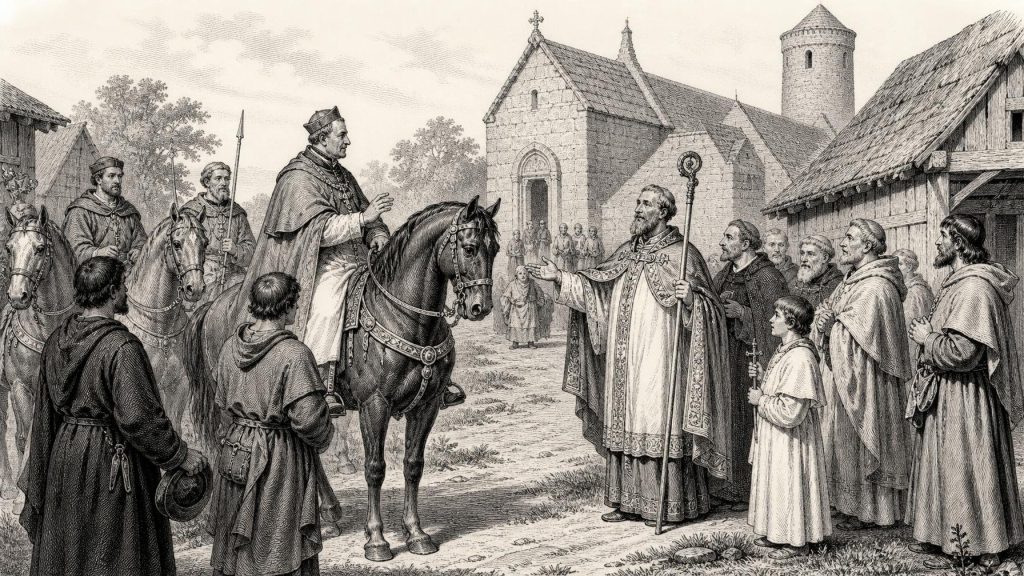
Cardinal Iohannes Paparo arrived in Ireland during 1151 as the representative of Pope Eugenius III. An earlier attempt to travel through England had been obstructed by King Stephen, and Paparo eventually approached through northern Britain. The Four Masters say that he came to establish rules and good conduct, correct abuses and confer with Gilla Meic Liac, the successor of Patrick at Armagh, in whose household he remained for a week. No exact Irish arrival date is securely recorded. His presence nonetheless began the immediate preparation for the great synod held at Kells in March 1152, where four metropolitan pallia were assigned to Armagh, Cashel, Dublin and Tuam.
Paparo entered a church already undergoing reform rather than introducing change to an isolated institution. Gilla Meic Liac conducted his second visitation of Connacht in 1151 and received traditional dues, including a gold ring weighing twenty ounces from Ua Conchobair. Flaithbertach Ua Brolcháin, successor of Colum Cille, likewise visited Síl Cathasaigh, receiving horses, sheep, clothing and a gold ring. Such circuits were pastoral, ceremonial and economic. They proclaimed the authority of major ecclesiastical federations while gathering the revenues required to maintain clergy, guests, schools, churches and dependants.
The year’s obituaries included Ua Maelfoghmhair, bishop among the Uí Amalgada and Uí Fiachrach Muaide, and Erolb, bishop of Limerick. Another notable death was that of Derbforgaill, daughter of Domnall Mac Lochlainn, wife of Tairdelbach Ua Conchobair and mother of several of his sons. She died while on pilgrimage at Armagh, illustrating the religious importance of the primatial settlement to aristocratic women as well as men. She should not be confused with the better-known Derbforgaill, wife of Tigernán Ua Ruairc, whose removal from Meath belongs to 1152.
Building and Daily Burdens
Amid war, construction began on a stone church at Cluain Coirpthe, identified with Kilbarry near Termonbarry on the Shannon. The Four Masters credit Cú Caille son of Mac Scolaigi and Gilla in Choimded, grandson of In Leastar Ua hAinlige and lord of Cenél Dobhtha. The notice is brief, but significant: erecting a substantial stone church required organised labour, skilled masons and elite patronage. It also shows that regional religious building continued despite the upheavals affecting Munster and the wider contest for overkingship.
For most inhabitants, the year’s politics were experienced less through royal titles than through requisitions, burned homes, lost livestock and compulsory movement. Cattle remained the most frequently recorded form of tribute and plunder, while gold, jewellery, horses, garments and prestigious heirlooms circulated among kings and church leaders. The annals close their account of the year with a changeable, windy and exceptionally wet winter. They do not record a harvest total or a securely dated famine in 1151, so its economic effects cannot be measured. Combined with extensive campaigning, however, the weather formed a sombre conclusion to a year in which Munster’s old political balance had been violently broken.
Primary Sources
- Annals of the Four Masters, Part 25
- The Annals of Tigernach, Part 23
- Mac Carthaigh’s Book
- Mac Carthaigh’s Book: CELT Document Details
- The Battle of Móin Mhór, 1151
- Desmond before the Norman Invasion: A Political Study
- Reform in the Twelfth-Century Irish Church: A Revolution of Outlook?
- The Transformation of the Irish Church in the Twelfth Century
- Ua Conchobair, Tairdelbach (O’Conor, Turlough)
- Ua Briain, Tairdelbach
- Mac Lochlainn, Muirchertach
- Mac Murchada, Diarmait (MacMurrough, Dermot)
- Gilla meic Liac (Gelasius)
- Paparo, Iohannes
- Malachy (Máel-Máedóc) Ua Morgair
- Ua Cerbaill, Donnchad
- Ua Conchobair, Conchobar
- Chronicon Scotorum
- The Annals of Clonmacnoise
- Place Names from Our Older Literature – II
- PAPARESCHI, Giovanni, cardinale
- St Bernard of Clairvaux’s Life of St Malachy of Armagh
- Chronological Synchronisation of the Irish Annals
- A History of the Ancient Church in Ireland