Rival Kingships1201 CE
In 1201, Ireland experienced interconnected struggles for kingship, lordship and ecclesiastical authority. In Connacht, Cathal Crobderg Ua Conchobair, aided by northern rulers and John de Courcy, failed to dislodge his kinsman Cathal Carrach, who received William de Burgh’s support. De Courcy’s subsequent defeat near Kilmacduagh and arrest by the de Lacys revealed rivalries among Anglo-Norman magnates. Ulster saw the killing of Ruaidhrí Mac Duinnsléibe and dynastic change in Cenél nEógain. In Munster, de Burgh campaigned with Ua Briain princes before churchmen mediated peace. King John redistributed lordships, while episcopal deaths and papal activity heightened institutional uncertainty. Conflict remained unresolved thereafter.
Dateline
In 1201, Ireland’s political map was shaped less by a single conquest than by overlapping struggles for authority. Gaelic kings, Anglo-Norman lords, churchmen and King John’s administrators each pursued local interests, often through alliances that crossed cultural and linguistic boundaries. The year’s most consequential fighting centred on Connacht, where the displaced Cathal Crobderg Ua Conchobair sought to regain the provincial kingship from his kinsman Cathal Carrach. Yet events in Ulster and Munster show that this was an island-wide moment of instability, negotiation and changing lordship.
A Year Recorded Unevenly
The evidence requires some care. The Annals of Ulster, Annals of Loch Cé and Mac Carthaigh’s Book place major Connacht and Ulster events under 1201. The much later Annals of the Four Masters, however, assigns some of the same Connacht campaigning to 1199. This is not a reason to discard either tradition, but it does mean that 1201 should be understood as the annalistic setting for a connected phase of war rather than as a modern day-by-day timetable. The sources are clearest about participants, places and outcomes, and much less secure about sequence, dates within the year and the size of forces.
The Contest for Connacht
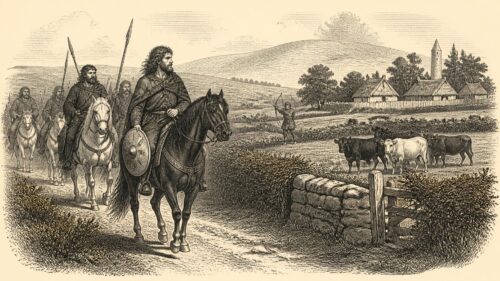
Cathal Crobderg, whose byname means ‘Red Hand’, had been driven from Connacht by Cathal Carrach, a rival from the same ruling Ua Conchobair dynasty. His exile drew northern support. The Annals of Ulster record Áed Ua Néill leading men of Magh Ítha and Airgialla in his aid, while other annals name Niall Ó hÉignigh, ruler of Fermanagh and Airgialla, among the allies. Their expedition reached Tech Báethín in Airtech and then moved towards Eas Dara, modern Ballysadare in County Sligo. There Cathal Carrach, supported by Connacht nobles and William de Burgh’s Limerick-based force, overtook them. The northern coalition was defeated and Niall Ó hÉignigh was among those killed.
This battle demonstrates the character of power in early thirteenth-century Ireland. Cathal Crobderg’s cause depended neither on a simple Gaelic resistance nor on an Anglo-Norman advance. His enemies and allies alike could recruit across those categories. William de Burgh backed Cathal Carrach because royal grants gave him a powerful interest in Connacht, while Cathal Crobderg turned to northern Irish rulers and to John de Courcy, lord of Ulster. Kingship remained a dynastic and military prize, but outside magnates could turn a family dispute into a contest with consequences for entire provinces.
De Courcy’s Defeat and Arrest
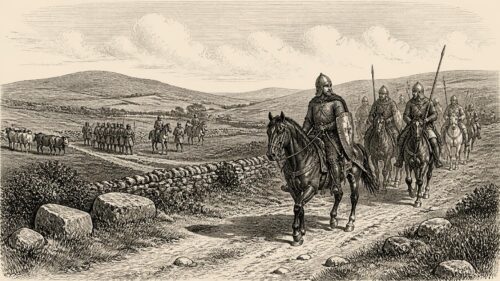
A second intervention for Cathal Crobderg ended still more dramatically. John de Courcy marched into Connacht with forces described by the annals as the ‘Foreigners’ of Ulster, joined by Hugh de Lacy and men from Meath. They reached Cell Mic Duach, near Kilmacduagh in south Galway, before Cathal Carrach’s army met them. The Annals of Ulster says that of five battalions only two emerged from the encounter; Mac Carthaigh’s Book calls it the defeat of An Forbhar. Whatever the precise scale behind such formulaic language, the expedition plainly failed and its survivors withdrew eastwards.
On the retreat, after crossing Lough Ree, de Courcy was seized by the de Lacy family. Later biographical and scholarly accounts identify Hugh de Lacy as the captor and explain that de Courcy was released after hostages were supplied by leading men of his Ulster following. The arrest was a sharp sign that the former allies were now competitors. De Courcy had built an exceptionally autonomous lordship in eastern Ulster, but King John was less willing than his predecessors to tolerate magnates acting beyond effective royal control. The imprisonment of 1201 did not yet end de Courcy’s career, but it exposed the vulnerability of his position and foreshadowed his eventual dispossession.
Violence and Change in the North
Ulster’s older political order was also under strain. Ruaidhrí Mac Duinnsléibe, king of Ulaid, was killed by followers of de Courcy. The annalists praise him extravagantly as a distinguished warrior, but their moral explanation is equally revealing: they linked his death to offences against the saints Paul, Peter and Patrick. Such language was not neutral reporting. It expressed the conviction that attacks upon churches, relics or sanctuary could have political as well as spiritual consequences. Meanwhile, the Cenél nEógain deposed Áed Ua Néill and installed Conchobar Mac Lochlainn, whose subsequent raid into Cenél Conaill provoked a response by sea and land. Northern politics therefore remained fragmented even as Anglo-Norman power pressed upon it.
Munster: Campaigning and Mediation
In Munster, William de Burgh assembled a major host with Muirchertach, Conchobar Ruadh and Donnchad Cairbrech, sons of the late Domnall Mór Ua Briain, as well as the settlers described as the English of Cork and Munster. The force spent a week at Ceann Eich and killed Amhlaoibh Ó Donnabháin, king of Uí Chairbre Éabha; the annal also records Anglo-Norman losses, including a member of the Mac Costello family. The outcome was not unrestricted conquest. A papal legate and the bishops of Munster negotiated peace between Síol Briain, Clann Charthaigh, Ó Mathghamhna and de Burgh. Síol Briain was permitted to return home, while de Burgh remained in Cork for most of the winter.
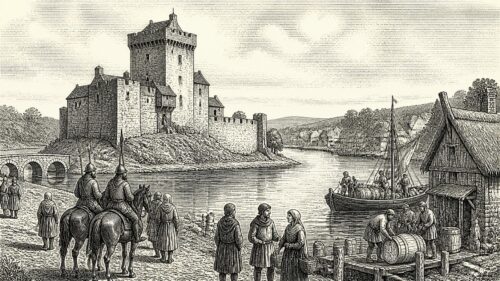
The episode shows why it is misleading to picture Munster as divided into fixed ‘Irish’ and ‘English’ blocs. De Burgh’s force incorporated Ua Briain princes, while the settlement involved several Gaelic dynasties, a royal magnate and churchmen. Cork’s importance in the record reflects its value as a coastal base and gathering point, not merely as an urban settlement apart from its hinterland. The annals do not permit a precise reconstruction of ordinary life or commerce in 1201, but they do show that military occupation, negotiation and winter residence could make towns and their surrounding food-producing districts central to regional politics.
Royal Grants and Local Lordship
King John’s actions supplied an important wider context. In January 1201 he granted William de Braose the honour of Limerick, excluding Limerick city itself, in return for the very large sum of 5,000 marks, payable in instalments. The royal reservation also protected the tenements and services of William de Burgh. This was not a straightforward transfer of a settled territory: it overlaid a new financial and feudal arrangement upon a contested region, where de Burgh still held land and exercised influence. The grant illustrates how the king sought revenue and leverage by redistributing Irish lordships among favoured barons.
Church, Learning and Authority
Church affairs mattered directly to political life. Tommaltach Ua Conchobair, successor of Patrick and arch-primate of Ireland, died in 1201; the Annals of Ulster commends his wisdom and piety. Cadla Ua Dubthaig, archbishop of the province of Connacht, also died, and the Four Masters records the death of Conn Ó Mella, bishop of Annaghdown. These were significant losses in a period when episcopal office, dynastic influence and provincial politics were closely entwined. The deaths made succession an urgent institutional question, especially at Armagh and in the western province.
There is firm evidence that Cardinal John of Salerno, papal legate, was active in Ireland in 1201: he joined the bishop of Leighlin in confirming property to St Thomas’s Abbey, Dublin. Later annalistic tradition places a great Dublin synod under 1201, but modern work dates the Dublin and Athlone councils to 1202. The distinction matters. It is responsible to connect the legate’s Irish mission with the ecclesiastical uncertainties visible in 1201, but not to claim a securely dated general synod during that calendar year. What can be said is that papal authority, diocesan rights and the reform of church governance were live issues alongside war and lordship.
An Unsettled Balance
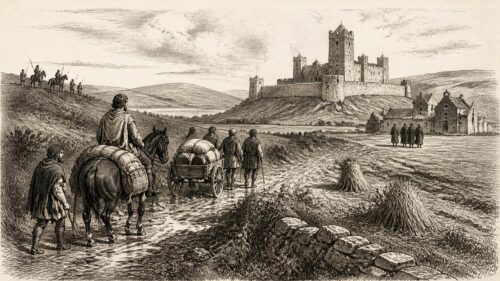
For many people, the year’s experience was likely shaped by the immediate burdens of armed movement, local raids, shifting allegiances and uncertainty over rulers. The surviving sources chiefly preserve the deeds of kings, magnates and bishops, rather than the voices of cultivators, artisans or traders. Even so, their pattern is clear: military power required routes, provisions, local allies and secure centres such as Cork, Limerick, Meath and Ulster’s lordly strongholds. In 1201 no side achieved a final settlement. Cathal Carrach held Connacht for the moment, de Courcy retained followers despite his arrest, and royal grants altered the framework of Munster without ending conflict. Ireland entered the following years with its rival kingships and lordships still very much unresolved.
Primary Sources
- The Annals of Ulster
- The Annals of Ulster: Irish Text
- Part 8 of Mac Carthaigh's Book
- Part 8 of Mac Carthaigh's Book: Irish Text
- The Annals of Loch Cé
- Part 8 of Annals of Loch Cé A.D. 1014–1590
- Part 3 of Annals of the Four Masters
- Part 3 of Annals of the Four Masters: Irish Text
- Annales Dominicani de Roscoman
- Courcy, John de | Dictionary of Irish Biography
- Lacy, Hugh de | Dictionary of Irish Biography
- Ua Conchobair, Cathal Mór Crobderg | Dictionary of Irish Biography
- Ua Conchobair, Cathal Carrach | Dictionary of Irish Biography
- Burgh, William de | Dictionary of Irish Biography
- Braose (Briouze, Briouse), William de | Dictionary of Irish Biography
- Calendar of Documents Relating to Ireland, 1171–1307
- Calendar of Ormond Deeds, Volume I, 1172–1350
- Notification of the King's Grant of the Five Fees Known as T'ath to William de Burgh
- John (1199–1216) – Records of Convocation
- Henry II, the Council of Oxford and Angevin Overlordship in Leinster, 1177–85
- John de Courcy and the Early Anglo-Irish Coinage
- Parchment Conquest, 1171–1307
- Protection Granted by John of Salernum, Papal Legate, to Thomas, Abbot of Killenny and His Convent, 1202
- Donnchad Mac Briain, Henry II and the Crown of Ireland