Maguirebridge’s Coldwater Ledger30451 BCE
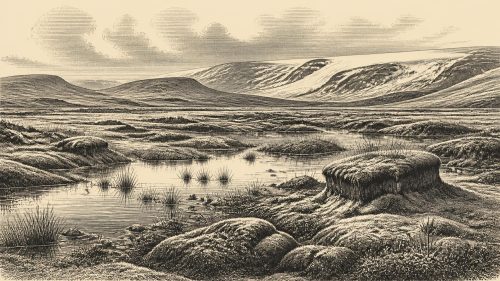
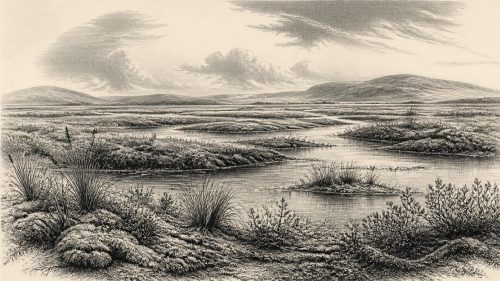
About 30,451 BCE, a modern label rather than a precise Irish date, Ireland experienced a cold Late Pleistocene interval. At Derryvree near Maguiresbridge, freshwater sediments between glacial tills record an ice-free phase before the Last Glacial Maximum. Pollen, plants, insects and sediments indicate tundra-like wetlands with shallow water, sedges, grasses, juniper and arctic-alpine species. Later ice buried this evidence. Castlepook Cave in Cork preserves diverse cold-stage fauna, including mammoth, reindeer, hyaena and Arctic fox, although remains span time. A possibly cut-marked reindeer bone suggests brief human presence, not settlement. No evidence supports contemporary polities, villages, trade, rituals or calendar-dated events.
Dateline
A Date Beyond Calendar History
“30,451 BCE” is a modern chronological label, not a year that can be recovered from Irish evidence with calendar-like precision. It lies roughly 32,400 years before AD 1950, the conventional baseline for “before present” dating, during the Late Pleistocene and Marine Isotope Stage 3. At such depth of time, radiocarbon measurements have substantial uncertainties and calibration produces broad ranges rather than a date for a particular winter, migration or human generation. The responsible historical question is therefore not what happened in Ireland in this named year, but what the surviving evidence can show about Ireland during the interval into which it falls.
The closest major Irish environmental archive is at Derryvree, near Maguiresbridge in County Fermanagh. Roadworks in 1969 cut through a drumlin and revealed freshwater silts and fine sands, including organic material, enclosed between two thick layers of glacial till. The sequence establishes an important order of events: ice had earlier crossed the locality; an ice-free interval then permitted water, sediment and living things to accumulate; and later glacial activity buried the deposit. It is not an annual record, nor evidence for the whole island, but it is unusually direct testimony to a habitable Irish landscape before the Last Glacial Maximum.
The organic horizon produced the conventional radiocarbon determination BIRM-166: 30,500 radiocarbon years BP, with an uncertainty of +1,170/−1,030 years. Recent chronological modelling has treated it as evidence for an Irish ice-free phase centred around 33,500 ± 1,200 calendar years BP. That range broadly reaches the modern label 30,451 BCE, but this overlap must not be mistaken for proof that the Derryvree plants grew in that exact year. The deposit supplies a window on a lengthy cold-stage interval, not a dated historical episode.
Fresh Water Between Ice Advances
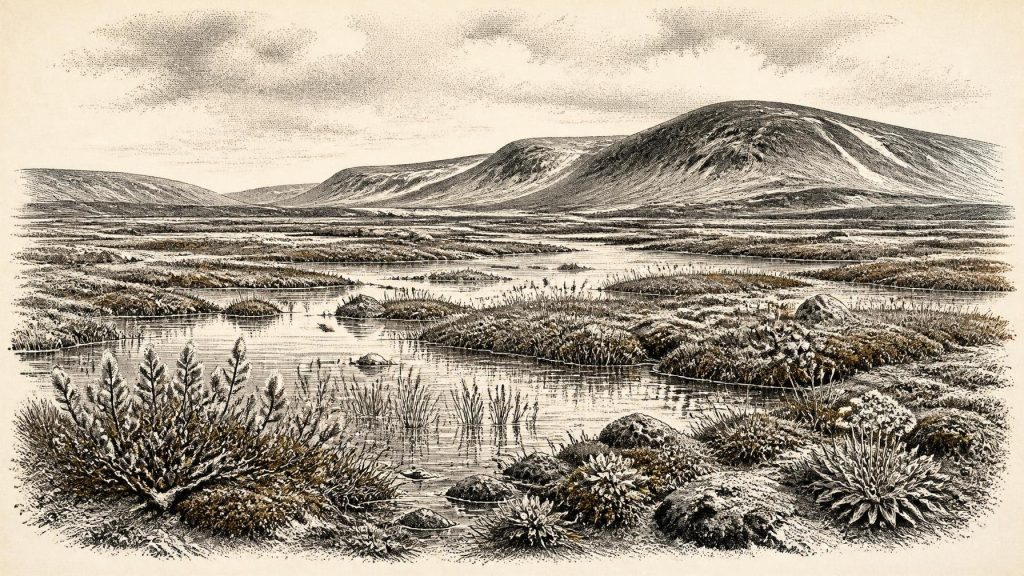
Derryvree is especially valuable because it corrects the image of Ice Age Ireland as an uninterrupted blank of glacier ice. The site’s freshwater silts preserve pollen, plant macrofossils, mosses and insects. Together they indicate open tundra vegetation and periglacial conditions: a severe climate in which land near ice masses was repeatedly affected by frost, thaw, saturated ground and brief growing seasons. Periglacial does not mean that the place itself was under ice. Rather, it describes an exposed terrain living under the influence of bitter winters and unstable frozen ground.
The evidence points to a patchwork of shallow water, wet mossy ground, sedge-rich margins and sparse vegetation beyond. Grasses, sedges, herbs and juniper occur in the record. Fossils associated with the deposit include bogbean (Menyanthes trifoliata), a plant of wet ground and freshwater margins, and arctic-alpine taxa such as mountain avens (Dryas octopetala) and lesser clubmoss (Selaginella selaginoides). Pollen of water-milfoil further supports the presence of freshwater. These remains make it possible to picture a functioning wetland ecosystem, though not a modern bog or meadow transplanted unchanged into the past.
The word “muskeg” has sometimes been used for this environment. It is a useful shorthand only if handled carefully. It conveys organic, waterlogged ground, mosses, sedges and pools, but it should not be treated as a precise reconstruction of every hill and valley in Ireland. Derryvree was one locality in south Fermanagh. Ireland’s relief, distance from coasts, snow cover, drainage and proximity to ice would have created varied local conditions. What can be said securely is that at least part of the island sustained freshwater life and open cold-climate vegetation during an interval later sealed beneath glacial deposits.
A Landscape Under Pressure
This was a world of climatic instability. The British-Irish Ice Sheet had not yet attained its Last Glacial Maximum extent, generally placed later, around 27,000–21,000 years ago. Yet ice was already an increasingly powerful force in the region. Reconstructions of the wider ice sheet indicate build-up after roughly 35,000–32,000 years ago, with margins oscillating in response to both climate and the internal behaviour of flowing ice. A wetland could form during an ice-free phase and subsequently disappear beneath advancing ice; Derryvree’s two tills, with its organic bed between them, preserve precisely such a sequence.
Sea level was much lower globally than it is today because water was stored in expanding ice sheets. That does not justify a simple claim that Ireland was joined to Britain by a walkable land bridge. Work on Irish relative sea level argues against such a terrestrial connection, while also showing that coastlines, rivers and offshore plains were very different from those of the present. For people or animals, the western edge of Europe was geographically broader but still environmentally demanding. The drowned landscapes around modern Ireland may contain parts of this story, while later ice movement and rising seas have removed or obscured much of the evidence.
Animals in the Southern Caves
County Cork cave deposits provide a different, less tightly contextualised record of Late Pleistocene Ireland. Castlepook Cave, near Doneraile, long known as Mammoth Cave, produced remains of woolly mammoth, reindeer, spotted hyaena, wolf, fox, Arctic fox, bear, hare and lemming, among other animals. The assemblage demonstrates that, during parts of Marine Isotope Stage 3, Ireland could be reached by a much richer cold-stage fauna than the island’s later historic mammal community. Reindeer and mammoth imply open grazing landscapes; lemmings and Arctic fox are consistent with severe conditions; hyaenas and wolves indicate predation, scavenging and competition around animal carcasses.
It would nevertheless be wrong to combine every Castlepook species into one scene or to place them all at Derryvree in 30,451 BCE. Cave collections were accumulated over time, many were excavated in the early twentieth century, and modern redating has shown that some older radiocarbon results from Irish caves were substantially too young. Castlepook is a remarkable faunal archive, but not a single, excavated living surface. The evidence supports a broad conclusion about the island’s changing animal communities, not a complete census for one calendar year.
The Human Question
One Castlepook reindeer femur has a deep linear modification interpreted by Ruth Carden and others as a possible cut mark made while processing a fresh carcass with a sharp stone implement. If that interpretation is sustained, it may represent extraordinarily early evidence that people briefly entered Ireland before the Last Glacial Maximum. It is an important possibility, not a licence to invent a settled population. No securely associated hearth, stone-tool assemblage, dwelling floor, burial, artwork or human remains of comparable age has been demonstrated at Castlepook.
Accordingly, society and everyday life can be discussed only conditionally. A visiting hunting party, if one was responsible for the marked bone, would have needed intimate knowledge of animal movement, shelter, fuel, stone tools and the dangers of exposure. Reindeer carcass processing would have offered meat, fat, hide, sinew and bone. But none of those likely practical activities can be dated to 30,451 BCE, and none proves that people lived continuously in Ireland. The most defensible description is of a possible short human encounter with a reindeer in a wider cold-stage landscape, not an established Irish Palaeolithic society.
No Polities, No Diplomacy
There is no evidence from Ireland at this date for political institutions, territorial boundaries, leaders, diplomacy, organised warfare or formal trade networks. Nor is there Irish evidence from this interval for monuments, ritual deposits, script, named traditions or an identifiable system of religious belief. Upper Palaeolithic peoples elsewhere in Europe made sophisticated tools and powerful works of art, but their cultural achievements cannot responsibly be transferred across the sea to Ireland without local evidence.
Nor should the absence of such evidence be represented as proof that no people ever arrived. The archaeological record has been heavily thinned by glacial erosion, redeposition, cave disturbance, submerged coasts and the sheer scarcity of surviving deposits. It means only that these subjects cannot presently be reconstructed. The historical emphasis must remain on what is actually preserved: freshwater sediment, plant traces, insects, animal bone, stratigraphy and radiocarbon measurements.
An Irish History of Silt and Bone
Around the broad period labelled 30,451 BCE, Ireland was not the wooded, farmed island of later prehistory. Nor was it simply an empty expanse beneath permanent ice. At Derryvree, water lay in a frost-shaped hollow, plants colonised wet margins and sediment settled quietly enough to preserve their remains. Elsewhere, large mammals moved through favourable parts of a harsh, open landscape. Ice subsequently returned and entombed some of the evidence. The resulting record is fragmentary, but it is substantial enough to show an Ireland repeatedly available to life at the northern edge of a growing ice world.
That is the proper scale for this date. Modern year numbering offers a convenient place in a chronology, but not an event. Derryvree’s cold-water sediments and Castlepook’s animal bones reveal environmental change, biological movement and a tantalising possible human trace. They do not disclose a king, a battle, a village or a calendar day. Their value lies in making the deeper past legible without pretending that it was ever written down.
Primary Sources
- A Middle Midlandian Freshwater Series at Derryvree, Maguiresbridge, County Fermanagh, Northern Ireland
- A Reconsideration of the Radiocarbon Dating of the Marine Isotope Stage 3 Fauna from Southern Ireland
- The Irish Quaternary Fauna Project
- New Insights on the Fauna of Ireland’s Younger Dryas and Early Holocene from Alice & Gwendoline Cave
- The Colonization of Ireland: A Human Ecology Perspective
- Character of Advance and Retreat of the Southwest Sector of the British-Irish Ice Sheet During the Last Glaciation
- Exploring Controls of the Early and Stepped Deglaciation on the Western Margin of the British-Irish Ice Sheet
- Extent and Timing of the Last Glacial Maximum in Britain and Ireland: A Review
- The IntCal20 Northern Hemisphere Radiocarbon Age Calibration Curve (0–55 cal kBP)
- Ireland: Submerged Prehistoric Sites and Landscapes
- The Island of Ireland: Drowning the Myth of an Irish Land-Bridge?
- Figure 6: The Subdivision of the Quaternary Period in Ireland
- Palaeoecology
- Irish Pleistocene Biostratigraphy
- Menyanthes trifoliata
- Dryas octopetala
- Selaginella selaginoides
- Myriophyllum alterniflorum
- 2022:564 – Castlepook Cave, Castlepook South, Cork
- Heritage Artefacts of County Cork
- Radiocarbon Constraints on the Age of the Maximum Advance of the British-Irish Ice Sheet in the Celtic Sea
- Anthropogenic Changes to the Holocene Nitrogen Cycle in Ireland