Fermanagh’s Middle-Cold Muskeg30350 BCE
Around 30,350 BCE, Ireland cannot be described through precise events or settlements, but through fragmentary environmental evidence from Marine Isotope Stage 3. At Derryvree, County Fermanagh, freshwater sediments trapped between glacial tills record a cold, treeless wetland of sedges, mosses, aquatic plants and dwarf shrubs during an interval without local overriding ice. Conditions varied regionally as the British–Irish Ice Sheet expanded. Castlepook Cave, County Cork, preserves time-averaged remains of mammoth, reindeer, giant deer and predators, showing changing open habitats and animal movement. A possibly cut-marked reindeer bone suggests, but does not prove, a brief human visit. A volatile landscape overall.
Dateline
Modern calendar-year precision is not available for Ireland in 30,350 BCE. The number is useful only as a convenient point on a very deep timescale: roughly 32,300 years before AD 1950, within Marine Isotope Stage 3 of the last glacial period. No Irish settlement, individual, battle, political institution or dated event can be assigned to this year. The responsible history of this moment must therefore be built from calibrated ranges, sediment sequences, animal remains and the changing extent of ice. These sources reveal an Ireland of severe environmental contrasts, not a recognisable human country.
A Date Within Broad Ranges
The closest important Irish environmental archive is at Derryvree, near Maguiresbridge in County Fermanagh. There, roadworks exposed freshwater silts, sands and organic deposits trapped between two tills: unsorted sediments laid down by glacier ice. The stratigraphy records a simple but powerful sequence. Ice had occupied the locality; a period followed in which water, plants and organic matter accumulated; and ice later returned, burying and preserving the wetland. This is direct evidence for a local interval without overriding glacier ice, not evidence that the whole island was simultaneously open or hospitable.
A conventional radiocarbon measurement from the Derryvree organic deposits, BIRM-166, was reported as 30,500 ± 1,100 radiocarbon years before present. Radiocarbon years are not calendar years. Because atmospheric carbon-14 has varied greatly through time, especially during the Ice Age, such measurements require calibration and carry wide uncertainties. Published discussion has placed the result broadly at about 36,900–31,700 calibrated years before present, approximately 34,950–29,750 BCE. The year 30,350 BCE falls within that broad interval, but the deposit cannot identify a particular season, generation or day at that point.
Older terminology calls the setting the Derryvree Cold Phase or Middle Midlandian cold phase. Such labels remain useful shorthand for comparing deposits, but they should not suggest that Irish climate changed everywhere at once, or that researchers possess a single universally agreed chronology. Marine Isotope Stage 3 was marked across the North Atlantic by abrupt climatic oscillations. Ireland’s local evidence is fragmentary because later ice movement, water action and erosion removed or disturbed much of the earlier record. The surviving sites are exceptional precisely because so little has endured.
Freshwater Beneath Future Ice
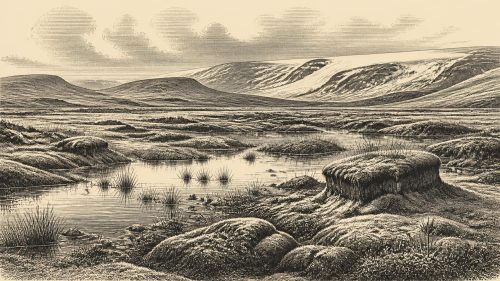
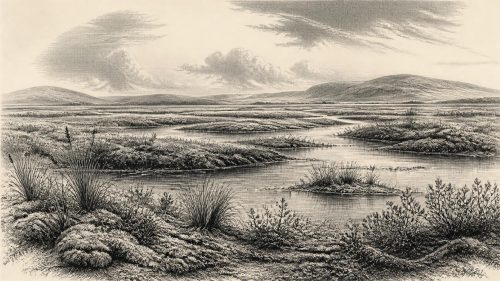
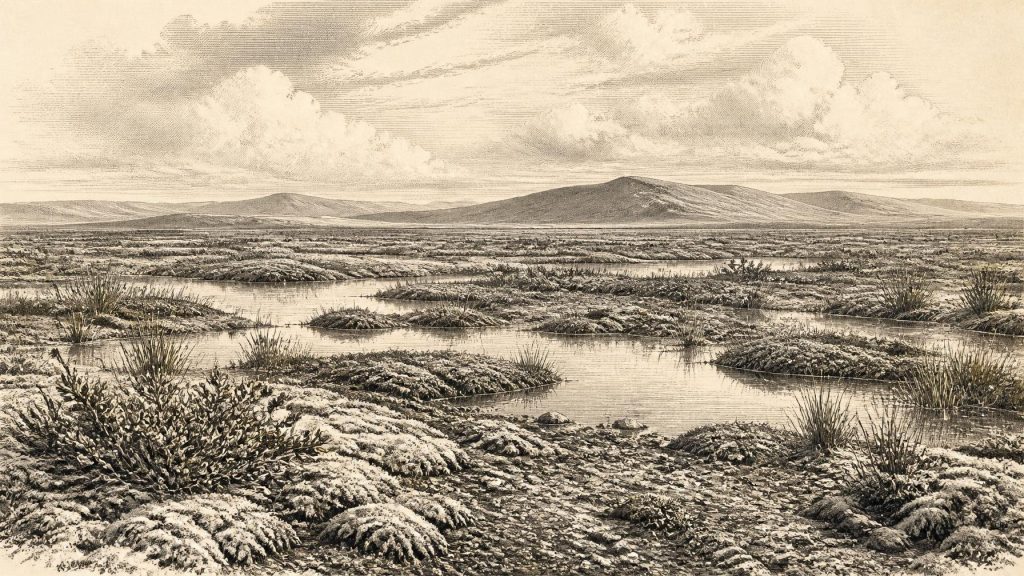
Derryvree’s buried organic horizon offers the clearest view of the sort of environment that may responsibly illuminate Ireland around this date. Plant macrofossils, pollen and associated sediments indicate freshwater and wet ground, with sedges, mosses, aquatic plants, low herbs and dwarf shrubs rather than closed forest. Earlier accounts describe the habitat as muskeg: a cold, waterlogged mosaic of shallow pools, saturated organic ground and vegetation. The word is a modern ecological comparison, not a claim that Fermanagh exactly resembled any present-day northern landscape.
This was not a mild woodland retreat. The evidence supports a treeless, exposed and strongly seasonal landscape shaped by frost, snow cover and short growing seasons. Local standing or slowly moving water allowed aquatic life and wetland plants to persist, while surrounding ground may have included bare mineral sediment, grasses, herbs and low willow-like vegetation. A productive summer margin around a pool could exist beside a broader terrain that was climatically harsh. The organic silts therefore show environmental possibility: freshwater habitats could form in parts of Ireland between advances of ice.
They do not provide a map of the island. By about 31,000 years ago, reconstruction of the growing British–Irish Ice Sheet indicates substantial upland ice in northern Ireland and glaciers or ice fields in several Irish mountain areas; rapid expansion followed during the succeeding millennia. At 30,350 BCE, conditions could have differed markedly between lowland basins, western coasts and uplands. It is safer to picture a shifting regional mosaic than either an entirely ice-covered Ireland or a uniformly open one. Ice margins, meltwater, periglacial ground and temporary wetlands were all part of the larger landscape story.
Animals and the Cave Record
Castlepook Cave, also called Mammoth Cave, near Doneraile in north County Cork, supplies a second and very different kind of evidence. Its galleries produced more than 2,000 bones during excavations conducted mainly in the early twentieth century. Direct dating has shown that the cave accumulated animal remains over a long span leading towards the Last Glacial Maximum. The fauna includes woolly mammoth, reindeer, giant deer, brown bear, spotted hyaena, wolf, Arctic fox and lemmings. Not every species need have lived together, and none can automatically be placed at 30,350 BCE; the cave is a time-averaged repository rather than a single living landscape.
Even so, Castlepook demonstrates that Ireland supported or received a far richer Ice Age mammal community than later historic Ireland. Herbivores such as reindeer, mammoth and giant deer indicate the existence, at different times, of open forage landscapes and movement routes into the island. Predators and scavengers show that the caves were part of animal ecologies rather than merely passive traps. Spotted hyaenas in particular may have carried bones into the cave, while water and older excavation methods further mixed deposits. The evidence is strong for animals; the exact relationships between species, dates and habitats remain interpretative.
Low sea levels during Marine Isotope Stage 3 made the Irish Sea narrower than today and increased opportunities for animal dispersal. That does not establish a simple, permanent land bridge, nor does it prove the route taken by any particular herd. It does, however, help explain why a changing Irish fauna can be considered within a wider north-west European world. Animal movement was likely intermittent, conditioned by sea level, coastlines, ice margins, vegetation and climate. “Trade” is not an appropriate category here: no exchange network, imported object or human-made distribution system is known from Ireland at this date.
The Human Question
The most tantalising possible human evidence is a reindeer femur from Castlepook bearing a surface mark interpreted by zooarchaeologist Ruth Carden as a cut made by a sharp stone implement during carcass processing. The bone has been publicly presented as approximately 33,000 years old. If the mark is confirmed as a butchery cut, it may indicate a brief Upper Palaeolithic human visit to Ireland, perhaps by people using a carcass in or near the cave. Such a finding would be important, but it cannot yet support a fuller social history.
The qualification matters. The specimen derives from an old cave collection, not a modern excavation of an undisturbed occupation surface. It is not accompanied by a securely associated hearth, stone-tool assemblage, dwelling, human remains or repeated processing area of comparable age. A date on a bone establishes when the animal lived, not necessarily when a mark was made or by whom. Recent re-examination of Irish cave faunas has also shown why improved bone pretreatment and direct dating can alter earlier chronologies. Around 30,350 BCE, therefore, human presence in Ireland is possible and deserving of continued investigation, but not demonstrated as a permanent population.
No Polities, But Real Histories
There is no evidence for political affairs, diplomacy, organised warfare, named communities, religion, ritual, art, learning or settlement in Ireland at this date. Nor can archaeologists responsibly reconstruct households, languages, kinship systems or seasonal camps. If people briefly reached the island, they would have belonged to mobile Ice Age hunter-gatherer worlds known elsewhere in north-west Europe; that is a regional comparison, not direct proof about Ireland. The human past here is bounded by absence as well as discovery.
The principal development around 30,350 BCE was environmental. In Fermanagh, freshwater sediments preserve a cold, treeless wetland interval later sealed by advancing ice. In Cork, cave bones preserve a long and complicated record of animals moving through a changing landscape. Together they overturn any simple image of an eternally frozen or wholly vacant island. They show instead a volatile Ireland: locally ice-free at some times and places, capable of sustaining wetland life and large mammals, yet increasingly subject to the growth of the ice sheet that would transform the island in the millennia ahead.
Primary Sources
- A Middle Midlandian Freshwater Series at Derryvree, Maguiresbridge, County Fermanagh, Northern Ireland
- Irish Pleistocene Biostratigraphy
- The Irish Quaternary Fauna Project
- A Reconsideration of the Radiocarbon Dating of the Marine Isotope Stage 3 Fauna from Southern Ireland
- Growth and Retreat of the Last British–Irish Ice Sheet, 31,000 to 15,000 Years Ago: the BRITICE-CHRONO Reconstruction
- BRITICE-CHRONO Maps and GIS Data of the Last British-Irish Ice Sheet 31 to 15 ka, Including Model Reconstruction, Geochronometric Age Spreadsheet, Palaeotopographies and Coastline Positions
- Castlepook Cave
- 2022:564 – Castlepook Cave, Castlepook South, Cork
- Mammoth Cave
- Cave Notes: Southern and Western Ireland
- Archaeological Heritage of County Cork
- Heritage Artefacts of County Cork
- Late Pleistocene Chronostratigraphy and Ice Sheet Limits, Southern Ireland
- Trimlines, Blockfields and the Vertical Extent of the Last Ice Sheet in Southern Ireland
- Deglacial Rates and Controls for BIIS Western Margin
- The IntCal20 Northern Hemisphere Radiocarbon Age Calibration Curve (0–55 cal kBP)
- IntCal Publications
- Warm Atlantic Surface Water Inflow to the Nordic Seas 34–10 Calibrated ka B.P.
- The Nature of MIS 3 Stadial–Interstadial Transitions in Europe: New Insights from Model–Data Comparisons
- An Ocean–Ice Coupled Response During the Last Glacial: A View from a Marine Isotopic Stage 3 Record South of the Faeroe Shetland Gateway
- New Insights on the Fauna of Ireland's Younger Dryas and Early Holocene from Alice & Gwendoline Cave
- Occurrence of Mammalia Relicts at Site Castlepook Cave
- Irish Association for Quaternary Studies Field Guide 16
- Irish Association for Quaternary Studies Field Guide 13