
Archived: 13 September 2026
Abstract
Although 31,803 BCE cannot denote a documented Irish event, it falls within MIS 3, before the Last Glacial Maximum. Ireland then experienced unstable cold conditions, with exposed tundra, wetlands and advancing ice rather than uniform glaciation. Derryvree sediments in Fermanagh indicate periglacial vegetation and freshwater habitats. Castlepook Cave, Cork, preserves a long, disturbed fossil record including mammoth, reindeer, giant deer, predators and lemmings, demonstrating access for Ice Age mammals. A marked reindeer femur may indicate brief Upper Palaeolithic butchery, but lacks secure context or supporting artefacts. Evidence supports animal landscapes and possible transient human visits, not settled population or polity.
Read Article

Archived: 13 September 2026
Abstract
Labelled 31,804 BCE, this period falls within unstable Marine Isotope Stage 3, for which only broad calibrated chronologies are defensible. Irish sediments show that some areas were ice-free before the later Last Glacial Maximum, supporting cold, open tundra environments and mobile fauna. Castlepook Cave in County Cork preserves diverse, time-layered Pleistocene animal remains. A reindeer femur, dated broadly to about 33,000 years ago, bears a mark interpreted as stone-tool damage during butchery. If confirmed, it suggests a brief human encounter with a carcass, not settlement. No evidence supports continuous occupation, identities, politics, religion, or culture, while expanding ice transformed Ireland.
Read Article

Archived: 13 September 2026
Abstract
31,805 BCE is a modern label within late Marine Isotope Stage 3, not a date for recoverable Irish events. Ireland experienced unstable glacial conditions, with ice-free areas varying regionally before later ice reshaped evidence. Derryvree’s freshwater sediments, preserved between tills, reveal cold, treeless tundra-like wetlands supporting insects and pools. Southern caves preserve fauna including mammoth, reindeer, giant deer, bear and hyaena, indicating open habitats but complex depositional histories. A possibly cut-marked reindeer bone from Castlepook raises prospects of transient Upper Palaeolithic visitors, yet no settlement or secure human occupation is known. These fragmentary archives demonstrate environmental change, not social history.
Read Article

Archived: 13 September 2026
Abstract
Circa 31,806 BCE, Ireland lay within the climatically unstable Marine Isotope Stage 3, not a precisely datable single year. Ice margins varied regionally: Glenulra records land depression and high local relative sea levels near northern ice, while southern coasts could remain ice-free. Open, largely treeless tundra-steppe supported hardy plants and animals including reindeer, mammoth, hyaena, bears, hares and foxes, evidenced especially in southern caves. A cut-marked Castlepook reindeer femur may indicate episodic human butchery, but cannot demonstrate settlement. Later glaciation destroyed much evidence. The period is best understood as a changing Ice Age landscape, with human presence uncertain and provisional.
Read Article
Archived: 13 September 2026
Abstract
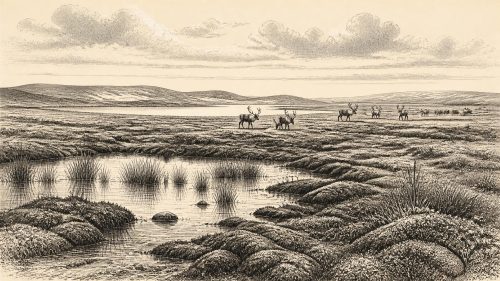
31,807 BCE is a modern marker within unstable Marine Isotope Stage 3, not a documented Irish year. Derryvree, County Fermanagh, preserves freshwater sediments between glacial tills, dated broadly enough to encompass this period. Bogbean, mosses, sedges, insects and sparse herbs indicate cold, open, wet tundra-like ground during an ice-free interval. Greenagho confirms intermittent freshwater environments, challenging assumptions of continuous ice cover. Castlepook Cave records cold-stage fauna, including reindeer, mammoth, predators and scavengers, but represents successive episodes rather than one community. A possible cut-marked reindeer bone suggests transient Upper Palaeolithic visitors, not settlement. Ireland was a shifting frontier before maximum glaciation.
Read Article

Archived: 13 September 2026
Abstract
31,808 BCE is a modern label rather than a recoverable Irish year, representing a broad Middle Midlandian interval within Marine Isotope Stage 3. Ireland’s conditions varied as the British–Irish Ice Sheet grew, producing severe, open periglacial landscapes rather than uniform ice cover. Derryvree and other Fermanagh deposits indicate wet treeless tundra, with sedges, grasses, shrubs, insects and freshwater habitats. Castlepook Cave preserves mammoth, reindeer, giant deer, predators and smaller cold-adapted animals, demonstrating intermittent ecological connections with Britain and Eurasia amid lower sea levels. A possibly cut-marked reindeer bone suggests, but does not prove, Upper Palaeolithic human presence without settlement evidence.
Read Article

Archived: 13 September 2026
Abstract
The reference year 31,801 BCE places Ireland within the Late Pleistocene, without claiming an event datable to that precise year. Glacial deposits, freshwater sediments and cave faunas suggest cold conditions before greater ice expansion. Open ground and freshwater environments could persist locally as the British-Irish Ice Sheet developed unevenly. Later glaciation destroyed or buried earlier surfaces, making annual reconstruction impossible. Evidence from Derryvree, Castlepook and regional ice studies instead supports environmental sequences. The article treats the date as an archival marker, explaining how fragmentary deposits, animal remains and calibrated dating inform cautious accounts of Ireland’s changing prehistoric landscape and ecology.
Read Article
Archived: 13 September 2026
Abstract
The reference year 31,802 BCE represents a Late Pleistocene setting rather than a securely dated Irish event. Cave remains, freshwater deposits and glacial geology provide the surviving evidence. Open landscapes supported tundra vegetation, freshwater habitats and large mammals while ice expanded unevenly across the British-Irish region. Later glaciation removed much of the earlier surface record, limiting certainty about local conditions and their timing. Castlepook research, Derryvree evidence, regional reconstructions and radiocarbon calibration therefore require cautious interpretation. The article explores habitable environments before wider ice cover while distinguishing modern archival chronology from the broad dating ranges supported by surviving scientific evidence.
Read Article
Archived: 13 September 2026
Abstract
The reference year 31,803 BCE offers a modern chronological marker for Ireland’s Late Pleistocene environment. No exact calendar record survives. Freshwater deposits in County Fermanagh indicate cold, open habitats with low vegetation, showing that ecosystems persisted before later ice expansion. Cave remains and glacial evidence contribute a regional picture. Ice growth, exposed ground and shifting habitats formed changing combinations rather than a uniform landscape. Derryvree studies, Castlepook investigations and regional reconstructions help interpret this fragmentary record. The article emphasises environmental change and chronological caution, explaining why broad scientific evidence cannot establish specific events in a single prehistoric Irish reference year.
Read Article
Archived: 13 September 2026
Abstract
The reference year 31,804 BCE situates Ireland near a glacial frontier within the Late Pleistocene. Glacial geology, freshwater sediments and cave faunas suggest uneven ice development across the British-Irish region. Some landscapes remained open and biologically active while others experienced stronger glacial influence. Subsequent ice movement removed or buried earlier material, leaving scattered evidence and broad dating ranges. Research concerning Derryvree, Castlepook, regional ice histories and radiocarbon calibration supports cautious environmental reconstruction. The article uses its date as an archival reference rather than an exact event, stressing the distinction between annual organisation and the limited precision of Ireland’s prehistoric record.
Read Article

