Glenulra’s Shifting Shore31806 BCE
Circa 31,806 BCE, Ireland lay within the climatically unstable Marine Isotope Stage 3, not a precisely datable single year. Ice margins varied regionally: Glenulra records land depression and high local relative sea levels near northern ice, while southern coasts could remain ice-free. Open, largely treeless tundra-steppe supported hardy plants and animals including reindeer, mammoth, hyaena, bears, hares and foxes, evidenced especially in southern caves. A cut-marked Castlepook reindeer femur may indicate episodic human butchery, but cannot demonstrate settlement. Later glaciation destroyed much evidence. The period is best understood as a changing Ice Age landscape, with human presence uncertain and provisional.
Dateline
The label 31,806 BCE should not be mistaken for a date that prehistoric evidence can identify with calendar-year precision. It is a modern way of placing a point roughly 33,755–33,756 years before 1950, within the later Pleistocene. Radiocarbon results from this depth of time must be calibrated and expressed as ranges, while deposits may record events spread across centuries or millennia. What can responsibly be said is that Ireland lay in Marine Isotope Stage 3, a cold and highly variable phase before the Last Glacial Maximum. Its landscapes were not the familiar green island of later millennia, and any human presence was, at most, fleeting and exceptionally difficult to demonstrate.
A Date Within a Long Cold Phase
Marine Isotope Stage 3, conventionally dated to about 57,000–29,000 years ago, was neither a single uniform winter nor a settled climatic age. North Atlantic temperatures shifted repeatedly between colder stadials and relatively milder interstadials. Those changes affected the reach of glaciers, the position of coasts, vegetation and animal movements. A notional date around 31,806 BCE falls late in this phase, several thousand years before the fullest expansion of the last British–Irish Ice Sheet, generally placed around 27,000–23,000 calibrated years before present.
Consequently, it is misleading to picture all of Ireland as continuously buried under ice at this moment. The evidence instead points to major regional differences and changing ice margins. In north-western Ireland, deposits at Glenulra in County Mayo indicate substantial ice loading nearby during parts of Marine Isotope Stage 3, and show that coastlines and relative sea level responded to the weight of ice. In southern Ireland, meanwhile, dated coastal deposits indicate that the south coast remained free of overriding glacier ice from before about 45,700 calibrated years ago until an advance after about 24,200 calibrated years ago. These are broad chronological brackets, not a map for one particular year; nevertheless, they establish that an ice-free or partly ice-free southern landscape was possible around the period in question.
Shorelines Under Pressure
Glenulra is important because it warns against treating sea level as a simple global measure. During the wider cold phase, the growth of ice sheets lowered the world ocean, exposing large areas of continental shelf. Yet the sheer mass of nearby ice also depressed the land. At Glenulra, raised marine deposits have been interpreted as evidence that the Donegal coast was substantially depressed for much of the interval between roughly 40,000 and 26,000 calibrated years ago. Local relative sea level could therefore be high even while global sea level was lower than today.
For people or animals, such processes mattered more than abstract maps. River mouths, bays and coastal plains could change their character as ice advanced, retreated or altered the land’s level. Much of the prehistoric terrain that might once have preserved campsites, trackways or hunting places is now offshore, beneath later sediments, or has been destroyed by glacier erosion. This uneven survival of evidence is central to the history of Pleistocene Ireland: the absence of a settlement is not automatically proof that nobody ever stood there, but neither does it permit archaeologists to invent a lost population.
Open Ground, Not Ancient Woodland
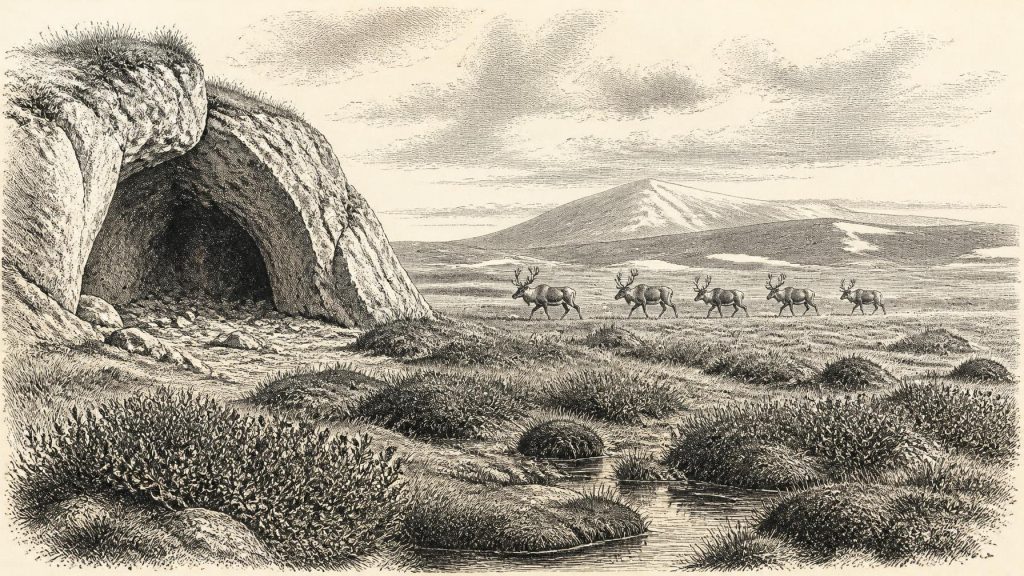
Plant and insect evidence from organic layers preserved beneath or between glacial deposits in Fermanagh provides the best guide to the kind of Irish environments that could occur during cold parts of Marine Isotope Stage 3. Sites including Hollymount, Aghnadarragh, Greenagho and Derryvree have yielded pollen, plant remains and beetle evidence. Their records point towards sparse, open vegetation: grasses and sedges, dwarf birch, willow, heaths, crowberry, mugwort and other hardy plants. Such communities are often described as tundra or tundra-steppe, though neither term should conceal local variation among wet hollows, sedge-rich pools, gravelly open ground and sheltered slopes.
At Aghnadarragh, insect evidence includes species whose modern distributions lie in Arctic Fennoscandia. Estimates derived from the assemblage suggest cold winters and cool summers, but these figures are reconstructions rather than direct thermometer readings. The terrain was probably treeless over wide areas and exposed to wind, frost and seasonal snow. It was not necessarily lifeless. Mosses, herbs and low shrubs could provide forage; wetlands could concentrate plant growth; and limestone caves offered sheltered cavities, though not automatically habitable homes for people.
The Animals of the Limestone Caves
Irish cave deposits preserve the clearest evidence for the animals living in, or passing through, this world. Castlepook Cave, near Doneraile in north County Cork, is especially significant. Its old excavations recovered a rich mixture of Pleistocene remains, including reindeer, woolly mammoth, spotted hyaena, brown bear, hare and fox. Reassessment and redating of material from Castlepook and other southern caves have shown that several earlier radiocarbon determinations were too young, moving important parts of the fauna further back into Marine Isotope Stage 3.
A cave bone is not a census of the countryside. Carcasses may have been brought in by carnivores, animals may have died naturally near an entrance, and nineteenth- and early twentieth-century excavations often recorded layers less precisely than modern fieldwork requires. Even so, the combined assemblage makes a powerful case for a cold-adapted animal landscape in southern Ireland before the last ice-sheet maximum. Reindeer, in particular, suggest open country with suitable grazing. Mammoths indicate the wider north-west European Ice Age fauna to which Ireland was then connected ecologically, even if individual species were not present everywhere at once or throughout the whole period.
Spotted hyaena adds another important caution. This was not the modern African animal transplanted unchanged to a polar landscape, but a Pleistocene carnivore capable of scavenging, hunting and accumulating bone in dens. Marks on bones, breakage and the location of finds must therefore be assessed through taphonomy: the study of what happened to remains after death. The Castlepook cave system was part of an animal landscape, not an uncomplicated archive of human activity.
The Castlepook Human Question
The most provocative evidence directly relevant to this era is a reindeer femur from Castlepook that carries deep incisions interpreted as cut marks made while the bone was fresh. It has been publicised as evidence of human activity in Ireland about 33,000 years ago. If that interpretation stands, it would push evidence for people on the island far earlier than the better-known Late Glacial and Mesolithic records. It would indicate not a named community, village or permanent colonisation, but at least one episode in which humans processed a reindeer carcass.
That conclusion must remain carefully bounded. The bone does not supply a house floor, hearth, stone-tool assemblage, human burial, route of arrival or evidence for families living year-round in Ireland. Nor can its radiocarbon age be converted honestly into a precise event on a modern calendar. The current Castlepook research programme is re-examining the cave’s deposits and looking for securely stratified material, including possible traces of occupation such as charcoal and artefacts. Until that work produces a fuller context, the responsible description of c. 31,806 BCE is one of possible, perhaps episodic human visitation within a faunally rich southern landscape.
No States, Borders or Diplomacy
There is no evidence from this period for political institutions, leaders, territories, warfare, diplomacy, organised religion or formal learning in Ireland. Such categories belong to much later societies and cannot be projected backwards merely because a modern calendar date has been assigned. If people did visit Castlepook’s region, their social world would have been that of small, mobile hunter-gatherer groups known elsewhere in Upper Palaeolithic Europe. They would have depended on close knowledge of animal behaviour, seasons, fuel, shelter and routes across a changing landscape. This is an informed comparison, not direct evidence for a particular Irish band.
Likewise, there is no basis for claiming trade networks, ritual sites or a settled economy on the island at this date. The narrowest evidence-based inference is that an animal carcass may have been processed with a stone-edged implement. Such an act would imply practical skill, but no artefact from that episode has yet been securely identified. The material culture, language, beliefs and identities of any visitors remain unknown.
An Ireland Before Lasting Settlement
By the later part of the last glacial cycle, advancing ice would transform or erase many earlier surfaces. The succeeding Last Glacial Maximum covered much of Ireland and its shelf, profoundly reworking the physical evidence. That later destruction helps explain why the island’s Palaeolithic record is so sparse compared with parts of Britain and continental Europe. The archaeological silence is therefore a product both of genuine uncertainty about occupation and of harsh preservation conditions.
For c. 31,806 BCE, the strongest history is environmental and archaeological rather than dynastic. Ireland was a place of unstable ice margins, altered shores, open cold-country vegetation and large mammals. In the caves of the south, bones preserve a partial record of reindeer, mammoth and predators; at Castlepook, one marked reindeer bone raises the possibility of human butchery. It is a remarkable clue, but still only a clue. The year is best understood not as a documented episode, but as a carefully located point within a long, changing Ice Age landscape.
Primary Sources
- A reconsideration of the radiocarbon dating of the Marine Isotope Stage 3 fauna from southern Ireland
- The Irish Quaternary Fauna Project
- Response of the Irish Ice Sheet to abrupt climate change during the last deglaciation
- Late Pleistocene chronostratigraphy and ice sheet limits, southern Ireland
- Radiocarbon constraints on the age of the maximum advance of the British–Irish Ice Sheet in the Celtic Sea
- Dimensions and chronology of the last ice sheet in Western Ireland
- Last Glacial Maximum cirque glaciation in Ireland and implications for reconstructions of the Irish Ice Sheet
- Irish Pleistocene biostratigraphy
- The IntCal20 Northern Hemisphere Radiocarbon Age Calibration Curve (0–55 cal kBP)
- IntCal: International Radiocarbon Calibration
- Recent developments in calibration for archaeological and environmental samples
- Marine20—the marine radiocarbon age calibration curve (0–55,000 cal BP)
- The colonization of Ireland: A human ecology perspective
- The marine δ18O record overestimates continental ice volume during Marine Isotope Stage 3
- Irish Cave Exploration
- Discovery of Stone Implements of Lower Palæolithic Age in Ireland
- Mammoth Cave, County Cork
- 2022:564 – Castlepook Cave, Castlepook South, Cork
- Archaeology Research Excavation Grant 2022: Castlepook Cave Project Final Report
- Ireland: Submerged Prehistoric Sites and Landscapes
- Landscapes and environments of the last glacial-interglacial transition: a time of amazingly rapid change in Ireland
- New insights on the fauna of Ireland’s Younger Dryas and Early Holocene