

Maguirebridge’s Three-Leaf Pool
31,444 BCE is not a recordable Irish year but falls within the climatically unstable Late Pleistocene. Deposits beneath a drumlin at Derryvree, County Fermanagh, reveal an ice-free interval containing freshwater sediments, mosses, sedges, aquatic plants, insects and pollen, indicating cold, largely treeless tundra wetland. Later ice buried and eroded much evidence. Castlepook Cave, County Cork, preserves cold-adapted fauna including mammoth, reindeer, giant deer, hyena and lemmings, though its deposits span episodes. A marked reindeer bone may indicate early human butchery, but remains unconfirmed. No secure contemporary settlement, tools, culture or institutions are known; the evidence instead documents a changing landscape.
View Record
Hollymount’s Inter-Till Lake
Although 31,445 BCE cannot identify an Irish event, it falls within Marine Isotope Stage 3, a climatically volatile Late Pleistocene interval. Inter-till deposits at Derryvree, Greenagho, Hollymount and Aghnadarragh demonstrate local ice-free phases amid advancing glaciers. Derryvree's freshwater sediments, dated broadly to 36,900–31,700 years ago, preserve evidence of tundra-like wetlands, aquatic plants and insects. Cave remains at Castlepook attest to diverse cold-adapted fauna, including mammoth, reindeer and hyaena, though their dates and associations vary. Human occupation remains unproven: a possibly butchered reindeer bone warrants investigation but demonstrates neither settlement nor continuity. Later ice destroyed or buried evidence, leaving environmental archives.
View Record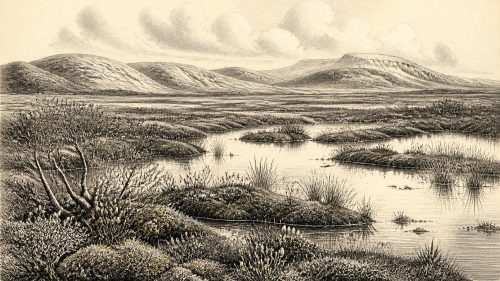
Derryvree’s Frozen Muskeg
31,446 BCE is a modern chronological label rather than a recoverable event. During Marine Isotope Stage 3, Ireland experienced fluctuating glacial conditions, not uniform ice cover. Sediments beneath Derryvree’s Fermanagh drumlin record a freshwater, moss-rich tundra wetland between ice advances, dated broadly to 36,900–31,700 calibrated years BP. Castlepook Cave in Cork preserves evidence of cold-stage mammals, including mammoth, reindeer, giant deer, predators and lemmings, showing intermittent connections with Britain. A possibly stone-cut reindeer bone may indicate early human visitation, but remains unconfirmed. No evidence supports settlement, society, politics or culture. These archives instead reveal environmentally diverse Ice-Age Ireland approaching glaciation.
View Record
Elephant Hall’s Cold Archive
31,447 BCE cannot be treated as a precise Irish historical year; evidence instead describes a broad late Pleistocene cold interval before the Last Glacial Maximum. Derryvree, County Fermanagh, preserves buried freshwater wetland deposits indicating treeless, tundra-like conditions with sedges, mosses, insects and limited forage. Castlepook Cave, north Cork, contains time-averaged remains of reindeer, mammoth, giant deer, hyaena and other animals, showing intermittent links with Britain and continental Europe. A possibly cut-marked reindeer bone suggests brief Upper Palaeolithic human activity, but lacks supporting artefacts or settlement evidence. Later ice expansion erased much evidence, leaving a cautious picture of habitable, fluctuating landscapes.
View Record
Mosses Under Maguiresbridge
31,448 BCE is a modern label for a broad Late Pleistocene interval, rather than a recordable Irish year. Sediments beneath Derryvree, County Fermanagh, document an ice-free freshwater wetland during MIS 3, later sealed by advancing ice. Mosses, pollen and insects indicate cold, open, wet, periglacial terrain with local ecological variety. Southern caves, especially Castlepook in County Cork, preserve diverse fauna including reindeer, mammoth, giant deer and predators. A cut-marked reindeer bone may indicate brief human carcass processing, but cannot prove settlement. Before the Last Glacial Maximum, Ireland's evidence chiefly reveals dynamic environments, scarce archaeological traces, and possible transient human presence.
View Record
BIRM-166’s Bogbean Horizon
31,449 BCE is a modern label within volatile Late Pleistocene MIS 3, not a datable Irish year. Derryvree, County Fermanagh, preserves freshwater silts between glacial tills, radiocarbon-calibrated broadly to 34,950–29,750 BCE. Its bogbean, dwarf willow, clubmoss, pollen and insects demonstrate locally ice-free, treeless tundra-like wetlands before later ice advance. Castlepook Cave’s fauna, including mammoth, reindeer, giant deer, predators and small mammals, confirms links with wider Pleistocene Europe. A possibly cut-marked reindeer bone may indicate early human butchery, but remains disputed and cannot prove settlement. No Irish evidence establishes society, institutions or regular exchange. They reveal a living Ice Age landscape.
View Record
Hyenahall’s Cold Fauna
Around 31,450 BCE, Ireland lay within a fluctuating Late Pleistocene environment rather than a datable historical moment. Derryvree sediments in Fermanagh record an ice-free, treeless periglacial wetland between glacial advances, demonstrating locally habitable conditions before later extensive ice cover. Castlepook Cave in Cork preserves a time-mixed assemblage of mammoth, reindeer, giant deer, bears, hyaenas and other cold-adapted animals, reflecting links with north-west European fauna. A possibly cut-marked reindeer femur may indicate Upper Palaeolithic human activity, but remains inconclusive without associated tools or habitation evidence. Environmental change, animal movement and advancing ice chiefly shaped Ireland; routes and human presence remain uncertain.
View Record
Maguirebridge’s Brief Thaw
31,451 BCE is a modern label for a broad Late Pleistocene interval, not a recoverable Irish historical year. Derryvree, County Fermanagh, preserves freshwater sediments between glacial tills, indicating a temporary ice-free, periglacial landscape of tundra wetlands, sparse vegetation and invertebrates before renewed glaciation. Castlepook Cave fauna demonstrate that reindeer, giant deer, mammoth, predators and other open-country animals occurred in MIS 3, though deposits span time. A cut-marked reindeer femur may indicate brief Upper Palaeolithic human activity, but cannot prove settlement. Shifting ice, low sea levels and uncertain routes linked Ireland variably to north-west Europe, while later ice destroyed much evidence.
View Record
Awbeg’s Limestone Winter
31,452 BCE is a modern label for a fluctuating Late Pleistocene environment, not a documented Irish year. Lower sea levels altered connections, but shifting ice, waterways and terrain restricted movement. Sediments at Fermanagh and marine evidence in the west show that some regions were ice-free or open before the Last Glacial Maximum. Treeless tundra-steppe, wetlands and severe seasonal cold supported cold-adapted fauna. Castlepook Cave in Cork preserves mammal remains, including reindeer. A possibly cut-marked reindeer femur suggests brief Upper Palaeolithic human contact, but cannot establish settlement. Ireland was a changing northern landscape, later glaciation having erased or buried much evidence.
View Record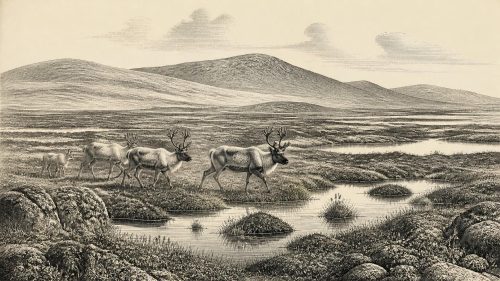
Greenagho’s Mossy Interstadial
31,453 BCE is a modern reference rather than a recorded Irish year. During unstable Marine Isotope Stage 3, Ireland experienced variable, local conditions rather than uniform ice cover. Freshwater deposits at Derryvree and Greenagho indicate ice-free, treeless tundra wetlands during intervals, while Crag Cave confirms episodic milder conditions supporting flowing water. Castlepook Cave preserves remains of mammoth, giant deer, reindeer, bears and hyenas, though mixed deposits limit precise reconstruction. A cut-marked reindeer bone may indicate brief Upper Palaeolithic human activity, not settlement. No contemporary houses, tools, burials, communities, politics or culture are securely known. Ireland was a frontier for fauna.
View Record