

Bogbean and Bone31135 BCE
31,135 BCE is a label for a Late Pleistocene interval, not a recorded year. Evidence depicts a cold, changing landscape rather than a human society. Derryvree deposits in Fermanagh preserve tundra-like freshwater wetlands, with bogbean, mosses, sedges, insects and open vegetation between glacial advances. Ice accumulated unevenly across Ireland, while fluctuating climate, lower seas and changing connectivity shaped habitats. Castlepook Cave in Cork contains mammoth, giant deer, reindeer, predators and fauna accumulated through varied processes. A reindeer femur possibly cut by a stone tool may signal brief human activity, but cannot demonstrate settlement. Dating, deposits and bone contexts require caution.
Dateline
The label 31,135 BCE is a modern chronological convenience, not a year recorded by anybody in Ireland. It lies roughly 33,000 years before the conventional archaeological present of AD 1950, within the Late Pleistocene and Marine Isotope Stage 3, a long, climatically unstable phase of the last Ice Age. No Irish calendar, written source, named community, political unit or datable event can be attached to this point. Archaeology can instead offer overlapping ranges: radiocarbon determinations, cave-fauna sequences, glacial sediments and fossil plant remains that illuminate conditions across centuries or millennia. They must not be treated as a diary for a single year.
For Ireland, this is a history principally of environment and possibility. The island’s surviving evidence suggests a cold, mostly open landscape whose habitats, animal populations and accessibility changed repeatedly as ice accumulated. It does not demonstrate a settled human population. The most striking object relevant to this broad era is a reindeer femur from Castlepook Cave near Doneraile, County Cork, carrying a mark interpreted as possibly made by a sharp stone tool. That interpretation is important, but the evidence remains too limited to turn it into a story of a village, a hunt on a known day, or continuous occupation.
A Date Beyond Calendar Precision
Scientific dates at this depth require special care. A radiocarbon age is not the same thing as a calendar age, and calibration turns one laboratory result into a probability range rather than an exact historical date. At Derryvree, near Maguiresbridge in County Fermanagh, organic-rich freshwater deposits produced a radiocarbon determination of 30,500 +1,170/−1,030 radiocarbon years BP. The uncertainty is already more than a millennium before calibration is considered. The deposit also accumulated over time. It is therefore responsible to say that it provides an unusually valuable environmental window on the Middle Midlandian cold phase, not that it describes Ireland precisely in 31,135 BCE.
The same restraint is needed at Castlepook Cave, also called Mammoth Cave. The cave contains bones deposited over a long interval, with individual dates extending across much of the period before and around the Last Glacial Maximum. A bone dates the life and death of an animal, not automatically the arrival of every other bone nearby, the making of a surface mark, or the presence of people. Earlier excavators recovered rich material, but their methods did not meet modern standards of contextual recording. Water movement, carnivore activity and old disturbance further complicate the archive.
Derryvree’s Cold Wetland
Derryvree is the clearest Irish environmental archive relevant to the wider period. Road cutting in 1969 exposed organic silts and fine sands between two thick tills beneath a drumlin. The lower till records an earlier episode of glaciation; the upper till shows that ice later returned and sealed the freshwater sediments. Between them lies evidence for a non-glacial, but still severe, landscape.
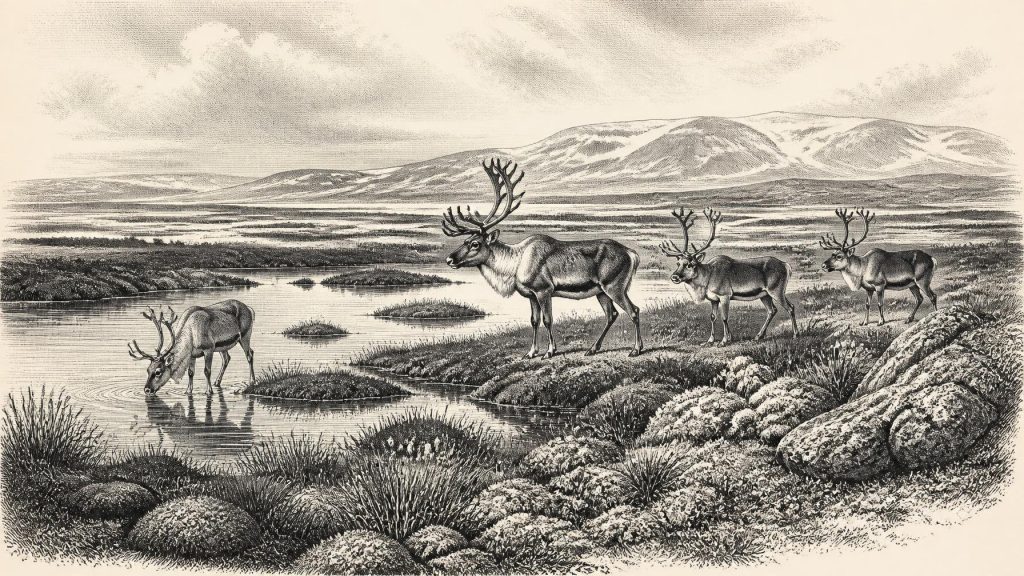
Fossil pollen, plant macrofossils, mosses, sedges and insects point to largely treeless, cold-open ground. The assemblage has been described as tundra or muskeg-like: wet, mossy and sedgy areas around shallow fresh water, with frost-affected terrain beyond. Finds of bogbean (Menyanthes trifoliata) and mountain-avens (Dryas octopetala) are especially evocative. Neither proves a uniform blanket of vegetation across all Ireland, but together with the wider plant and insect evidence they indicate conditions very different from the wooded, oceanic island of later millennia.
This was not necessarily an empty white wilderness. Freshwater pools, margins of sedge and moss, patches of herbs, exposed mineral ground and low shrubs could create a varied local mosaic. Yet it was a difficult setting, shaped by long winters, seasonal freezing and short productive summers. The Derryvree deposits document living communities of plants and invertebrates close to water. They do not disclose fields, houses, farms or human food stores. Agriculture, permanent villages and managed landscapes belong to far later Irish prehistory.
Ice Building Across the Island
At this broad point in time, the British–Irish Ice Sheet was developing unevenly rather than sitting at its final maximum. Modern reconstructions begin their detailed sequence around 31,000 years before present because evidence earlier than that is sparse. They indicate ice accumulation in northern and upland Ireland, including a substantial northern ice cap and smaller ice fields or glaciers in several mountain regions. By about 28,000 years before present, reconstruction models show Ireland becoming almost wholly ice-covered; the maximum extent of the wider ice sheet followed later, broadly around 26,000 years before present.
That sequence matters because it rules out easy generalisations. Ireland was neither simply ice-free nor uniformly buried beneath an unchanging sheet at every moment in this era. Conditions varied by region, altitude and climatic pulse. In south-west Ireland, Crag Cave in County Kerry preserves speleothems—cave calcite deposits—whose episodic growth during Marine Isotope Stage 3 indicates intervals when liquid water circulated and mean annual temperatures were sufficiently mild for calcite formation. Such deposits are evidence for climatic fluctuation, not for comfortable conditions or human habitation. Their significance lies in showing that Irish climate responded sharply to wider North Atlantic changes.
Sea level was lower than today, and the configuration of coasts and shallow seas differed greatly. Ireland’s ecological connections to Britain and continental north-west Europe could consequently have changed with climate and sea level. But the available Irish evidence cannot establish a particular land bridge, crossing route or journey in 31,135 BCE. It is safest to speak of changing regional connectivity rather than to imagine a known migration corridor.
Castlepook’s Animal World
Castlepook Cave provides the richest known Irish vertebrate record for the time leading towards the Last Glacial Maximum. Its fauna includes woolly mammoth, giant deer, reindeer, brown bear and spotted hyaena; later deposits have also yielded Arctic fox, wolf and lemmings. This collection demonstrates that, during favourable phases of the Late Pleistocene, Ireland supported or received a far more varied large-mammal fauna than the modern island does.
It would nevertheless be misleading to place all these animals in one simultaneous scene. Cave assemblages can combine remains of different ages, and carnivores can carry bones from elsewhere into a den. Spotted hyaenas are particularly important to interpretation. Their presence means that at least some bones may record scavenging, prey transport and denning rather than human disposal. The cave is an archive of repeated animal and geological processes, not a neatly preserved camp floor.
Reindeer are especially relevant to the cold, open environments indicated at Derryvree. Their presence suggests grazing landscapes capable of supporting mobile herbivores, while mammoth and giant deer point to extensive plant resources in at least some phases. Predators and scavengers reveal an active food web. This was an ecological world in which carcasses were contested resources and caves could become repositories of bone. That conclusion is directly supported by faunal evidence; claims about exact herd routes, seasonal movements or population sizes remain interpretation.
The Marked Reindeer Femur
The Castlepook reindeer femur has given this period unusual archaeological importance. It has been presented by Ruth Carden and County Cork heritage publications as approximately 33,000 years old and as bearing a deep incision consistent with cutting fresh tissue using a sharp stone tool. If the mark is confirmed as anthropogenic, it may indicate that one or more Upper Palaeolithic people processed a reindeer in Ireland during the broader period represented by the bone.
That is a major possibility, but it is not proof of settlement. No securely associated stone-tool assemblage, hearth, built shelter, burial, occupation surface or repeated butchery area of comparable age has been recovered from Castlepook. Nor does the bone prove that people killed the animal, butchered it inside the cave, lived nearby, or remained on the island. County Cork’s own heritage interpretation notes a plausible alternative sequence: the animal may have been butchered elsewhere, after which carnivores carried discarded remains into the cave.
The distinction is more than academic. A brief visit by a small hunting party is very different from a resident population. Across north-west Europe, Upper Palaeolithic Homo sapiens communities used sophisticated stone technologies, fire, tailored clothing and wide social networks; some also made art and personal ornaments. Those comparisons make short-lived visits to a cold Irish landscape conceivable. They do not supply direct evidence that these practices occurred in Ireland at this date. Irish archaeology has not yet recovered an in-situ assemblage that can responsibly support such detail.
What Cannot Yet Be Written
There are no political affairs to report for Ireland in this notional year: no rulers, territories, alliances, diplomacy or warfare can be identified. There is likewise no evidence for religion, ceremonial monuments, formal learning, exchange networks or trade. A reindeer bone bearing a possible cut mark may speak to practical knowledge of animal anatomy and sharp tools, but it cannot reveal language, belief or social organisation. The absence of evidence is partly a consequence of later glaciation, erosion and sea-level change, all of which removed or buried potential sites; it is also a reminder not to fill the silence with invention.
What can be said is both narrower and remarkable. Around the broad time represented by 31,135 BCE, Ireland was a changing Ice Age environment rather than a recognisable historical society. Freshwater tundra wetlands survived in Fermanagh between episodes of ice advance. In southern limestone caves, a distinctive cold-stage fauna left a fragmented record. Expanding ice was increasingly transforming the island and limiting habitats. A single reindeer femur from Castlepook may preserve a fleeting human connection to that world. Future controlled excavation, microscopic analysis of bone modifications, improved dating and sediment study may strengthen or weaken that claim. For now, bogbean seeds, moss-rich silts and animal bone remain the responsible witnesses.
Primary Sources
- Early Midlandian–Middle Midlandian, Pleistocene, Northern Ireland
- The Subdivision of the Quaternary Period in Ireland
- Middle Midlandian Interstadial Deposits at Greenagho, Near Belcoo, County Fermanagh, Northern Ireland
- An Inter-Till Freshwater Deposit at Hollymount, Maguiresbridge, County Fermanagh
- Freshwater Organic Deposits and Stratified Sediments Between Early and Late Midlandian (Devensian) Till Sheets, at Aghnadarragh, County Antrim, Northern Ireland
- A Reconsideration of the Radiocarbon Dating of the Marine Isotope Stage 3 Fauna from Southern Ireland
- Castlepook Cave: County Geological Site Report
- The Irish Quaternary Fauna Project
- Growth and Retreat of the Last British–Irish Ice Sheet, 31,000 to 15,000 Years Ago: the BRITICE-CHRONO Reconstruction
- Exploring the Last British-Irish Ice Sheet: New Geological and Geochronological Data from the Continental Shelf and Onshore Ireland
- The Deglaciation of the Western Sector of the Irish Ice Sheet from the Inner Continental Shelf to its Terrestrial Margin
- Last Glacial Maximum Cirque Glaciation in Ireland and Implications for Reconstructions of the Irish Ice Sheet
- Episodic Speleothem Deposition Tracks the Terrestrial Impact of Millennial-Scale Last Glacial Climate Variability in SW Ireland
- Spatio-Temporal Dynamics of Speleothem Growth and Glaciation in the British Isles
- Ireland: Submerged Prehistoric Sites and Landscapes
- First Evidence of a Late Upper Palaeolithic Human Presence in Ireland
- New Insights on the Fauna of Ireland’s Younger Dryas and Early Holocene from Alice & Gwendoline Cave
- Archaeological Heritage of County Cork
- Heritage Artefacts of County Cork
- 2022:564 – Castlepook Cave, Castlepook South, Cork
- Pleistocene History of Betula with Special Reference to the British Isles