BIRM-166’s Interstadial Edge30372 BCE
Around 30,372 BCE, Ireland lay within the Late Pleistocene, near the end of a Greenland interstadial, but no annual Irish record survives. The Derryvree deposits in County Fermanagh, bracketed by glacial tills, show a locally ice-free freshwater wetland between advances; BIRM-166 dates broadly to 36,900–31,700 years before present. Low, treeless vegetation supported marsh communities, while caves at Castlepook document diverse cold-stage mammals. A modified reindeer bone may indicate human activity, but proves neither settlement nor occupation. Evidence reveals climatic instability and ecological possibility, not politics, society or securely documented human history across the island at this date in any detail.
Dateline
The label 30,372 BCE cannot denote a recorded Irish year. It is a modern calendar conversion, approximately 32,321 years before AD 1950, the conventional “present” of radiocarbon chronology. No writing, political history, settlement sequence or annually resolved environmental record survives for Ireland at this depth of time. The responsible approach is therefore to place the date within broad calibrated ranges. It belongs to the Late Pleistocene, during Marine Isotope Stage 3, and falls near the end of Greenland Interstadial 5.2, a relatively milder North Atlantic episode conventionally dated to about 32,500–32,040 years before 2000. That global climatic framework is useful, but it is not a weather report for Ireland.
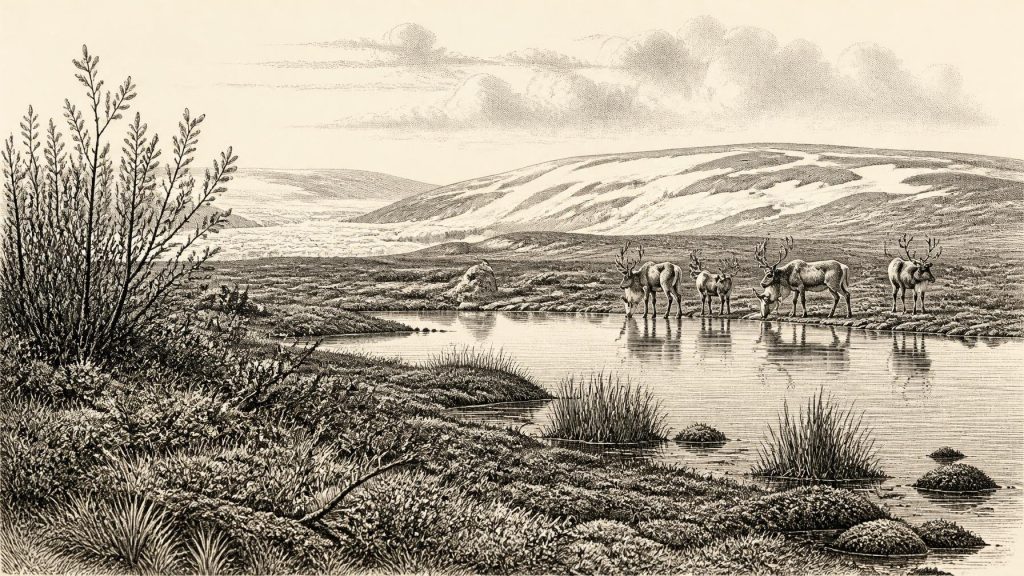
The nearest major Irish archive is a buried freshwater deposit at Derryvree, near Maguiresbridge in County Fermanagh. There, roadworks exposed organic silts and fine sands caught between two layers of glacial till. A radiocarbon determination from the sequence, BIRM-166, has been calibrated broadly to roughly 36,900–31,700 years before present. The notional year 30,372 BCE lies within that wide span. It cannot be assigned to a particular sediment layer, animal, plant or season. Yet Derryvree offers an unusually clear glimpse of the environmental world from which this date must be understood: a cold, treeless wetland landscape that existed between episodes of glaciation.
A Date Inside a Range
Radiocarbon dates do not translate straightforwardly into calendar years. They measure the remaining radioactive carbon in once-living material, then require calibration against independent records of past atmospheric change. Beyond 30,000 years ago, uncertainty becomes substantial. BIRM-166’s age range is consequently measured in millennia, not decades. Nor does a date from one Fermanagh basin define conditions across every coast, upland and interior plain of the island.
Its stratigraphy is nevertheless decisive. Lower till shows that glacier ice had affected the locality. Above it, organic sediment accumulated in standing or slowly moving freshwater, demonstrating a period when the site was free of local ice. Upper till records a later return of glacial conditions. This sequence is not evidence for a single dramatic thaw, nor proof that all Ireland was simultaneously ice-free. It is firm evidence for powerful environmental oscillation: ice, then wetland, then ice again.
At approximately 32.3 thousand years before AD 1950, the wider North Atlantic climate was unstable. Greenland ice-core chronologies identify an interstadial, a comparatively warm interval amid the long last glacial period. Such events could bring rapid shifts in temperature, sea ice, precipitation and wind patterns around the North Atlantic. Ireland’s response would have been shaped by its position at the Atlantic margin, local relief, glacier behaviour and changing drainage. The point is not that Derryvree experienced a modern-style summer, but that it belonged to an unsettled climatic world in which ecological opportunities could expand and contract sharply.
The Fermanagh Wetland
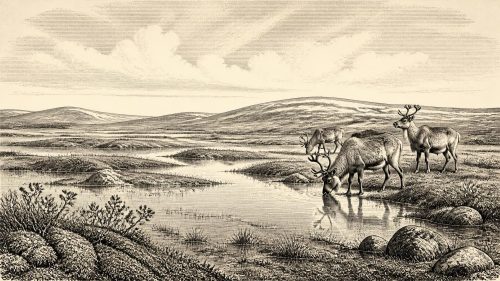
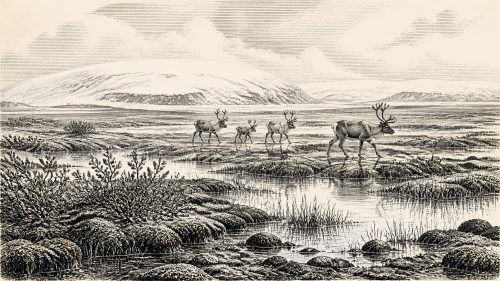
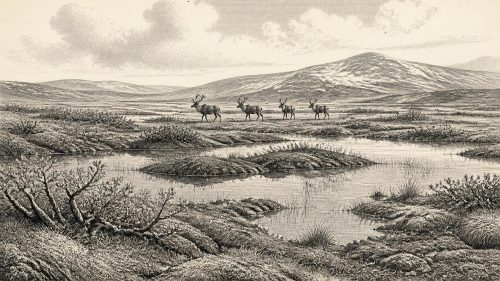
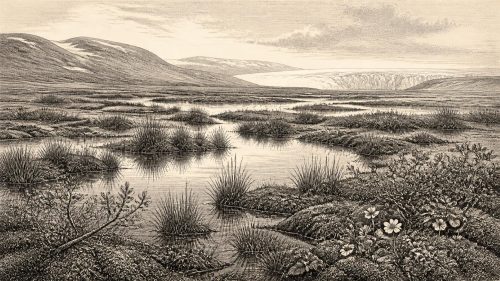
The Derryvree plant and animal remains indicate open, cold-stage country rather than forest. Mosses, sedges, grasses and hardy herbs grew around shallow water. Finds of bogbean, water-milfoil, dwarf willow, juniper and plants associated with calcareous or damp ground show that the basin was not lifeless. It supported a varied freshwater and marsh-edge community. In warmer months, low vegetation could exploit long northern daylight; in winter, frost, snow cover and frozen ground would have imposed severe limits.
This was a patchwork landscape, not an uninterrupted white waste. Pools, wet sedge margins, gravelly or sandy ground, mossy surfaces and more exposed slopes would each have offered different habitats. The vegetation was low and discontinuous by later Irish standards. There were no oak woods, hazel scrub, cereal fields, grazing livestock or peat-cutting communities. The familiar green, wooded and densely inhabited island lay very far in the future.
Even so, care is required with the word “tundra”. It conveniently conveys cold, open and largely treeless conditions, but it can conceal local variation. Derryvree was specifically a freshwater setting, and its organic sediments preserve what grew near water more readily than plants from distant dry ground. Its evidence should be read as a detailed local record within a broader periglacial landscape, not as a complete inventory of Ireland’s vegetation.
Animals in a Changing Country
Southern Irish caves provide another, very different archive. Castlepook Cave near Doneraile, County Cork, has yielded one of Ireland’s richest Pleistocene faunal assemblages. Its deposits include woolly mammoth, reindeer, giant deer, brown bear, wolf, Arctic fox, mountain hare, collared and Norwegian lemmings, and spotted hyaena. Not every specimen is contemporary with every other: caves collect bones over long periods, water can disturb deposits, and old excavations did not always record stratigraphy to modern standards. Nonetheless, the assemblage establishes that Ireland was repeatedly accessible to a striking range of cold-stage mammals before the Last Glacial Maximum.
These animals imply mobile food webs across open country. Reindeer and horses, where present, could have moved through broad grazing landscapes; mammoths and giant deer required substantial forage; hyaenas, wolves and bears occupied different predatory or scavenging roles. Cave deposits, however, do not prove a thriving animal population in every district or season. Carnivores may have carried bones into caves, and flooding could redeposit them. Their value is greatest when they are treated as evidence of regional possibility rather than as a census.
The approaching growth of the British–Irish Ice Sheet mattered profoundly. Ireland was not yet necessarily at the maximum extent of the final glaciation, which came thousands of years later, but glaciers and ice sheets were becoming dominant agents of change. They redirected water, buried soils and wetlands, destroyed or reworked older deposits, and altered potential routes for animals. Subsequent ice advance is one reason the surviving evidence for this period is so fragmentary.
People: A Serious Possibility, Not a Settlement
Human history at this date must be expressed with particular restraint. At Castlepook, a reindeer femur bears a deep linear modification interpreted by zooarchaeologist Ruth Carden as a mark made on fresh bone by a sharp stone implement, perhaps during carcass processing. The associated discussion has raised the possibility of human activity in Ireland around 33,000 years ago. It is an important proposition because it would push evidence for people on the island far earlier than the well-attested post-glacial settlement record.
But one marked bone cannot demonstrate a resident population, a camp, a hunting expedition, a route of migration, language, kinship or a date as exact as 30,372 BCE. No securely associated stone-tool assemblage, hearth, dwelling, burial or occupation surface is known from Ireland for this interval. The National Museum of Ireland continues to describe unequivocal Palaeolithic human evidence as absent. The tension between that cautious institutional position and the Castlepook interpretation should be retained, not smoothed away. At most, the femur makes transient human presence a serious research question.
People were living elsewhere in north-west Europe during the Upper Palaeolithic, adapting sophisticated stone technologies, hunting large mammals and using symbolic forms of culture. None of that can simply be transferred to Ireland. Low sea levels exposed shelves and changed coastlines, but ice, channels, dangerous seas and shifting habitats governed actual access. Whether people reached Ireland at this moment, and if so whether they remained long enough to leave a recoverable archaeological signature, remains unknown.
No Polities, No Trade Network
There is no evidence for political affairs, warfare, diplomacy, named groups, religious observance, art, formal learning or trade in Ireland at this date. Those absences are historical findings, not empty categories waiting to be filled with later ideas. There were no known settlements from which to reconstruct households, no graves from which to infer ritual, and no exchange goods from which to map connections. If small groups did visit, their social worlds are archaeologically invisible here.
Nor can an economy be reconstructed in the usual sense. The evidence allows only the ecological basis of possible subsistence: freshwater plants and animals in Fermanagh, and large mammals in southern Ireland. It does not establish that people hunted reindeer, processed mammoth, traded hides, occupied caves or managed landscapes. Castlepook was a place where animal remains accumulated, not a proven human base.
An Island Before History
Ireland around this notional date was therefore a place of environmental change rather than documented events. Derryvree’s BIRM-166 horizon preserves the clearest Irish lesson: between glacial advances, cold freshwater habitats could flourish, supporting a resilient but limited plant world. Castlepook shows that impressive mammals entered the island’s wider ecological sphere. The disputed reindeer femur suggests, but does not prove, that people may have entered it too.
That is as far as the evidence responsibly reaches. Rather than a year of kings, conflicts or communities, 30,372 BCE marks an interval when ice, water, vegetation and animal movement determined the possibilities of life in Ireland. The traces are sparse, local and difficult to date precisely. Their survival beneath till and within caves makes them all the more valuable: they are fragments of an Irish landscape that existed long before Ireland acquired either history or a human past that can be securely narrated.
Primary Sources
- Advances in Irish Quaternary Studies
- Quaternary Deposits and Glacial Stratigraphy in Ireland
- Last Glacial Maximum Cirque Glaciation in Ireland and Implications for Reconstructions of the Irish Ice Sheet
- Deglaciation Chronology of the Donegal Ice Centre, North-West Ireland
- Early Deglaciation of the British-Irish Ice Sheet on the Atlantic Shelf Northwest of Ireland Driven by Glacioisostatic Depression and High Relative Sea Level
- Dimensions and Chronology of the Last Ice Sheet in Western Ireland
- Quaternary Glaciations of Northern Europe
- A Critical Review and Re-Investigation of the Pleistocene Deposits
- Castlepook Cave
- The Irish Quaternary Fauna Project
- A Review of the Phylogeography of Red Deer, Cervus elaphus, in Europe
- Prehistoric Details
- The Mesolithic in Ireland: When Was It?
- Publications
- Field Guides
- 32564: Castlepook Cave, Co. Cork
- Consistently Dated Atlantic Sediment Cores Over the Last 40 Thousand Years
- A Stratigraphic Framework for Abrupt Climatic Changes During the Last Glacial Period Based on Three Synchronized Greenland Ice-Core Records: Refining and Extending the INTIMATE Event Stratigraphy
- Independent Tephrochronological Evidence for Rapid and Synchronous Oceanic and Atmospheric Temperature Rises Over the Greenland Stadial-Interstadial Transitions Between ca. 32 and 40 ka b2k
- Bipolar Volcanic Synchronization of Abrupt Climate Change in Greenland and Antarctic Ice Cores During the Last Glacial Period
- Reconstruction and 36Cl Based Geochronology of the Deglaciation of Central Ireland