Maguirebridge Mud, Doneraile Bone30373 BCE
The label 30,373 BCE cannot identify an annual Irish event, but falls within Late Pleistocene Marine Isotope Stage 3. Derryvree deposits near Maguiresbridge, Fermanagh, record an ice-free interval between tills, dated broadly to about 33,500 calendar years BP, with freshwater tundra vegetation, insects and wetland conditions during this interval. Kerry speleothems indicate regional variation and flowing groundwater. Castlepook Cave, Cork, preserves mixed fauna including reindeer, mammoth and hyaena; a cut-marked reindeer femur may indicate brief Upper Palaeolithic human activity, not settlement. No political or social history is recoverable. Changing ice, drainage, coastlines and habitats made Ireland biologically productive yet precarious.
Dateline
“30,373 BCE” is a modern chronological label, not a recoverable year in Ireland’s human past. No Irish calendar, inscription, settlement sequence or historical tradition can identify an event in that particular year. In calendar arithmetic the label lies roughly 32,300 years before AD 1950, but that does not make it a date to which archaeology can attach an annual narrative. The responsible approach is to place it within the Late Pleistocene, in Marine Isotope Stage 3, and to use broad calibrated ranges, stratigraphy and fossil evidence. Around this point, Ireland was a cold and changing north-western frontier, not a known country of peoples, rulers or recorded communities.
A Date Beyond Annual History
The most relevant Irish chronology comes from the Derryvree freshwater deposits near Maguiresbridge in County Fermanagh. In 1969 roadworks cut through a drumlin and exposed organic silts and fine sands lying between two thick sheets of till: sediment deposited by separate episodes of glacier ice. The sequence is valuable because it establishes an order of events. Ice had formerly occupied the site and left the lower till; an ice-free interval then allowed water, mineral silt and organic remains to accumulate; later glacial activity laid down the upper till and sealed the deposit.
Organic material from this freshwater bed gave the radiocarbon determination BIRM-166: 30,500 radiocarbon years BP, with a substantial published uncertainty of +1,170 and −1,030 years. A radiocarbon age is not a calendar age. Atmospheric radiocarbon concentrations have varied markedly, especially this far back, so results must be calibrated against independently dated records. Modern modelling has treated BIRM-166 as evidence for ice-free conditions in Ireland around 33,500 ± 1,200 calendar years BP; other calibrations express a still wider range. The nominal year 30,373 BCE is therefore in the broad chronological neighbourhood of this evidence, not a precisely dated layer in the Fermanagh silt.
This distinction matters. Derryvree cannot tell us what happened across the island in one named year, whether a particular pool froze in winter, or when any animal passed its shore. It does show that northern Ireland was not uniformly buried beneath ice throughout the relevant part of the cold stage. Its buried wetland was real, local and biologically active. The subsequent till is equally important evidence: conditions changed again, and later ice transformed or destroyed much of the older landscape.
Fresh Water Beneath a Drumlin
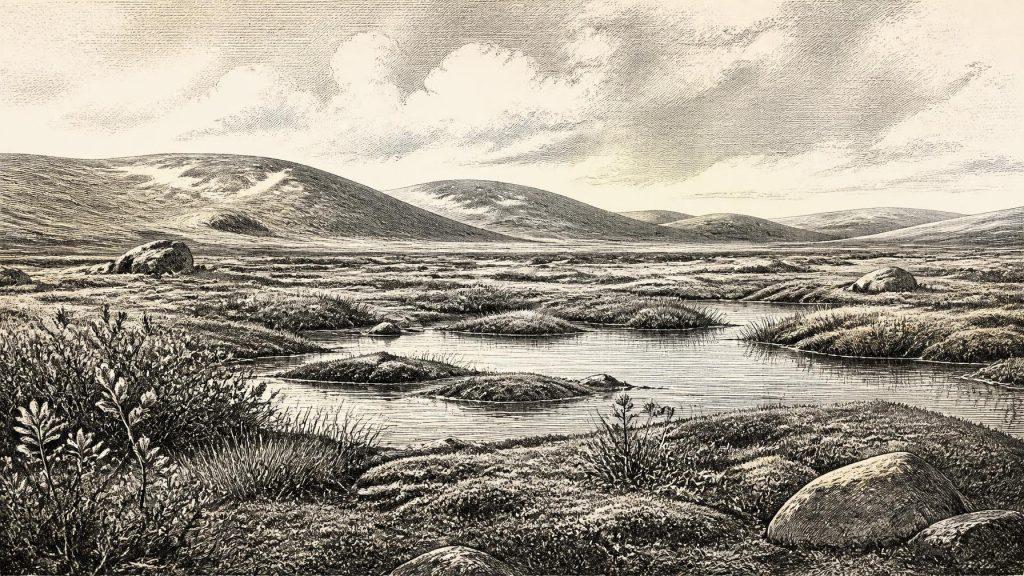
The Derryvree fossils replace the misleading image of a wholly blank, frozen Ireland with a more complicated landscape. Plant macrofossils, moss remains and insects indicate open tundra or muskeg-like ground around shallow or slow-moving fresh water. Sedges, grasses, mosses and hardy herbs grew in wet margins and on exposed ground. The assemblage includes plants associated with cold, damp settings, such as mountain-avens, dwarf willow, lesser clubmoss, bogbean and water-milfoil. Their presence is direct evidence for particular ecological niches; the wider picture of a patchwork of pools, saturated ground and sparse vegetation is an interpretation based on their combination.
There was little basis for closed woodland in the immediate Derryvree setting. Trees need not have been wholly absent from every sheltered Irish locality, but the local record points firmly towards treeless, frost-affected country. Summer growth, standing water and decaying plant matter made the wetland productive on a small scale, while prolonged winter cold, short growing seasons and unstable drainage imposed severe limits. This was no modern bog and no uniform Arctic plain. It was a shifting cold-climate mosaic whose particular form depended on relief, water supply, snow cover and proximity to ice.
Other records reinforce the conclusion that conditions varied considerably. At Crag Cave in County Kerry, uranium-thorium dating shows phases of speleothem growth during Marine Isotope Stage 3, including a phase close to 32,100 years ago. Stalagmite formation requires water to move through cave rock, so it is evidence against a simple model of unbroken deep permafrost in south-west Ireland. It does not prove that Kerry and Fermanagh shared the same weather, vegetation or ice margin. Rather, the sites together show why Ireland at this time must be understood regionally: local ice, ground moisture and temperature could differ greatly within a small island.
The Cork Cave Record
At Castlepook Cave, near Doneraile in north County Cork, a very different archive survives. Excavations undertaken in the early twentieth century recovered a large and mixed collection of Pleistocene animal bones, now associated principally with the National Museum of Ireland’s Natural History collections. The fauna includes reindeer, woolly mammoth, giant deer, brown bear, wolf and spotted hyaena. It demonstrates that a range of large mammals entered Ireland during the wider Middle Midlandian cold stage, when suitable habitats and routes existed. It does not demonstrate that all these animals lived together, or at Castlepook, in 30,373 BCE.
Caves are selective and troublesome witnesses. Carnivores can carry in prey or scavenged limbs; water can redistribute bone; frost, collapse and later digging can mix deposits. Castlepook was excavated before modern standards of stratigraphic recording, and later radiocarbon reassessment has shown why old determinations from Pleistocene bone require careful scrutiny. The cave is consequently best treated as evidence for a long sequence of animal presence and bone accumulation, not as a neatly preserved scene of one Ice Age day.
One Castlepook object nevertheless gives this distant period exceptional archaeological importance: a reindeer femur bearing a deep linear mark. Zooarchaeologist Ruth Carden has interpreted the mark as damage made by a sharp stone tool while fresh bone was being processed, and County Cork heritage material dates the bone broadly to about 31,000 BC. If the interpretation is upheld, it may be evidence that people butchered or otherwise processed a reindeer in Ireland during the Upper Palaeolithic. That would move possible human activity on the island far earlier than the long-established terminal-Pleistocene record.
The limitations are as significant as the possibility. A date on the bone measures when the reindeer died, not necessarily the exact instant at which a surface mark was made. A single modified bone does not reveal whether people killed the animal, encountered a carcass, worked elsewhere and discarded the limb, or stayed in Ireland beyond a brief visit. No securely associated hearth, stone-tool assemblage, shelter floor, burial, food store or repeated camp surface has yet established a resident human population here at this age. The femur is a serious clue, not proof of a settled Palaeolithic Ireland.
People, Politics and Everyday Survival
For that reason, the normal headings of political history have almost no evidential purchase. There are no named communities, chiefs, territories, alliances, diplomatic contacts or wars known from Ireland around this date. Nor is there evidence for religious monuments, formal ritual places, art, writing, schools or inherited institutions on the island. Silence on these subjects is not a gap to fill imaginatively: it is the correct historical result of the surviving record.
If people did reach Ireland, the Castlepook bone permits only a narrow inference about practical knowledge. Processing a large animal with a sharp stone edge would imply familiarity with cutting technology and with the useful parts of a carcass. Across Upper Palaeolithic north-west Europe, hunters used meat, fat, marrow, hide, sinew and bone; this provides a plausible comparative context, but not proof of an Irish economy or a local cultural identity. There is no evidence for farming, livestock, permanent villages, markets, long-distance trade or seafaring networks in Ireland at this point.
Mobility is more defensible than settlement as a general possibility. Lower global sea levels altered coastlines and exposed parts of the continental shelf, while glaciers, marine channels and changing ice margins complicated movement. It is unsafe to turn lower sea level into a claim for a dependable dry land bridge from Britain, or to assume that animals and people crossed by the same route. The Irish Sea basin was dynamically shaped by water, ice and isostatic change. Access to Ireland may have opened, narrowed and closed in ways that remain imperfectly resolved.
An Approaching Transformation
The larger development was environmental. The Last Glacial Maximum lay millennia ahead, conventionally dated to about 26,500–19,000 years BP, but ice-sheet growth was already becoming a decisive force in the wider region. Modern reconstructions differ over the timing, thickness and exact limits of the British-Irish Ice Sheet before its maximum. Yet the Derryvree sequence supplies a clear local lesson: a freshwater tundra landscape existed between two glacial episodes, and the later episode buried it. Ireland’s terrain, drainage, coastlines and habitats were being repeatedly remade.
Thus the strongest account of Ireland around 30,373 BCE is neither a story of an invented tribe nor an empty frozen wilderness. It is a cautiously reconstructed world of wet tundra in Fermanagh, Ice Age animals in Cork, flowing cave water in Kerry and expanding ice that would erase or conceal much of what came before. Derryvree’s mud and Castlepook’s bone are modest survivors, but together they illuminate a landscape capable of supporting life while remaining precarious, fragmented and almost beyond the reach of conventional history.
Primary Sources
- Middle Midlandian Freshwater Series at Derryvree, Maguiresbridge, County Fermanagh, Northern Ireland
- Middle Midlandian Freshwater Series at Derryvree, Maguiresbridge, County Fermanagh, Northern Ireland
- Exploring Controls of the Early and Stepped Deglaciation on the Western Margin of the British-Irish Ice Sheet
- Exploring Controls of the Early and Stepped Deglaciation on the Western Margin of the British-Irish Ice Sheet
- A Reconsideration of the Radiocarbon Dating of the Marine Isotope Stage 3 Fauna from Southern Ireland
- The Irish Quaternary Fauna Project
- Heritage Artefacts of County Cork
- 2022:564 – Castlepook Cave, Castlepook South, Cork
- Occurrence of Mammalia Relicts at Site Castlepook Cave
- Episodic Speleothem Deposition Tracks the Terrestrial Impact of Millennial-Scale Last Glacial Climate Variability in SW Ireland
- Spatio-Temporal Dynamics of Speleothem Growth and Glaciation in the British Isles
- The IntCal20 Northern Hemisphere Radiocarbon Age Calibration Curve (0–55 cal kBP)
- IntCal Publications
- A Stratigraphic Framework for Abrupt Climatic Changes During the Last Glacial Period Based on Three Synchronized Greenland Ice-Core Records: Refining and Extending the INTIMATE Event Stratigraphy
- The Timing and Magnitude of the British-Irish Ice Sheet Between Marine Isotope Stages 5d and 2
- The Deglaciation of the Western Sector of the Irish Ice Sheet from the Inner Continental Shelf to its Terrestrial Margin
- Timing and Pace of Ice-Sheet Withdrawal Across the Marine-Terrestrial Transition West of Ireland During the Last Glaciation
- Last Glacial Maximum Cirque Glaciation in Ireland and Implications for Reconstructions of the Irish Ice Sheet
- Trimlines, Blockfields and the Vertical Extent of the Last Ice Sheet in Southern Ireland
- Figure 6: The Subdivision of the Quaternary Period in Ireland
- Menyanthes trifoliata
- Dryas octopetala
- Freshwater Organic Deposits and Stratified Sediments Between Early and Late Midlandian (Devensian) Till Sheets, at Aghnadarragh, County Antrim, Northern Ireland
- New Insights on the Fauna of Ireland’s Younger Dryas and Early Holocene from Alice & Gwendoline Cave
- Geology of Ireland