BIRM-166 Under Ice31077 BCE
Labelled 31,077 BCE, this notional date cannot yield a conventional Irish history, because evidence consists of stratified deposits, fossils and calibrated ranges rather than records. At Derryvree, County Fermanagh, BIRM-166 dates organic freshwater sediments from an ice-free interval between tills, indicating cold, treeless wetland with mosses, sedges and northern insects. Castlepook Cave, County Cork, preserves MIS 3 fauna including reindeer, mammoth and predators, though mixed cave contexts prevent a single-date reconstruction. A marked reindeer femur may indicate human butchery, but proves neither settlement nor population. Environmental change dominated, as later ice-sheet expansion transformed Ireland’s physical landscapes, habitats and drainage systems.
Dateline
31,077 BCE is a modern calendar label, not a recoverable Irish year. No person in Ireland then used such a date; there are no texts, named communities or annual records. Archaeology cannot identify a political event, a birth, a battle or even a particular season for this point in deep time. In calendar terms it falls roughly 33,000 years before the conventional radiocarbon reference year of AD 1950, within the Late Pleistocene and Marine Isotope Stage 3 (MIS 3), a climatically unsettled phase of the last Ice Age.
The responsible history of Ireland at this date must therefore be told through deposits, fossils, stratigraphy and calibrated ranges. These sources illuminate environments and possibilities, not a diary of a single year. The most valuable Irish evidence close to this notional date is a buried wetland deposit at Derryvree, near Maguiresbridge in County Fermanagh, together with the older animal collections from Castlepook Cave near Doneraile, County Cork. Each is important; neither supplies the foundation for a conventional year-by-year narrative.
A Date Within a Range
Derryvree was exposed during roadworks in 1969, when a cut through a drumlin revealed a sequence of fine sands, freshwater silts and organic layers between two thick bodies of till. Till is the unsorted sediment deposited by glacier ice. The basic order of the sequence is clear: ice had occupied the locality; an interval followed in which water, vegetation and organic matter accumulated; then a later glacial advance buried the record beneath fresh till. That makes Derryvree an unusually eloquent witness to a changing Pleistocene landscape.
Organic material from the freshwater layers produced the radiocarbon determination BIRM-166: 30,500 radiocarbon years before present, with a substantial uncertainty of +1,170 and −1,030 years. Radiocarbon ages are not identical to calendar ages, especially at this depth in time. Using modern calibration, the determination has been discussed as broadly about 36,900–31,700 calibrated years before present, or approximately 34,950–29,750 BCE. The requested year lies within that broad span, but it cannot be placed in one particular layer or treated as the date on which a pool, plant or animal existed.
Indeed, the range is the point. BIRM-166 dates material within an accumulating deposit, while calibration itself is a statistical conversion based on changing atmospheric radiocarbon. The current IntCal20 curve extends to 55,000 calibrated years before present, but it does not turn a Late Pleistocene sample into annual history. Derryvree may responsibly illuminate Ireland around 31,077 BCE; it cannot certify the conditions of the whole island in that numbered year.
Freshwater Between Glaciers
The Derryvree evidence indicates that this part of Fermanagh was locally free of glacier ice during the period represented by the organic beds. It does not prove that every coast, upland or valley in Ireland was ice-free simultaneously. Ireland’s climate and ice cover were regionally variable, and the subsequent expansion of the Irish Ice Sheet destroyed, disturbed or sealed much of the older evidence. The surviving record is therefore both precious and geographically limited.
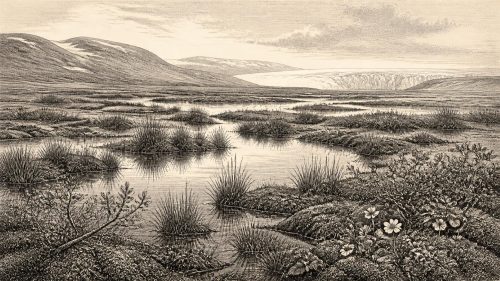
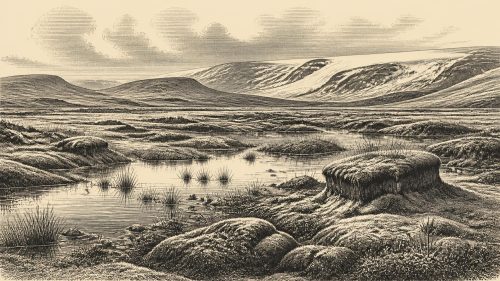
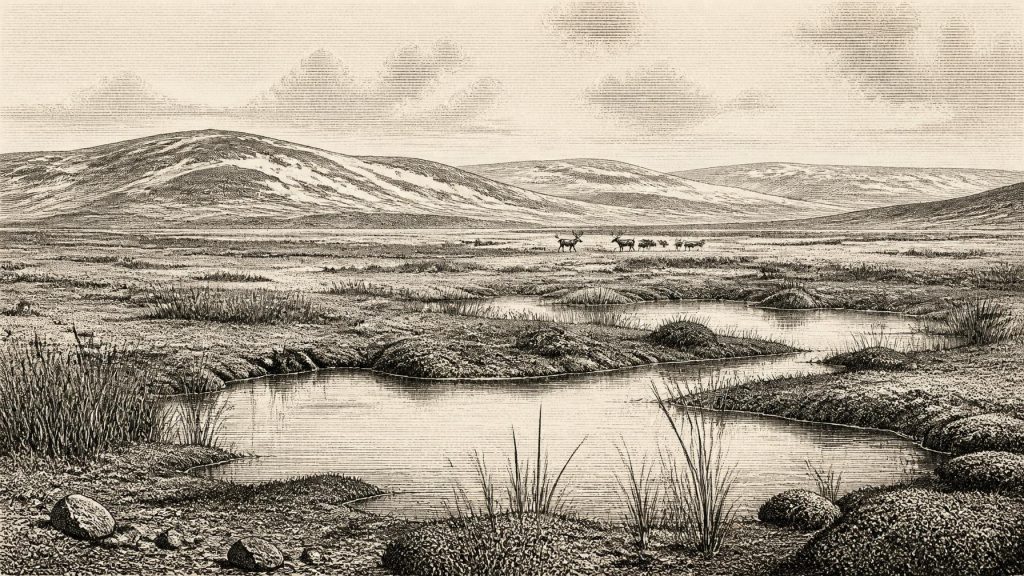
What did survive at Derryvree was the signature of cold, open ground with standing or sluggish freshwater. The deposit contained freshwater mosses and sedges, together with insects of northern, cold-climate aspect. These remains support an image of wet, treeless terrain: pools and saturated margins, low vegetation, seasonally productive patches and severe winters. This was not the wooded island familiar from later prehistory or the modern period. It was a periglacial landscape, strongly shaped by frost and cold, though not permanently entombed beneath ice at that locality.
Such country need not have been biologically empty. Sedge beds, mosses, shallow water and short-lived summer growth could sustain small but real food webs. Yet Derryvree should not be enlarged into an imagined national park. Its sediments record a particular basin near Maguiresbridge. Sheltered hollows, limestone country, exposed uplands and coastal margins may all have offered different conditions. The evidence demonstrates local freshwater and cold-adapted vegetation; wider reconstructions are informed interpretation, not direct observation.
Cork’s Cave Fauna
Castlepook Cave, also known as Mammoth Cave, in north County Cork provides the principal animal archive relevant to this broad interval. Antiquarian excavations there recovered a remarkable but difficult collection from cave passages: bones of reindeer, woolly mammoth, giant deer, brown bear, wolf, Arctic fox, hare and spotted hyaena are among the animals identified from Castlepook and related southern Irish cave records. Their presence shows that, during parts of MIS 3, Ireland supported or was visited by a varied cold-stage fauna.
Cave collections require careful handling. Bones can enter caves after natural death, carnivore activity, flooding or sediment movement. Castlepook was extensively excavated in the early twentieth century, before modern standards of recording, and its faunal material derives from more than one episode. Direct re-dating has shown that some older Irish cave radiocarbon determinations were significantly too young, while the revised results place part of the Castlepook fauna much earlier, within MIS 3. A mammoth or reindeer bone is thus strong evidence that such animals occurred in Ireland during a broad interval; it is not proof that they all grazed together in one valley in 31,077 BCE.
The animal record nevertheless has important environmental implications. Reindeer are well suited to open, cold landscapes; mammoth and hyaena, in their different ways, belong to ecological settings very unlike later forested Ireland. Their occurrence supports the conclusion from Derryvree that substantial areas could have been open rather than densely wooded. Predators and scavengers also remind us that caves were not neutral containers: they were places used by animals, altered by water and later investigated by people separated from the original deposits by tens of millennia.
The Human Question
A reindeer femur from Castlepook has attracted particular attention because it bears a deep mark interpreted as consistent with cutting or chopping by a stone tool during butchery. County Cork heritage publications describe it as Palaeolithic material of about 31,000 BC, and the find has been presented as potentially extending evidence of human activity in Ireland far beyond the long-accepted post-glacial record.
This claim is important but remains limited. If the mark was made by people, it indicates a human action upon an animal: perhaps the processing of meat, hide, marrow or another useful resource. It does not demonstrate a resident population, a settlement, a hearth, a tool-making site, a burial, a repeated hunting ground or a route of arrival. No securely associated lithic assemblage or intact occupation surface establishes an Upper Palaeolithic camp at Castlepook. The bone’s cave context and the history of early excavation make the strongest claims difficult to test.
The fairest conclusion is neither dismissal nor certainty. Ireland may have been visited by people during MIS 3, and the marked femur is a serious reason to investigate that possibility further. But at 31,077 BCE there is no secure basis for describing Irish families, languages, ethnic groups, religious rites or seasonal migration patterns. The first firmly documented human presence in Ireland still belongs much later, after the great ice had retreated, although research at Castlepook may yet refine the deeper story.
No Politics, But Profound Change
Political affairs, diplomacy and warfare leave no identifiable trace for Ireland at this date. There were no known states, chiefs, monuments, treaty sites or named territories. Even if small human groups crossed or reached the island, the evidence cannot tell us how they organised authority, settled disputes or related to communities elsewhere. It would be misleading to fill this silence with models borrowed from better-known Upper Palaeolithic societies in continental Europe.
The great historical development was environmental rather than political: the approach of major glaciation. Derryvree’s upper till records the return or expansion of ice after the freshwater interval. More broadly, evidence from Ireland and its surrounding seas indicates that the last Irish Ice Sheet expanded after these MIS 3 ice-free intervals, reaching much greater extent during the Last Glacial Maximum, broadly between about 26,500 and 19,000 years ago. At 31,077 BCE this maximum still lay ahead, but the conditions that would transform Ireland’s terrain, drainage and habitats were gathering force.
Lower global sea levels altered coastlines and the geography of the surrounding shelf, but they do not by themselves establish a dry, usable land bridge or a known route into Ireland at this time. Any human visitor would have faced a changing Atlantic-edge world in which water crossings, exposed shelf lands, ice margins and animal movements varied over long timescales. The archaeological evidence is insufficient to reconstruct a journey with confidence.
What Can Be Said
Everyday life, economy, trade, religion and learning cannot be directly recovered for Ireland in this year. There is no evidence for farming, metalworking, exchange networks, shrines, art or formal institutions. If people were present, their likely subsistence would have depended on immediate knowledge of animals, weather, fuel, shelter and stone, but that is an inference from hunter-gatherer life elsewhere, not a demonstrated Irish fact.
What can be said with confidence is more modest and more remarkable. Around this point in the Late Pleistocene, a freshwater wetland existed during an ice-free interval at Derryvree in Fermanagh. Cold-adapted plants and insects inhabited its margins. Across the island, or at least during overlapping phases of MIS 3, cave deposits preserve evidence of large mammals and carnivores in landscapes later radically altered by ice. One marked reindeer bone from Cork raises, but does not settle, the question of an earlier human visit. BIRM-166 is therefore not a record of a lost Irish year. It is a surviving fragment of a much longer environmental story, sealed between glaciers and still capable of changing what Ireland’s earliest past may mean.
Primary Sources
- A Middle Midlandian Freshwater Series at Derryvree, Maguiresbridge, County Fermanagh, Northern Ireland
- Early Midlandian–Middle Midlandian, Pleistocene, Northern Ireland
- Middle Midlandian Interstadial Deposits at Greenagho, Near Belcoo, County Fermanagh, Northern Ireland
- Irish Pleistocene Biostratigraphy
- Exploring Controls of the Early and Stepped Deglaciation on the Western Margin of the British Irish Ice Sheet
- A Reconsideration of the Radiocarbon Dating of the Marine Isotope Stage 3 Fauna from Southern Ireland
- New Insights on the Fauna of Ireland's Younger Dryas and Early Holocene from Alice & Gwendoline Cave
- 2022:564 – Castlepook Cave, Castlepook South, Cork
- Archaeological Heritage of County Cork
- Heritage Artefacts of County Cork
- Ireland's Palaeolithic Archaeology – Fleeting Footprints in a Frozen Land
- The Last Irish Ice Sheet: Extent and Chronology
- Dimensions and Chronology of the Last Ice Sheet in Western Ireland
- Late Pleistocene Chronostratigraphy and Ice Sheet Limits, Southern Ireland
- Last Glacial Maximum Cirque Glaciation in Ireland and Implications for Reconstructions of the Irish Ice Sheet
- Oscillating Retreat of the Last British-Irish Ice Sheet on the Continental Shelf Offshore Galway Bay, Western Ireland
- Stratigraphic and Palaeo-Geomorphological Evidence for the Glacial-Deglacial History of the Last British-Irish Ice Sheet in the North-Western Irish Sea
- Advance and Retreat of the Marine-Terminating Irish Sea Ice Stream into the Celtic Sea During the Last Glacial: Timing and Maximum Extent
- The IntCal20 Northern Hemisphere Radiocarbon Age Calibration Curve (0–55 cal kBP)
- IntCal Data
- Figure 6—The Subdivision of the Quaternary Period in Ireland
- References and Recommended Reading
- Pleistocene, Northern Ireland
- Conserving Quaternary Geoheritage in Northern Ireland