
Awbeg’s Cold Steppe31065 BCE
Around 31,065 BCE, Ireland experienced unstable Late Pleistocene conditions before full expansion of the last Irish Ice Sheet. Derryvree sediments in Fermanagh indicate treeless, waterlogged tundra vegetation, while lower sea levels enlarged the landmass but left migration routes uncertain. Castlepook Cave in County Cork preserves remains of reindeer, mammoth, giant deer, lemmings, wolves, bears, foxes and hyaenas, demonstrating diverse cold-steppe food webs. A possibly cut-marked reindeer bone may indicate brief Upper Palaeolithic human activity, but cannot prove settlement. No evidence supports societies, politics, ritual or trade. Subsequent ice advance destroyed or buried much earlier evidence, leaving a limited environmental record.
Dateline
“31,065 BCE” is a modern chronological convenience, not a date that anyone then living in Ireland could have recognised, and the evidence cannot resolve events to a single calendar year. In calibrated terms, it corresponds approximately to 33,000 years before present. Ireland at this point belongs to Marine Isotope Stage 3, a long, climatically unstable part of the Late Pleistocene preceding the fullest expansion of the last Irish Ice Sheet. The responsible historical question is therefore not what happened in a particular year, but what the surviving sediments, animal remains and landforms allow us to say about Ireland in the broad interval around it.
Before the Last Ice Sheet
At about 33,000 calibrated years ago, Ireland was approaching a decisive environmental transformation. The island was not yet buried beneath the ice that would later shape much of its modern surface. Research on glacial chronology indicates that substantial areas remained ice-free until roughly 34,000 years ago, while the maximum extent of the last Irish Ice Sheet belongs later, broadly to about 27,000–23,000 calibrated years before present. This was not a settled, stable prelude. Climate in the North Atlantic changed sharply and repeatedly; ice expanded and retreated across the wider region, while the precise timing and local extent of ice in Ireland remain matters of active reconstruction.
A key Irish record comes from Derryvree in County Fermanagh. There, organic, moss-rich mud lay between separate glacial deposits. A conventional radiocarbon determination of 30,500 ± 1,100 radiocarbon years before present has been calibrated to a broad range of roughly 36,900–31,700 calendar years before present. That range overlaps the modern label 31,065 BCE, but it does not date a moment, a settlement or the whole island. It shows that, before renewed ice covered the deposit, waterlogged ground and vegetation existed in this part of northern Ireland during a cold phase of the last glaciation.
Wet Ground and Open Country
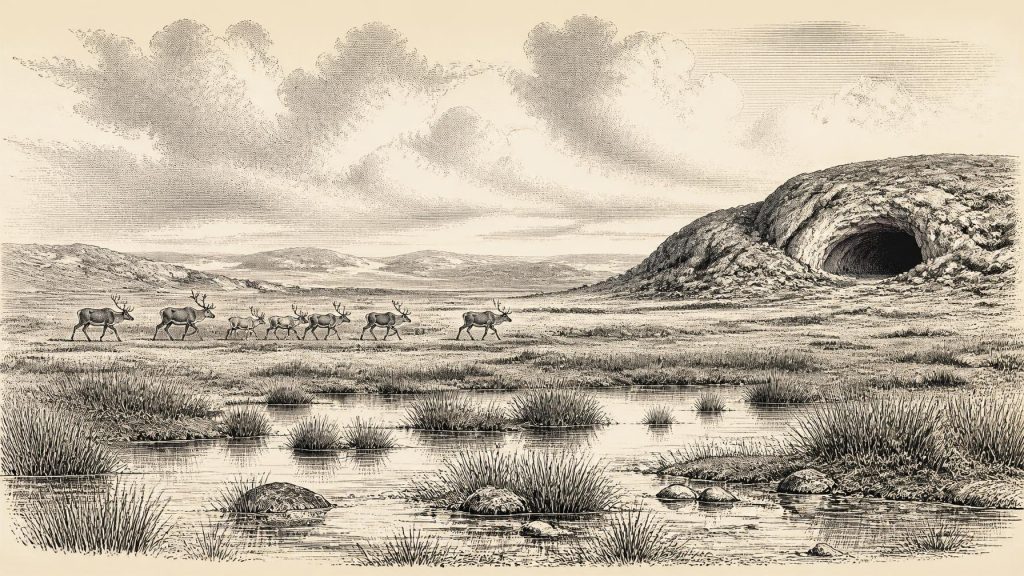
The Derryvree sediments preserve plant remains rather than a picturesque landscape. Their value lies precisely in that modesty. They point to a treeless muskeg or wet tundra environment: sedges, mosses and cold-adapted plants around shallow water and saturated ground, rather than forest. Such evidence should not be converted into a uniform national weather report. Local wetland conditions in Fermanagh cannot tell us exactly what a valley in Cork, the western uplands or an exposed eastern coast looked like on the same day. They do, however, fit a wider picture of an open, cold, largely treeless Ireland, with sheltered wet places amid extensive periglacial terrain.
Sea level was much lower than it is today because large quantities of water were held in northern ice sheets. Ireland’s coastline consequently stood farther offshore, and the land available to plants and animals was larger than the present island. Yet lower sea level did not automatically mean a dependable land bridge to Britain or continental Europe. The changing Irish Sea basin, ice margins and coastlines make routes of movement difficult to reconstruct. Animals certainly reached Ireland during the Pleistocene, but the mechanism, timing and frequency of particular migrations cannot simply be read back from a modern map.
Castlepook’s Animal World
The richest glimpse of southern Ireland near this broad horizon comes from Castlepook Cave, also known as Mammoth Cave, near Doneraile in north County Cork, close to the Awbeg and Blackwater river systems. Excavations undertaken between 1904 and 1913 recovered a remarkable mixture of bones from cave deposits. Later study and redating have made the site central to discussion of Ireland’s pre-Last Glacial Maximum fauna, while also stressing a major limitation: the deposits were disturbed, accumulated over a long time and do not provide a single neatly sealed occupation surface.
Even so, the securely identified animal spectrum is striking. It includes reindeer, woolly mammoth, giant deer, wolf, red fox, Arctic fox, brown bear, spotted hyaena and lemmings. This was an ecosystem unlike that of historic Ireland. Reindeer and lemmings indicate cold, open habitats; mammoth and giant deer imply substantial grazing country; wolves and hyaenas reveal a formidable predator and scavenger guild. A cave may have been a den, a trap, a refuge, a place into which water and sediment moved bone, or a combination of all these. Its assemblage therefore records animals using a landscape, not a census of creatures living simultaneously beside the entrance.
The more secure interpretation is nevertheless important: Ireland supported a diverse Pleistocene fauna during parts of Marine Isotope Stage 3. It was not an empty icebound land at all times before the Last Glacial Maximum. Food webs extended from tundra plants and grazing herbivores to large carnivores. Seasonal movement is plausible for some animals, especially reindeer, but the cave evidence does not reveal exact migration routes, herd sizes or seasons of use. Nor can it establish which species were present in every Irish region at about 33,000 years ago.
The Human Question
Castlepook has also generated the most provocative claim for this period: a reindeer femur carries a deep mark interpreted by zooarchaeologist Ruth Carden as consistent with cutting by a sharp stone tool during carcass processing. Public presentation of the object has associated it with roughly 33,000 years ago. If the mark was made by people on fresh bone and belongs with the animal’s date, it may represent an exceptionally early indication of human activity in Ireland. It would suggest a brief visit or episode of butchery by Upper Palaeolithic hunter-gatherers long before the better evidenced post-glacial human presence.
But that conditional language matters. A dated animal bone does not by itself date the making of a surface mark; identifying a cut mark requires taphonomic judgement; and an isolated modified bone is not a settlement. Castlepook has not yielded a securely stratified contemporary hearth, stone-tool assemblage, dwelling, burial or repeated occupation surface. Nor does it show whether people hunted the reindeer, found a carcass, removed meat or sinew, or merely passed through the area. The evidence permits the possibility of human presence, not a confident narrative of a resident population.
No Kingdoms, No Recorded Communities
For this reason, political history cannot responsibly be written for Ireland in 31,065 BCE. There is no evidence for kingdoms, territories, chiefs, diplomacy, warfare between human groups, law or named communities. There are no inscriptions, monuments, houses or material assemblages from which to reconstruct an Irish society. Even the term “Ireland” is geographical shorthand: it refers to the landmass in the position of the modern island, not to a people, state or cultural identity that existed then.
The same restraint applies to everyday life. If small groups of people reached the island, their survival would have depended on mobility, close knowledge of animal behaviour, protection from cold and wet, fire, clothing and reliable stone technology. Those are reasonable inferences from Upper Palaeolithic lifeways elsewhere in north-west Europe, not observations from an excavated Irish camp. We cannot identify their language, kinship arrangements, seasonal round, food-sharing customs or relations with groups across the sea. The Castlepook bone, if anthropogenic, offers a trace of action rather than a biography of its maker.
Culture Beyond Recovery
There is likewise no direct Irish evidence from this date for ritual, formal religion, art, music, teaching or trade. Caves can acquire symbolic importance in later societies, but Castlepook’s Pleistocene bone deposits do not demonstrate ceremony. Reindeer antler, hide, meat, marrow and sinew were valuable materials for hunter-gatherers elsewhere, yet no Irish evidence identifies their use here. Trade is even less visible: no imported stone tools, ornaments or exchange goods can be assigned securely to this horizon.
What can be said is that the landscape itself imposed a common ecological framework. Open ground favoured grazing animals; wetlands supported specialised plants; caves created focal points for carnivores and accumulated remains that later researchers could study. Repeated climatic deterioration was the larger historical force. Over the following millennia the last Irish Ice Sheet expanded, eroding, burying and rearranging much of the earlier landscape. That process helps explain why the pre-maximum archaeological record is so slight: possible camps, surfaces and artefact scatters were vulnerable both to ice and to subsequent coastal change.
A Narrow Window
Ireland around 31,065 BCE is therefore best understood as a narrow evidential window between earlier and later ice advances. Derryvree preserves a northern wetland interval; Castlepook preserves a southern cave fauna of cold-country herbivores and predators; glacial research establishes that the island’s complete ice cover lay ahead, not yet fully realised. The possible cut-marked reindeer femur adds a compelling human question, but not a settled answer. At this depth of time, the most meaningful history is one of environments, animals and geological change, with the prospect—still unproven in full—of fleeting human presence at Europe’s Atlantic edge.
Primary Sources
- A Reconsideration of the Radiocarbon Dating of the Marine Isotope Stage 3 Fauna from Southern Ireland
- Trimlines, Blockfields and the Vertical Extent of the Last Ice Sheet in Southern Ireland
- Response of the Irish Ice Sheet to Abrupt Climate Change During the Last Deglaciation
- Growth and Retreat of the Last British–Irish Ice Sheet, 31,000 to 15,000 Years Ago: the BRITICE-CHRONO Reconstruction
- The Last Irish Ice Sheet: Extent and Chronology
- Ireland: Submerged Prehistoric Sites and Landscapes
- Occurrence of Mammalia Relicts at Site Castlepook Cave
- The Exploration of Castlepook Cave, County Cork
- Pleistocene Vertebrates in the British Isles
- Regional Pleistocene Geology
- South Fermanagh, Northern Ireland
- Late Quaternary Stratigraphy and Glacial History of Southern Ireland
- The Irish Quaternary Fauna Project
- Heritage Artefacts of County Cork
- Castlepook Excavation Report, 2022
- Archaeological Excavations at Killuragh Cave, Co. Limerick: A Persistent Place in the Landscape from the Early Mesolithic to the Late Bronze Age
- The Mesolithic in Ireland: When Was It?
- What Is the Quaternary?
- Outreach and Education Resources
- Anthropogenic Changes to the Holocene Nitrogen Cycle in Ireland
- New Data for the Last Glacial Maximum in Great Britain and Ireland
- First Evidence of a Late Upper Palaeolithic Human Presence in Ireland
- Pattern and Timing of Retreat of the Last British-Irish Ice Sheet
- Quaternary Science Reviews 339 (2024) 108827