BIRM-166 Beneath Maguiresbridge30349 BCE
30,349 BCE is a label rather than a datable Irish year, representing a Late Pleistocene interval within Marine Isotope Stage 3. At Derryvree, County Fermanagh, organic sediments between glacial tills, dated BIRM-166 to about 30,500 radiocarbon years BP, preserve a cold, open freshwater wetland with tundra vegetation. Castlepook Cave, County Cork, records diverse cold-stage fauna, including mammoth, reindeer, hyaena and Arctic fox, accumulated across extended periods. A potentially cut-marked reindeer femur suggests human carcass processing around 33,000 years ago, but cannot demonstrate sustained occupation. Together, these fragmentary archives show fluctuating ice-age environments, regional ecological diversity and limits on historical reconstruction.

Dateline
30,349 BCE is a modern chronological label, not a recoverable year in Ireland’s past. No Irish annal, settlement sequence or dated human action can be assigned to it. At this depth of time, the responsible unit is a broad archaeological and environmental interval: the later part of the Late Pleistocene, within Marine Isotope Stage 3, during the last Ice Age. Radiocarbon determinations require calibration against changing atmospheric carbon levels and produce probability ranges rather than calendar-year certainties. The evidence most relevant to this nominal date therefore illuminates an Ireland of roughly the mid-30,000s to low-30,000s calibrated years before present, not a precise day, season or generation.
A Date Beyond Annals
The calendar equivalent of 30,349 BCE lies about 32,300 years before AD 1950, the conventional reference point for radiocarbon dating. That is broadly near, but not identical with, the ages represented by Ireland’s best-known records for this stage of the Ice Age. The essential distinction is between a modern date written in BCE and a laboratory measurement expressed in radiocarbon years BP. Calibration can shift a radiocarbon age by several thousand calendar years and may yield more than one possible interval. It would be misleading to claim that any Irish deposit records conditions in this particular year.
The most important local environmental archive is at Derryvree, near Maguiresbridge in County Fermanagh. Roadworks in 1969 exposed organic silts and fine sands between two separate sheets of glacial till within a drumlin. The freshwater sediments produced the determination BIRM-166: 30,500 radiocarbon years BP, with an uncertainty of +1,170 and −1,030 years. The deposit is consequently close enough to frame the period, but it is not an annual record and cannot simply be translated as “30,500 BCE”. Its value lies in showing that, during one cold interval between glacial advances, part of northern Ireland contained a functioning freshwater wetland.
Water Beneath the Drumlin
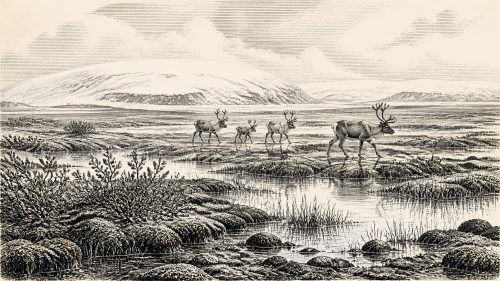
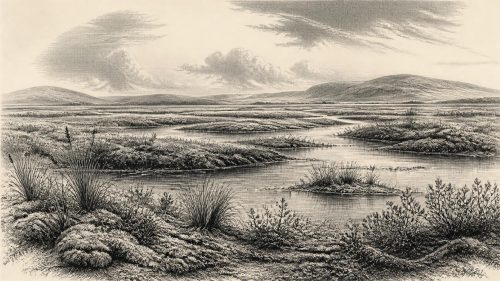
Derryvree is unusually revealing because its fossil content survived between later glacial deposits. Plant remains, pollen, mosses and insect evidence describe an open, treeless setting rather than modern Ireland’s damp Atlantic woodland. Grasses, sedges, juniper and cold-adapted herbs occurred around wet ground. Fossils of dwarf willow, mountain avens, lesser clubmoss and bogbean point to an Arctic-alpine or tundra-like vegetation mosaic. Water-milfoil and other aquatic evidence show that shallow fresh water was present too. This was not a featureless snow desert: it was a landscape of mossy margins, pools, saturated sediment and seasonally productive vegetation.
Yet “tundra” should not make the scene seem stable. The periglacial climate inferred at Derryvree meant severe winters, repeated freezing and thawing, short growing seasons and vulnerable soils. Ground ice and frost action probably shaped the surface, while meltwater and changing drainage repeatedly altered pools and channels. Vegetation may have responded quickly to swings in temperature and moisture. The evidence supports a cold, open wetland in Fermanagh; it does not allow a single nationwide weather report for 30,349 BCE. Ireland’s terrain was regionally varied, and the advances and retreats of ice changed which land was habitable for plants and animals.
The layers above and below the organic deposit are equally important. They demonstrate that the wetland existed between phases of glaciation. In other words, the Derryvree sediments are a surviving interlude, preserved only because later ice buried them. Ireland around this broad period was not on a simple path from ice to warmth. The British–Irish Ice Sheet was dynamic, and the exact timing, scale and geography of ice before the Last Glacial Maximum remain subjects of active research. The maximum expansion came later, broadly between about 26,000 and 20,000 years ago, and would erase or conceal much earlier evidence.
Cork’s Cave Fauna
At the other end of the island, Castlepook Cave near Doneraile in north County Cork provides the principal animal archive. Also known as Mammoth Cave, it produced a remarkable collection of Late Pleistocene bones from caves with names such as Hyena Hall and Elephant Hall. The fauna includes woolly mammoth, reindeer, giant deer, brown bear, wolf, Arctic fox, mountain hare, lemmings and spotted hyaena. It shows that Ireland was, at least at intervals, ecologically connected to wider north-west European cold-stage environments. Herbivores found forage in open country, while large predators and scavengers belonged to a substantial food web.
That list must not be turned into a census for a single year. Cave deposits accumulated over long periods, and their contents could be moved by carnivores, water, collapse, excavation and later disturbance. Improved radiocarbon pretreatment has also revised the chronology of several Irish cave bones, in some instances making them thousands of years older than earlier measurements suggested. Castlepook therefore establishes a changing sequence of Ice Age fauna in southern Ireland, not a guarantee that every recorded species stood together on the Doneraile landscape in 30,349 BCE.
Still, the assemblage helps explain the character of the country. Reindeer and mammoth are consistent with extensive open vegetation, though their precise local habitat requirements should not be reduced to a single modern analogue. Hyaena and wolf indicate predation and scavenging; lemmings and Arctic fox are particularly strong signals of cold conditions. Animal movement would have followed forage, shelter, snow cover, water and season. The exposed landmass and changing coastlines of the Ice Age also meant that Ireland’s relation to Britain and continental Europe differed greatly from the present island geography. Connections for animal populations were intermittent and conditioned by sea level, ice margins and terrain, not by modern coastlines.
The Reindeer Bone Question
The most consequential possible human trace for this era is a reindeer femur from Castlepook. Zooarchaeologist Ruth Carden identified a deep mark on the bone as consistent with damage made by a sharp stone tool while the carcass was fresh. Public interpretation has associated the bone with activity roughly 33,000 years ago. If that reading is upheld, it would push evidence for human activity in Ireland far earlier than the previously secure terminal-Pleistocene evidence from County Clare.
Its importance demands restraint. The direct evidence is an ancient reindeer bone bearing a modified surface. The interpretation is that a person made the mark while processing the animal. Even if correct, it would demonstrate an episode of butchery or carcass processing, not a permanent population, a cave dwelling or a settled hunting community. No securely associated stone-tool assemblage, hearth, occupation floor, human burial, house, art panel or repeated camp sequence of comparable age has been published from Castlepook. Nor can the cave prove that the animal was killed there: carcass remains may have been carried into the cave by carnivores or moved after disposal.
Accordingly, political history cannot responsibly be written for Ireland at this date. There is no evidence for rulers, territories, warfare, diplomacy, formal trade networks or institutions. Nor is there evidence capable of identifying religion, language, kin groups, ritual practice or artistic traditions. Silence does not mean that people, if present, lacked social bonds, practical knowledge or beliefs; it means the Irish record has not preserved material from which those matters can be demonstrated. The same caution applies to “economy”. Reindeer meat, hide, sinew, bone and antler would have been valuable resources to mobile hunter-gatherers elsewhere in Europe, but their use in Ireland at this time remains an informed possibility rather than a documented Irish system.
What Everyday Life Can—and Cannot—Show
If people reached Ireland during this broad interval, they would have operated in a demanding seasonal world. Successful movement through cold open terrain required detailed knowledge of animals, safe water, shelter, weather, stone and routes across changing land. This is a comparative inference from Upper Palaeolithic hunter-gatherer life elsewhere, not direct evidence of an Irish camp. The reindeer femur does not tell us how many people were involved, where they came from, whether they returned, or whether their presence endured beyond a single encounter.
For most living things, however, the evidence is clearer. Fermanagh’s buried wetland confirms that ice-age Ireland could support aquatic plants, mosses, sedges, insects and other organisms even in harsh conditions. Castlepook confirms that large mammals and predators occurred on the island across the wider Late Pleistocene. Together, these records reveal regional contrast: freshwater tundra in the north and a limestone cave archive in Cork, both subsequently altered by ice and time. They also reveal why the archaeological record is so thin. Later glaciation scoured landscapes, rising seas drowned former lowlands and early cave excavations did not always retain the stratigraphic detail now expected.
An Environmental Turning Point
The principal development illuminated around 30,349 BCE is environmental rather than political: Ireland lay within a fluctuating Ice Age world, capable at times of sustaining open wetland ecosystems and rich cold-stage faunas, but vulnerable to renewed glaciation. The Derryvree deposit documents a precious interval of water and vegetation between ice advances. Castlepook records the longer, more complicated history of animal communities moving through southern Ireland. The possible cut-marked reindeer bone raises the prospect of a very early human visit, while leaving major questions unresolved.
This is therefore not a year of named events. It is a carefully bounded reconstruction based on silts, seeds, pollen, insects, bones, cave deposits and scientific dating. The strongest conclusion is also the most evocative: beneath a Fermanagh drumlin, freshwater sediments preserve evidence of a cold but living landscape, while a Cork cave retains fragments of the animals that crossed it. Any human story at this date remains provisional—important precisely because the evidence is so slight, and because future reanalysis may yet change it.
Primary Sources
- Middle Midlandian Freshwater Series at Derryvree, Maguiresbridge, County Fermanagh, Northern Ireland
- A Reconsideration of the Radiocarbon Dating of the Marine Isotope Stage 3 Fauna from Southern Ireland
- New Insights on the Fauna of Ireland’s Younger Dryas
- The Irish Quaternary Fauna Project
- Irish Pleistocene Biostratigraphy
- The Timing and Magnitude of the British–Irish Ice Sheet Between Marine Isotope Stages 5d and 2
- Late Pleistocene Chronostratigraphy and Ice Sheet Limits, Southern Ireland
- Last Glacial Maximum Cirque Glaciation in Ireland and Implications for Reconstructions of the Irish Ice Sheet
- Trimlines, Blockfields and the Vertical Extent of the Last Ice Sheet in Southern Ireland
- Quaternary Glaciations of Northern Europe
- Figure 6.— The Subdivision of the Quaternary Period in Ireland
- Castlepook Cave, County Geological Site Report
- Mammoth Cave
- Menyanthes trifoliata
- Salix herbacea
- Dryas octopetala
- Selaginella selaginoides
- Myriophyllum alterniflorum
- The IntCal20 Northern Hemisphere Radiocarbon Age Calibration Curve (0–55 cal kBP)
- The IntCal20 Approach to Radiocarbon Calibration Curve Construction
- Heritage Artefacts of County Cork
- The Mesolithic in Ireland: When Was It?
- Deposits of the Last Glaciation
- Reindeer Bone Found in Cork Cave Shows Human Activity in Ireland 33,000 Years Ago