Maguirebridge’s Frozen Fen30516 BCE
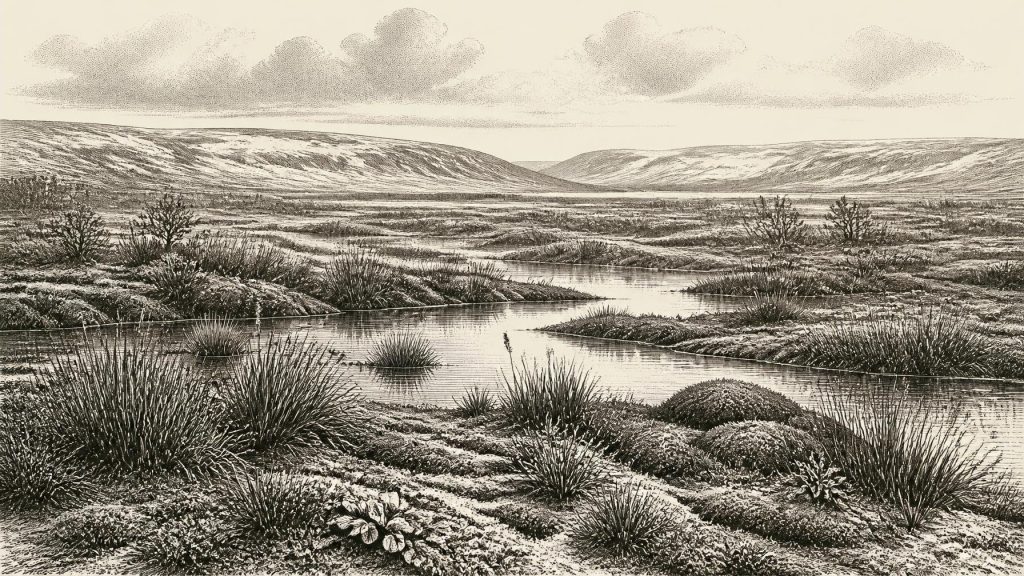
Thirty thousand five hundred and sixteen BCE is a filing label rather than a precise Irish date. At Derryvree near Maguiresbridge, Fermanagh, freshwater silts between glacial tills, radiocarbon dated broadly to the mid-30,000s cal BP, record an ice-free interval before later glaciation. Mosses, plant remains and sediments indicate a cold, open, tundra-like wetland with shallow water, sedges and sparse vegetation. Castlepook Cave in Cork preserves mammoth, giant deer, reindeer, predators and other cold-adapted fauna, demonstrating links with wider north-west Europe. A marked reindeer bone may indicate human processing, but proves neither settlement nor population. Evidence supports dynamic Late Pleistocene environments.
Dateline
Modern calendar-year precision is not available for Ireland at this depth of time. “30,516 BCE” is a useful filing label, not a date on which a recorded Irish event can be placed. Numerically, it is about 32,465 calendar years before AD 1950, the reference point used for “cal BP” dating, but no excavation or environmental sequence can distinguish that single year from the centuries around it. The responsible subject is therefore Ireland in the Late Pleistocene, broadly Marine Isotope Stage 3, before the Last Glacial Maximum.
The closest illuminating evidence is not a settlement, ruler or battle but a buried wetland at Derryvree, near Maguiresbridge in County Fermanagh. In 1969, a road cutting exposed freshwater silts and fine sands between two thick layers of till, the unsorted debris deposited by glacier ice. The sequence showed a local order of events: ice had occupied the ground; an interval followed in which water, plants and sediment accumulated; and later ice covered and preserved the deposit. That rare survival makes Derryvree one of the most important Irish windows onto the world in and around this remote period.
A Date Beyond Annals
Organic material from the Derryvree deposits produced the radiocarbon determination BIRM-166: 30,500 radiocarbon years BP, with a large quoted uncertainty of +1,170/−1,030 years. It is a conventional radiocarbon age, not a calendar date and not proof that the pool existed in one particular numbered year. Calibration with modern Northern Hemisphere curves places a result of this antiquity broadly in the mid-30,000s cal BP, but its uncertainty and the character of the original organic sample require broad ranges rather than false precision. It nonetheless provides strong evidence that this part of Fermanagh was ice-free long enough for a freshwater basin and its vegetation to develop before a later glacial advance.
This matters because the phrase “Ice Age Ireland” can wrongly suggest an island eternally sealed beneath one unchanging white cover. Ireland’s last glacial cycle was dynamic. Ice sheets grew, retreated or altered their margins; temperatures and precipitation shifted; and exposed ground, pools and animal habitats appeared in some regions at some times. Derryvree is local evidence, not a map of the whole island. It cannot tell us that every coast, valley and upland was open at once. Yet it demonstrates that a cold, living landscape existed in at least one northern locality during the broad period to which this article belongs.
Water, Moss and Open Ground
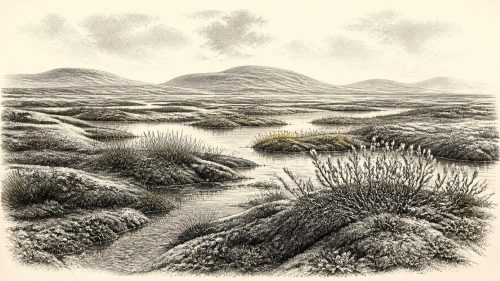
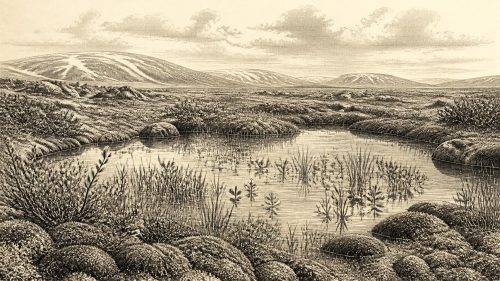
The Derryvree flora and fauna indicate a periglacial environment: ground strongly affected by severe seasonal freezing, frost action and short growing seasons, near the fluctuating margins of larger ice masses. The vegetation was open and treeless or nearly so. Herb pollen was poorly preserved, but plant macrofossils and mosses are more revealing. Grasses and sedges, herbs, juniper and cold-tolerant plants were represented. Finds associated with wet, cold ground include bogbean (Menyanthes trifoliata), while other elements of the assemblage support shallow freshwater, wet margins and sparse tundra-like cover rather than woodland.
A useful image is not an empty polar desert, nor the familiar wooded Ireland of later millennia. It is a low basin holding cold freshwater and seasonally waterlogged ground: mossy surfaces, sedgy edges, patches of low herbs and exposed mineral soil beyond them. Such a place would have altered markedly through the year. Summer growth may have been brief but biologically significant; winter freeze and snow cover would have reshaped drainage and soils. The fine sediments preserve the outcome of those processes, not a direct view of a single day’s weather.
The Derryvree evidence also warns against reading every pollen grain literally. Some pollen can travel far, be redeposited from older material or survive unevenly; a few grains from trees do not establish a nearby forest. Archaeologists and palaeoecologists therefore give greatest weight to the combined pattern of sediments, plant remains, mosses and invertebrate evidence. The defensible conclusion is a cold, open freshwater wetland in south Fermanagh, not a detailed reconstruction of every species or contour across Ireland.
Animals in a Changing Island
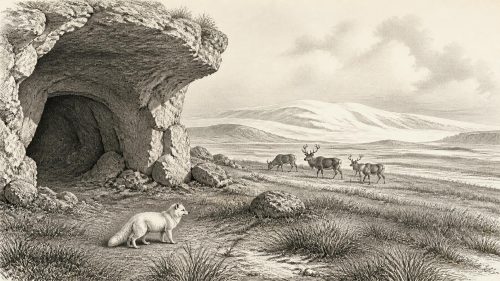
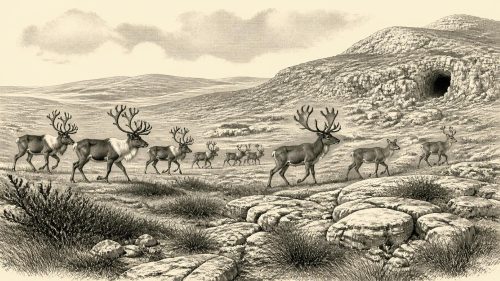
South-western Ireland supplies a complementary record. Castlepook Cave, also called Mammoth Cave, near Doneraile in County Cork, is Ireland’s richest known cave assemblage for vertebrates from the period leading towards the Last Glacial Maximum. Its collections include woolly mammoth, giant deer, reindeer, brown bear and spotted hyena, alongside smaller cold-adapted animals such as lemmings, Arctic fox, hare and wolf. The cave accumulated remains over a long span, through carnivore activity, natural deaths, water movement and later disturbance; it is not a single, neatly sealed snapshot.
The animals nevertheless show that Ireland was connected ecologically to the wider north-west European cold-stage world. Large herbivores could exploit open vegetation, while predators and scavengers followed or used the same habitats. Spotted hyena is especially striking: Castlepook is the only recognised Irish site for the species. A cave used or entered by hyenas could gather bones in ways very different from a human camp, which is why animal remains alone cannot demonstrate hunting, settlement or a particular human population.
Reindeer are particularly relevant to the question of people. A reindeer femur from Castlepook has been reported as roughly 33,000 years old and bears a deep mark that zooarchaeologist Ruth Carden has interpreted as damage from a sharp stone tool during carcass processing. If that interpretation is upheld, it would be a remarkable indication that humans handled a reindeer in Ireland far earlier than the island’s long-established post-glacial settlement record. It remains a limited clue, however. The bone derives from an old cave collection rather than a recently excavated living floor with associated tools, hearths, shelters or human remains.
Nor does a date on a bone prove the moment when its surface was marked. The Castlepook find may be close in broad age to the date represented here, but it cannot be assigned responsibly to 30,516 BCE itself. Its importance lies in opening a serious research question: could small Upper Palaeolithic groups have made short visits to Ireland during favourable phases of the Ice Age? Continuing work at Castlepook seeks undisturbed deposits and securely associated evidence capable of answering that question more firmly.
People: Possibility, Not Population
There is no securely dated house, hearth, stone-tool workshop, grave, artwork or settlement surface in Ireland for this precise period. There are no names, languages, communities or traditions that can responsibly be recovered. It would be tempting to populate the Derryvree wetland with hunters because related Upper Palaeolithic societies lived in Britain and continental Europe. That would be interpretation by analogy, not Irish evidence. The possible Castlepook cut mark permits no more than a cautious inference that people may have processed an animal on the island during the wider pre-Last Glacial Maximum period.
Accordingly, there is no evidence for political affairs, diplomacy, formal territories or warfare in Ireland at this point. Nor can archaeology identify households, leadership, kinship systems or social rank. If people visited, their numbers could have been very small and their movements seasonal or short-lived. The environmental evidence makes hunting and scavenging conceivable activities, especially where reindeer and other herbivores were available, but it does not show that a group lived beside Derryvree, controlled a route through Fermanagh or maintained a permanent Irish population.
The same limits apply to religion, culture and learning. No Irish ritual place, burial, image, musical instrument or symbolic object is known from around this time. Absence of evidence is not proof that visitors lacked beliefs, stories, technical knowledge or social customs; rather, it reflects the extremely fragmentary survival of evidence and the destructive force of later glaciation. The later ice sheets eroded, redeposited and buried much of the older landscape. Caves and intertill deposits are exceptional survivors, not a complete archive.
No Economy of Exchange
There is likewise no basis for describing farming, herding, trade or organised exchange. Agriculture lay many millennia in the future. The economic possibilities supported by the evidence are narrower: wild animals, freshwater, plants and workable stone may have been resources for any passing people, but none has been demonstrated as an Irish system of production or trade. Mammoth and reindeer bones testify to faunal movement, not commerce. A possible butchered femur would indicate an episode of carcass processing, not a stable hunting economy.
Geography remains important even where human evidence is absent. Lower global sea levels made the lands around Ireland different from those of today, but the precise routes available at any moment depended on changing ice, sea level and local topography. It is unsafe to imagine a simple permanent land bridge or an effortless crossing. Animal dispersal and any possible human arrival must be considered against a mobile mosaic of ice margins, exposed shelf, coasts and waterways.
What This Year Can Mean
The most meaningful history for 30,516 BCE is therefore environmental and evidential. Fermanagh’s buried freshwater silts show that, during a broad cold-stage interval, life persisted in an open periglacial wetland between episodes of glaciation. Castlepook’s cave fauna demonstrates that large mammals and formidable carnivores reached Ireland during the wider Late Pleistocene. One marked reindeer bone raises the possibility of a human encounter with that world, while also illustrating the high standard of proof required for claims about the island’s first people.
This is not yet Ireland of chronicles, kingdoms or monuments. It is an Ireland known through a drumlin road cutting, fossil mosses, seeds, silts and cave bones: partial records from a landscape repeatedly remade by ice. Their restraint is their value. Rather than inventing an event for a year that cannot be isolated, they reveal a colder, wetter, more open island whose changing habitats made later human history possible, but did not yet record it.
Primary Sources
- A Middle Midlandian Freshwater Series at Derryvree, Maguiresbridge, County Fermanagh, Northern Ireland
- A Middle Midlandian Freshwater Series at Derryvree, Maguiresbridge, County Fermanagh, Northern Ireland
- Exploring Controls of the Early and Stepped Deglaciation on the Western Margin of the British-Irish Ice Sheet
- The Irish Quaternary Fauna Project
- The Irish Quaternary Fauna Project
- New Insights on the Fauna of Ireland’s Younger Dryas and Early Holocene from Alice & Gwendoline Cave
- New Insights on the Fauna of Ireland’s Younger Dryas and Early Holocene from Alice & Gwendoline Cave
- Castlepook Cave: County Geological Site Report
- Spotted Hyena Skull
- 2022:564 – Castlepook Cave, Castlepook South, Cork
- Ireland’s Palaeolithic Archaeology – Fleeting Footprints in a Frozen Land
- Heritage Artefacts of County Cork
- Palaeoecology
- Figure 6.— The Subdivision of the Quaternary Period in Ireland
- Irish Pleistocene Biostratigraphy
- The IntCal20 Northern Hemisphere Radiocarbon Age Calibration Curve (0–55 cal kBP)
- Radiocarbon Dating and Chronological Modelling
- The Island of Ireland: Drowning the Myth of an Irish Land-Bridge?
- The Island of Ireland: Drowning the Myth of an Irish Land-Bridge?
- Deglaciation, Earth Crustal Behaviour and Sea-Level Changes in the Determination of Insularity: A Perspective from Ireland
- The Late Quaternary History of East-Central Ireland
- Menyanthes trifoliata L.