Galway’s November Fealty1388 CE
On 5 November 1388, Galway’s burgesses publicly swore fealty to William Burke of Clanricarde, transferring royal local revenues, except customs, and demonstrating preference for regional protection over Richard II’s distant authority. Their bloodless revolt formed part of wider competing jurisdictions. Connacht suffered extensive warfare among O’Conor branches and allied lordships, involving raids, burning of homes and corn, prisoners, hostages and mercenary forces. Conflict also touched Assaroe and north-western territories, while violence killed learned men and a local lord. Fosterage linked Desmond’s heir with an O’Brien household. Despite de Vere’s fall, royal administration issued writs, but lacked effective command in Ireland.
Dateline
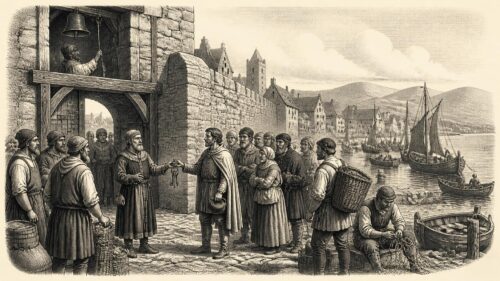
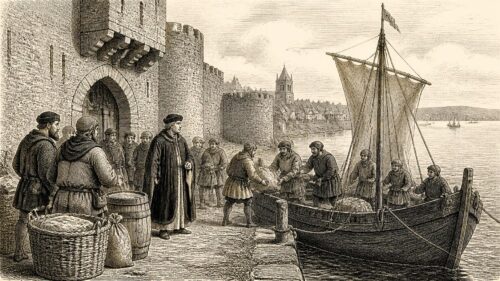
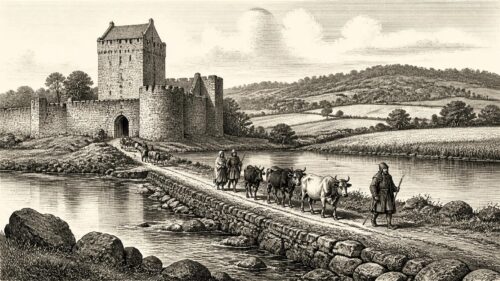
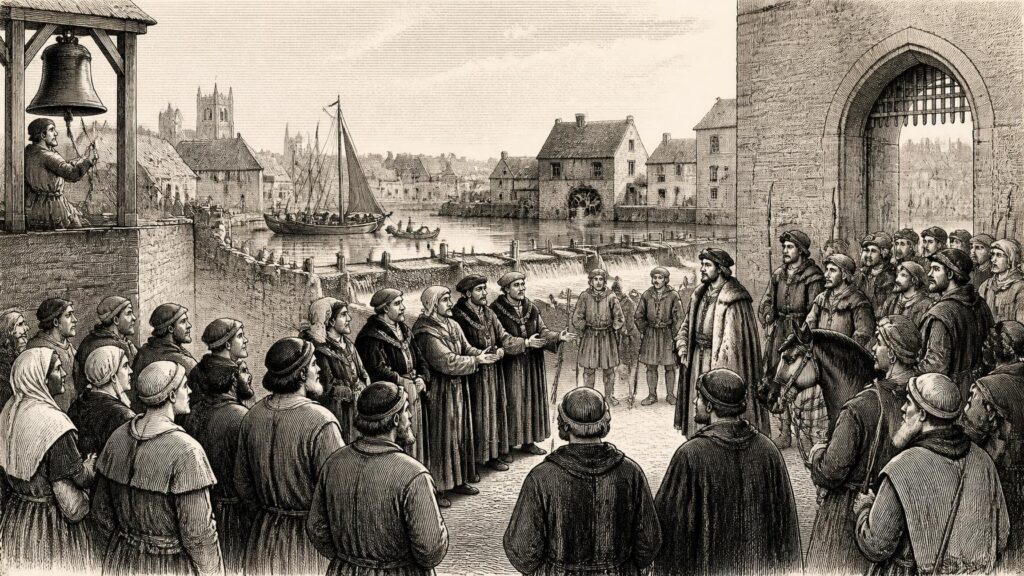
On Thursday 5 November 1388, the bell of Galway was rung and the town’s burgesses made a remarkable collective choice. According to evidence later heard in the king’s court, Henry Blake and the wider community of Galway swore the fealty owed to Richard II not to the Crown but to William Burke, son of Richard Burke and lord of Clanricarde. They delivered to him the king’s local profits: fish-weirs, mills, rents and services. Only the customs revenue known as the coket was excepted. It was an act described by royal officials as seditious and felonious; in practical terms, it showed that a walled English town on Ireland’s west coast could decide that the protection and authority of a powerful neighbouring lord mattered more than distant royal government.
A Precisely Dated Defiance
The date of the Galway submission is unusually secure. It was set down in proceedings held at Ballinrobe in June 1391, when royal justices reviewed the events of the revolt. The record says that the bell was struck, the community acted by common assent, and William Burke received the town’s fealty “by name of lordship”. It is therefore possible to see not merely a private bargain by a few leading men, but a public political demonstration involving the civic community.
The episode should not be mistaken for a simple ethnic contest between an ‘English’ town and an ‘Irish’ countryside. Galway was an English-founded borough within the lordship of Ireland, but its inhabitants traded, negotiated and competed with Gaelic and Hiberno-English powers around Connacht. The Burkes of Clanricarde were themselves descendants of Anglo-Norman settlers, yet had become major regional lords whose political world crossed linguistic and legal boundaries. The recorded transfer of fish-weirs, mills and rents points to the material stakes of the revolt. Control of water-powered milling, salmon fisheries and urban dues meant command over food, cash income and the town’s economic life.
There is no evidence in the surviving record that Galway’s change of allegiance on 5 November itself involved a battle or sack. That restraint is significant. Its force lay in the appropriation of authority, revenue and civic obedience. The following year, the burgesses would go further by delivering the town gates’ keys to Burke, but that belongs to 1389 rather than to this year. In 1388, the bell, the oath and the revenues were enough to announce a sharp local reversal.
War Across Connacht
Galway’s decision came amid an exceptionally troubled year in Connacht. The annals describe a widening conflict between rival branches of the Uí Conchobair, O’Conor Roe and O’Conor Don, while the Mac Diarmatas and Clann Donnchada were drawn into the struggle. Such labels conceal shifting alliances rather than neat sides. Lords depended on kinsmen, client families, mounted followers, mercenary soldiers and negotiated local support; a raid could swiftly turn into a campaign of retaliation.
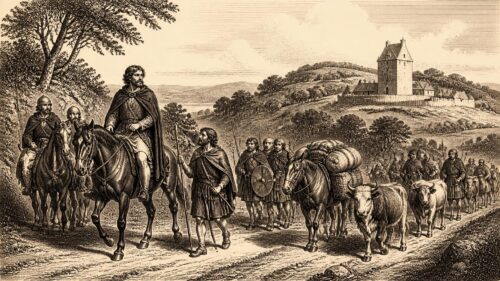
Cormac Mac Donnchada, tanist or recognised heir of Tírerrill, made a night raid into Moylurg and carried off substantial prey. Pursuit followed. The Annals of Connacht say that Cormac covered the retreat of his own people and refused quarter, forcing his pursuers to kill him. His death was treated as a major loss: the annalist called it grievous beyond that of any king’s son in Ireland. Conchobar Mac Donnchada, Murchad son of Cormac and Mac Diarmata Ruad were taken prisoner. These were not anonymous casualties. Captive aristocrats were valuable instruments of settlement, coercion and ransom, while the loss of a tanist could change the balance within a lordship.
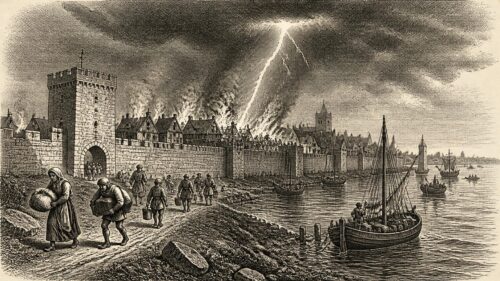
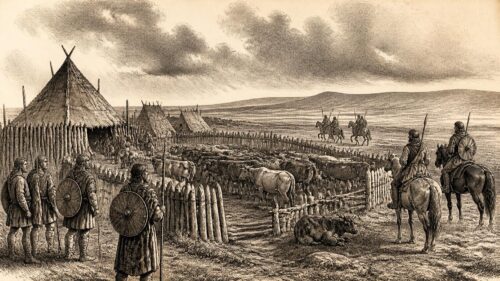
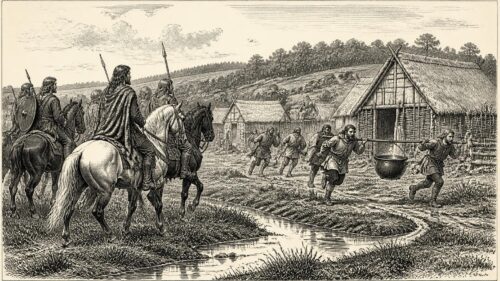
The wider consequences were severe for ordinary communities. The annals report that Moylurg was burned, including both houses and corn. This is unusually revealing language. Burning dwellings displaced households, but burning corn also attacked the stores on which people, livestock and lordly hospitality depended through winter and into the next season. Elsewhere, Domnall O’Conor raided Machaire Connacht, burning Ard-an-Choillin and the islands of Loch Cairrgin; on that expedition Domnall Óg Mac Domnaill, described as a constable of gallowglasses, was killed. The presence of such a commander demonstrates the military importance of professional heavy infantry from the Gaelic world of the western seaways.
The annals also state plainly that O’Conor Roe’s raids on O’Conor Don produced a ‘great general war’ in Connacht. That is a contemporary judgement, not a modern exaggeration. It does not mean every district was continuously at war, but it captures the breadth of insecurity created when leading kindreds fought across the province. The beginnings of another war, between O’Rourke and Clann Donnchada, extended the tension towards Breifne. On 24 February, Cú Choicriche Ó Maolmhuaidh, lord of Fir Cell, died; the annal’s precise dating offers a quiet contrast to the movement of armies and raiders around him.
Assaroe and the North-West
Conflict also reached the north-western frontier of Connacht and Tír Chonaill. Muirchertach, son of Domnall Ó Conchobair, attacked the O’Donnell stronghold at Assaroe, beside the monastery on the Erne. The annals record many deaths, including sons of the Ó Baoighill family, and the seizure of horses and captives. Mac Suibhne and his son were among those carried away. The location mattered: Assaroe was both a religious site and a strategic passage at the falls of the Erne. Yet the evidence does not say that the monastery itself was plundered or damaged, and it would be unsafe to claim that it was.
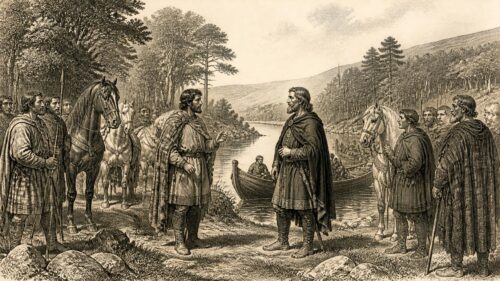
O’Donnell answered with a campaign into Carbury of Drumcliff after reaching Sligo. The Annals of the Four Masters say that the territory was plundered and devastated, and that Domnall, son of Muirchertach, eventually entered O’Donnell’s house to make peace. He met O’Donnell’s demands and surrendered hostages previously taken from Cenél Conaill. Here warfare and diplomacy were inseparable. A lord’s house was a place of hospitality, negotiation and submission; hostages gave a peace agreement practical security. The sequence also cautions against treating raids as aimless violence. They were means of enforcing claims, recovering people and compelling political recognition.
Learning, Lordship and Kinship
Violence in 1388 struck learned families as well as fighting men. Sigraid and Cairpre Ó Cuirnín were killed by the ‘Foreigners’ of Leinster, while another account names Gilla Pátraic Ó Cuirnín among the dead. The Annals of Ulster called Sigraid’s death a great loss to learning. The Ó Cuirníns belonged to the hereditary learned world that preserved legal, genealogical, historical and literary knowledge for patrons. That brief lament is valuable evidence that scholarship was not secluded from politics: learned households travelled, served powerful families and could be exposed to the same regional violence as everyone else.
Another killing registered the fragility of lordship at its most intimate. Seaan Ruad Ó Tuathail, lord of Uí Muiredaig, was killed in his own house by a member of his household, described dismissively in the annals as a clown; the killer was then slain. The annalist praised Seaan’s hospitality and valour. Such praise was more than obituary convention. Hospitality sustained a ruler’s reputation, bound dependants to him and made his household a political institution. Murder within that household was therefore an assault upon personal authority as well as a crime.
In Munster, a royal licence granted in 1388 allowed Gerald FitzGerald, earl of Desmond, to foster his son James with Conchobhar Ó Briain despite the Statutes of Kilkenny’s restrictions on such practices. Fosterage created durable ties of affection, obligation and alliance across family and political boundaries. The licence is a revealing acknowledgement by the royal administration that a leading magnate could cultivate Gaelic customs and relationships while remaining, formally, a royal subject. It is also a reminder that cultural exchange was not a marginal process but part of high politics.
Government Without Command
Events in England altered the political setting. In February 1388, Robert de Vere, Richard II’s favourite and the holder of the exceptional title duke of Ireland, fell from power and forfeited his position. His grand, impractical association with Ireland had never solved the lordship’s underlying difficulties. The crisis at the English court did not cause the Connacht wars or Galway’s revolt, but it weakened the credibility of a royal system already dependent on local officers and magnates.
Government nonetheless continued to function. Sir Robert Preston acted as keeper of the Great Seal, while Richard Plunkett, a justice of the King’s Bench, received authority on 23 September to seal and issue writs because Preston’s service with the lord justice kept him travelling through Ireland. This administrative detail conveys a larger reality: royal law required seals, fees, courts, clerks and men able to move between regions. Its machinery endured, but it did not ensure obedience in Galway or prevent the destruction of cornlands in Moylurg.
Thus 1388 is best understood not as a year in which one Ireland moved in one direction, but as a year of competing jurisdictions. In Galway, burgesses transferred practical allegiance to a Burke lord. In Connacht and the north-west, raids, hostage-taking and negotiated peace reshaped lordships. In Munster, fosterage linked an Anglo-Irish earl to an O’Brien household. And in Dublin’s governmental world, the Crown continued to issue writs even as its authority was being tested far beyond the reach of its immediate force.
Primary Sources
- The Annals of Ulster: Year U1388
- Annála Connacht: Annal 1388
- Annála Connacht: CELT Project Edition and Bibliography
- Annals of the Four Masters: Volume 4 English Translation
- Annals of the Four Masters: Irish Text
- Annala Rioghachta Eireann: Annals of the Kingdom of Ireland, Volume IV
- Urban Rebels in Medieval Connacht: The Revolt of Galway, 1388–9
- Urban Rebels in Medieval Connacht: The Revolt of Galway, 1388–9 (PDF)
- Richard II
- Richard II: The National Archives Learning Resource
- The Appeal of the Lords Appellant, February 1388
- Chronicle of the Law Officers of Ireland: Lord Chancellors and Keepers of the Great Seal
- Fitzgerald, Gerald (d. 1398), Dictionary of National Biography
- Annales Breves Hiberniae
- The Red Book of the Earls of Kildare
- The Calculus of Faction and Richard II’s Irish Policy
- The Rise and Fall of the Clann Éinrí Aimhréidh Uí Néill: Dynastic Feuding and Geopolitics in the Late Medieval Irish Sea World
- CIRCLE: A Calendar of Irish Chancery Letters, 1244–1509
- The History of the Viceroys of Ireland
- The Clan Donald of Connaught
- Burke of Clanricarde, 1334 to 1387
- The English Lordship of Ireland and the Irish Sea World: Re-assessing