Aodh Buidhe’s Last Raid1444 CE
In 1444, Aodh Buidhe O’Neill of Clandeboye died from wounds received raiding Iveagh, prompting Eóghan O’Neill of Tír Eógain to intervene. Clandeboye leaders, allied with the MacQuillans, ambushed and defeated him in Dufferin, taking hostages including his son. Eóghan also compelled Dundalk to pay money and wine, while English government met at Drogheda with limited reach. Thomond suffered a violent Ó Briain succession rupture, including Mathgamain’s blinding and Toirdelbach’s seizure of power. Rome appointed Cormac Mác Shamhradháin bishop of Ardagh, while Trim’s Marian miracle cult, charity, deaths, warfare, and learned patronage reflected Ireland’s interconnected yet fragmented political and religious world.
Dateline
In 1444, Ireland’s politics were made in raids, assemblies, church appointments and family coups. The most consequential upheaval came in east Ulster, where the death of Aodh Buidhe O’Neill of Clandeboye opened a sudden contest between related branches of the wider O’Neill kindred. Yet the year was not reducible to one conflict. Eóghan O’Neill of Tír Eógain pressed the English settlements around Dundalk for payment; Thomond saw an exceptionally brutal overthrow; a new bishop of Ardagh was provided from Rome; and reports from Trim show how pilgrimage and miracle could shape popular religious life. The surviving record is uneven, but it gives an unusually vivid impression of how power worked: through armed followings, hostages, negotiated payments, ecclesiastical patronage and local reputation.
A Death in Iveagh
The firmest date in the year is 2 May, when Aodh Buidhe O’Neill died after being wounded during a raid in Iveagh, in what is now south County Down. The Annals of the Four Masters say that he had been struck by a javelin and lingered for twenty-four days, from Spy Wednesday in Holy Week until the beginning of summer. The Annals of Ulster, though more compressed, likewise place the wound in Passion Week and the death in summer. Such agreement makes the broad sequence secure even if the annalists’ devotional language should not be read as a literal account of his final spiritual state.
Aodh Buidhe was lord of the Clandeboye O’Neills, whose territories lay across parts of modern Antrim and Down. The Four Masters praise him as a renowned, generous and formidable prince, adding that he had settled or seized more English land than any contemporary. That is praise from a later Gaelic annalistic tradition, not a land survey, but it conveys the political reality behind the phrase. In the fifteenth-century north-east, control over cultivated districts, routes, castles, fishing grounds and rents was continually contested. The English lordship around Carrickfergus and the Ards, Gaelic lordships such as Clandeboye and Iveagh, and the expanding power of Tír Eógain all met in a crowded frontier zone.
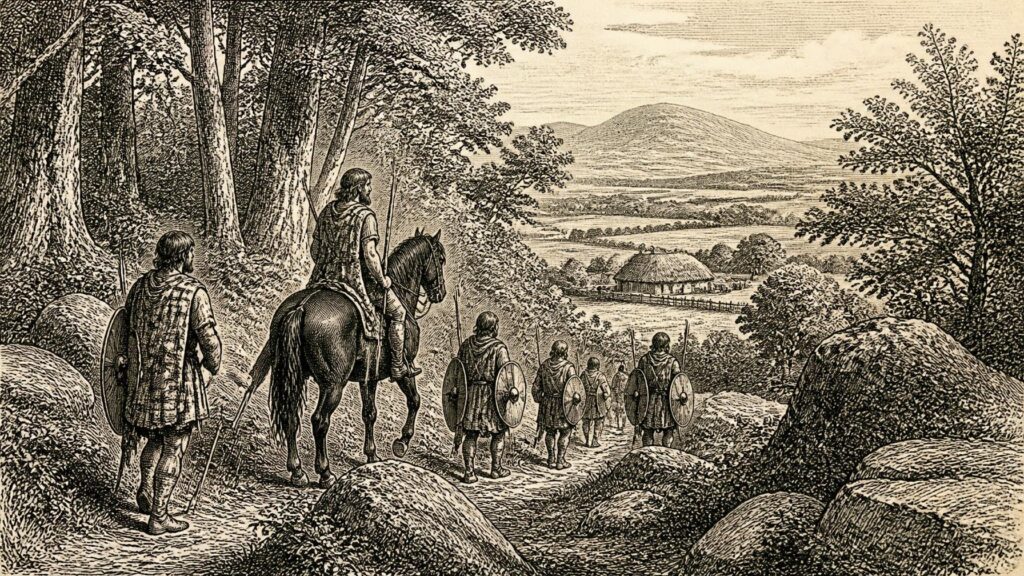
Aodh’s final expedition against the Magennises of Iveagh was therefore not a peripheral quarrel. Raiding could seize cattle and goods, punish a rival, demonstrate leadership to one’s own followers, and alter the balance of tribute. It also carried obvious personal danger. A spear or javelin wound sustained on a relatively small campaign could remove a lord whose authority rested heavily on his capacity to lead in person. His death created precisely such a moment of vulnerability.
The Dufferin Ambush
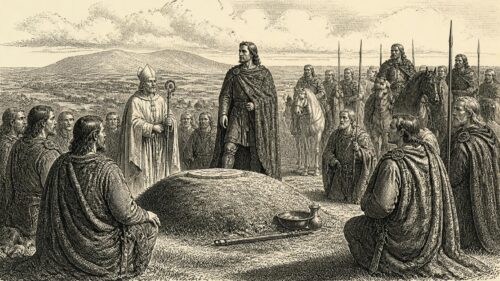
Eóghan O’Neill, ruler of Tír Eógain, moved quickly after Aodh Buidhe’s death. His intervention in Clandeboye was an attempt to turn a neighbour’s succession crisis into an extension of his own influence. It failed. Later reconstruction from the annalistic evidence places the decisive encounter in the wooded country of Dufferin in north County Down. There, Muircheartach Ruadh O’Neill, Aodh Buidhe’s brother and a leading Clandeboye lord, joined with another brother, Henry, and with the MacQuillans. The alliance was striking because recent rivalry had made the MacQuillans natural enemies of Clandeboye; immediate survival, rather than permanent friendship, produced the coalition.
The attacking force from Tír Eógain was caught in an ambush and badly beaten. The Annals of Ulster records a defeat at Bealach-Curdhit inflicted on Eóghan son of Niall Óg O’Neill by the sons of Mac Ui Néill Buidhe. It names among the dead Toirdelbach Mac Domhnaill, a galloglass captain serving as constable to an O’Neill lord, and says that many others were taken as hostages. Modern biographical scholarship identifies this encounter with the Dufferin disaster and notes that hostages handed over by Eóghan’s side included his son Aodh.
Hostages were central to the settlement. They were not merely captives of war: they were guarantees that an agreement would be observed, and their delivery publicised the victor’s superiority. A lord’s son was particularly valuable because his detention bound a dynasty as well as an individual. The episode shows both the limits of Tír Eógain’s regional ambitions and the resilience of Clandeboye. Aodh Buidhe’s death did not leave his lordship helpless; instead, its surviving leaders could mobilise kin, former rivals and difficult terrain to defend it.
Pressure on Dundalk
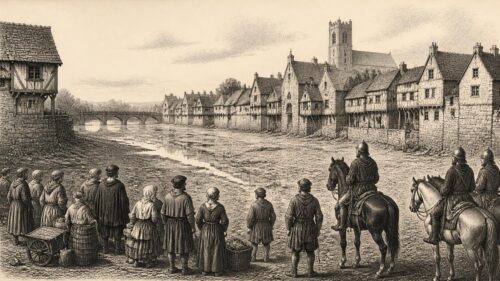
While the Clandeboye struggle unfolded, Eóghan O’Neill also exerted pressure on the English settlements of Oriel. The Four Masters state that he led a great army into the region, plundering and burning settlements and reaching Dundalk. The town escaped destruction after providing sixty marks and two tons of wine. The precise timing within 1444 is not supplied, so it cannot safely be placed before or after the Dufferin defeat. What is clear is that Dundalk’s community judged payment cheaper than sack.
The detail about wine is especially revealing. It points to the town’s place in maritime and commercial networks reaching beyond its hinterland, and to the practical value of imported provisions as well as coin. The sixty marks were not a regular tax in a modern sense; the annal presents them as a payment secured under threat. But the transaction also had a diplomatic function: it converted military pressure into a temporary accommodation. Eóghan later accepted rewards for a half-year peace with the English, though the same annal says that the arrangement was soon strained when his kinsman Brian, son of Domnall, raided the settlements and was killed by a stone cast during the expedition. Edmund MacMahon was taken prisoner in the same affair.
This was the insecure world immediately beyond the Pale. The English administration could maintain towns, courts and lordly estates, but it could not prevent a major northern army from reaching Dundalk. Nor were the boundaries simple ethnic lines. MacMahons, O’Neills, galloglasses and inhabitants of English towns all participated in shifting combinations of fighting, ransom, payment and truce.
Drogheda and the Lordship
English Ireland still possessed important institutions. On 21 June, James Butler, fourth earl of Ormond and the king’s lieutenant, held a great council at Drogheda. The surviving administrative record confirms the gathering, and Sir James Alleyn, chief justice of the common bench, is associated with it as speaker. Drogheda was an appropriate setting: a major walled port on the Boyne, close to the most densely governed districts of the lordship and well placed for communication with England.
It would be misleading, however, to treat the council as an all-Ireland government. Its reach was strongest in Dublin, Meath, Louth and the other districts where English law, borough institutions and aristocratic estates endured. Beyond them, the political map was a patchwork of Gaelic lordships and semi-autonomous Anglo-Irish powers. The contrast between formal council at Drogheda and the compelled payment at Dundalk captures the condition of the lordship in 1444: administration existed, but its military and fiscal authority was constrained.
Thomond’s Violent Change
In Thomond, covering much of present-day Clare and adjoining districts, the year brought a dynastic overthrow of unusual severity. The Annals of Ulster state that Mathgamain Ó Briain was blinded and deposed by his brother Toirdelbach, who was then made king over Thomond. Blinding was a calculated political act. Physical integrity mattered in ideals of Gaelic kingship, and mutilation could disqualify an opponent as well as remove his immediate capacity to command.
The Four Masters preserve a differently framed notice, recording the death of Teige Ó Briain, lord of Thomond, in the same year. Rather than force these terse and not wholly identical notices into a single certainty, it is safer to say that both witness a grave rupture within the Ó Briain ruling house during 1444. The Ulster annal firmly attributes the seizure of power to Toirdelbach. For ordinary communities, such changes could mean renewed demands for food, billeting, military service and cattle, even where no battle is recorded.
Another death underlines the importance of elite networks in Thomond: Sioda Cam Mac Conmara, chief of Clann Chuiléin, died between Christmas and New Year. The annals call him a protector of the men of Ireland, a conventional but significant compliment denoting status and patronage. He was associated with the Franciscan friary at Quin, an important Mac Conmara foundation. His death removed a major lord from the political and religious landscape of Clare at the moment when the Ó Briains’ own succession was unsettled.
Church, Charity and Reputation
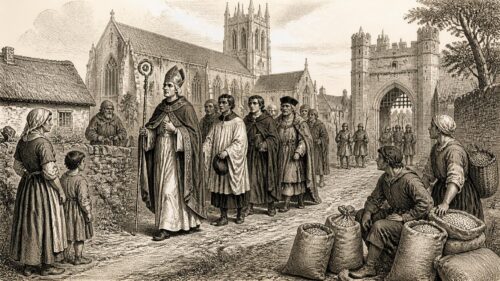
Church affairs gave the year another, very different kind of connection between local Ireland and wider Christendom. Richard Ó Fearghail, bishop of Ardagh, died. On 6 November Pope Eugenius IV appointed Cormac Mác Shamhradháin, an Augustinian and prior of Drumlane, to succeed him. The appointment was made at Rome, but its significance lay in the midlands and Breifne, where diocesan office, monastic connections and leading families overlapped. Cormac’s appointment also required a papal dispensation connected with his birth, a reminder that canon law and papal administration could have direct consequences for Irish ecclesiastical careers.
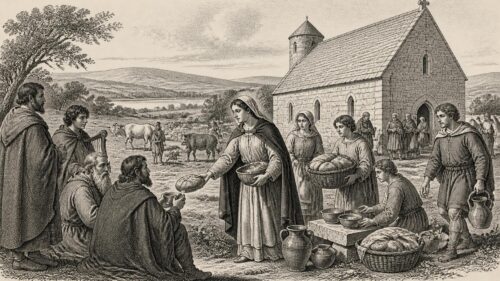
Religious experience was not confined to bishops and Rome. The Four Masters report that an image of the Virgin at Trim performed cures for people described as blind, mute, crippled or otherwise afflicted. This cannot be treated as medical fact, but it is firm evidence that a miracle claim circulated and was considered worthy of annalistic record. Trim’s religious institutions and its position within the lordship made it a plausible focus for pilgrimage, offerings and public devotion.
The annals also preserve quieter measures of esteem. Dubchablaigh, daughter of Thomas Maguire of Fermanagh and wife of Eóghan Mac Cathmhaoil, was remembered as a leading practitioner of almsgiving and charity. Gráinne, wife of Denis Mac Gilla-Coisgle, a canon of Clogher, died on 27 June. Such notices do not recover the lives of most women, farmers, townspeople or dependants, but they show that generosity, household standing and ecclesiastical connection were publicly meaningful forms of reputation.
Learning and Loss
Aodh Buidhe’s obituary calls him a protector of the learned companies of Ireland and Scotland. The phrase matters. Learned families of poets, historians, lawyers and churchmen depended on patrons who could provide land, food, protection and rewards. Their work travelled through Irish-speaking lordships and across the North Channel; the cultural world invoked by the annalist was not bounded by the modern state. The lord killed in a raid could thus also be mourned as a supporter of scholarship.
Other recorded deaths and killings convey the year’s local texture: an Ó Conchobair was shot by an arrow around the feast of St Brendan; a group of O’Farrells and eight companions were killed on Sliabh Cairbre in Annaly; and two MacMahons identified as heirs to the lordship of Oriel died, one being buried at Clones. These brief entries are not a complete register of violence or mortality. They are selective memorials of people whose kin and rank made them visible to annalists. Taken together, they show a country in which formal authority, family succession, warfare, devotion and learned patronage were inseparable.
For 1444, the decisive lesson is contingency. Aodh Buidhe’s death seemed to invite intervention by Tír Eógain, but Clandeboye’s defenders turned bereavement into an unexpected victory. Dundalk bought safety with money and wine; Drogheda hosted government within a narrower political sphere; Thomond’s royal house was violently reordered; and religious institutions continued to supply authority, consolation and prestige. Ireland was not a single polity, but its regions were linked by conflict, commerce, clerical appointments and a shared culture of lordship.
Primary Sources
- The Annals of Ulster, Year U1444
- Annals of the Four Masters, Annal M1444
- The Annals of Ulster
- Annals of the Four Masters: Volume 4 English Translation
- O'Neill (Ó Néill), Aodh Buidhe
- O'Neill (Ó Néill), Aodh
- Butler, James
- Alleyn, Sir James
- O'Neill (Ó Néill), Brian Ballach
- Annála Connacht
- Annals of Connacht: Manuscript C iii 1
- Annals of Connacht: Annála Connacht A.D. 1224–1544
- Annals of Loch Cé, Volume II
- Irish Manuscripts Commission Digital Editions
- Annals of Ulster, Otherwise Annala Senait
- Annals of the Kingdom of Ireland
- Annals of Ireland: Three Fragments
- James Dokeray, Mayor of Drogheda and Constable of Carrickfergus Castle, fl. 1444–82
- Notes to The History and Topography of the County of Clare
- The Patron Saint of the Locality: Cuinche