Edenderry and the Returning King1427 CE
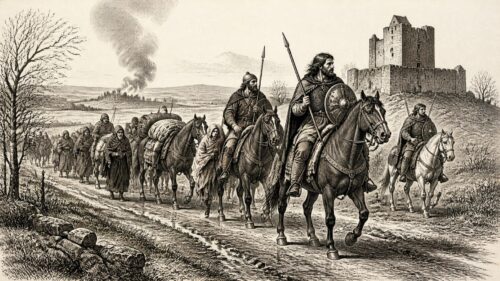
In 1427, Ireland’s fragmented political order was shaped by dynastic rivalry, constrained English administration and local military action. Donnchadh Mac Murchadha, king of Leinster, returned after eight years’ imprisonment in England, challenging his brother Gerald’s authority while receiving English support. Lord Grey briefly assumed the lieutenancy, reliant on local deputies amid fiscal and factional weakness. English or Anglo-Irish forces demolished Edenderry Castle, while an Ulster coalition led by Niall Garbh Ó Domhnaill defeated MacQuillan’s forces, taking prisoners and booty. Annalistic obituaries emphasised penitence, hospitality and charitable guest-houses, demonstrating that reputation, kinship and religious patronage remained central to power and standing.
Dateline
The surviving record for 1427 presents Ireland not as a country moving to one political rhythm, but as a mosaic of lordships, dynasties, ecclesiastical territories and a much-reduced English royal administration. This was a year in which a king of Leinster returned from long imprisonment in England, an English lord lieutenant arrived to take charge of government, a castle in Offaly was dismantled, and a northern alliance used force to alter the balance of power. Yet the annals also preserve quieter measures of status and social obligation: penitential deaths, long-lived hospitality, and the work of a woman who had maintained guest-houses for fifty-six years. The contrast is instructive. Authority rested not only on castles and armed followings, but on kinship, service, shelter and reputation.
Dates and the Evidence
Only a few events can be fixed closely within the calendar year. The Annals of Ulster date Brian Ua Daimín’s death to 6 January, Joan Mag Uidhir’s to 20 January, and Catherine, wife of Eóghan Ó Néill, to 5 June. Most other notices simply say “this year”. There is also a chronological warning. The Annals of Ulster put Lord Grey’s arrival and Mac Murchadha’s release under 1427, whereas the later Annals of the Four Masters place the release in their annal for 1428. Modern biographical work supports 1427 for Donnchadh Mac Murchadha’s return. The difference is not a licence to invent a day or month; it is a reminder that medieval Irish annals must be read critically, especially where compilations used differing year systems.
A Leinster King Returns
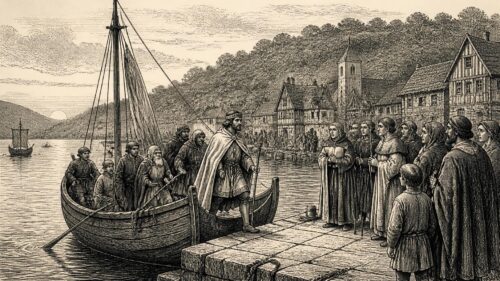
The principal political development was the return of Donnchadh mac Airt Mac Murchadha, described by the annalist as king of Leinster. His father, Art Mór Mac Murchadha, had been the foremost Gaelic ruler in Leinster, but Donnchadh had been captured by John Talbot in 1419 and imprisoned in the Tower of London. His release after about eight years did not restore a settled inheritance. During his absence, his brother Gerald had become the effective power among the Mac Murchadhas, while the O’Byrnes and other Leinster lords pursued their own agreements with the English administration and the Butlers. Donnchadh’s return was therefore a deliberate intervention in a contested provincial kingship, not the simple homecoming of an undisputed ruler.
The English government had reasons to encourage that intervention. Donnchadh was connected by marriage to the Butler family: his wife Aveline was half-sister to James Butler, fourth earl of Ormond. The administration granted him a fee, hoping he could restrain Gerald Mac Murchadha and help stabilise a frontier region where accommodation, raiding and rivalry were closely intertwined. That calculation reveals a recurring feature of lordship in Ireland: royal officials could not simply impose authority from Dublin, but sought influence through alliances with powerful local kindreds. Donnchadh’s position remained weak while Gerald lived, but the release itself changed Leinster’s political possibilities in 1427.
Grey’s Brief Administration
Lord Grey’s arrival marked a change at the head of the English lordship. James Butler, earl of Ormond, had served as justiciar until the new lieutenant arrived in July. Grey’s tenure was brief and depended substantially on Edward Dauntsey, bishop of Meath, who acted as his deputy after Grey returned to England in December. The arrangement exposes the limited institutional reach of royal government: formal office came from the English crown, but effective administration required resident churchmen, magnates, officials and local networks. It also occurred against the background of the destructive Talbot–Ormond factional contest, which had weakened the administration’s ability to act consistently beyond its core territories.
Even Dublin Castle required attention. An order made early in 1427 directed that an old, cancelled silver seal in the treasury be sold and the proceeds used to repair the ruined windows of the castle hall. This modest expedient should not be exaggerated into a grand rebuilding programme. It does, however, offer an unusually material glimpse of government: the castle was the place where council, courts and records depended on buildings that could be neglected, damaged and difficult to maintain. The sale of redundant royal metalwork for repairs suggests fiscal constraint rather than administrative confidence.
Edenderry’s Broken Castle
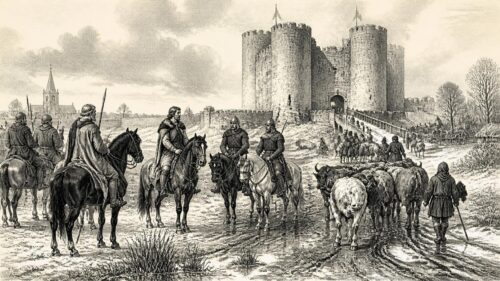
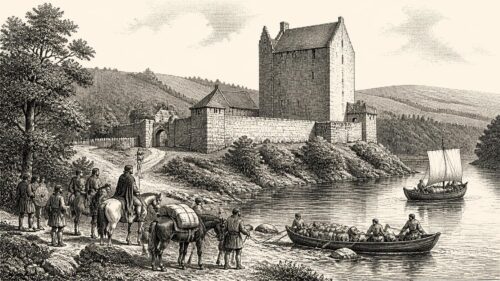
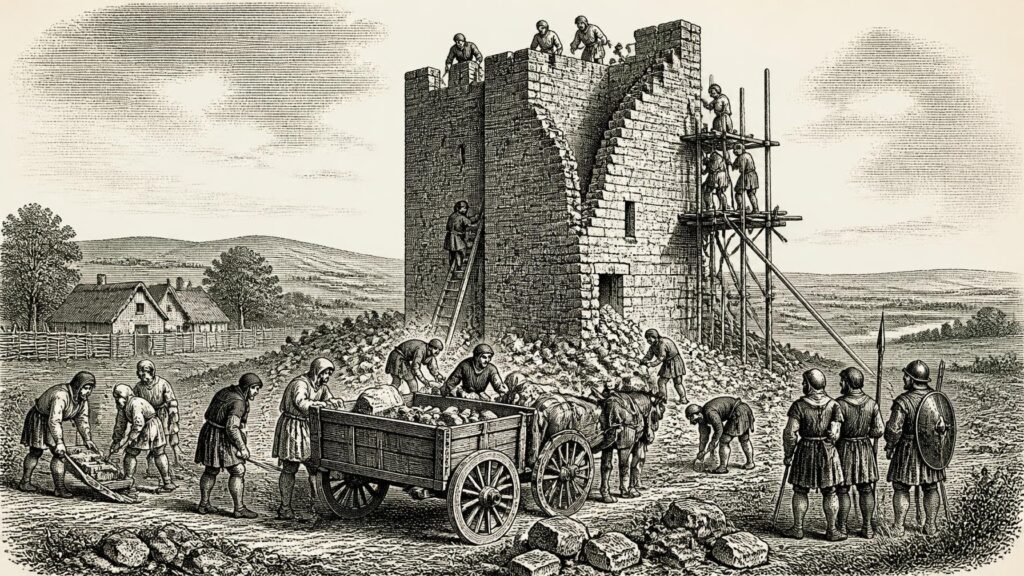
The Annals of Ulster state that the castle of Éadan Daire, Edenderry in Offaly, was “broken down by Foreigners” in 1427. In this annalistic language, “Foreigners” normally denotes the English or Anglo-Irish rather than people from abroad in the modern sense. The notice gives no commander, siege narrative or exact date, so none should be supplied. Nor can it securely be identified with every nearby campaign. What can be said is that the destruction mattered sufficiently to enter a chronicle whose entries ranged across the island. A castle was a storehouse, defensible residence and assertion of lordship; its demolition was therefore a political act as well as a military one. Edenderry had already suffered an earlier recorded razing in 1416, showing that this was a contested strategic landscape rather than an isolated episode.
Alliance and Fighting in Ulster
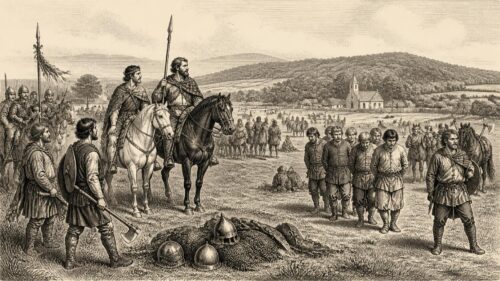
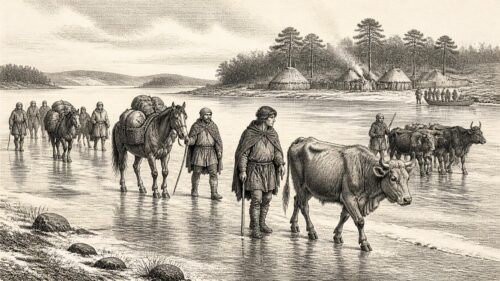
In the north, Niall Garbh Ó Domhnaill of Tír Chonaill led a hosting into Trían Conghail against Ó Néill, with support from the Clandeboye branch of the Ó Néills. The Annals of the Four Masters say that Mac Uidhilín, or MacQuillan, was defeated, many of his people were killed, two sons of Donnchadh Mac Suibhne were captured, and substantial cattle and other booty were taken. Modern accounts identify the wider purpose: Muircheartach Ruadh and Aodh Buidhe Ó Néill of Clandeboye allied with Ó Domhnaill against the rival great Ó Néill of Tyrone, while MacQuillan of the Route was their common enemy. This was not a national war between two fixed camps. It was a regional coalition, made from overlapping dynastic interests, which briefly strengthened Clandeboye against both neighbours and internal challengers.
The Ulster campaign and the demolition at Edenderry illustrate the importance of armed mobility. Hosts could move across lordship boundaries, gather allied contingents, seize prisoners and drive away livestock; castles and defended settlements were vulnerable when a political relationship collapsed. The annals do not provide figures for forces, casualties or the value of plunder, and it would be misleading to manufacture them. Their language nevertheless makes clear that taking captives and movable wealth was central to the outcome of conflict. Control was repeatedly negotiated through the ability to protect dependants, punish opponents and distribute gains.
Hospitality, Kinship and Religious Reputation
The most revealing social notices of 1427 concern hospitality. Diarmait Ua Mathgamna, lord of Fonn Iartharach, was praised as a man of outstanding generosity; Úna, daughter of Aodh Mag Uidhir and wife of Tadhg Ua Ruairc, was remembered as exceptionally hospitable, pious and charitable in Lower Connacht. Such praise was not incidental ornament. In aristocratic society, a lord or lady’s standing rested partly on maintaining followers, travellers, clerics and dependants. Generosity was a political resource, expressed in food, lodging, protection and gift-giving. At the same time, the phrasing is the annalist’s idealising judgement, not a modern audit of welfare. It shows what conduct contemporaries believed deserved commemoration.
Joan, daughter of Bishop Mac Cathmhail and widow of the “great archdeacon” Maurice Mag Uidhir, receives the fullest notice. She died on 20 January after maintaining guest-houses at Claeninis and Ros-oirther for fifty-six years, described as reputable, humane and charitable. The length of service is striking. Her commemoration demonstrates that elite women could be remembered publicly through sustained household and religious patronage, not solely as links in dynastic marriages. Her husband’s position as archdeacon of Clogher also points to the close interweaving of leading ecclesiastical offices, lordly families and local communities around Lough Erne.
Several other deaths show the same vocabulary of kinship and moral standing. Brian Mag Samradhain, son of the chief of Tellach Eachdhach, was praised for charity and hospitality; Gilbert Ua Flannagáin was called reputable and well mannered; and Brian Ua Daimín, chief of Tír Cheannfhoda, died on 6 January. Catherine, wife of Eóghan Ó Néill, died on 5 June. The annals give women’s identities through both natal and marital affiliations, yet their inclusion confirms that marriages between ruling families were politically visible events. Conversely, Murchadh, son of Toirdelbach Ua Briain, was killed treacherously by his own brother: a terse but potent record of the lethal risks within dynastic competition.
A Year of Fractured Authority
Nothing in the surviving evidence permits a confident claim about harvests, prices, overseas trade or environmental crisis in 1427. Nor is there a securely dated foundation, book production or major ecclesiastical reform to add merely for balance. The year is important precisely for what its well-attested fragments reveal. Grey’s administration was financially and politically constrained; Donnchadh Mac Murchadha’s release reshaped Leinster’s rivalries; Edenderry’s castle was destroyed; and an Ulster alliance won plunder and prisoners. Alongside these events, the obituaries preserve a society in which religious penance, hospitality and the maintenance of guest-houses carried public weight. In 1427, the exercise of power in Ireland was local, negotiated and often precarious.
Primary Sources
- The Annals of Ulster, Year U1427
- The Annals of Ulster
- Annals of the Four Masters
- Annála Connacht
- Annála Connacht: Electronic Edition Information
- MacMurrough Kavanagh (Mac Murchadha Caomhánach), Art Mór
- Butler, James, Fourth Earl of Ormond
- Dauntsey, Edward
- O'Byrne (Ó Broin), Donnchadh
- O'Toole (Ó Tuathail), Feidhlim
- Talbot, John
- Talbot, Richard
- O'Donnell (Ó Domhnaill), Niall Garbh
- O'Neill (Ó Néill), Aodh Buidhe
- Mac Maghnusa (MacManus), Cathal Óg
- Blundell Castle
- His Majesty's Castle of Dublin
- Mac Carthaigh's Book
- Exploring the Irish Annals
- The Annals of the Four Masters: Four Courts Press
- Annals of Ulster: Manuscript and Printed Edition
- The Governing of the Lancastrian Lordship of Ireland in the Time of James Butler, Fourth Earl of Ormond, c.1420–1452
- New Findings on the Buildings in the Middle/Lower Yard at Ormond Castle
- Annals of the Four Masters Digitised and Available Online