Loch Melvin’s Night Coup1421 CE
In 1421, Irish annals recorded interlocking conflicts, successions and deaths across Connacht, Breifne, Fermanagh, Offaly, Ulster and Munster. Ruaidhrí Mac Diarmata’s death brought Tomaltach’s contested succession in Moylurg, while Murchadh Ó Conchobhair’s death preceded Calbhach’s accession in Uí Fhailghe. Ó Ruairc, allied with Ó Domhnaill and Mag Uidhir, campaigned destructively against Clann Donnchadha; retaliation damaged Ó Ruairc’s residence before peace followed. Cathal Ó Ruairc seized Inis Caoin on Lough Melvin through garrison betrayal, capturing its lord and castle. Notices also commemorated bishops, nobles, Mór Mumhan, and historian Gilla Riabhach Ó Cléirigh, revealing ideals of hospitality, piety, learning and martial defence.
Dateline
The record for 1421 is unusually rich in connected local events, though it offers no single island-wide turning point. Ireland appears instead as a mosaic of lordships, church territories, castles, lakeside strongholds and monastic centres. In Connacht, Breifne, Fermanagh, Offaly and the north-west, deaths altered successions; alliances brought large forces across regional boundaries; and one night attack on an island in Lough Melvin changed possession of a strategically valuable lake. The surviving annals give the year a strongly western and northern emphasis. They also preserve the values by which leading people wished to be remembered: generosity, hospitality, religious penitence, courage, learning and the ability to defend dependants.
The sources require care. Annála Connacht and the Annals of Ulster place a substantial group of events firmly in 1421. The seventeenth-century Annals of the Four Masters, drawing on earlier material, supplies further detail, including named places and incidents. It is therefore possible to describe the year’s conflicts and deaths with confidence, while avoiding invented dates, troop totals, motives or consequences that the evidence does not establish.
Losses and New Lords
The annalists themselves opened the year with loss. Ruaidhrí mac Aodha Mac Diarmata, king of Moylurg in north Connacht, died at his stronghold on 21 April according to Annála Connacht. He was buried at Boyle Abbey, the great Cistercian house closely associated with the Mac Diarmata ruling family. The annalist’s praise is revealing rather than merely ornamental: Ruaidhrí was represented as a leader who did not refuse a request, a generous patron comparable in bounty and martial valour to heroic figures from Irish tradition. In a society dependent on personal lordship, such generosity signified more than private virtue. A ruler’s household fed visitors, retained followers, received clerics and scholars, and turned gifts into political loyalty.
Tomaltach Mac Diarmata succeeded Ruaidhrí. Yet succession did not guarantee tranquillity. Later in the same year, Tomaltach went to Killaraght with only a few horsemen and was surprised in the settlement by kinsmen, the sons of Fergal Mac Diarmata, with their followers. The annal says his own men deserted him. Wounded, he fought his way out and crossed the Boyle river to safety. The dramatic language celebrates a gallant escape, but its historical importance is simpler: the replacement of a lord could immediately expose fractures within his own lineage. The Mac Diarmata lordship was not an impersonal state that passed automatically from one office-holder to another; it rested on negotiated and contested family power.
Leinster saw a comparable change. Murchadh Ó Conchobhair, king of Uí Fhailghe, died at his residence and was buried at Killeigh. His successor was Calbhach. The obituary calls Murchadh an outstanding defender and a victor over both Galls and Gaels who opposed him. In this context, “Galls” could refer to the English or Anglo-Irish inhabitants and forces of the lordship, while “Gaels” denotes Irish opponents; the formulation captures the mixed political geography of central Ireland rather than a simple ethnic frontier. Killeigh’s long-established religious complex gave his burial a setting of institutional memory and local prestige.
The Four Masters also report a raid into Leix in 1421 by Mac Giolla Phádraig and an English associate, with 240 soldiers. Ó Conchobhair Fáilghe met them near the monastery of Leix, defeated them and acquired armour, weapons and equipment as spoils. The annal does not date this episode more closely, nor does it permit a confident reconstruction of every participant’s allegiance. It does, however, show that warfare in the central Midlands remained immediate after Murchadh’s death, and that monasteries and their surrounding settlements lay within the routes of armed parties.
Breifne’s Ecclesiastical Vacancy
Two deaths in Breifne brought secular and ecclesiastical authority into view. Tomás Óg Ó Raghallaigh died in his own house. The annals describe him as a leading man of the descendants of Aodh Finn, distinguished by hospitality and prowess. Nicholas Mac Brádaigh, bishop of Breifne, also died. He is praised for wisdom, uprightness, charity and humanity. Such obituary formulae cannot be read as neutral biographies, but they demonstrate what contemporaries expected from a bishop: learned authority, moral standing and practical generosity. Episcopal office was embedded in regional society. A bishop’s death mattered alongside that of a ruling-lineage leader, and the same vocabulary of hospitality linked churchmen and lay elites.
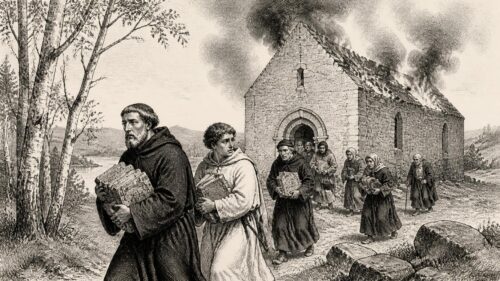
Religion also shaped the reporting of death. Ruaidhrí Mac Diarmata and Murchadh Ó Conchobhair were said to have received unction and penance before dying; Nicholas Mac Brádaigh “rested in Christ”. These notices do not disclose the precise liturgies performed or the private beliefs of every witness. They do show that the annalists understood a good death through sacramental preparation, penitence and burial at prestigious ecclesiastical sites. Monasteries such as Boyle and Killeigh were thus not remote spiritual refuges. They were places where rulership, commemoration, burial and local religious life met.
War in Tíreragh and Tír Oilealla
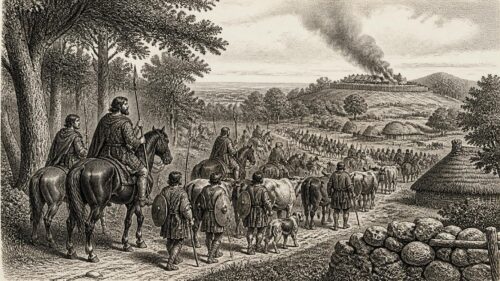
The largest recorded campaign of the year began with war between the Uí Ruairc and Clann Donnchadha, the Mac Donnchadha lineage. Ó Ruairc assembled a large host. Turlough Ó Domhnaill of Tír Chonaill joined him with his forces, as did Aodh Mag Uidhir of Fermanagh, while the men of Breifne formed the core of the coalition. The alliance stretched from Donegal and Fermanagh into the north-western Connacht–Breifne borderlands. Its movement into Tír Oilealla, in the area later known as Tirerrill in County Sligo, was destructive: much of the country was burned and Cathal, son of Mac Donnchadha, was killed, along with other unnamed men.
Burning was not incidental scenery in this sort of warfare. It attacked stores, crops, dwellings and the resources on which a rival lord’s following depended. The annals do not provide a damage total or identify every settlement affected, so it would be wrong to call the whole territory devastated. Their language nevertheless makes clear that the campaign aimed to impose a heavy cost on Clann Donnchadha and to demonstrate the reach of the coalition.
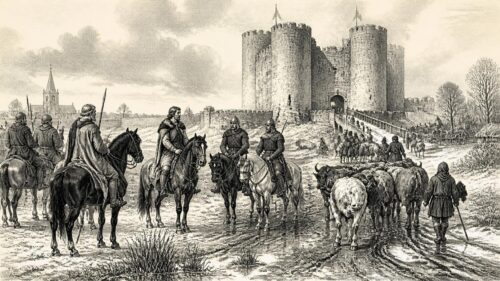
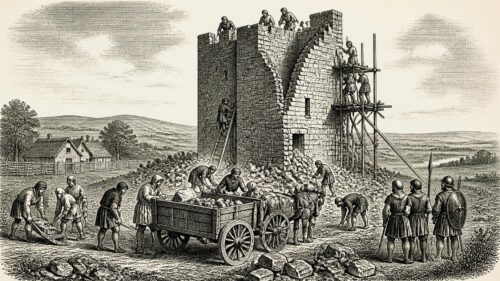
The expedition produced retaliation. While Niall Ó Domhnaill and his army, together with Ó Ruairc and his drovers, were away towards Assaroe Bay, Clann Donnchadha and Cathal son of Ruaidhrí Ó Conchobhair struck at Ó Ruairc’s stronghold. They burned the residence, pulled down its stone wall and ravaged the nearby country. The detail of a demolished stone enclosure is significant. Lordship depended on defended residences, but a castle or fortified house was not invulnerable once its defenders were absent. Control required people, livestock, supplies and intelligence as much as masonry.
Fighting continued around Ard Fhearna and Bundrowes Castle, near the approaches to Ballyshannon and Assaroe. The annalist says that men and horses were killed or wounded daily. Several named men fell, while Aodh, son of Muireadhach Ruadh Mac Lochlainn, drowned at the ford of Ballyshannon. Eventually the parties made peace. No treaty text survives in these entries, and no terms are stated. The settlement should therefore be understood only as a reported end to this phase of fighting, not as proof that the rivalries had been resolved permanently.
Taking the Lake
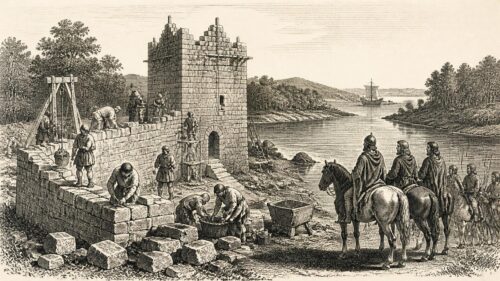
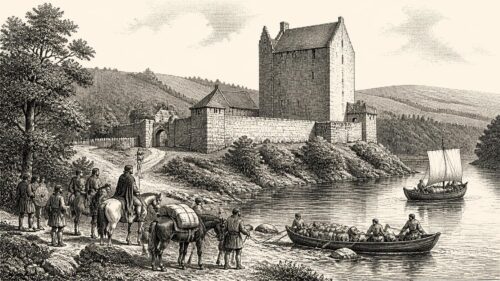
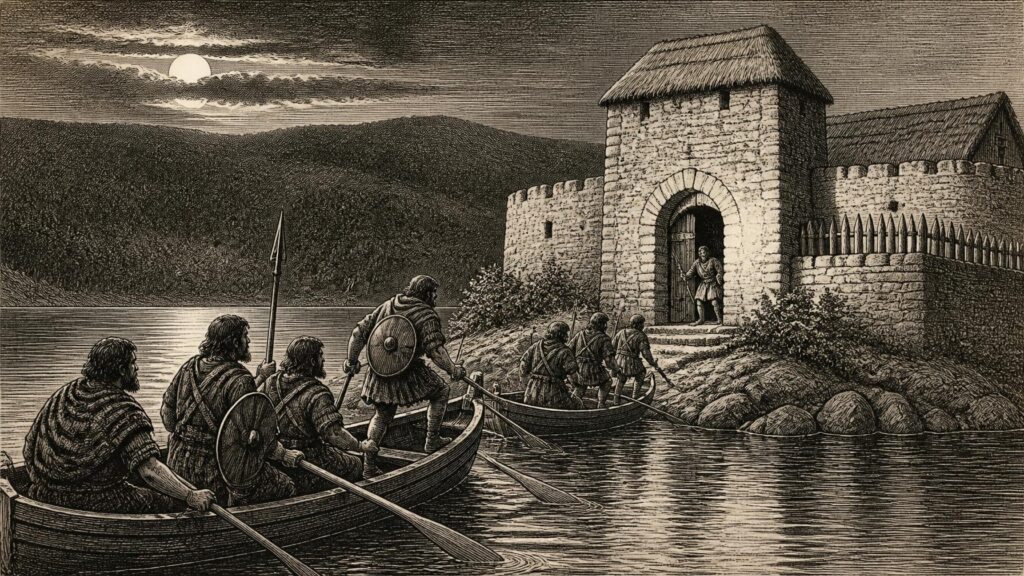
A more concentrated but striking episode occurred on Inis Caoin, an island in Lough Melvin. Cathal Ó Ruairc and his sons launched a night attack against a local rival. The account in Annála Connacht has some uncertainty in its family-name forms, while the Four Masters identifies the captive as Mac Clancy Óg. Both accounts agree on the essentials: the island garrison betrayed its charge, surrendered the lake’s boats to Cathal Ó Ruairc and his sons, and enabled them to capture the young lord, the lake and its castle. Five sons of the defeated family and numerous men of Dartry were killed; survivors sought refuge with the men of Carbury.
The episode makes the landscape itself politically important. Lough Melvin was not merely a boundary or scenic feature. Boats determined access to an island castle, the movement of fighters and the escape of those under attack. Possession of vessels, secured through betrayal rather than a conventional siege, made the night coup possible. The annals’ emphasis on the garrison’s action also warns against imagining medieval conflicts as contests between great lords alone. Lesser retainers and custodians of strategic places could alter a struggle decisively.
Captivity, Kinship and Reputation
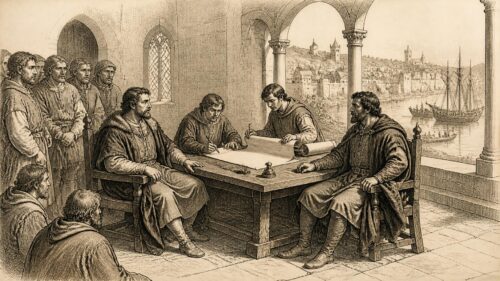
Other entries reveal politics conducted through custody and family networks. Eóghan Ó Néill was captured by Mac Uí Néill Buí while travelling to meet “the Earl” at Dundalk, almost certainly James Butler, fourth earl of Ormond and the king’s lieutenant in Ireland during this period. The record does not explain the purpose of the proposed meeting or the captor’s demands. It does establish that Dundalk was a point of contact between Ulster politics and the English administration, and that a journey to negotiate there could be interrupted by a rival within the wider Ó Néill world.
In Munster, Cormac na Coille Mac Carthaigh of Carbery was killed by the sons of Eóghan Mac Carthaigh. The annalist’s commendation of Cormac’s generosity and prowess again frames violent death through ideals of aristocratic conduct. Mór, daughter of Brian Ó Briain and wife of Walter Burke, also died. She had previously been married to Tadhg Ó Cearbhaill, and was remembered as Mór Mumhan, an exceptionally distinguished woman of Munster, noted for learning, hospitality, judgement and piety. The notice is a rare, valuable acknowledgement of a woman whose standing crossed major dynastic connections in Munster and Connacht.
Finally, Gilla Riabhach Ó Cléirigh, described as an eminent historian, died. His notice is brief, yet it matters. The year’s events survive because learned families and ecclesiastical writers maintained traditions of recording, judging and ordering political memory. In 1421, Ireland’s annalists did not portray a country waiting upon a single central authority. They recorded a world of competing lordships, religious institutions, waterways and strongholds, in which succession, hospitality, imprisonment, local knowledge and sudden violence all shaped public life.
Primary Sources
- The Annals of Ulster, Year U1421
- Annals of the Four Masters, Annal M1421
- Annála Connacht, Annal 1421
- CELT: Annals of Ulster
- CELT: Annals of the Four Masters
- CELT: Annála Connacht
- Translated Texts at CELT
- Irish Texts at CELT
- Exploring the Irish Annals
- Butler, James
- The English Lordship of Ireland and the Irish Sea World: re-assessing
- Boyle Cistercian Abbey
- Boyle Cistercian Abbey Highlights
- KILLEIGH: ‘The Abbey’, Offaly
- Killeigh
- Historic Landscape: Killeigh
- MS C iii 3 (The Annals of the Four Masters)
- The chronology and sources of the early Irish annals
- The Dating of the Irish Annals
- The Irish Annals
- Chronological Synchronisation of the Irish Annals