Limerick’s Stone and Timber Fire1413 CE
In 1413, Ireland remained politically fragmented, with Gaelic lords, Anglo-Irish interests, towns and churches exercising local power. Limerick suffered a destructive fire attributed by annals to an unnamed woman. Roscommon Castle became the focus of rival military operations, while raids and victories in Meath and Leinster demonstrated continuing frontier warfare. Tuathal Ó Máille’s returning fleet was wrecked near Scotland, causing extensive loss of life. At Lough Conn, violation of church sanctuary led to restitution of land. Annals also recorded lordly deaths, legal learning and Henry V’s accession, portraying a connected yet dangerous society shaped by warfare, religion, trade and reputation.
Dateline
In 1413 Ireland was not governed as a single political unit, nor did any one event bind the island into a common story. Power lay in a shifting patchwork of Gaelic lordships, Anglo-Irish liberties, walled towns, ecclesiastical estates and maritime communities. Yet the annals for this year preserve an unusually vivid range of experiences: an urban fire at Limerick, victories on the Leinster frontier, a struggle over Roscommon castle, a disastrous sea crossing from Ulster, and a settlement for the violation of church sanctuary beside Lough Conn. Read together, they show a society in which lordship depended on armed followings, cattle and land, but also on churches, ships, fortified places and reputations for generosity.
What Can Be Dated to 1413
The principal evidence is annalistic. The Annals of Ulster, Annals of Loch Cé, Annála Connacht and the later Annals of the Four Masters each place a number of occurrences under 1413. They do not offer a modern day-by-day chronicle. Some give a feast day or a calendrical date; many say only that something happened “this year”. Their accounts are nevertheless especially valuable because they record local matters which royal English records often pass over: the deaths of regional rulers, the movements of mercenaries, the capture of a church, the loss of ships, and the burning of towns and countryside.
There are differences between the compilations. The Ulster and Loch Cé annals, for example, both report the death of Conchobhar Ó Dochartaigh, lord of Inis Eoghain, and the maritime catastrophe involving Tuathal Ó Máille. Annála Connacht adds a much fuller Connacht and Leinster sequence. Such variation is a reminder that an annal is not a neutral national register. It preserves what its compilers or their sources considered memorable. Where accounts agree, confidence is stronger; where an episode appears in a single tradition, its wording should be treated with appropriate caution.
A New English Lord
One firmly dated change beyond Ireland had direct constitutional relevance. Henry IV died on 20 March 1413 and was succeeded by his son Henry V, who inherited the title Lord of Ireland with the English crown. The Connacht annalist marked the death of “the King of the English”, evidence that a change at Westminster was noticed in Irish learned circles. It would be wrong, however, to make 1413 a sudden turning point in Irish government. There is no evidence in these annals for an immediate island-wide intervention by Henry V. The crown’s effective authority remained strongest in and around Dublin and in the lordships held by Anglo-Irish magnates, while other rulers exercised power independently in much of the country.
The annals’ language makes this fractured political geography clear. Their “Foreigners” or Galla could denote English settlers and forces of the lordship, rather than every person of English ancestry. Conversely, alliances did not fall into a simple Irish-versus-English pattern. At Roscommon, a conflict recorded in 1413 involved both Gaelic and Gall allies on opposing sides. Local power, kinship, access to castles and rival claims to lordship could matter more than broad ethnic labels.
The Fire at Limerick
The most arresting urban notice is stark: Limerick was burned, “stone and wood”, by a woman. The phrase occurs in both Annála Connacht and the Four Masters. It should not be expanded beyond what the sources permit. They give neither the woman’s name nor a date, motive, legal outcome, or a trustworthy measure of the damage. Nor should “all Limerick” be read as an archaeological survey of complete destruction. Annalists commonly used emphatic language to convey calamity.
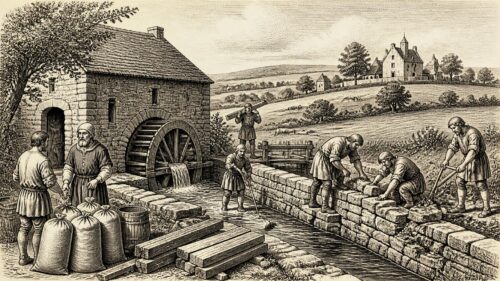
Even so, the entry is important. Limerick was a fortified river city and port, with buildings of timber as well as stone. A serious blaze in such a place endangered houses, stores, workshops, streets and the closely packed fabric of both the older English town on King’s Island and settlements across the Shannon. The specific contrast between stone and wood conveys the scale of the reported disaster: fire could damage not only ordinary timber structures but also roofs, fittings and interiors in more substantial masonry buildings. For residents, recovery meant replacing shelter and goods, restoring trade and repairing communal defences. The sources do not let us reconstruct that recovery, but they leave no doubt that the fire was remembered as a major event of the year.
Roscommon’s Contested Stronghold
In Connacht, 1413 brought conflict focused on Roscommon. The annals first report that Ó Conchobair Ruadh, William Ó Ceallaigh and Donnchadh Mac Domhnaill with gallóglaigh broke the bábhún, or outer defensive enclosure, of Roscommon. A constable of Mac Diarmata was killed by an arrow shot from the castle. The detail captures the practical character of late-medieval warfare: defended enclosures mattered, professional heavy infantry served powerful lords, and missile fire could decide a moment in an assault.
A further entry describes a large force led by the sons of Domhnall son of Muircheartach Ó Conchobair and Clann Donnchada. They marched to assist the descendants of Ruaidhrí Ó Conchobair and to provision the castle at Roscommon. Their opponents, Ó Conchobair Ruadh and the Uí Maine, supported by their respective Gaelic and Gall allies, routed the relief force at Carrickadarrin and pursued it through Cluain Aithrech into Ferann na Sithe. Murchadh Ó hAinlí and Fergal Grumach Mag Raghnaill were killed.
These notices should not automatically be compressed into one neatly dated siege. They demonstrate a connected struggle for a strategic site, but do not securely establish the exact order, duration or full aims of every operation. Roscommon castle had long been a potent symbol as well as a military position: an Anglo-Norman foundation beside an Ó Conchobair centre of power, it had been in Ó Conchobair hands since the fourteenth century. In 1413 its walls and provisions again made it a focus of regional rivalry. Control of such a place strengthened a claimant’s authority over surrounding people, routes, rents and supplies.
Raids and Victories
War also crossed the central and eastern frontiers. Tomás Óg Ó Raghallaigh of East Breifne and the Mac Cabas raided into Meath, burning and plundering. The pursuing English force caught them; Mathghamhain and Lochlainn Mac Cába, with many followers, were killed, while Tomás Óg was struck in the leg by a spear or javelin and remained lame thereafter. This was not a formal campaign between modern states but a raid-and-pursuit conflict, in which livestock, movable wealth and the destruction of crops or buildings were central weapons.
In Leinster, Art Mac Murchadha, king of Leinster, won a victory over the Galls of County Wexford, with many killed and captured. Ó Broin won another over the Galls of Dublin. Neither annal supplies a battlefield, date or casualty total, so the victories cannot responsibly be mapped in detail. Their significance lies in what they reveal about the pressure on the colonial frontier. Mac Murchadha’s lordship remained a formidable regional power, while the Ó Broins of the Wicklow uplands could strike at forces associated with Dublin. Captives were not incidental: they could be held for ransom, exchanged, or used to compel political concessions.
A Fleet Lost off Scotland
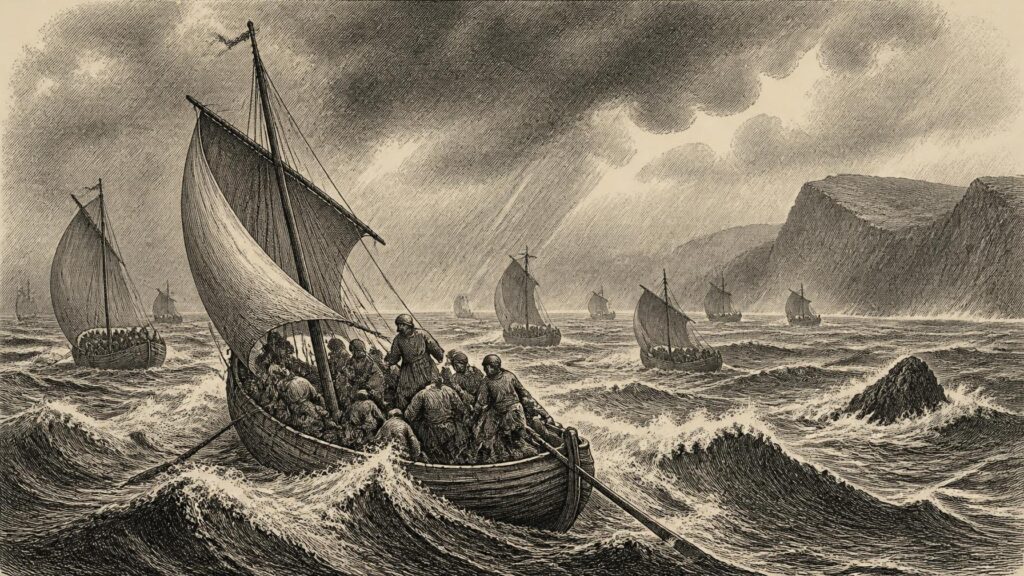
The year’s gravest human loss came at sea. Tuathal Ó Máille had spent a year in Ulster as a mercenary. Returning with seven ships and their companies around the feast of Colum Cille, a great storm in the western sea drove the fleet north towards Scotland. Six vessels were lost. The accounts name Tuathal’s two sons, Donnchadh Mac Suibhne and Domhnall Ballach Mac Suibhne Girr among the dead; Annála Connacht gives a total of 240 drowned, “gentle and simple”. Tuathal himself reached Scotland only with difficulty.
The phrasing matters. These were not merely chiefs travelling alone but shiploads of men and women, followers and dependants. Their presence in Ulster shows how military service connected western Connacht to the north; the route near Scotland reveals an Irish Sea world in which Irish, Hebridean and Scottish waters formed a single, hazardous zone of movement. Ships carried fighters, households, news and possibly goods, but a storm could erase a lord’s kin and retinue in hours. The disaster was therefore both a personal bereavement and a political blow to the maritime community of Umhaill.
Sanctuary, Land and Reputation
At Aireach or Errew on Lough Conn, Robert Mac Wattin seized Henry Barrett inside a church and carried him off by force. All the principal annals that record the event agree that the church was thereby violated. They also report the resolution in explicitly religious terms: the local saint, Tigernán, appeared to Mac Wattin in dreams until the captive was restored, and Mac Wattin granted a quarter-land in perpetual compensation, an éraic, for the dishonour done to the saint.
Whether one accepts the dream narrative as miracle, moral explanation or literary convention, the episode supplies unusually clear evidence of the church’s social standing. Sanctuary was a real claim with political consequences. A secular captor could be pressed to restore a prisoner and transfer valuable land to repair the injury. The church was not outside power struggles; it was embedded in them, capable of acting through saints’ cults, local memory and property rights.
Deaths recorded in 1413 similarly show the social expectations attached to lordship and learning. Conchobhar Ó Dochartaigh of Inis Eoghain and Cathal Ó Madadháin of Síl nAnmchadha died, while the obituary language for Ó Dochartaigh praises generosity and hospitality to poor people. The Four Masters also note the death of a Mac Aodhagáin of Ormond, learned in Fénechas, Irish legal learning. Such notices preserve ideals as much as biographies: a successful lord fed dependants and visitors, while legal specialists retained recognised authority in a world otherwise dominated in the annals by armed conflict.
An Uneven Year
Thus 1413 was not a year of one kingdom’s advance or collapse. It was a year in which Limerick faced an alarming fire, Roscommon became the prize in a contested war, Leinster lords defeated frontier opponents, a Breifne raid ended in losses, and an Ó Máille fleet was destroyed in the Irish Sea. Churches could demand redress, learned law remained prestigious, and distant changes in the English crown and papacy entered Irish annalistic notice. The surviving record is partial, but its fragments offer a grounded picture of Ireland as a connected, dangerous and resilient society in the early fifteenth century.
Primary Sources
- The Annals of Ulster, Year U1413
- Annals of Ulster otherwise Annala Senait, Annals of Senat, Year U1413
- Annals of the Four Masters, Annal M1413 (English translation)
- Annals of the Four Masters, Annal M1413 (Irish text)
- Annála Connacht
- Annals of Loch Cé, Annal LC1413 (English translation)
- Annals of Loch Cé, Annal LC1413 (Irish text)
- Murphy: The Annals of Clonmacnoise
- MacMurrough Kavanagh (Mac Murchadha Caomhánach), Art Mór
- O'Neill (Ó Néill), Eóghan
- O'Neill (Ó Néill), Enrí
- English Lordship of Ireland and the Irish Sea World: Re-assessing the Origins of the Kildare Ascendancy, c.1390–c.1513
- Roscommon Castle-South West Tower
- Ferrar: The History of Limerick
- Curry's Lane, Limerick, LIMERICK
- King John's Castle
- Memoranda Roll, 13-14 Henry IV (no. 123), membrane 36
- Calendar of the Close Rolls Preserved in the Public Record Office: Henry V, Volumes 1413-1419
- Calendar of the Patent Rolls: Henry V. 1413-1422. 2 v
- Henry V, 1413 to 1422
- Patent Rolls, Henry V (1413 to 1416)
- Irish Manuscripts