MacMurrough’s Burning Trail1405 CE
In 1405, Art Mór Mac Murchadha Caomhánach devastated County Wexford and burned Carlow and Tristledermot, demonstrating the vulnerability of English lordship towns and routes in Leinster. His campaign reflected conflicts over land, tribute, jurisdiction and authority, despite earlier interventions by Richard II. Government continued through appointments and James Butler, earl of Ormond’s deputyship, although his death added uncertainty. Elsewhere, warfare over dues in Moylurg killed Tadc Mac Diarmata and prompted succession. Annals also record local feuds, gallowglasses, learned men’s deaths, monastic burials and an early reference to uisce beatha. Ireland remained politically fragmented, culturally sophisticated and shaped by local power.
Dateline
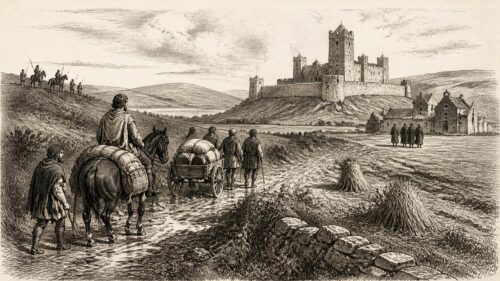
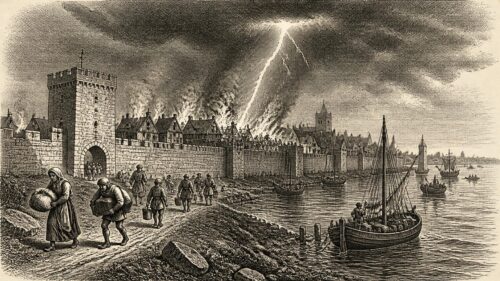
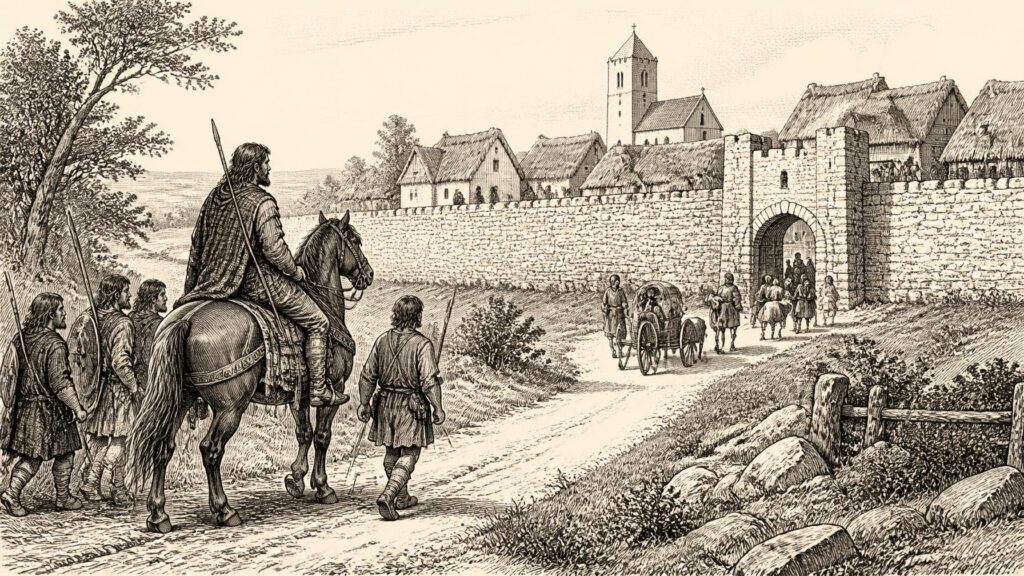
The annals place 1405 firmly among the hard years on the Leinster frontier. Art Mór Mac Murchadha Caomhánach, the formidable Gaelic ruler generally called MacMurrough, made war on the English of the lordship. The surviving Irish chronicles agree on the consequence, if not on a day-by-day sequence: County Wexford was ravaged, while Carlow and Tristledermot—modern Castledermot—were burned. This was not an isolated border raid. It exposed the fragility of the lordship’s towns and routes beyond Dublin, and showed that MacMurrough remained able to bring the war from mountain and woodland country into settled, walled and administratively important places.
A War Carried into Towns
The wording of the Annals of Connacht is unusually direct: Mac Murchadha made “a great war” upon the Galls, the term used here for the English or Anglo-Irish population and political interest. It records the “ravaging and burning” of County Wexford, followed by the burning of Carlow and Tristledermot. The Annals of the Four Masters, compiled later from earlier material, likewise associates the campaign with Wexford, Carlow and Diseart Diarmada, the Irish name behind Tristledermot. Neither source responsibly permits a precise date within 1405, a route of march, casualty total or a claim that every settlement in Wexford was destroyed. What can be said securely is that the annalists treated the attacks as a major Leinster war of that year.
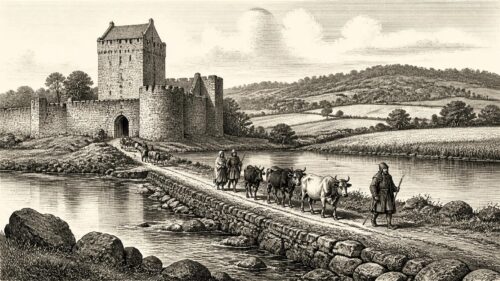
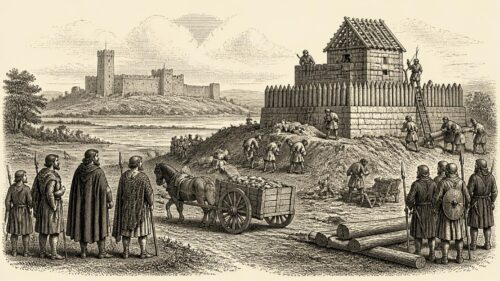
Wexford, Carlow and Tristledermot mattered because they were not merely groups of houses. They were nodes in the English lordship’s infrastructure: places of market, taxation, local justice, ecclesiastical life and communications. Wexford was a walled port-town with a long Norse and Anglo-Norman past. Carlow stood on the Barrow and guarded a vital crossing and approach into the interior. Tristledermot lay on the road corridor through southern Kildare, near the unstable meeting ground of settler lordships and Gaelic Leinster. In the previous century it had hosted royal councils and parliamentary sessions; its walls, gates and religious houses gave it an urban identity far beyond that of a rural settlement.
Fire was a devastating but practical instrument of medieval warfare. It could ruin timber buildings, food stores, workshops, roofs, carts and merchandise, and could drive inhabitants from suburbs or poorly defended quarters. Stone walls and churches might endure while the community within them suffered severely. Thus “burned” should not be imagined automatically as complete physical obliteration. Yet its economic and social effects could last: interrupted markets, lost rents, damage to defensive works, displaced households and a renewed need for labour and money. Later local evidence remembers the 1405 assault as a destructive episode in Castledermot’s difficult fifteenth-century history.
Art MacMurrough and the Leinster Frontier
The campaign belongs to the long contest between MacMurrough’s Leinster kingship and the English administration. Art’s authority rested on lordship over followers and allies, command of mobile fighting men, and influence across the borderlands of Carlow, Wicklow and Wexford. He had repeatedly resisted royal efforts to contain him. Richard II’s two great Irish expeditions in 1394–95 and 1399 had sought to impose a durable settlement; neither secured it. After Richard’s departure and deposition in 1399, the political setting changed again, but MacMurrough’s underlying grievances and power did not disappear.
One important background issue was land. Art’s marriage around 1390 to Elizabeth Calf, heiress of Norragh, had brought him into conflict with the colonial legal order, which treated the marriage and its consequences through the restrictive assumptions of the Statutes of Kilkenny. Agreements with Richard II had temporarily addressed the dispute, but such arrangements did not make Leinster peaceful. The war of 1405 should therefore not be reduced to an ethnic contest between fixed blocs. It involved land, tribute, jurisdiction, access to towns and the standing of rival rulers. Gaelic lords, English officials and Anglo-Irish magnates could negotiate, fight, exchange protection and alter alliances according to immediate interest.
The violence also had a political message. MacMurrough’s ability to burn towns demonstrated that the Crown’s writ did not extend evenly through the lordship of Ireland. Dublin remained its centre, but authority weakened sharply along exposed roads and manorial frontiers. Town walls could slow attackers and shelter people, but they could not by themselves secure a countryside in which raiding parties could move quickly, draw on local support or retreat into difficult terrain. The burning of Tristledermot was especially pointed: an administrative venue and frontier town had proved vulnerable despite its enclosure.
Government in the Lordship
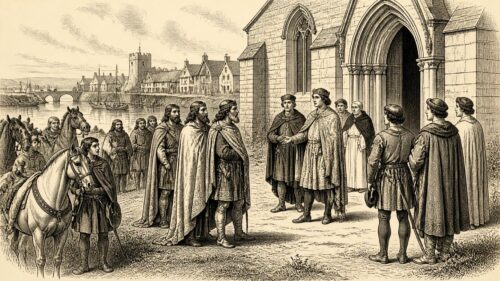
At the same time, government did not cease. Documents from 1405 show officials still issuing appointments and conducting business. On 28 January, at Dublin, John Bermingham was appointed a justice to hear pleas before the king in Ireland. On 4 July, at Naas, James Butler, third earl of Ormond, formally took up office as deputy to Stephen Scrope, who was himself deputy of Thomas of Lancaster, the king’s lieutenant in Ireland. The ceremony took place before Thomas Cranley, archbishop of Dublin and chancellor, Laurence Merbury, the treasurer, and other councillors.
These details reveal a layered and often absentee administration. Thomas of Lancaster, son of Henry IV, held the lieutenancy, while Scrope carried much of the practical burden as deputy lieutenant and governor of the wars. In Scrope’s absence during 1405, Ormond’s appointment gave a powerful resident magnate a central role. Ormond was no outsider to Gaelic politics: although a leading Anglo-Irish earl, he could use Irish language and custom when useful, and his influence was concentrated in the Nore–Suir–Barrow region. His assumption of office at Naas, rather than an immediate record of decisive victory in the field, is a reminder that administration, patronage and legal appointment remained indispensable even during crisis.
Ormond died later in 1405. His death removed an experienced figure who had served as justiciar and deputy lieutenant on several occasions. His heir, James Butler, was still young. The succession did not end Butler power, but it increased the importance of guardianship, household management and rival connections at a time when the lordship needed military resources and political co-operation. It would be misleading to claim that this death caused MacMurrough’s campaign: the annals do not make that connection. It nevertheless belongs to the year’s political atmosphere of uncertainty.
Conflict Beyond Leinster
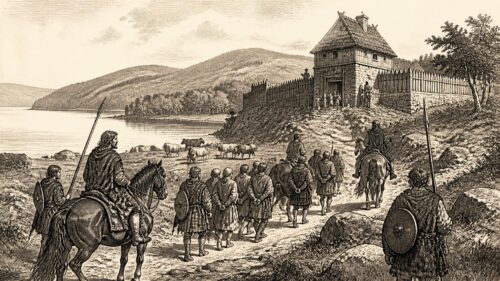
Other annalistic entries show that 1405 was not defined by a single national war. In Moylurg, around the modern Roscommon region, Tadc Mac Diarmata led an expedition into Airtech to demand the dues attached to his lordship. The language is revealing: this was presented as an assertion of a customary right, not simple plunder. His opponents included branches of the Ó Conchobair kindred, local people of Airtech and associated clans. At Loch Labain, Mac Diarmata’s force initially beat back a larger mixed host. Then he was struck by an arrow and died shortly afterwards, according to the Annals of Ulster; the Annals of Connacht gives the fuller account and places the great killing on the feast of the Crosses.
The outcome combined battlefield loss and succession. Ruaidri, son of Aed Mac Diarmata, was made ruler of Moylurg after Tadc’s burial. Such a transition mattered to dependants as much as to elite families. A lord’s dues, protection, judicial authority and capacity to raise men rested on personal leadership as well as inherited claim. The episode also records the presence of gallowglasses among Ó Conchobair’s force: heavily armed professional soldiers of Gaelic-Scottish origin, increasingly significant in late medieval Irish warfare. Horses, archery, foot soldiers, retainers and local levies all appear in the annalists’ compressed picture of conflict.
Elsewhere, the chronicles note killings among local ruling families: Donnchad Ó Lochlainn of Corcomroe was slain in a vengeance killing; Diarmait Ó Conchobair Ciarraige was killed by FitzMaurice of Kerry; Miles Dalton was slain amid a dispute involving Daltons; and the Uí Broin demolished Newcastle. These brief notices do not amount to a unified revolt. Rather, they show an island in which authority was dispersed and violence could arise from inheritance, retaliation, disputed dues and local rivalry as readily as from the large political divide visible in Leinster.
Learning, Faith and Everyday Risk
The obituary notices of 1405 preserve another Ireland: one held together by learned households, churches and professional education. Gilla-Duibin Mac Cruitín, ollam to the Uí Bhriain, was remembered as eminent in music, history and literary accomplishment. Cerball Ua Dálaigh, ollam of Corcomroe, died; so did William Ua Deoradhain, acclaimed as Leinster’s foremost ollam in jurisprudence, and Donnchadh Ua Mail-Conaire, historian to the Síol Muireadhaigh. Gilla na Naem Ó Cianáin, historian to the Fir Manach, died suddenly while staying in the household of Nede Ó Mailchonaire’s son and was buried at the monastery of Lorrha.
These were not casual titles. An ollam was a recognised master in a specialised hereditary learned tradition. Lawyers, historians, poets and musicians helped preserve law, genealogy, memory, praise and political legitimacy. Their deaths in one annal year do not prove a sudden collapse of learning; they instead provide rare, named evidence of an active intellectual world extending across Thomond, Corcomroe, Leinster, Connacht and Fermanagh. Monasteries remained important places of burial, sanctuary and remembrance, while clerics such as Johannes, vicar of Templehouse, appear alongside rulers and scholars in the record.
One striking notice concerns Risderd Mag Ragnaill, eligible for the chieftainship of Muintir Eolais, who died after excessive drinking of “water of life”. The annalist’s grim wordplay makes clear that this was regarded as fatal excess. It is an early explicit Irish annalistic reference to uisce beatha, later associated with whisky, but it should not be stretched into evidence for a nationwide commercial spirits industry in 1405. It does, however, bring a human detail into a chronicle otherwise dominated by war and lordship: strong distilled drink was known, socially meaningful and dangerous enough to be remembered in an elite obituary.
For Ireland, 1405 is therefore best understood through connected but uneven landscapes. In Leinster, MacMurrough’s war demonstrated the reach of Gaelic military power into the urban borderlands of the English lordship. In Connacht, a contest over dues ended in the death of a ruler and a swift succession. Across the island, offices were filled, councils met, scholars died, monasteries received burials and families endured the consequences of conflict. The sources do not yield a complete national narrative, but they give a clear impression of a politically divided, culturally sophisticated and intensely local society.
Primary Sources
- Annála Connacht, Annal 1405
- The Annals of Ulster, Year U1405
- Annals of the Four Masters, Annal M1405 (Irish text)
- CELT: Annals of the Four Masters—textual and editorial information
- CELT: Annals of Loch Cé—textual and editorial information
- Note 28 for The Description of Ireland: early reference to uisce beatha
- Patent Roll 6 Henry IV (1404–1405), Item 32
- Patent Roll 6 Henry IV (1404–1405), Item 60
- CIRCLE: A Calendar of Irish Chancery Letters, 1244–1509
- Castledermot Town Walls: Conservation, Management and Interpretation Plan
- Castledermot
- The Medieval Walled Towns of Kildare
- Wexford
- Wexford Town Wall Conservation Plan
- MacMurrough Kavanagh (Mac Murchadha Caomhánach), Art Mór
- Butler, James (a.1360–1405), third earl of Ormond
- Butler, James (c.1390–1452), fourth earl of Ormond
- Scrope, Stephen
- Cranley, Thomas
- CELT Project: Annála Connacht
- CELT Project: The Annals of Ulster
- Exploring the Irish Annals