The Battle of Magh Slecht1256 CE
Dateline
In 1256, the political frontier running through Connacht and Breifne was anything but fixed. The year’s fullest surviving narrative, preserved in the Annals of Connacht and the closely related Annals of Loch Cé, records a remarkable sequence of armies, negotiations, raids, hostage-taking and local feuds. Its central event was a hard-fought encounter at Magh Slecht, near the passes of Sliabh an Iarainn, where Áed Ó Conchobair and Conchobar Ó Ruairc defeated leading men of the Uí Raghallaigh. Yet the battle was not an isolated clash: it exposed the fragile alliances and overlapping claims that shaped life in the Irish midlands.
A Great Hosting into Connacht
Walter de Burgh, lord of Connacht, mounted the year’s first great display of power. The annals call his expedition a slúagadh, or hosting, against Fedlimid Ó Conchobair, king of Connacht, Fedlimid’s son Áed, and the sons of Tigernán Ó Ruairc. It marched through the English settlement of Magh Éo, then via Balla and across Luighne, plundering as it went. The chronicler’s claim that the army numbered 20,000 must be treated as rhetorical rather than a dependable headcount. It does, however, convey the exceptional scale of the mobilisation in contemporary eyes.
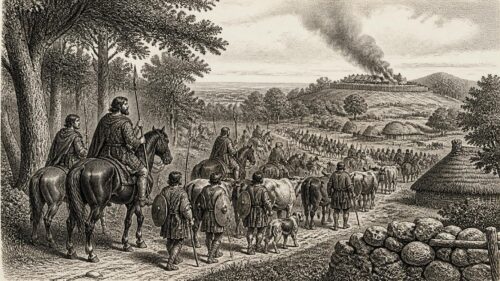
De Burgh’s force represented more than a private raid. His inheritance and lordship in Connacht rested upon a royal grant and upon the continuing ability of the Anglo-Irish colony to turn legal title into practical authority. The route through Mayo and north Connacht showed that the contest was being conducted across settled farming country, ecclesiastical lands and lordly territories, not in an empty military zone. Plundering meant the seizure of movable wealth, especially cattle, provisions and horses, and it could interrupt cultivation, displace households and diminish a lord’s capacity to reward followers.
The expedition also sought contact with the Uí Raghallaigh of eastern Breifne. They were invited to meet the host at Cros Doire Chaoin, near Brat Sliabh, but withdrew without doing so. This refusal mattered. The Uí Raghallaigh were important actors on the Connacht–Breifne–Meath frontier, where Irish dynasties, Anglo-Irish lords and royal officials each sought alliances that could bring fighting men, tribute and strategic access across the Shannon basin.
Magh Slecht and Alt na hÉlti
The campaign rapidly became a conflict within and around Breifne. On a Friday identified by the annalist as the feast of the Cross, Conchobar, son of Tigernán Ó Ruairc, gathered the men of Breifne and Conmaicne. He was joined by Áed Ó Conchobair, Connacht nobles, the Síl Muiredaig and a substantial following of younger warriors. The liturgical dating strongly places this phase in early May, but the annals do not provide a modern-style battlefield timetable.
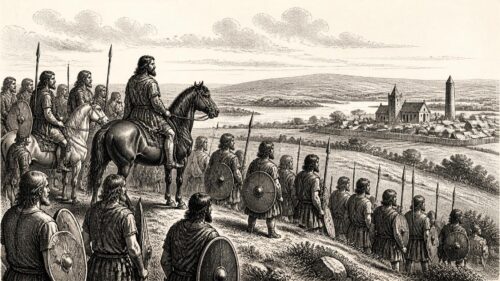
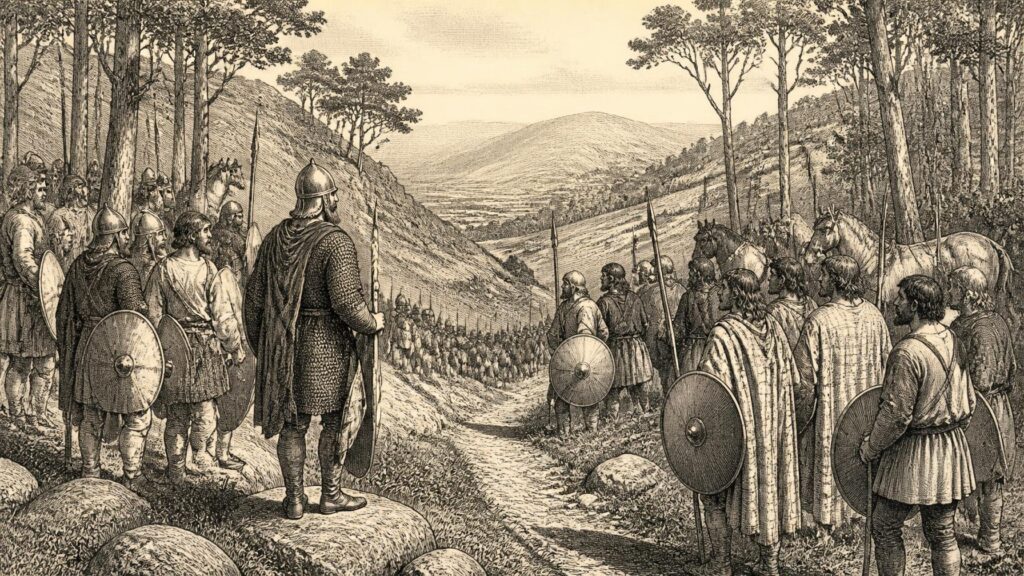
Initial fighting occurred around Soilten Gasan and Alt Tíge Mic Chuirrín. The Uí Raghallaigh counter-attacked and, according to the annalistic account, routed an advance force three times before the larger army arrived. The decisive engagement took place at Alt na hÉlti, above Bealach na Beithighe, on the edge of Magh Slecht. The location lay amid difficult upland routes between Breifne and Connacht. Such passes were militarily valuable: they channelled movement, limited cavalry’s freedom and made foreknowledge of tracks, woodland and river crossings a major advantage.
The annalist writes with unmistakable admiration for Áed, styling him the heir of Connacht and depicting him at the forefront of the fighting. That portrait is literary as well as historical, intended to celebrate the prince’s martial authority. Its core testimony is nevertheless confirmed by the Annals of Ulster: Áed and Conchobar Ó Ruairc defeated the Uí Raghallaigh, while important men on both sides were killed. Conchobar Ó Ruairc, Murchadh Finn Ó Fergail, Áed Ó Fergail and Máelruanaid Mac Donnchada fell among Áed’s coalition. The opposing losses included Cathal Ó Raghallaigh, members of his family, and many leading followers.
For contemporaries, a battle was measured not simply by possession of ground but by the deaths of named aristocrats and the capture of dependants. The loss of a king or a cluster of close kinsmen could transform a local political order. The long roll of casualties at Magh Slecht therefore signals a major blow to Uí Raghallaigh leadership, even if the precise total cannot be recovered. The battlefield was also a place of delayed mortality: the annals note men who died later of wounds at home, a reminder that survival after combat did not mean recovery.
Hostages, Churches and Retaliation
Victory did not settle the region. Fedlimid and Áed Ó Conchobair, accompanied by Conn Ó Ruairc and Breifne forces, subsequently moved to Loch an Trein. They attacked churches in Breifne, though Fidhnacha was spared, and carried off hostages from several local lineages. Hostages were not merely prisoners of war. They were living guarantees for agreements, submitted lordship and future good conduct; their delivery could formalise a new hierarchy without requiring permanent occupation.
The sparing of one church and the attack on others reveal a political landscape in which ecclesiastical communities were materially exposed but could also possess special claims to protection. Monasteries and churches held land, livestock, food stores, books, relics and dependent populations. They could serve as places of refuge, negotiation and commemoration, but were not outside warfare. The year also records Sitric Mac Senlaig seeking the protection of the religious order at the monastery of the Buill, where Donnchad Mac Senlaig later died. Such notices show religious houses operating as recognisable sanctuaries amid secular instability.
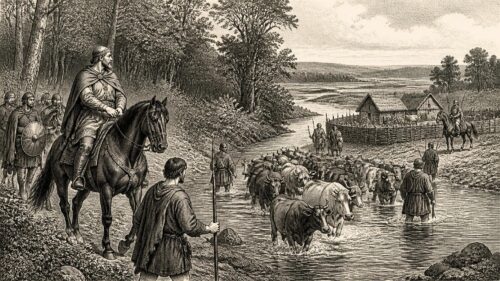
Uí Raghallaigh losses invited further retaliation. A force associated with Ó Ruairc defeated them again at Farnacht, killing thirty-six men according to the annals. Conchobar Ó Ruairc and allied chiefs then pursued Domnall Ó Raghallaigh after a meeting at Fidhnacha, killed his son Annad and took a substantial prey. The language of prey is important. Cattle and other livestock were stores of wealth, food, status and compensation; their removal inflicted immediate hardship while proclaiming the victor’s right to dominate the district.
Rindoon’s Conditional Peace
Against this background, the arrival of a new justiciar was a development of island-wide consequence. Alan la Zouche came to Ireland in 1256 as justiciar for the lord Edward, to whom Henry III had granted the lordship of Ireland. The annals say he came to settle disputes over lands among the barons and knights of Ireland. This was a reminder that royal government was attempting to regulate Anglo-Irish landholding and authority even while its frontier magnates fought their own campaigns.
Áed Ó Conchobair met the justiciar at Rinn Dúin on Lough Ree. The meeting produced peace on the condition that Ó Conchobair’s territory would not be reduced during la Zouche’s tenure. The qualification is revealing. It did not create a permanent settlement between Connacht and the colony; it was a time-limited guarantee tied to one office-holder. Still, it recognised Áed as a negotiating power rather than simply a rebel to be subdued.
Rinn Dúin was an apt setting. Founded in 1227 as a royal borough and castle, it stood on a peninsula above Lough Ree, close to the Shannon route and the contested approaches to Connacht. Its masonry, harbour and defended settlement embodied the colonial effort to secure communication, trade and military movement. A peace conference there demonstrated both royal reach and its limits: agreements had to be made with the very Gaelic rulers whose lands lay beyond, around and sometimes within the practical frontier.
Raids Beyond the Settlement
Peace with the justiciar did not end local violence. Áed raided the lands of Richard Cuisin in revenge for the killing of Ruaidrí Ó Gadhra, king of Sliabh Lugha, by David, Richard’s son. He demolished Cuisin’s castle, killed those inside, and took control of Loch Techet. The annals present this as vengeance for a treacherous killing, while their details underline the tactical importance of small castles: they were bases from which a family claimed land, gathered rents and offered protection, but could become conspicuous targets.
Walter de Burgh, meanwhile, raided Ruaidrí Ó Flaithbertaigh’s territory around Gno Mór and Gno Beag and took possession of Loch Orbsen, now Lough Corrib. Control of the lake mattered because it connected lordships, islands, fisheries and routes through western Connacht. Elsewhere, Áed met John de Verdun at Áth Liag na Sionna, and Athlone and Dún Daighre were burned on the same day. The sources do not safely explain every motive or identify every perpetrator, but together these entries show that waterways, bridgeheads, lake shores and fortified places remained central to conflict.
The year ended with another rupture. Friendship between Áed Ó Conchobair and Conn Ó Ruairc collapsed into open war when Ó Ruairc made a separate peace with the English without Fedlimid’s or Áed’s consent. Áed retaliated with a raid on the Wednesday before Christmas; peace followed afterwards. This compressed sequence captures the political reality of 1256. Alliances were personal and conditional, peace was negotiated repeatedly rather than achieved once, and authority depended upon the ability to mobilise kin, retain hostages, command routes and survive the next season’s campaigning.
Religion and learning were not absent from this violent year. Flann Mac Flainn, archbishop of Tuam, died at Bristol while pursuing church business in England, probably before 29 June. A noted scholar and churchman, he had sought royal redress over ecclesiastical rights and jurisdiction. The annals also record the deaths of the archbishop of Dublin and of abbots at Annaghdown and Holy Trinity, Tuam; the Dublin succession was complicated, and Fulk de Sandford was provided to the see in July. These changes, alongside war in Connacht and Breifne, reveal a country linked to English royal government, papal administration and Irish ecclesiastical institutions, yet governed on the ground by a shifting balance of lordship and force.
Primary Sources
- Annals of Loch Cé, A.D. 1014–1590
- Annals of Loch Cé, Part 11
- Annála Connacht
- Annála Connacht, Annal 1256
- The Annals of Ulster
- Annals of the Four Masters
- Annals of the Four Masters: Irish Text
- The Annals in Cotton MS. Titus A. XXV
- The Annals in Cotton MS. Titus A. XXV, Part 3
- Mac Flainn, Flann (Florence, Florentius)
- Burgh, Walter de
- O'Reilly (Ó Ragallaig), Matthew (Matha) Ruad
- Sandford, Fulk de
- O'Connor (Ó Conchobair), Fedlimid
- Rinn Duin-Rindoon Deserted Medieval Town
- Rindoon County Roscommon Management Plan
- Rindoon Castle, Co. Roscommon: A Border Castle on the Irish Frontier
- Rindoon
- Irish Castles: 1180 to 1310
- Alan la Zouche, Named 1242 to 1467
- Exploring the Irish Annals
- Annals of the Kingdom of Ireland: Table of Contents