Feidlim at Henry’s Court1240 CE

Dateline
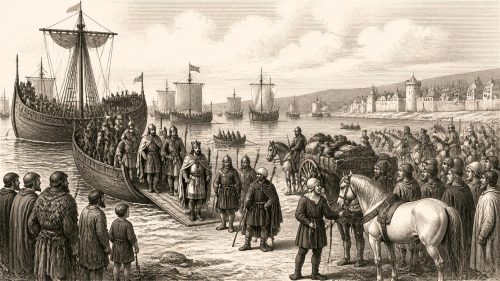
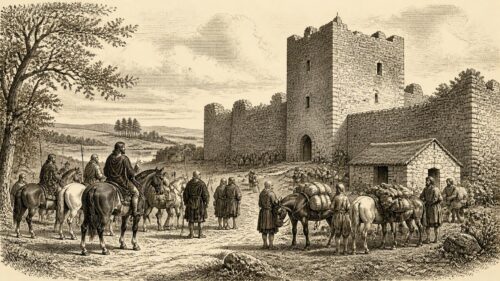
In 1240, one journey gave Irish politics an unusually direct connection with the court of King Henry III of England. Feidlim Ua Conchobair, king of Connacht, crossed the sea to present his case before the English king. The Annals of Connacht state plainly that he went to complain of the Galls and Gaels of Ireland: that is, of both the Anglo-Norman settlers and lords commonly called ‘Foreigners’ in Irish chronicles, and Irish opponents. The annalists say that Henry received him with great honour and that Feidlim returned safely, cheerful and satisfied. The brief notice does not preserve the arguments, concessions or promises made. Yet the visit was a striking act of political calculation: a Gaelic king who faced powerful enemies at home sought justice, recognition and protection from the ultimate authority claimed by the English administration in Ireland.
A King Appeals Across the Sea
Feidlim’s voyage must be understood against the unsettled background of Connacht after the Anglo-Norman invasion. This was not a new war begun in 1240, but an established condition shaping the year. Richard de Burgh had secured a royal grant of Connacht, while Feidlim had fought repeatedly to retain practical authority within his father’s former kingdom. After defeat and submission in 1235, Feidlim had been allowed the king’s five cantreds in Roscommon on terms that acknowledged English royal claims. De Burgh and other colonial interests nevertheless continued to build influence west of the Shannon through castles, landholding and the arrival of settlers.
For Feidlim, therefore, an appeal to Henry III was not an abandonment of Gaelic kingship but an attempt to use the king’s own overlordship against men exercising power in Ireland. The wording of the annals is important. He complained not simply about ‘the English’, but about Irish as well as Anglo-Norman adversaries. Connacht’s conflicts crossed every supposed ethnic boundary. Gaelic dynasties competed among themselves; some Irish rulers made alliances with colonial magnates; Anglo-Norman lords relied upon Irish allies and fighting men; and local communities bore the costs of raids whichever language their leaders spoke.
The contemporary annals agree on the essentials of Feidlim’s journey. The Annals of Ulster report that he went to ‘the house of the king of the Saxons’ and returned with honour and respect. The Dominican annals compiled at Roscommon also mark his crossing to the king of England. Later interpretation identifies Richard de Burgh’s encroachments in Connacht as a principal grievance, but the surviving 1240 notices themselves do not provide a formal petition. It is safest to say that Feidlim brought a broad complaint concerning the political pressures placed upon him by Irish and Anglo-Norman rivals, and that he obtained a ceremonially favourable reception rather than a securely recorded settlement.
Violence in Moylurg
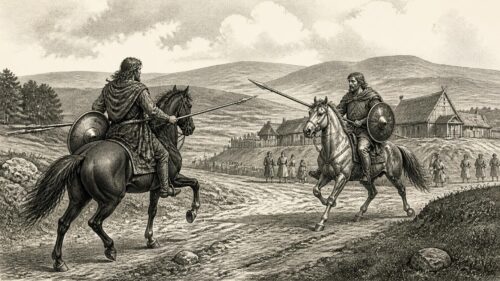
While Feidlim pursued redress abroad, northern Connacht saw a forceful alteration in the lordship of Moylurg, the territory around Lough Key and Ardcarne in present-day County Roscommon. Cú Chonnacht Ó Raigillig, or O’Reilly, led a great raid against Cormac son of Tomaltach Mac Diarmata. The Annals of Connacht say that his forces plundered the country as far as Ardcarne and killed many people in vengeance for Cú Chonnacht’s son. The Annals of Ulster name that son as Ferghal and record his killing by Máelruanaid, son of Ferghal, together with Conchobar, son of Cormac Mac Diarmata.
The entries show how a dynastic killing could become a campaign that exposed an entire district to devastation. Raiding was not merely a clash between armed retainers. It endangered households, livestock, stores, church lands and the movement of people along roads and waterways. The chroniclers’ phrase that the country was plundered as far as Ardcarne conveys a broad punitive incursion rather than a neatly bounded battle. It also reveals the vulnerability of places attached to the church: Ardcarne was both a religious centre and a landmark in a contested political landscape.
The immediate political consequence was Cormac Mac Diarmata’s deposition. The Annals of the Four Masters say that Donnchadh, son of Muirchertach Mac Diarmata, assumed the lordship of Moylurg. The Annals of Ulster, using the language of a particular dynastic centre, says that Donnchadh took ‘the kingship of the Rock’, almost certainly the Mac Diarmata stronghold on Lough Key. Together, these accounts describe not an administrative succession but a change imposed amid external pressure and kin-group rivalry. A lordship could be territorial, familial and physical at once: control of Moylurg was expressed through command over its people, tribute and hosting obligations, but also through possession of an island stronghold and its surrounding lake country.
Ó Raigillig power came from Breifne, to the north-east, but the raid illustrates how readily regional rivalries reached into Connacht. Cú Chonnacht was ambitious beyond his own lordship, and the Mac Diarmata family’s internal divisions made intervention possible. This did not make Moylurg a passive victim. Its rulers remained actors in Connacht politics, but 1240 demonstrates the precariousness of their position between the Ó Conchobair kings, Breifne’s powerful Ó Raigillig dynasty, neighbouring lordships and the expanding Anglo-Norman world.
Deaths, Lordship and Local Networks
Other notices from the year are short, but they bring local political relationships into view. Áed, son of Gilla na Naem Crom Ó Seachnasaigh, was killed by Conchobar, son of Áed, son of Cathal Crobderg Ua Conchobair, and by Fiachra Ó Flainn. The event belongs to the web of rival Connacht lineages surrounding Feidlim’s family. It is not possible from this entry alone to reconstruct motive, location or scale, and the restraint of the record is a reminder that medieval annals preserve outcomes more often than their full causes.
The annals also record the death of Sadb, daughter of Ó Cennétig and wife of Donnchadh Cairbreach Ó Briain of Thomond. Her notice is brief, but the identification of both her natal and marital families shows the importance attached to high-status marriage connections between ruling houses. Such women were central to the kinship networks through which lordship, fosterage, alliance and claims to honour circulated, even when the sources rarely record their own actions in detail.
At Ardcarne, Gilla na Naem Ó Dreain, described as airchinnech or erenagh, died during the year. An erenagh was a hereditary ecclesiastical office-holder responsible for the temporal management and local standing of a church estate. His death, set beside the raid that reached Ardcarne, points to the close interweaving of church institutions and secular lordship. Religious communities held land, received protection and hospitality, and could be exposed when warfare passed through their district. No source states that the raid caused this churchman’s death; the two notices should not be falsely joined. Their presence in the same annalistic year nevertheless shows why Ardcarne mattered as more than a remote religious site.
Armagh and Westminster
Church affairs also connected Ireland directly to England in 1240. Albert Suerbeer, a learned cleric from Cologne who had been provided to the see of Armagh before March 1239, was consecrated archbishop at Westminster on 30 September 1240. The consecration took place in the presence of Henry III and the papal legate Otto. The Annals of Ulster record the fact in compressed form, calling him Alberic or Albert and noting that the archbishop of Armagh was consecrated in England.
This was firmly an ecclesiastical event of 1240, but it should not be mistaken for Albert’s arrival in Ireland: the Dominican annals place his arrival there in 1242. His consecration instead demonstrates the international channels through which the Irish church operated. The primatial see of Armagh stood at the meeting point of papal provision, English royal influence and Irish ecclesiastical claims. Albert’s background in the schools of continental Europe and his consecration at Westminster underline that the church in Ireland was part of a wider Latin Christian world, even as its local churches remained embedded in Gaelic lordships such as those around Ardcarne.
Franciscan Foundations and Caution
Two Franciscan foundations are traditionally assigned to 1240. The Annals of the Four Masters state that Sir Hugh Purcell founded a house for Friars Minor at Waterford, and that Mac Carthaigh Reagh founded one at Timoleague in Carbery, where a tomb was prepared in the friars’ choir. Waterford’s foundation is broadly accepted as dating from about 1240, although modern archaeological assessment cautions that the precise details and date of its origin rest on later testimony rather than surviving contemporary foundation documents. What can be said securely is that a Franciscan house existed at Waterford by 1245, when it received royal alms.
Timoleague requires still greater care. The Four Masters place a Franciscan foundation there in 1240, but modern heritage and monastic studies date the friary only to before 1316 or stress uncertainty over its founder and early development. The 1240 entry is valuable evidence for a strong historical tradition linking the Mac Carthaigh Reagh family and the Friars Minor to Timoleague; it is not sufficient to claim confidently that the surviving friary complex was begun in that calendar year.
Even with those qualifications, the notices matter. They belong to the rapid spread of the mendicant orders through thirteenth-century Ireland. Franciscans established urban and rural houses dependent on patronage, alms and local goodwill rather than the older model of large landed monasteries alone. A foundation at the port city of Waterford and a traditionally remembered one in west Cork suggest how this new religious life could take root in contrasting settings: a royal and commercial town on the south-east coast, and a Gaelic lordship beside the Argideen estuary.
A Year of Connected Authorities
There is no securely dated harvest failure, epidemic or climatic disaster recorded for Ireland in 1240, and silence should not be turned into evidence of an easy year. What the sources do preserve is a sequence of contested authority. Feidlim Ua Conchobair sought the English king’s favour while Connacht’s smaller lordships were remade by raid and deposition. Armagh gained an archbishop consecrated at Westminster but not yet installed in Ireland. Franciscan expansion was remembered in Waterford with reasonable confidence, and at Timoleague through a tradition that must be handled cautiously. Across these developments, Ireland in 1240 was neither simply conquered nor simply independent: its rulers, churches and communities worked within overlapping Gaelic, Anglo-Norman, royal and papal worlds.
Primary Sources
- The Annals of Ulster, Year U1240
- The Annals of Connacht, Annal 1240
- Annals of the Four Masters, M1240
- Annals of the Four Masters, Irish text, M1240
- Annales Dominicani de Roscoman
- O'Connor (Ó Conchobair), Fedlimid
- Burgh, Richard de
- Suerbeer, Albert (Albertus, Albrecht)
- O'Reilly (Ó Ragallaig), Cathal
- Waterford
- Waterford Franciscan Friary
- The Franciscans in Waterford
- County Waterford City Urban Archaeology Survey
- Timoleague Franciscan Friary
- Timoleague Franciscan Friary
- Timoleague (Co. Cork)
- A History of the Franciscan Order in Ireland
- Parchment Conquest, 1171–1307
- Calendar of Documents, Relating to Ireland: Preserved in Her Majesty's Public Record Office, London, 1171–1307
- Annals of the Kingdom of Ireland
- Exploring the Irish Annals