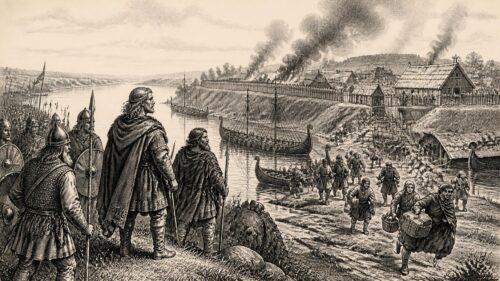
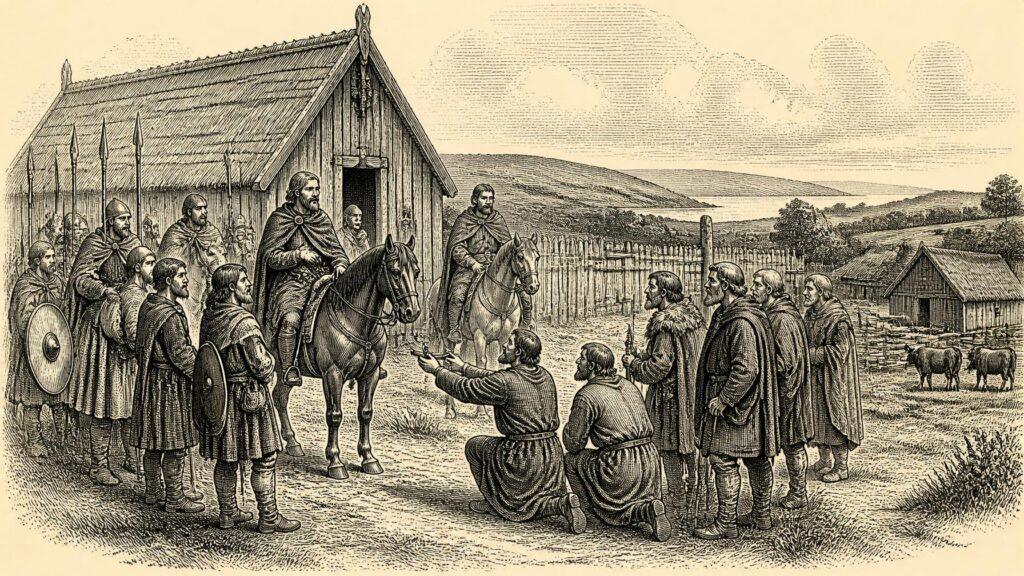
Domnall’s Dál Araide Pledges960 CE
Dateline
For Ireland in 960, the surviving record is brief but unusually revealing. It does not offer a single decisive battle, a royal inauguration or a named treaty. Instead, the nearest contemporary annalistic sequence preserves a cluster of movements: a northern ruler took pledges in Dál Araide; a man of the Dublin dynasty suffered defeat at an otherwise uncertain place; a figure called Muiredach made a wide circuit of Connacht; and Cathmug, associated with the great church of Lismore, died. Read carefully, these notices illuminate the practical business of power in a country of many kings, river routes and ecclesiastical communities.
A Year with a Dating Problem
The date requires care. Irish annals were compiled and recopied over centuries, and their year headings do not always align perfectly with the modern calendar. The relevant notice in the Annals of Ulster stands under U960, headed “AD 959 alias 960”: in other words, the compilers themselves preserved a one-year ambiguity. It is therefore responsible to connect the events below with 960, but not to assign them to a particular season or day.
This caution matters because later compilations can appear more generous than the evidence warrants. The Annals of the Four Masters place a far larger group of raids, deaths and naval actions under their heading for 960. Yet comparison with the Annals of Ulster, the Annals of Inisfallen and Chronicon Scotorum shows that several of those notices belong in later annalistic positions. They should not be silently transferred into the calendar year 960. The firmer picture is smaller: a northern expedition, pressure around Dublin, a Connacht circuit and the passing of a leading churchman.
Pledges in Dál Araide
The most substantial entry records that Domnall son of Muirchertach led an army into Dál Araide and took pledges. Domnall was the leading representative of Cenél nEógain, the powerful northern branch of the Uí Néill, and had begun his reign after the killing of Congalach Cnogba in 956. Later historical language often calls such a ruler high king, but that convenient label can conceal the realities of tenth-century politics. Domnall’s authority depended upon repeated personal intervention, alliances and the acquisition of guarantees from lesser kings.
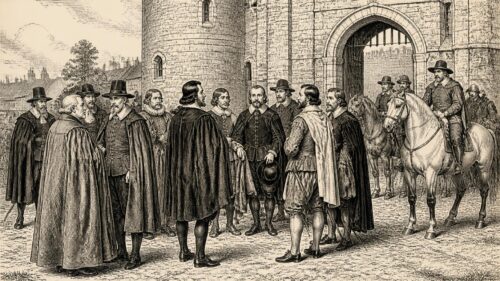
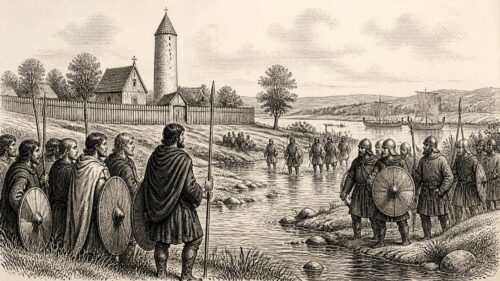
Dál Araide lay in eastern Ulster, principally in the region of modern County Antrim and adjoining areas. It was politically important because it stood among the competing peoples of Ulaid and beside routes towards the Irish Sea. Domnall’s expedition was not necessarily an attempt at permanent occupation. The annal says nothing of a battle, burning or annexation. Its significant word is “pledges”. In early medieval Irish politics, pledges were people delivered as security for an agreement or submission. Their presence in a ruler’s custody helped turn a momentary show of force into an enforceable relationship.
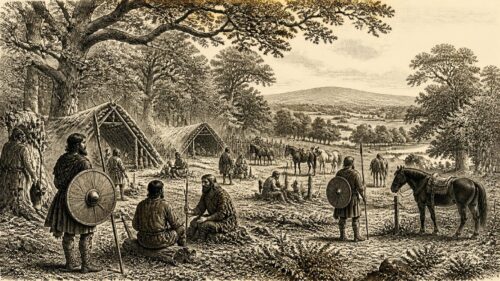
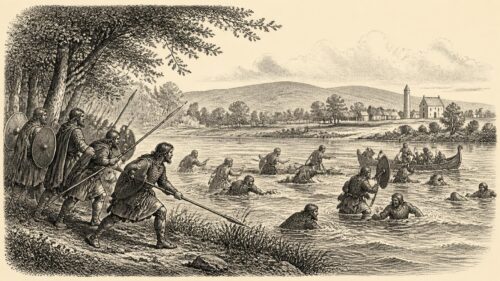
Such an expedition would have involved far more than armed aristocrats. A hosting needed food, cattle, horses, attendants, scouts and guides; it also required knowledge of roads, fords and local supplies. The taking of pledges placed families and client networks under acute pressure. It could protect an agreement, but it also advertised hierarchy: Domnall’s army had reached Dál Araide, and its rulers had supplied a tangible sign of compliance. In a landscape without a central bureaucracy, this was one of the principal ways in which an overking made political claims real.
Dublin’s Unsettled Orbit
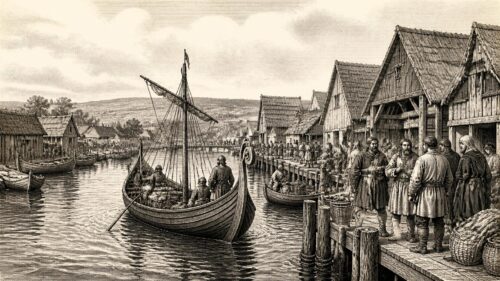
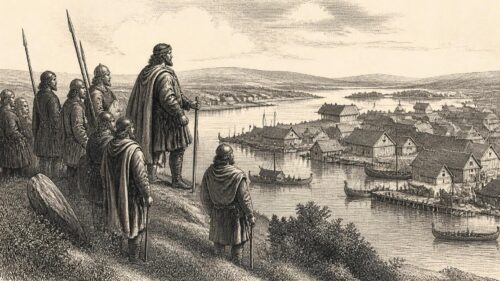
Another entry states that Carlus, son of Conn son of Donnchad, was killed at Áth Cliath, Dublin. The annalist supplies neither assailants nor motive, so the notice cannot honestly be expanded into a known battle or feud. Its setting is nonetheless important. Dublin was by this date a Hiberno-Norse port and a seat of armed rulers, traders, craftspeople and enslaved people, tied by sea to Britain, the Isles and Scandinavia and by river and road to Irish kingdoms. Violence at Dublin was never merely local, even when the sources give only a name.
The same annal notes the defeat of Camán, son of Amlaíb son of Gothfrith, at a place called Dub. Camán’s genealogy connects him to the dynasty associated with Dublin’s Scandinavian rulers. But “Dub” has not been securely identified from this brief entry, and the annal does not describe the opposing force, the scale of the encounter or its political consequences. The safe conclusion is limited but meaningful: members of that dynasty were active in conflict during the year, while Dublin’s connections reached beyond its defended settlement and harbour.
These notices are a useful corrective to the old habit of treating “Irish” and “Viking” as fixed opposing camps. By 960, people of Scandinavian ancestry in Ireland had long formed families, military followings and commercial ties within Irish politics. The annals sometimes call them foreigners, but political relationships changed with circumstance. A ruler could ally with, fight beside or fight against a Dublin force according to immediate advantage. Domnall’s march into eastern Ulster and the notices from Dublin belong to the same broad world of rival powers negotiating the coast, the sea lanes and the approaches to the north-east.
Connacht and Lismore
The year’s western notice is tantalising: Muiredach son of Fergus “made a great circuit of Connacht”. It does not tell us whether this was a royal progress, a military raid, an assertion of claims, a levy-gathering journey or a combination of these. The phrase nevertheless implies movement on a considerable scale across a province divided among dynasties such as the Uí Briúin, Uí Fhiachrach and Uí Maine. A circuit could demonstrate lordship by receiving hospitality, hearing disputes, collecting renders and showing that one’s followers could travel through contested territory.
Connacht’s political geography was shaped by lakes, rivers, pastureland and routeways as much as by genealogies. Its kings and leading families measured power in cattle, clients, armed retainers and control of strategically placed churches. A “great circuit” was therefore an event in the lived landscape: households prepared food, stock was driven or protected, boats and fords mattered, and local rulers had to decide whether to receive the travellers, negotiate with them or resist them. The terse annal preserves the movement but not the many obligations that made it possible.
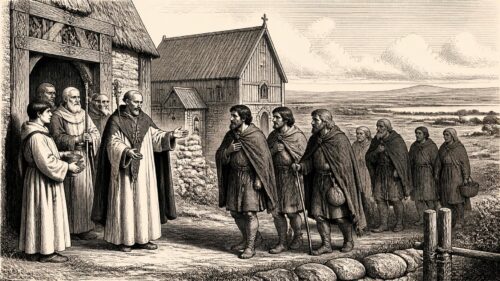
The final related entry records the repose of Cathmug, superior of Lismore. A southern annal identifies him more fully as bishop of Cork and abbot of Lismore, although it places his death in a neighbouring year heading. This is precisely the kind of chronological variation that prevents an exact day or season being claimed. What is secure is that Cathmug belonged to the senior ecclesiastical world of Munster in this period. Lismore, on the Blackwater, was not simply a secluded religious house: monasteries were landholders, places of worship, centres of literacy and craft, and nodes in regional travel and exchange.
Life Beyond the Annals
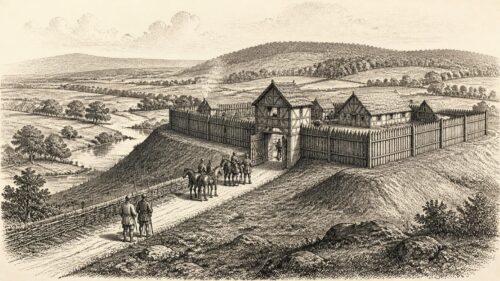
The annals chiefly remembered kings, clerics, killings and expeditions, not ordinary routines. Archaeology helps restore that missing ground. Most people lived in a dispersed rural world of farms, ringforts, enclosed homesteads and smaller settlements. Cattle remained central to wealth and lordship, but households also grew cereals, kept other animals, worked wood and iron, ground grain and used waterways to move people and goods. The exact experience differed sharply by status: a royal follower, a tenant farmer, an enslaved person and a religious scholar met the same political events very differently.
Christian institutions were embedded in that society rather than standing apart from it. Churches and monasteries required labour, food, land and protection; they also offered religious prestige, education and places where documents, genealogies and memory could be maintained. Cathmug’s death thus belongs alongside Domnall’s pledges, not in a separate story. Both demonstrate how influence was organised through personal bonds, landed resources and recognised authority.
960 was consequently not a quiet interval between better-known crises. It was a year in which authority was enacted on the road: Domnall compelled assurances in Dál Araide; Dublin’s ruling milieu remained militarily unsettled; Muiredach’s followers traversed Connacht; and Lismore marked the loss of an eminent superior. The surviving notices are few, but they show an Ireland whose politics rested on movement, hostages, kinship, ecclesiastical standing and command of the routes that connected local kingdoms.
Primary Sources
- The Annals of Ulster
- Annals of the Four Masters
- Annals of Inisfallen
- Chronicon Scotorum
- Annals of Tigernach
- Fragmentary Annals of Ireland
- Cogadh Gaedhel re Gallaibh: The War of the Gaedhil with the Gaill
- Vikings in Ireland and Scotland
- Viking Ireland and its Aftermath
- The Economy of Early Medieval Ireland
- Early Medieval Dwellings and Settlements in Ireland, AD 400–1100
- The Archaeology of Livestock and Cereal Production in Early Medieval Ireland, AD 400–1100
- Early Medieval Ireland: Archaeological Excavations, 1930–2009
- Mapping Social, Ideological and Economic Transformations: Settlement and Landscape in the Early Medieval Kingdom of Brega, AD 400–1100
- Early Christian Monasteries
- Early Monastic Churches
- Waterways Study: Lanesborough to Shannonbridge
- Discover the Walled Towns of Ireland
- Early Christian Ireland
- Tara Research Project