Enniskillen Hostages1439 CE
In 1439, Irish politics were shaped by local struggles over captives, castles, succession and recognition. Domhnall Ballach Maguire seized Tomás Óg Maguire at Enniskillen, securing his release only through hostages and control of the castle. Niall Garbh Ó Domhnaill died in English captivity, enabling Neachtan’s succession in Tír Chonaill, although sources dispute where he died. Cathal Ó Conchobair’s death triggered competing claims to Connacht’s kingship and warfare. Dublin suffered plague, while lordship changed through Donnchadh Dubh Ó hEadhra’s religious profession. A reported English deputy’s capture further illustrates fragmented authority, negotiated power and connections across Ireland and the Irish Sea alike.
Dateline
In 1439, Ireland’s political map was not altered by a single national campaign or royal settlement. Instead, the year is revealed through a cluster of crises in which control of people, strongholds and titles was fiercely contested. The most vivid episode occurred in Fir Manach (Fermanagh), where Tomás Óg Maguire, lord of the territory, was seized inside his own castle. Yet the annals also record a change of lordship in Tír Chonaill, a disputed succession in Connacht, severe sickness in Dublin, and a lord’s decision to abandon secular power for religious life. Taken together, these events show how authority worked in fifteenth-century Ireland: personal, local, dynastic, and sustained by alliances as much as by territory.
Reading a Sparse Year
The evidence for 1439 is uneven. The Annals of Ulster and the Annals of Loch Cé preserve terse year entries, while the seventeenth-century Annals of the Four Masters, drawing on earlier material, supplies fuller narratives and additional notices. Their agreement is especially valuable for the Maguire crisis, the death of Niall Garbh Ó Domhnaill and the killing of Feradhach Maguire. Elsewhere, particularly for the reported mortality in Dublin, the detail belongs to the Four Masters alone and needs cautious handling. The annals were not modern newspapers or population registers: they selected matters that their compilers considered memorable, politically significant or morally meaningful.
That selectiveness should not make the year seem empty. It directs attention towards the machinery of lordship. Captivity, fosterage, marriage, hostage-taking, the possession of a castle, religious profession and public recognition of a successor were all practical instruments of power. They mattered to rulers and their followers, but also to the households, tenants, churchmen, learned families and fighting men whose security depended on the outcome.
A Castle Taken From Within
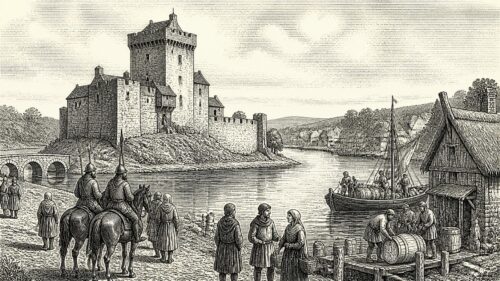
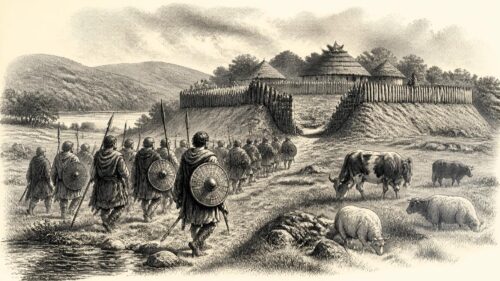
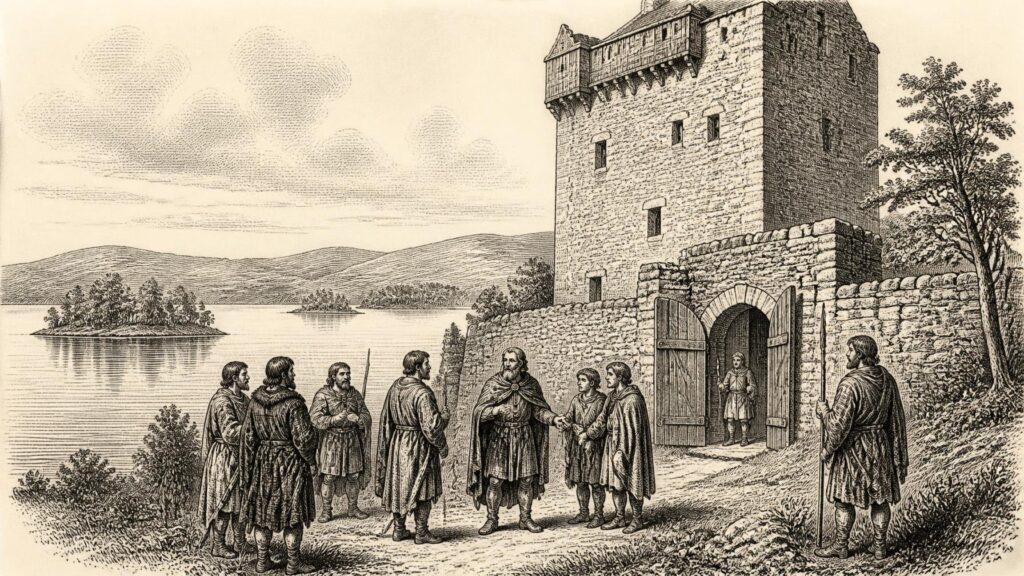
About the feast of St Patrick, in mid-March, the leading event of the year unfolded at the Maguire castle of Inis Ceithlenn, now Enniskillen. Tomás Óg Maguire, ruler of Fir Manach, had imprisoned a kinsman, Pilib Maguire, in 1438. In 1439 Domhnall Ballach Maguire, called “the Freckled” in the annals, turned this detention against Tomás. He captured the lord in his own stronghold and released Pilib on the same day. The Four Masters add a striking detail: the fetters formerly used on Pilib were put on Tomás. Whether or not every narrative flourish can be tested, the basic reversal is independently supported by the Ulster and Loch Cé annals.
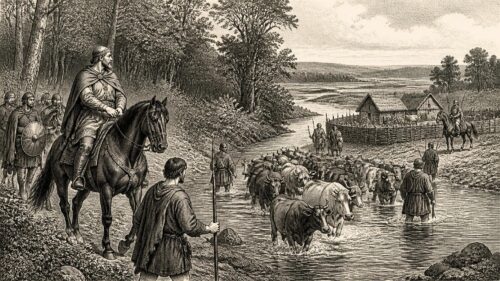
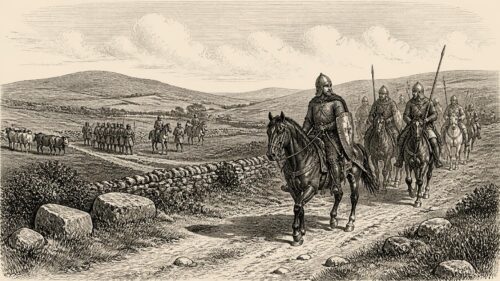
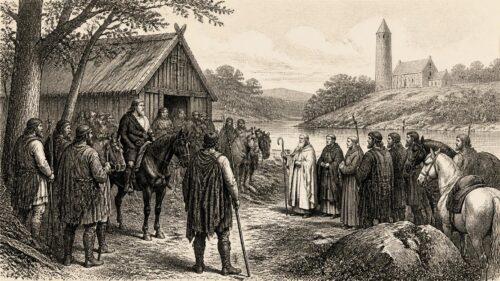
This was not merely a private quarrel. Tomás’s capture exposed a fracture within the Maguire kindred and endangered the stability of the Erne lordship. Énrí Ó Néill of Tír Eóghain responded by gathering a force and marching to Port-abhla-Faelain, where Tomás was being held by Domhnall and Pilib. His intervention did not simply restore his ally by force. A negotiated settlement followed. Tomás was freed, but his son Éamonn, his wife—the daughter of Mag Eochagáin—and other hostages were handed over. Domhnall Ballach also received the castle of Inis Ceithlenn.
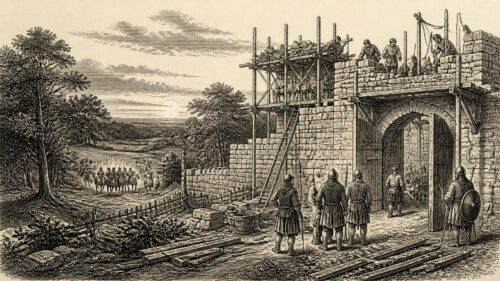
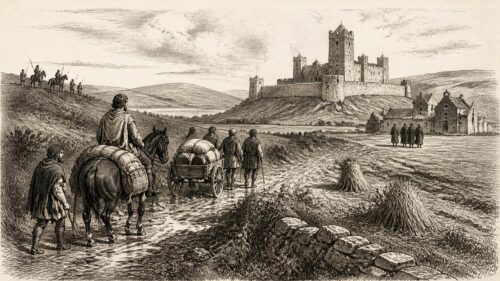
The terms expose the limits of a lord’s recovery. Tomás regained his person but not full freedom of action: close members of his household guaranteed the settlement, while a rival obtained a strategically important residence. Enniskillen stood at a crucial crossing within the waterways of Lough Erne, and the 1439 entry is the earliest known written reference to its castle. Archaeological work confirms that a fifteenth-century Maguire tower-house lay at the core of the later complex. The episode therefore marks the castle not as a silent symbol of lordship, but as an active prize in a living family conflict.
Violence continued around the edges of this dispute. Feradhach, son of Donn and grandson of Cú Chonnacht Maguire, was killed by the Oirghialla in 1439. The short entry gives no battle narrative, but it places Maguire kin in danger beyond Fir Manach’s immediate borders. The year’s events make clear that internal division could invite, or at least coincide with, pressures from neighbouring powers.
Captivity and Succession in Tír Chonaill
Another northern lordship changed hands in 1439. Niall Garbh Ó Domhnaill died while a captive of the English, and his brother Neachtan became lord of Tír Chonaill. The fact of Niall’s death and Neachtan’s succession is secure across the annalistic tradition. The place of his death is less certain. The Annals of Ulster says that he died in Wales; the Annals of Loch Cé and the Four Masters place him in Manann, understood as the Isle of Man. The Four Masters further states that he had been taken there in connection with a ransom, and records one hundred marks being paid to discover the terms demanded. The disagreement should be retained rather than smoothed away: the surviving sources agree on captivity and death in 1439, but not on the final location.
Niall’s removal from Tír Chonaill was part of a wider history of warfare and negotiation involving the Ó Domhnaills, Ó Néills and the English lordship. In 1439, however, the immediate consequence was a succession. Neachtan’s installation did not automatically end rivalry, but it preserved continuity within the ruling family at a vulnerable moment. The death of a captive lord also shows that the Irish Sea was not a boundary separating Irish politics from English power. Captives, ransoms and intelligence moved through a maritime world linking north-west Ireland, Man, Wales and the ports under English influence.
Connacht’s Divided Kingship
In Connacht, the Four Masters dates the death of Cathal, son of Ruaidrí Ó Conchobair, styled king of Connacht, to 19 March 1439. It immediately describes competing acclamations. Tadhg, son of Ó Conchobair Ruaidh, was called “the Ó Conchobair” by the descendants of Fedlimid; Aodh, son of Ó Conchobair Donn, received the designation from Brian, son of Domhnall Mac Muircheartaigh Ó Conchobair Sligigh, with the support of Clann Donnchada. War followed in Machaire Chonnacht.
The language matters. “The Ó Conchobair” was not a simple hereditary title passing automatically from father to eldest son. Recognition by leading branches and allied kindreds made a claimant effective. Cathal’s death therefore produced not one uncontested replacement but rival claims, rooted in different lines of the dynasty. The conflict also illustrates the reduced but still potent meaning of provincial kingship. Connacht was not governed as a unitary state; Burke, Mac Diarmata, Ó Conchobair and other lordships all possessed their own interests. Even so, the title of king of Connacht remained worth contesting because it expressed seniority, honour and a claim to wider leadership.
Plague in Dublin
The Four Masters reports that plague raged in Dublin from the beginning of spring until the end of May, and gives a dramatic figure of 3,000 dead: men and women, adults and children. It also names several victims, including clerics and members of prominent Connacht families. The outbreak itself belongs responsibly to the annalistic record for 1439, but the total cannot be treated as a verified census. Medieval mortality figures were often rhetorical as well as numerical, designed to convey calamity. Still, a spring epidemic in a busy port and administrative centre would have been socially disruptive even at a lower scale.
Illness was not confined in the record to Dublin. The Annals of Ulster notes the death from plague of Meyler Mac Feorais, whom it praises as a fosterer, a provider of hospitality and a supporter of learned people. Such a description offers a brief glimpse of social obligations beneath high politics. Fosterage created enduring ties between families; hospitality required stores, servants and an open household; patronage sustained poets, historians, lawyers and clerics. The death of a man who performed these roles could unsettle a local community as surely as the death of a military leader.
Faith, Office and the English Lordship
Religion and lordship intersected visibly in Connacht. Donnchadh Dubh Ó hEadhra, son of John Ó hEadhra, entered the friars at the monastery of Beann-fhoda, modern Banada in County Sligo. He resigned the Ó hEadhra lordship to his brother Cormac, while Cormac’s former position passed to John Mac an Easpaig Ó hEadhra. The annal records a deliberate rearrangement of secular authority prompted by religious vocation. It is a useful corrective to any picture of lordship as purely martial: a decision to enter a religious community had consequences for inheritance, dependants and the standing of an entire kindred.
The Four Masters also contains a lone, imprecisely identified notice that a deputy or justiciar of the king of England came to Ireland, was captured by Cahir Ó Conchobair Fhailí, and was redeemed when the English of Dublin supplied a Plunket hostage in exchange. As no exact date, personal name or corroborating contemporary administrative record is provided, the incident should be treated cautiously. If accurately placed in 1439, it nevertheless fits the political conditions of the English lordship: royal authority was strongest around Dublin and the Pale, while neighbouring Gaelic lords could bargain with it through raids, prisoners and hostages.
Thus 1439 was a year of no single Irish “government”, but of multiple political worlds in contact. At Enniskillen, a lord’s own castle became the setting for his humiliation and conditional release. In Tír Chonaill, the death of a captive opened a succession. In Connacht, a king’s death activated rival networks of recognition. Dublin faced disease, while Banada received a renouncing lord. These were local developments, yet each demonstrates how power in late medieval Ireland rested on people as much as on land: kinsmen, hostages, foster-kin, patrons, religious communities and those able to command a castle or acknowledge a name.
Source References
Hover over a number to see the source. Select it to open the source.

- [1] The Annals of Ulster
- [2] Annals of the Four Masters
- [3] Part 7 of Annals of the Four Masters
- [4] Part 5 of Annals of Loch Cé
- [5] Part 5 of Annals of Loch Cé A.D. 1014–1590
- [6] Annála Connacht
- [7] Annála Connacht (Irish text)
- [8] Maguire (Mág Uidhir), Tomás Óg
- [9] O'Donnell (Ó Domhnaill), Neachtan
- [10] Talbot, Richard
- [11] The Maguire Story
- [12] Excavations.ie: Enniskillen Castle, Fermanagh
- [13] Gazetteer of Ireland / Gasaitéar na hÉireann
- [14] Exploring the Irish Annals
- [15] Close Roll 9 Henry VI, Item 9 – Virtual Treasury
- [16] The Talbot–Ormond Struggle for Control of the Anglo-Irish Government, 1414–47
- [17] Fosterage; Child-Rearing in Medieval Ireland
- [18] Docwra's Relation of Service Done in Irlande: Bibliographical and Place-Name Notes
- [19] Irish Names of Places, Volume II
- [20] The Annals of the Four Masters: CELT Project Documentation
- [21] The Annals of Ulster: CELT Project Documentation
- [22] The Annals of Loch Cé
Primary Sources
- The Annals of Ulster
- Annals of the Four Masters
- Part 7 of Annals of the Four Masters
- Part 5 of Annals of Loch Cé
- Part 5 of Annals of Loch Cé A.D. 1014–1590
- Annála Connacht
- Annála Connacht (Irish text)
- Maguire (Mág Uidhir), Tomás Óg
- O'Donnell (Ó Domhnaill), Neachtan
- Talbot, Richard
- The Maguire Story
- Excavations.ie: Enniskillen Castle, Fermanagh
- Gazetteer of Ireland / Gasaitéar na hÉireann
- Exploring the Irish Annals
- Close Roll 9 Henry VI, Item 9 – Virtual Treasury
- The Talbot–Ormond Struggle for Control of the Anglo-Irish Government, 1414–47
- Fosterage; Child-Rearing in Medieval Ireland
- Docwra's Relation of Service Done in Irlande: Bibliographical and Place-Name Notes
- Irish Names of Places, Volume II
- The Annals of the Four Masters: CELT Project Documentation
- The Annals of Ulster: CELT Project Documentation
- The Annals of Loch Cé