Palatine Refugees1709 CE
In 1709, wartime pressures, food regulation and fears of Jacobite loyalty shaped Irish government. Proclamations restricted grain exports, addressed market manipulation and crime, and linked public worship to British military fortunes, without proving a nationwide famine. Parliament reinforced the penal system through an abjuration oath, tighter controls on Catholic clergy, education, property and employment. Dublin received about 3,000 Protestant Palatine refugees, whose protection and settlement posed practical challenges. Samuel Molyneux’s Connacht journey recorded poor roads, domestic textiles, poverty, improvement and cultural division. By December, Hougher violence against cattle reflected resistance to pasture expansion and smallholders’ displacement, revealing sharper social contestation.
Dateline
In 1709 Ireland was drawn together by pressures that were at once local and European: a long continental war, nervousness about loyalty and succession, regulation of food, the arrival of refugees, and rural unease over land. The year did not produce a single decisive battle or change of ruler within Ireland. Its importance lies instead in a sequence of closely dated official acts and human encounters which reveal how the Protestant political order sought security, while many inhabitants experienced economic insecurity, religious constraint and a changing countryside.
War, Provisions and Authority
Queen Anne’s kingdoms remained engaged in the War of the Spanish Succession. Ireland was not a principal battlefield, but war shaped government priorities. It made communications, coasts and food supplies matters of state; it also intensified the fear that Catholic allegiance might be linked to the exiled Stuart claimant, James Edward Stuart, and to France. On 2 March, a proclamation prohibited Irish fishermen from corresponding with the enemy. A public fast followed on 29 March, while thanksgiving days on 17 March and 22 November connected Irish public worship to Britain’s military fortunes.
The European winter of 1708–09, widely remembered as the Great Frost, had grave effects in several continental regions. Irish evidence does not support treating 1709 as a national famine year, and it would be misleading to import continental mortality into Ireland. Yet the Irish government’s actions show an acute concern with provisioning. On 11 March it prohibited the export of corn, grain and meal. In October it acted against forestalling, regrating and engrossing—practices understood as manipulating supplies and prices by buying up grain for resale. On 19 December it again prohibited the export of corn, grain and meal, allowing only necessary ship provisions. These measures demonstrate anxiety over the availability and price of staple food; they do not, by themselves, prove a uniform harvest failure or famine across the island.
Other notices suggest the everyday range of government concerns. Rewards were offered for robbers of the Queen’s revenue in June, for sheep-killers and beehive robbers in September, and for the interception of mail. The language of “tories, robbers and rapparees” in a December proclamation shows an administration ready to place crime, disorder and political insecurity in the same frame. Dublin Castle’s reach, however, was uneven. Orders issued in the capital depended upon local magistrates, landlords, clergy, soldiers and informers for effect.
A Summer Parliament and the Oath
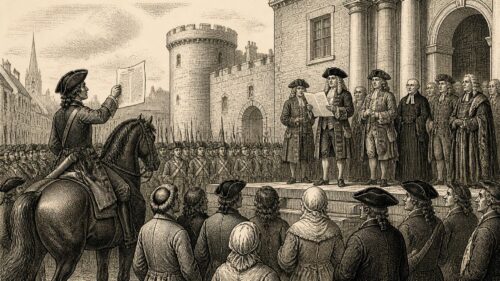
The Irish Parliament sat during the summer, and on 30 August the lord lieutenant went in state to Parliament House to grant royal assent to its legislation. The most consequential measure was 8 Anne, chapter 3: an act “for explaining and amending” the earlier Act to Prevent the Further Growth of Popery. It was not a fresh beginning in religious policy but an effort to make an already restrictive system more durable and enforceable.
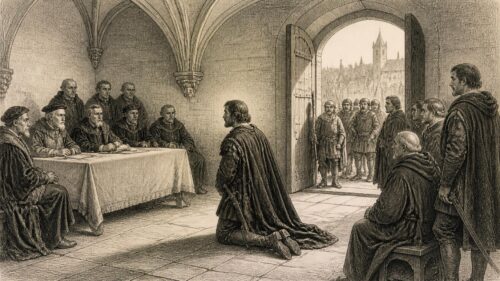
Its provisions reached deeply into Catholic life. The statute made the registration legislation governing Catholic clergy permanent. It required registered Catholic priests to take the oath of abjuration by 25 March 1710 or suffer the disabilities attached to unregistered regular clergy. The oath was politically charged: it required rejection of the Stuart claimant’s title and declarations Catholics could not accept in conscience. The legislation also strengthened restrictions on Catholic schooling. A Catholic who publicly taught, taught in a private house, or served as an usher could face the penalties assigned to a regular clergyman; schoolmasters were required to take prescribed oaths and declarations.
Nor was the measure confined to clergy and teachers. Two justices could summon any man aged sixteen or over to take the oath of abjuration. Refusal exposed him first to imprisonment or a fine, and later to more serious proceedings. The act recruited neighbours and local officeholders into surveillance: people could be compelled to give evidence concerning a recent Mass, a priest’s residence, or a concealed schoolmaster. Rewards for discovering Catholic bishops, regulars and unregistered clergy gave material force to the policy. Its language repeatedly described Catholicism as a growth to be checked. In practice, enforcement could vary greatly, but the law changed the legal vulnerability under which Catholic families, priests and educators lived.
The statute also shows that property remained central to the Protestant ascendancy’s conception of security. It addressed conveyances, leases and trusts through which Catholics might retain or acquire beneficial interests in land. It regulated the consequences of conversion for family property and children’s education, and restricted Catholic traders’ apprentices, while allowing an exception for hemp and flax manufacture. Such clauses joined religion, inheritance, occupational opportunity and landholding. The state’s stated aim was confessional; its practical effect was also to reinforce a social order in which political power and landed property were overwhelmingly Protestant.
Three Thousand ‘Poor Strangers’
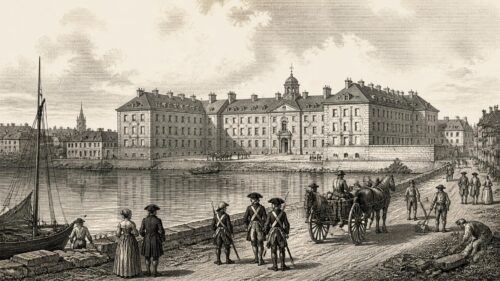
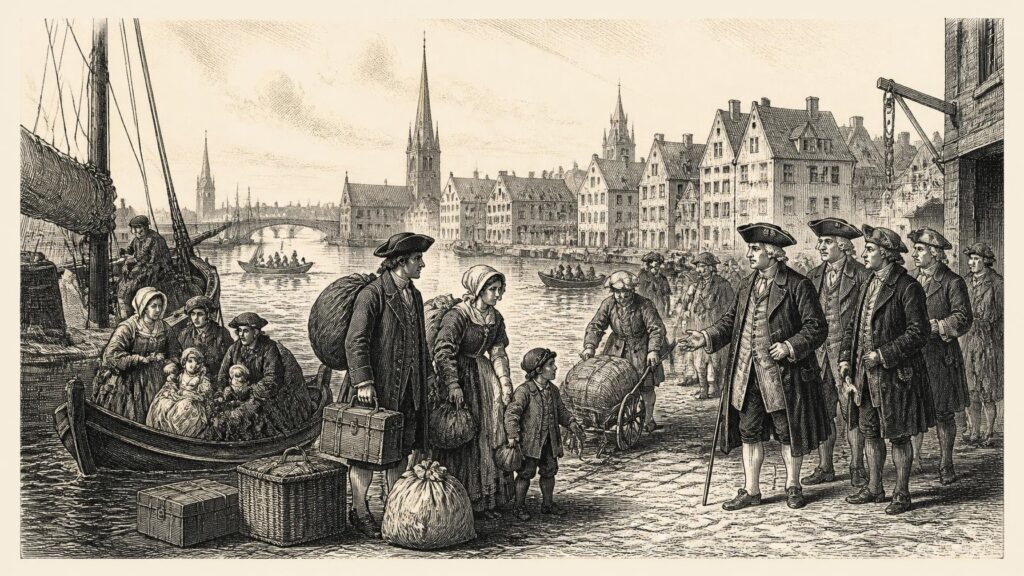
Within days of the parliamentary session’s end, Dublin received an unusually visible group of newcomers. Between 4 and 8 September, roughly 800 families of German-speaking Palatine refugees—about 3,000 people in all—arrived in the city. They had been swept into a larger migration from the Rhineland and neighbouring territories, where war, devastation and hardship had driven people westward. Their arrival connected Ireland directly to a Protestant refugee crisis being managed from London.
The newcomers were commonly called the “Poor Palatines”. That label was charitable but also political. Their Protestant identity made them attractive to Irish landlords and officials who wished to increase the Protestant tenant population. Yet an arrival of this scale posed immediate challenges of shelter, food, employment, language and public order in a city already dependent on fragile provisioning. The municipal response was revealing. Dublin’s lord mayor issued a proclamation ordering that the strangers be treated fairly: they were not to be overcharged or supplied with inferior goods, and those who insulted or assaulted them were to be prosecuted. A government proclamation of 22 September likewise ordered that the refugees be well treated.
These instructions acknowledge that welcome could not be assumed. The Palatines were beneficiaries of Protestant solidarity, but also poor foreigners competing for lodgings, work and victuals. Their first Irish experience was therefore urban and temporary rather than the settled rural picture often associated with later Palatine communities. In 1709, plans to distribute them on estates were still an experiment. The city’s proclamations record both compassion and the practical fear that exploitation or hostility might turn a charitable undertaking into a disturbance.
A Road Through Connacht
A remarkable contemporary journey gives the year an unusually close texture. From 5 April to 3 May, Samuel Molyneux travelled from Dublin through Kildare and Westmeath, crossed the Shannon at Athlone, and went on through Connacht to Galway and its western hinterland. His observations are those of a well-connected Protestant traveller, not a neutral social survey. His dismissive descriptions of Irish-speaking people and poor settlements need to be read as evidence of his attitudes as much as of the communities he passed. Nevertheless, the journal catches particular places and occupations in motion.
Beyond Dublin, Molyneux found a landscape of meadow, tillage, sheep-walks, bog and weak enclosure. Roads quickly became difficult: a journey of seventeen miles from Kilcock towards Westmeath took eight hours. In poor cabins he noticed yarn drying, and recorded that women could help make rent by producing small quantities of cloth while also supplying household linen. This was not yet a description of a fully commercial linen economy in Connacht; indeed, he believed the manufacture there little developed for wider sale. But it shows domestic spinning and weaving woven into the survival strategies of tenant households.
Athlone appeared as a significant crossing-point, with barracks, artillery and a felt manufacture. West of the Shannon, he remarked upon rocky soils, bogs, sheep-walks and few enclosures. He saw many more beggars than he expected and attributed their presence to the “hard times of war”. That was his interpretation, not a statistical finding; still, it is valuable contemporary testimony to visible poverty on the road. Near Athenry he encountered a town whose former walls, streets and ruined buildings spoke of an older urban prosperity, while cabins and gardens occupied much of the enclosed space. A local improver had established napping and tucking mills and contemplated weaving, drawing on inhabitants described as weavers and cottoners. Improvement, craft and decay coexisted.
On 21 April Molyneux visited the aged Gaelic scholar Roderic O’Flaherty at Park in Iar-Chonnacht. O’Flaherty, author of Ogygia, had lost much of his inherited position and, according to the visitor, had few manuscripts left. The meeting is a small but poignant cultural fact of 1709: an English-speaking Trinity student, curious about antiquities and natural history, sought out an elderly Irish scholar whose learned world had been impoverished by confiscation and marginalisation. Molyneux’s contemptuous account of the western population should not be adopted as description. It does, however, expose the continuing mental boundary between the governing culture centred on Dublin and communities beyond Galway.
Land, Livestock and Protest
Late in the year, the first stirrings of what became known as the Hougher disturbances can cautiously be placed in Connacht. The dating of the opening is not exact enough to attach every early incident to a particular day, but historians conventionally locate the movement’s emergence around December 1709. Its name came from “houghing”, the maiming of cattle by cutting the hamstrings. The targets and methods expressed hostility to expanding pasture, cattle-raising and the displacement of small occupiers from land. It was a brutal form of protest, but one rooted in an economic conflict: whether land would support people through tillage and small holdings, or yield rent and profit through grazing.
That unrest belongs beside, rather than beneath, the year’s proclamations and statutes. In Dublin, government answered uncertainty with oaths, grain controls and official supervision. In Connacht, some rural people answered the changing use of land with clandestine violence. Between them stood a country of improvers and old towns, domestic textile work and military barracks, Catholic worship under threat, hungry-looking travellers on the road, and refugees newly disembarked at the quays. The events firmly dated to 1709 do not form one simple story, but together they show an Ireland being governed more closely, and contested more sharply, than before.

Primary Sources
- Journey to Connaught, April 1709
- Part 8 of Journey to Connaught, April 1709
- Note 27 for Journey to Connaught, April 1709
- Travel to Ireland, Geography and Customs of the Country
- Statute Law Revision Act 2015
- Number 23 of 2015
- Statutes in Chronological Order: The Reign of Queen Anne
- The Eighth Year of Anne, Chapter III
- A Proclamation by the Lord Mayor of the City of Dublin (Dublin, 1709)
- Dublin Aug. 30th, 1709: Royal Assent to Acts
- A Brief History of the Irish Palatines
- European Migrants in Eighteenth Century Ireland: The Great Palatine Migration of 1709 and its Aftermath
- The Houghers: Agrarian Protest in Early Eighteenth-Century Connacht
- Religion: Background to Eighteenth-Century Ireland
- Climate: Background to Eighteenth-Century Ireland
- Statute Law Revision (Pre-Union Irish Statutes) Act 1962, Schedule
- Statute Law Revision Act 2009, Schedule 2
- History of Parliament in Ireland
- The Poor Palatines of 1709
- The Great Frost of 1709
- A Non-Famine History of Ireland?
- The Cambridge History of Ireland: The Eighteenth Century