Storm and Rivalry1037 CE
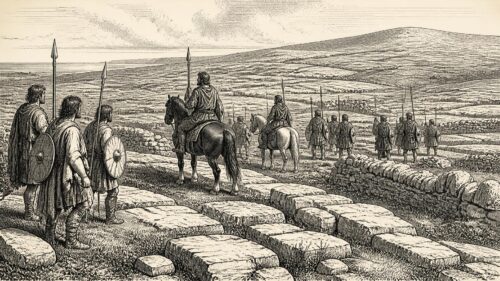
In 1037, Ireland remained a fragmented political landscape, where provincial kings, local dynasties and churches competed for power. Annals, despite differing dates and detail, record blinding, assassination, raiding and ecclesiastical violence across Leinster, Meath, Connacht and the north. Osraige’s Donnchad mac Gilla Pátraic displaced a Leinster rival, while Diarmait mac Máel na mBó strengthened his position and was linked to Waterford’s burning. Waterford’s ruler died amid internal and external conflict. Kings made pilgrimages, but churches were also plundered and sanctuary violated at Lorrha. Trade, farming and craft continued despite disorder. Exceptionally wet, stormy weather compounded an unstable year for communities.
Dateline
Ireland in 1037 was governed not as a single kingdom with settled institutions, but through a shifting hierarchy of provincial kings, local rulers, dynastic kindreds and powerful churches. The surviving annals record no great set-piece battle or island-wide assembly for the year. Instead, they reveal authority being contested through raids, blinding, assassination, pilgrimage and attacks upon towns and religious sites. Waterford suffered a destructive assault, rival claimants were removed from power, and violence reached even the altar of a stone church at Lorrha. Alongside these events, one northern chronicle remembered exceptionally wet and stormy weather.
Reading a Fragmentary Record
The evidence is unusually dispersed. The Annals of Ulster, Annals of Inisfallen, Annals of Tigernach, Chronicon Scotorum, Annals of Loch Cé and the later Annals of the Four Masters preserve overlapping but not identical reports. Their placement of events can differ by a year, while some incidents appear in only one annalistic tradition. They rarely supply exact days, motives or sequences. A responsible account must therefore distinguish events firmly entered under 1037 from political changes placed around 1036–37 by different chronicles.
The agreement between independent traditions is nevertheless valuable. Several record the pilgrimage of Cathal son of Ruaidrí to Armagh, the blinding of Flann Ua Máel Sechnaill, the death of Waterford’s ruler and killings among the Uí Bresail, Uí Nialláin, Uí Maine and Uí Maíl Doraid. Their cumulative picture is of widespread local conflict rather than one coordinated war.
Kingship Without Unity
Donnchad mac Briain, son of Brian Bóruma, remained king of Munster and possessed substantial influence beyond it. The recently made shrine of the Stowe Missal called him “king of Ireland”, but such a title expressed political ambition and prestige rather than uncontested rule. His authority faced increasingly powerful neighbours, especially Donnchad mac Gilla Pátraic of Osraige and the rising Uí Chennselaig leader Diarmait mac Máel na mBó.
Leinster’s kingship was particularly unstable. The annals place the blinding and consequent death of Donnchad son of Dúnlang, an Uí Dúnlainge king of Leinster, around 1036–37. His captor was Donnchad mac Gilla Pátraic, king of Osraige, whose expansion had carried him beyond his home territory. The Annals of Inisfallen record in 1037 the death of “Dúnlang’s son, king of Leinster” at the hands of the Osraige, while Chronicon Scotorum and Tigernach place the blinding in 1036. The Four Masters include it under 1037. The event belongs securely to the immediate political setting of the year, even though its precise annalistic date is uncertain.
Diarmait mac Máel na mBó was also consolidating power in south-eastern Leinster. Another rival, Ruaidrí son of Tadc Ua Lorcáin, was seized in a stone church at Kilcullen and blinded by Diarmait, an incident again placed around 1036–37. These removals helped clear the way for Diarmait’s later dominance, but in 1037 that outcome was not yet inevitable. Leinster remained contested among Uí Dúnlainge, Uí Chennselaig and Osraige interests.
The Destruction of Waterford
The year’s most consequential attack was directed against Port Láirge, Waterford. The Annals of Ulster state that Cú Inmain Ua Robann, king of Port Láirge, was killed by his own people. His Irish name and royal title illustrate the political mixing found in coastal towns founded by Scandinavians but long embedded in Irish alliances, rivalries and kinship networks.
Waterford was then plundered, burned and badly damaged. The sources disagree over responsibility. The Annals of Inisfallen say that the town was burned “by the foreigners, or by the Laigin”, openly preserving uncertainty. Tigernach and the Four Masters attribute the attack to Diarmait mac Máel na mBó. It is possible that internal upheaval and an external Leinster assault formed parts of the same crisis, but the surviving texts do not permit a confident reconstruction.
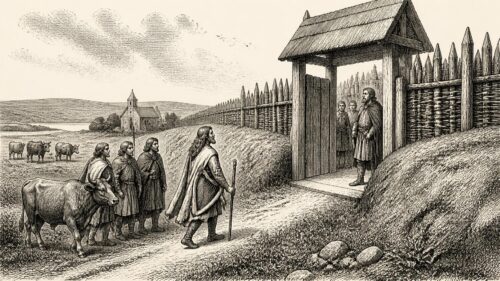
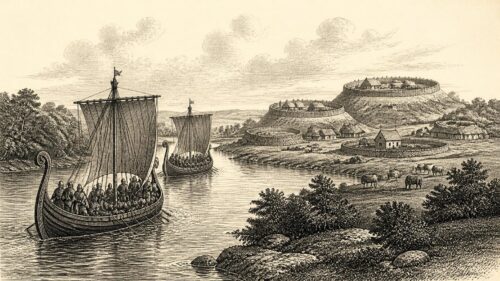
The destruction mattered beyond the death of one ruler. Archaeology shows that Waterford had been continuously occupied since the Viking period and functioned as a defended settlement, harbour and centre of craft production and exchange. Its people were connected by sea to Dublin, Britain and the wider Irish Sea, while its hinterland supplied food, livestock, timber and other necessities. Burning the town therefore struck at a political stronghold and an economic resource. The annals do not say how much was destroyed or how quickly rebuilding began, and “destroyed” should not be taken to mean permanent abandonment.
The Four Masters also record the treacherous killing of a man named Ímar by the foreigners of Waterford. Whether this belonged directly to the crisis surrounding Cú Inmain and the burning cannot be proved, but it reinforces the impression of factional violence within or around the town.
Conflict Across the Provinces
In Meath, Flann Ua Máel Sechnaill was blinded by his brother Conchobor. Blinding was a political weapon: bodily injury could disqualify a rival from sacral kingship while avoiding immediate execution. The incident exposes competition within the dynasty that had produced Máel Sechnaill mac Domnaill, the powerful king who died in 1022.
Farther north, Árchú Ua Ceilecáin, king of Uí Bresail, and Ruaidrí Ua Lorcáin, king of Uí Nialláin, were killed at Craeb Chaille by Muiredach Ua Ruadacáin and the Uí Echach. These were rulers of relatively small territories in the Armagh region. Their deaths demonstrate how the annals’ repeated use of “king” encompassed many levels of lordship, from provincial overkings to leaders of local peoples.
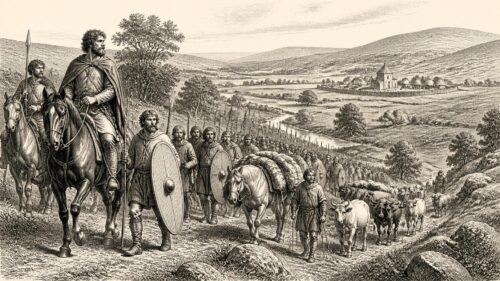
Three members of the Uí Maíl Doraid were killed, while Cernachán Got fell to Ua Flannacáin of Uí Maine. The Four Masters add the deaths of three Uí Follamain and Finnachta Ua Ercada at the hands of Áed Ua Conchobair. In Connacht, Ua Con Cenainn, described as a potential royal successor, was killed after carrying off prey from Brénainn. Such cattle-raiding was not random lawlessness. It was a normal instrument of warfare, punishment and political pressure, though it could provoke deadly pursuit and retaliation.
Pilgrimage, Sanctuary and Learning
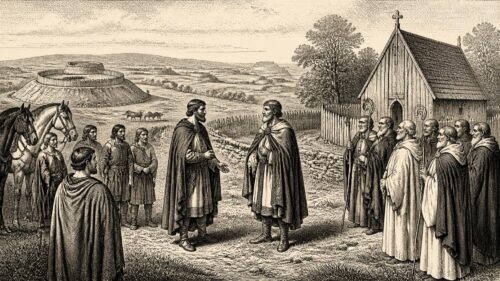
Cathal son of Ruaidrí, king of western Connacht, went on pilgrimage to Armagh. The annals do not say that he abdicated or remained there permanently. His journey nevertheless reflects Armagh’s exceptional standing as the principal centre associated with Patrick. A royal pilgrimage could be an act of penitence and devotion, but it also placed a ruler within a prestigious ecclesiastical network.
Another notice concerns Ua Bruic, a bishop and coarb of Senán. The Annals of Inisfallen describe him elliptically as being “on his pilgrimage” and state that Muirchertach succeeded him in the abbacy. A coarb was the recognised successor to a founding saint, exercising authority over the saint’s church and dependants. The entry appears to mark Ua Bruic’s death or the vacancy of his office, but preserves no further details.
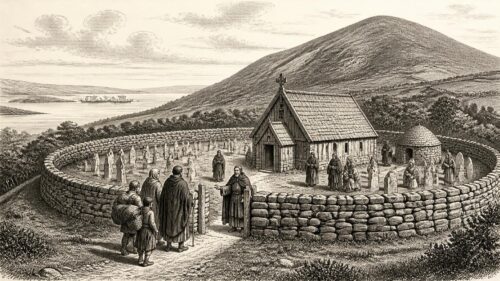
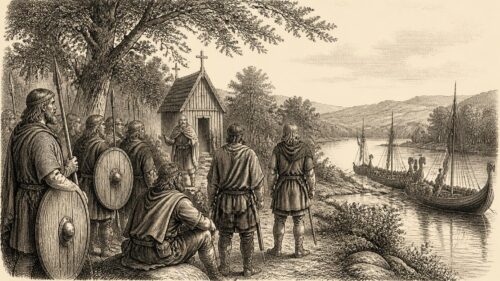
The sharpest violation of sanctuary occurred at Lothra, modern Lorrha. Cú Chaille son of Cennétig, king of Múscraige, and his son were forcibly removed from the altar and killed before the settlement’s stone church. Mathgamain Ua Cathail was slain on the same night. The language is significant: the annalist deliberately emphasised the altar, forced removal and church doorway, presenting the killings not merely as political murders but as sacrilege.
Mathgamain has been identified by scholars with a patron named on the early eleventh-century shrine of the Stowe Missal, an outstanding work associated with Lorrha. Its inscription also names Donnchad mac Briain and its maker, Donnchad Ua Taccáin of the community of Clonmacnoise. The shrine demonstrates that religious books could be enclosed in elaborate metalwork carrying prayers for rulers and churchmen. The killing at Lorrha thus touched a community linked to royal patronage, skilled craftsmanship and manuscript culture.
Chronicon Scotorum records the death of Flaithbertach son of Loingsech, bishop of Clonmacnoise. The Four Masters additionally list Flann, prior of Glenn Uisenn; Cinaed Ua Máel Temin, a learned elder of western Leinster; and Cairbre son of Rodach, airchinnech of a church at Clonmacnoise. Such notices remind us that learning and administration were distributed among bishops, abbots, priors, teachers and airchinnig, the latter often managing ecclesiastical lands and resources.
Religious wealth also attracted attack. Chronicon Scotorum and the Four Masters say that Dublin’s foreigners plundered Scrín Coluim Chille and Daimliag, generally identified with the churches of Skryne and Duleek in Meath. Churches held food, livestock, metalwork, books and valuables, making them both sacred centres and tempting political targets.
Work, Trade and Weather
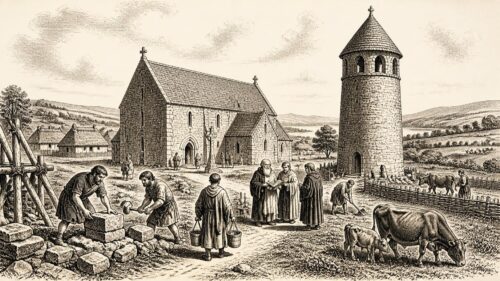
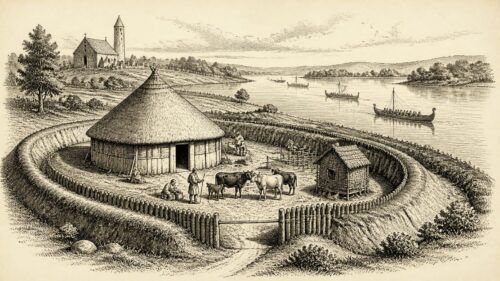
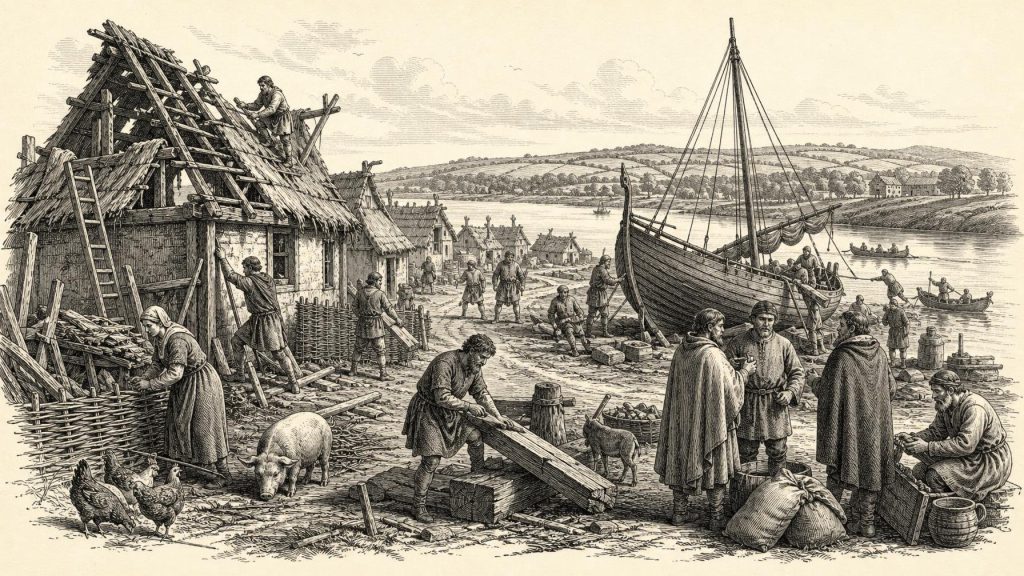
Most people left no individual trace in the annals. They lived in dispersed farmsteads, ringforts, cashels, crannógs and settlements around churches. Cattle remained fundamental to diet, wealth and status, while cereals, dairying, pigs, sheep, woodland resources and fishing supported households. Craftspeople worked in iron, wood, leather, textiles and non-ferrous metals. Watermills and organised arable production were established features of the early medieval economy.
Dublin continued to mint silver pennies and remained a major Irish Sea port. Waterford’s burning did not erase the wider commercial system connecting towns with rural producers and overseas markets. Coin use was most visible in the towns and high-level transactions; cattle, produce, services and weighed silver remained important forms of value elsewhere.
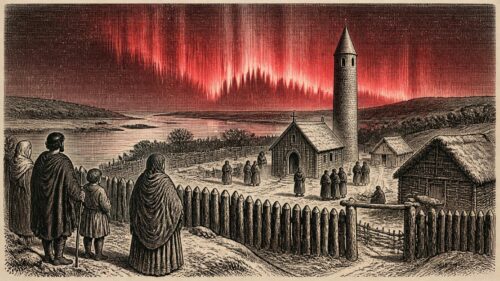
The Annals of Ulster close their account with “very wet stormy weather this year”, while the Annals of Loch Cé similarly report enormous storms and heavy wetness. This is a firmly dated environmental observation, but no source explicitly connects it to famine or harvest failure. Persistent rain would have complicated travel, haymaking, grain ripening and the movement of armies and livestock, yet its actual economic consequences in 1037 are unknown.
The year therefore stands out less for a single decisive contest than for accumulating instability. Waterford’s destruction advertised Diarmait mac Máel na mBó’s rising power; Osraige intervention reshaped Leinster; dynastic violence removed claimants in Meath and elsewhere; and churches served simultaneously as sanctuaries, political institutions, treasuries and targets. Beneath the terse record lay a society resilient enough to rebuild, trade, cultivate land and preserve the memory of a turbulent and rain-soaked year.
Primary Sources
- The Annals of Ulster: Year U1037 — English Translation
- The Annals of Ulster: Year U1037 — Original Text
- Annals of Inisfallen: Annal AI1037 — English Translation
- Annals of Inisfallen: Annal I1037 — Original Text
- Annals of Tigernach: Annals T1036–T1037
- Annals of the Four Masters: Annal M1037 — English Translation
- Annals of the Four Masters: Annal M1037 — Original Text
- Chronicon Scotorum
- Annals of Loch Cé
- Donnchad mac Briain — Dictionary of Irish Biography
- Diarmait mac Máel na mBó — Dictionary of Irish Biography
- Donnchad mac Gilla Pátraic — Dictionary of Irish Biography
- 950–1450: Vikings, Normans and Medieval Mints
- Shrine of the Stowe Missal — National Museum of Ireland Notes
- Irish Book Shrines: A Reassessment
- The Archaeology of Early Medieval Ireland, c.400–1169: Settlement and Economy
- The Economy of Early Medieval Ireland
- Early Medieval Dwellings and Settlements in Ireland, AD 400–1100
- Agriculture, Settlement and Society in Early Medieval Ireland
- County Waterford and Waterford City Urban Archaeology Survey
- The Book of Armagh — MS Trinity College Dublin 52
- The Annals of Ulster, 912–1100
- The Chronology and Sources of the Early Irish Annals
- CELT Project: Annals of Tigernach
- CELT Project: Annals of Inisfallen
- Lorrha Dominican Priory — Heritage Ireland
- Saint Ruadhan’s Church, Lorrha — Buildings of Ireland