Fire and Reform1074 CE
In 1074, Ireland’s annals emphasised ecclesiastical affairs, dynastic violence and unstable political authority rather than major warfare. Tairdelbach Ua Briain maintained an expanding, but negotiable, supremacy over Munster, Leinster, Dublin and other regions following earlier campaigns. Donnchad Ua Cellaig of Uí Maine and Ragnall Ua Madadáin, heir of Ailech, were killed amid succession struggles. On 6 May, fire devastated Armagh’s churches, bells and settlement divisions. After Bishop Dúnán’s death, Dublin sent Gilla Pátraic to Canterbury, where Lanfranc consecrated him and received his obedience. Clerical deaths across Ireland reveal interconnected churches whose religious, economic and social roles sustained wider local communities.
Dateline
The surviving record of this year is unusually revealing about Ireland’s religious institutions, even though it says little about great campaigns or pitched battles. The annalists opened their entries by noting that 1 January fell on a Wednesday and that the moon was twenty-nine days old, details reflecting the computistical learning used to order Christian time. Their notices then concentrated on deaths among church leaders, two violent dynastic successions, the destruction of Armagh by fire and a decisive change in the bishopric of Dublin. These are firmly associated with 1074 by several independent annalistic traditions. Broader descriptions of kingship, settlement and daily life must be treated as context rather than as events confined to this single year.
A Dominant Southern King
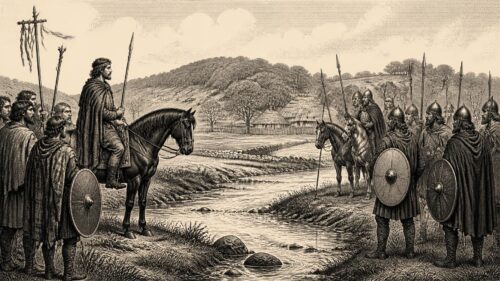
Ireland had no permanent national monarchy. It consisted of provincial and local kingdoms whose rulers competed for hostages, tribute, allies and recognition. The most powerful king in 1074 was Tairdelbach Ua Briain, grandson of Brian Bóruma and ruler of Munster. His position had been transformed by the death of his former protector and rival, Diarmait mac Maíl na mBó, in battle in 1072. Tairdelbach then entered Leinster and Osraige, took hostages and received authority over Dublin. In 1073 he campaigned in Mide and Connacht, compelling further submissions.
No comparable expedition by Tairdelbach is securely recorded for 1074. That silence should not be mistaken for proof of peace or inactivity. It may instead mark a year of consolidation after the rapid advances of 1072–73. Gofraid grandson of Ragnall remained king of Dublin, but under Tairdelbach’s superior power. The arrangement was temporary: in 1075 Tairdelbach would expel Gofraid and eventually place his own son Muirchertach over the city. Thus the political situation visible in 1074 was one of unstable supremacy. Ua Briain influence extended far beyond Munster, yet depended upon submissions that continually had to be renewed.
Violent Successions
Two killings show how dangerous succession could be within Irish ruling kindreds. The Annals of Tigernach and Chronicon Scotorum report that Donnchad Ua Cellaig, overking of Uí Maine, was treacherously killed by his own brother. Uí Maine occupied a broad territory in what is now eastern Galway and southern Roscommon, lying between the Shannon and central Connacht. The later Annals of the Four Masters identify the killer as Tadhg and place the deed on an island in Loch Caelain. Because that location and fuller genealogy occur in a much later compilation, they are best presented cautiously rather than treated as independently confirmed detail.
In the north, Ragnall Ua Madadáin, heir-designate of Ailech, was killed by his own people according to the Annals of Ulster and the Annals of Loch Cé. Ailech was the leading kingship associated with Cenél nEógain, but the designation of an heir did not guarantee succession. Kings and prospective kings relied upon support among powerful relatives, subordinate rulers and military followers. A chosen successor could be removed when that coalition failed. Both deaths therefore belong to a wider political culture in which kingship was hereditary within a royal dynasty but competitive among eligible men, often producing conflict between brothers, cousins and nephews.
Armagh in Flames
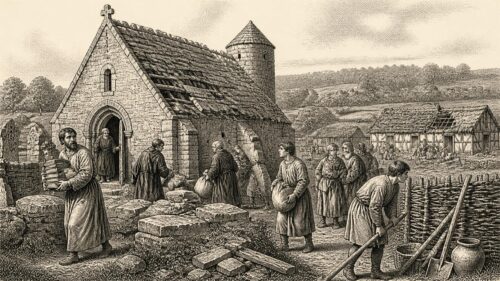
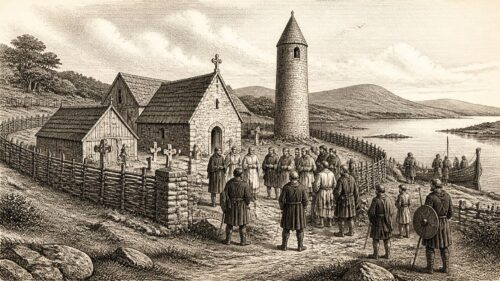
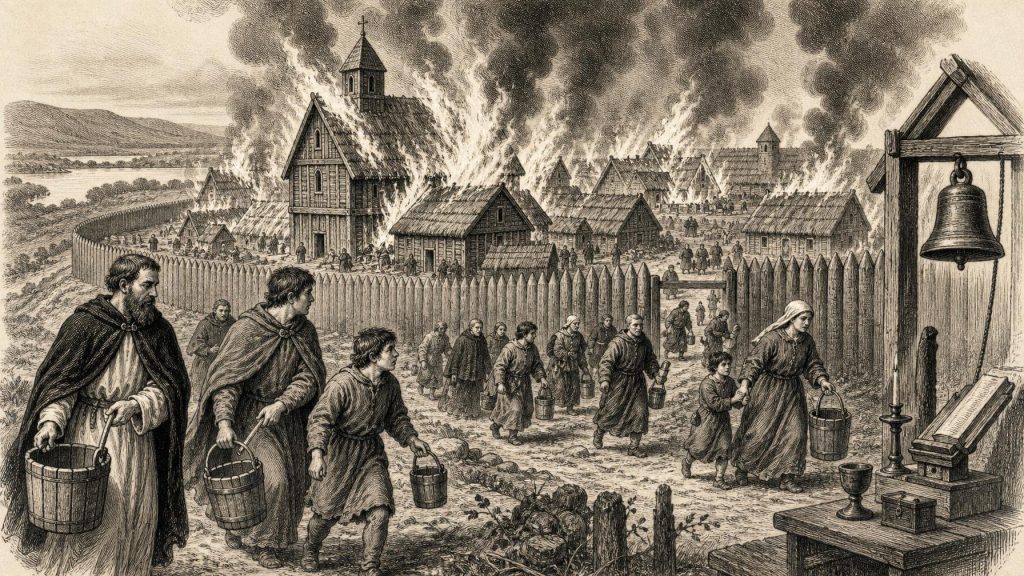
The most precisely dated Irish event of the year occurred on Tuesday, 6 May, described by the annalists as the Tuesday after May Day. Armagh was burned with its churches and bells, including both the Ráith and the Trian. These terms indicate that the disaster spread through the ecclesiastical settlement rather than consuming only one isolated church. The Ráith was the enclosed sacred and administrative core, while the Trian formed one of the organised divisions of the larger settlement. The Annals of Inisfallen also mention burned houses at Ard Pátraic, although their brief wording does not permit a confident reconstruction of the fire’s complete extent.
Armagh was the principal centre of the cult of Patrick and one of Ireland’s most influential churches. It contained clergy, students, artisans, dependants, pilgrims and households serving the community. Many buildings were constructed substantially from timber, wattle and thatch, making a crowded settlement vulnerable once flames took hold. Bells were valuable ritual objects and powerful symbols of a church’s identity; their explicit inclusion conveys the severity of the loss. The annals do not state whether the fire was accidental or deliberate, and no cause should be invented. Rebuilding would have required timber, labour, food for workers and support from Armagh’s estates and patrons.
Dublin and Canterbury
Another major development followed the death of Dúnán, described by the Annals of Ulster as chief bishop of the foreigners. The phrase referred to the Hiberno-Norse population of Dublin, not to a bishop exercising authority over every outsider in Ireland. Dublin’s bishopric differed from many older Irish churches because it served a compact urban community and was developing along territorial diocesan lines. Dúnán’s death opened the way for the selection of Gilla Pátraic, usually called Patrick in Latin sources.
The clergy and people of Dublin, with the support of King Gofraid, sent Patrick to Lanfranc, archbishop of Canterbury. Lanfranc consecrated him at St Paul’s in London in 1074, and Patrick made a written profession of obedience to Canterbury. Lanfranc also entrusted him with letters for Gofraid and Tairdelbach Ua Briain, urging royal assistance in correcting practices that the archbishop considered contrary to canon law, particularly in marriage and episcopal government. Patrick had been trained as a Benedictine monk at Worcester and was a learned Latin author, although his surviving writings cannot all be assigned specifically to this year.
The consecration was important, but it should not be exaggerated into the submission of the entire Irish church. Armagh, Emly, Ardfert and other ancient ecclesiastical federations continued to possess their own traditions, leaders and political patrons. Canterbury’s practical connection was principally with the Hiberno-Norse coastal bishopric of Dublin. Nevertheless, Patrick’s appointment linked Dublin more closely to English Benedictine and continental reforming currents. It also demonstrates how kingship and church government overlapped: Gofraid represented Dublin, while Lanfranc recognised that Tairdelbach possessed the greater political influence.
Churches and Communities
The year’s numerous clerical obituaries map an extensive network of important churches. Diarmait son of Máel Brénainn, successor or coarb of Brendan, died at Ardfert in Kerry. Flaithem Ua Cáróc, abbot of Ros Cré in Tipperary, and Máel Mórda, successor of Ailbe at Emly, also died. Cú Cairrce, successor of Mura, probably headed the community associated with Fahan in Donegal. The Annals of Inisfallen additionally record Flann Ua hAingeda at Killaloe and Gilla Brénainn Ua Léimíne of Leitir Odráin, now Latteragh in north Tipperary.
A coarb was not merely a parish priest. He inherited the institutional authority associated with a founding saint and could oversee lands, tenants, relics and dependent churches. Such offices carried religious prestige and material responsibilities, while succession could involve both clerical families and local kings. The death of Cormac Ua Maíl Dúin, praised for wisdom and piety and described as an anchorite, represents a different form of religious authority founded upon learning and disciplined withdrawal. Cumuscach Ua hErodán, called head of the poor of Ireland, died after notable penance. His title is exceptional evidence that organised care for the poor could itself command national ecclesiastical honour.
Work, Wealth and Trade
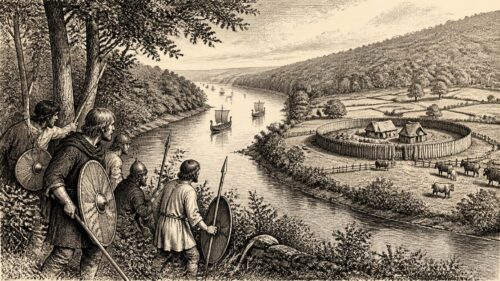
The annals rarely describe ordinary labour unless famine, disease or violence disrupted it, and no harvest failure can be securely assigned to 1074. Archaeology and law texts nevertheless provide responsible context. Most people lived in rural farmsteads, including ringforts and, in wetter districts, crannogs. Cattle were central to wealth, rents and diet, especially through dairying, while sheep, pigs and cereal cultivation also mattered. The capture of livestock in preceding campaigns was therefore an attack upon food supplies, status and the ability of households to meet obligations to lords.
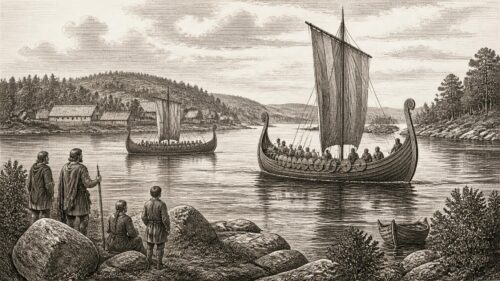
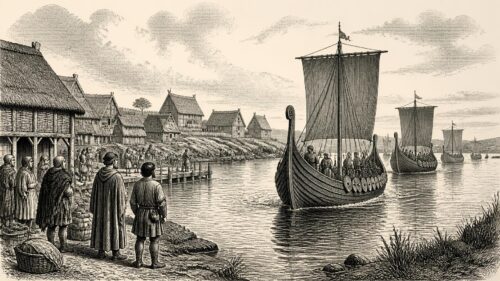
Dublin offered a contrasting, increasingly urban economy. Excavated houses, workshops, property boundaries and streets reveal merchants and specialised craftspeople working in wood, leather, bone, metal and textiles. Ships connected the port with Britain, the Isles and continental Europe, carrying commodities, travellers and ideas. Patrick’s journey to London was part of this busy Irish Sea world rather than an isolated ecclesiastical adventure. Inland churches likewise functioned as centres of production, hospitality, education and exchange. The deaths of abbots and coarbs, and the burning of Armagh, consequently affected lay workers and dependent families as well as monks.
A Year of Transition
Seen as a whole, 1074 was not dominated by one battle or royal assembly. Its importance lies in several simultaneous transitions. Tairdelbach Ua Briain stood at the height of an expanding but still negotiable supremacy. Uí Maine and Ailech experienced lethal internal struggles over leadership. Armagh suffered a devastating fire on a firmly recorded date, exposing the vulnerability of even Ireland’s greatest ecclesiastical settlement. In Dublin, the death of Dúnán and consecration of Patrick established a stronger and better-documented connection with Canterbury.
The year also reminds us what the annalists valued: the ordering of time, the succession of kings, the deaths of learned or holy people, the survival of churches and the moral standing of penitents and carers of the poor. Around those notices lay a society of farmers, craftspeople, sailors, scholars and dependants whose daily work sustained both royal courts and religious communities. Their individual names are mostly lost, but the events recorded in 1074 repeatedly reveal their presence beneath the formal language of kingship and church office.
Primary Sources
- The Annals of Ulster: Year U1074
- Annals of Inisfallen: Annal AI1074
- The Annals of Tigernach: Annal T1074
- Chronicon Scotorum
- Annals of Loch Cé: Annal LC1074
- Annals of the Four Masters
- Annales Hiberniae
- Annales Breves Hiberniae
- Patrick (Gilla-Pátraic)
- Ua Briain, Tairdelbach
- Ua Conchobair, Ruaidrí na Saide Buide
- Ua Briain, Muirchertach
- Diarmait (Diarmait mac Maíl na Mbó)
- Ua hÉnna, Domnall
- Canterbury’s Claim to Primacy over Ireland
- Chronological Synchronisation of the Irish Annals
- Exploring the Irish Annals
- Viking
- Agriculture, Settlement and Society in Early Medieval Ireland
- Early Medieval Farming and Food Production: A Review of the Archaeobotanical Evidence from Archaeological Excavations in Ireland
- The Archaeology of Livestock and Cereal Production in Early Medieval Ireland, AD 400–1100
- Early Medieval Ireland: Archaeological Excavations, 1930–2009
- The Zooarchaeology of Medieval Ireland
- Dublin City Urban Archaeology Survey
- The Archaeology of Early Christianity in the North of Ireland