Diarmait’s Purge1141 CE
In 1141, Ireland remained a polity where Tairdelbach Ua Conchobair exercised contested high-kingship through raids, fortifications, hostages and submissions. His campaign in the midlands coincided with dynastic killings in Meath and lordships. Leinster’s Diarmait Mac Murchada ordered, or authorised, a purge that killed or blinded leading nobles, securing power but weakening provincial cohesion; he was defeated while raiding Laois. Conchobar Ua Briain gained Dublin, then his forces raided Connacht and destroyed Dún Gaillimhe. Church communities suffered and received protection, while monastic penance and burial bound elites to religious institutions. Cattle-raiding, provisioning, Dublin trade and rivalries underpinned an unstable political order.
Dateline
The Ireland visible in the records for 1141 was not a single state governed through permanent institutions. It was a shifting hierarchy of provincial kings, local rulers, dynastic kindreds, church communities and Hiberno-Norse towns. Tairdelbach Ua Conchobair, king of Connacht, stood at its summit as high-king ‘with opposition’: powerful enough to demand hostages and intervene far beyond Connacht, but unable to command unquestioned obedience. The year’s surviving notices describe campaigns, negotiations, political killings and attacks on ecclesiastical property. They also reveal what power rested upon—cattle, crops, fortified places, family alliances, religious legitimacy and control of routes and towns. Most events below are explicitly assigned to 1141 by one or more Irish annals. Broader observations about society and economy are context rather than separately dated occurrences.
Ua Conchobair’s Ascendancy
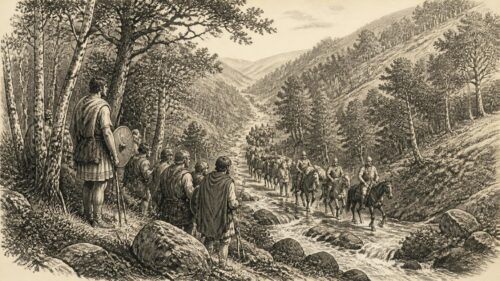
Tairdelbach Ua Conchobair remained the most energetic overking in Ireland. His authority had been strengthened by military engineering, fleets and fortifications, including a stronghold at Bun Gaillimhe and bridges across the Shannon. In 1141 he led what the Annals of the Four Masters call a great plundering army into Fotharta Airbrech, a territory associated with the borderlands of Meath and Uí Failge. His forces despoiled people of Meath, the Fotharta and the church settlement called Regles Uí Dhúnáin. This was more than undirected destruction. Predatory expeditions removed cattle and provisions, punished resistance and demonstrated an overking’s ability to enter contested country.
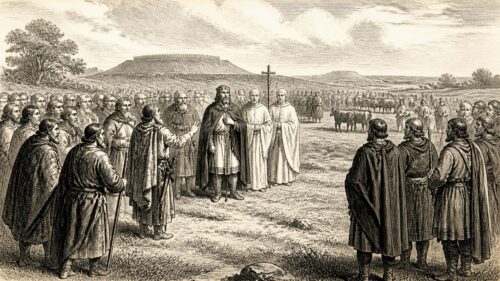
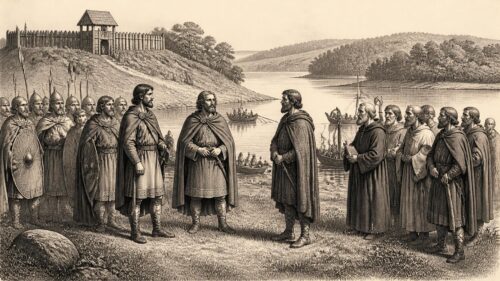
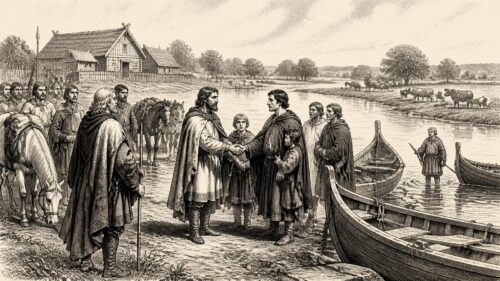
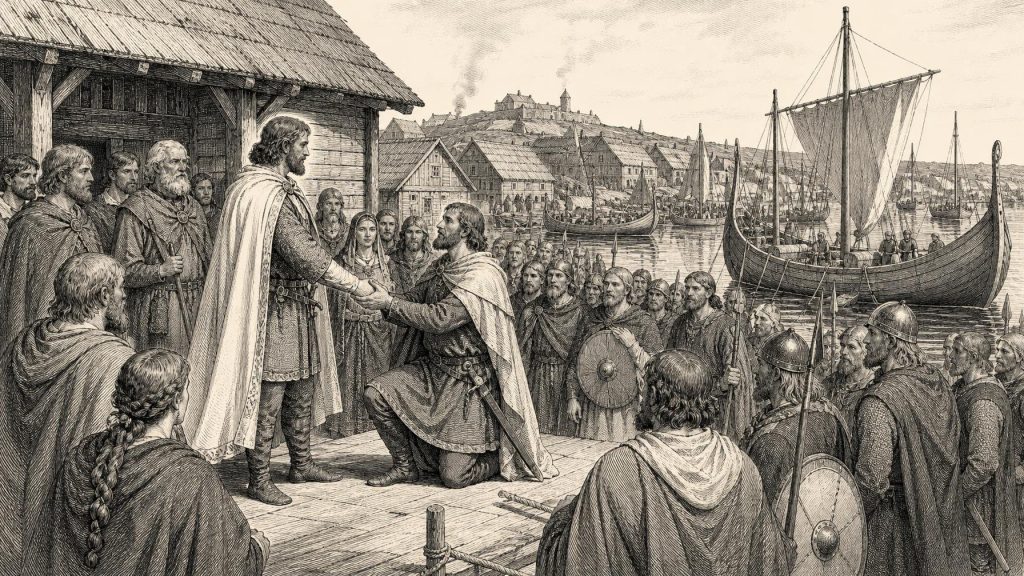
A more diplomatic expression of Tairdelbach’s supremacy came at Uisneach, the symbolically important hill in the Irish midlands. There he held a peace conference with Murchad Ua Maeleachlainn, king of Meath and claimant to the traditional kingship of Tara. Murchad gave hostages for Meath and Teathba, while hostages from Bréifne were also taken by Tairdelbach. Hostages were living guarantees of political submission, not merely ceremonial guests. Their surrender acknowledged obligations that might include tribute, military assistance and acceptance of the superior king’s settlement. Yet the need to renew such arrangements shows the limits of high-kingship: authority had to be repeatedly enforced through campaigning, negotiation and personal pledges.
Violence Within Meath
The settlement at Uisneach did not end the internal struggle among the Ua Maeleachlainn dynasty. Conchobar, a grandson of Donnchad Ua Maeleachlainn, was killed while held in fetters by Murchad. The annalist then reports that Murchad’s son Art, heir-designate to Tara, died a fortnight later. The Four Masters interpreted Art’s death as a divine miracle of vengeance for the prisoner’s killing. That judgement belongs to the moral language of medieval chroniclers, not to evidence of a demonstrable cause. Nevertheless, the two deaths were politically connected in their consequences. Murchad had removed one rival but rapidly lost his own intended successor, weakening dynastic continuity at a moment when Meath was already being pressed into submission by Connacht.
Elsewhere in the midlands, Domnall son of Ruaidrí Ua Maíl Muaid, king of Fir Cell, was killed by Muintir Luanaim, reportedly at Rahan. Donnchad Ua Conchobair Failge was killed by members of Uí Failge, identified as Clann Maíl Ugra. Such notices are terse, but they show that local kings faced danger from neighbouring families and from factions within their own territories. Provincial politics rested upon a dense foundation of smaller kingdoms, each with its own succession disputes, subordinate lineages and capacity for armed resistance.
The Leinster Purge
The year’s most notorious act occurred in Leinster. Diarmait Mac Murchada, king of Leinster, moved against leading nobles of the northern part of the province. The sources differ slightly in assigning direct agency: some blame Diarmait himself, while the Annals of Tigernach name his brother Murchad as the man who carried out the violence. The most responsible reconstruction is that Diarmait ordered the purge and Murchad acted as his lieutenant.
Seventeen members of Leinster’s ruling aristocracy were killed or blinded, with others of lower rank suffering alongside them. Those named include Domnall Mac Fáeláin, lord of Uí Fáeláin and a potential heir to Leinster; Murchad Ua Tuathail; and Muirchertach Mac Gilla Mo Cholmóc, lord of Fera Cualann, who was blinded. Three sons of Mac Gormáin were also among the victims recorded by one annal. Blinding was a calculated political punishment because bodily wholeness was closely connected with fitness for kingship. The attack therefore removed present opponents while disqualifying possible future claimants.
The Four Masters judged that the affair caused ‘great weakness’ in Leinster. That assessment is persuasive. Diarmait secured his immediate position, but at the cost of destroying or alienating families whose co-operation could have stabilised his rule. An annalistic notice that Ulstermen living throughout Leinster returned north was interpreted as a sign of coming vengeance, though its exact circumstances are obscure. Diarmait also raided Laois during the year, carried away prey and was defeated by the local population. The episode underlines the difference between terrorising rivals and establishing durable authority over a province’s many autonomous peoples.
Dublin Changes Kings
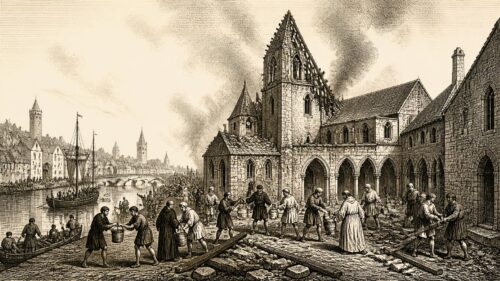
Conchobar Ua Briain, ruler in Munster and a leading opponent of Tairdelbach Ua Conchobair, marched to Dublin in 1141. The city’s Hiberno-Norse inhabitants submitted and accepted him as king. Dublin was not simply a prize to be occupied. Its community retained sufficient political identity to recognise rulers, while ambitious Gaelic kings sought its fleet, wealth, warriors and international connections. Its timber houses and workshops supported metalworkers, woodworkers, textile producers, leatherworkers and merchants trading across the Irish Sea and farther afield.
The Dublin kingship strengthened Conchobar’s position but did not give him secure mastery of Ireland’s east coast. Some members of his following died on their return journey after eating green corn in Laois, a rare annalistic glimpse of the hazards of feeding a moving army. The notice may describe illness caused by consuming unripe grain, although the precise medical explanation cannot now be recovered. It demonstrates that hosts depended heavily upon provisions taken or gathered along their route.
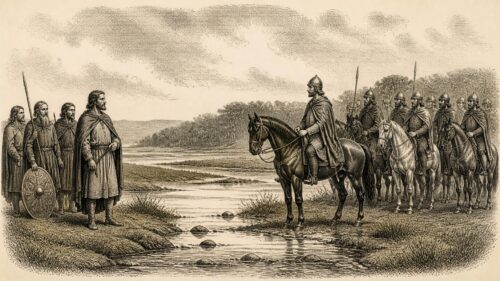
Conchobar then carried war towards Tairdelbach’s own sphere. An Uí Briain-led force crossed western Connacht, drove away many thousands of cattle and sacked and demolished Dún Gaillimhe. The fort at the mouth of the Gaillimh had been established by Tairdelbach in 1124 as part of his network of strongpoints and naval bases. Its destruction was therefore both materially damaging and symbolically provocative. The same coalition also raided Uí Chennselaig as far as Loch Garman, modern Wexford. These operations connected Munster’s dynastic ambitions with Dublin’s strategic value and pressure upon both Connacht and Diarmait’s Leinster heartland.
Churches, Protection and Penance
Ecclesiastical communities were deeply embedded in this political world. At Cluain Fionnlocha, the successor or coarb of St Ciarán—named as Máel Mochta in the Chronicon Scotorum—was robbed by Síl Anmchada and Conchobar son of Mac Cochláinn. The booty was promptly restored by Conchobar, son of Tairdelbach Ua Conchobair. The incident illustrates both the vulnerability of church property and the political value of defending it. A royal prince who compelled restitution could present himself as guardian of ecclesiastical privilege while extending his family’s influence.
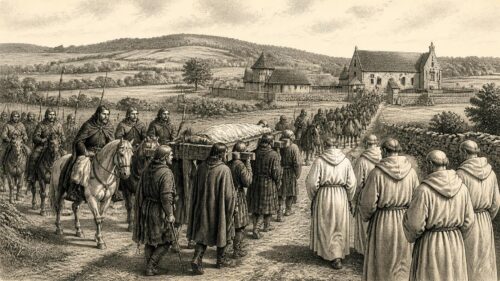
Several deaths likewise show the bond between aristocratic life and religious institutions. Domnall Ua Coinfhiacla, lord of Teathba, died at Clonard after undertaking penance. Gilla na Naem Ua Fearghail, chief of Muintir Angaile and praised for exceptional prosperity, died at an advanced age and was buried at the monastery of Inis Clothrann in Lough Ree. Aed Ua Longáin, steward of Munster, also died during the year. Monasteries were places of burial, commemoration, learning and retirement as well as worship. The language of penance surrounding elite deaths reflected a recognised ideal that rulers should seek reconciliation before death.
These events occurred during the wider reform of the Irish Church begun earlier in the century. Diocesan structures promoted since the Synod of Ráith Bressail in 1111 existed alongside older networks centred on saints, coarbs and hereditary church communities. The record for 1141 does not preserve a major reforming council, but its references to Ciarán’s successor, protected church goods, monastic burial and penitent rulers show that older institutions remained socially and politically powerful.
Land, Cattle and Livelihood
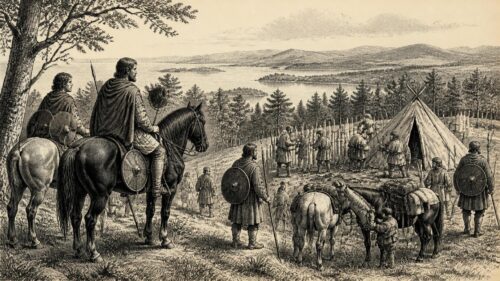
The annals concentrate on kings because kings and churchmen supported record-keeping, yet their campaigns depended upon ordinary households. Most people lived in a rural landscape of farmsteads, ringforts, dispersed settlements, fields and pasture. Mixed farming supplied grain, dairy produce, meat, wool and hides. Cattle were especially important as stores of wealth, sources of food and measures of tribute. Consequently, the repeated seizure of herds in 1141 was an economic strategy as well as a military one. A raid carrying away thousands of animals could enrich followers while depriving communities of breeding stock, milk, traction and future security.
Dublin represented a different concentration of labour and consumption. Its markets drew agricultural surplus from the countryside, while its craftspeople transformed timber, iron, antler, wool, leather and imported materials into saleable goods. Silver coinage had long circulated there, although cattle and valued objects remained fundamental in wider Irish exchange. Control of the city offered access to ships, customs, merchants and overseas contacts unavailable to most inland kings.
An Unsettled Balance
No single battle decided Ireland’s political future in 1141. Instead, the year exposed an unstable balance. Tairdelbach Ua Conchobair compelled submissions in the midlands but saw his western fortress attacked. Conchobar Ua Briain gained Dublin and struck into Connacht, yet his coalition remained dependent upon mobile campaigning. Diarmait Mac Murchada crushed rivals in Leinster but damaged the aristocratic framework upon which provincial rule relied. Across Meath, Uí Failge, Fir Cell and Dál Araide, lesser kings were killed in local struggles. Authority could be spectacular, but it was personal, negotiated and vulnerable. The hostages of Uisneach, the blinded nobles of Leinster, the cattle driven from Connacht and the restored property of Ciarán’s coarb together capture the realities of Irish power in this turbulent year.
Primary Sources
- Part 24 of Annals of the Four Masters
- Part 22 of The Annals of Tigernach
- Chronicon Scotorum
- Part 3 of Mac Carthaigh's Book
- Mac Carthaigh's Book
- The Annals of Tigernach
- Annals of the Four Masters
- Chronicon Scotorum: Corpus of Electronic Texts Edition
- Exploring the Irish Annals
- Ua Conchobair, Tairdelbach (O'Conor, Turlough)
- Mac Murchada, Diarmait (MacMurrough, Dermot)
- Mac Murchada (MacMurrough), Murchad
- Ua Briain, Conchobar
- Ua Briain, Tairdelbach
- Viking
- Early Medieval
- 950–1450: Vikings, Normans and Medieval Mints
- Medieval Ireland 1150–1550
- Crisis and Recovery: Church and Society in Twelfth Century Ireland
- The Origins of the Irish Parish
- The Irish Charters in the Book of Kells
- Galway/Gaillimh: Irish Historic Towns Atlas
- Medieval and Post Medieval: Galway City Museum
- Dublin's Foundations: A Viking Legacy