Castlepook’s Open Season31845 BCE
At the notional date of 31,845 BCE, Ireland lay within the climatically unstable MIS 3 phase of the last Ice Age, approaching wider glaciation but retaining varied ice-free environments. Fermanagh sediments demonstrate freshwater habitats during broad calibrated ranges encompassing this period. Castlepook Cave in County Cork preserves Ireland’s richest Ice Age vertebrate collection, including mammoth, reindeer, giant deer, bears and hyaenas, deposited over millennia. A reportedly cut-marked reindeer femur, about 33,000 years old, may indicate brief Upper Palaeolithic butchery. However, it cannot prove permanent settlement or society. Glacial erosion, complex cave deposits and uncertain dating require caution; animals certainly ranged.
Dateline
The label 31,845 BCE gives a reassuringly exact appearance to a time for which exact calendar years are unattainable. No people in Ireland then used a calendar, no written record exists, and archaeology cannot identify an event that happened in this particular year. The date should instead be treated as a modern point within a broad Late Pleistocene span: Marine Isotope Stage 3 (MIS 3), a climatically variable interval of the last Ice Age. The responsible history of Ireland at this point is therefore one of dated ranges, sediments, animal bones and carefully limited inferences—not named leaders, battles or settlements.
A Date Within a Range
In archaeological convention, “before present” means before 1950, while radiocarbon measurements require calibration before they can be expressed as calendar ages. Those procedures produce probability ranges rather than annual anniversaries, especially this far back. Around 31,845 BCE—roughly 33,795 years before 1950—Ireland was approaching the major expansion of the last British–Irish Ice Sheet, but was not necessarily uniformly ice-covered. The island’s conditions differed greatly between regions and changed repeatedly over long human timescales.
The best direct environmental guide comes from northern Ireland. At Derryvree, near Maguiresbridge in County Fermanagh, road-cutting exposed organic freshwater silts and fine sands trapped between two separate sheets of glacial till. The deposits produced a radiocarbon determination of 30,500 +1,170/−1,030 radiocarbon years BP. Later discussion has placed its calibrated span broadly at 36.9–31.7 thousand calendar years BP: approximately 34,950–29,750 BCE. That wide interval includes 31,845 BCE. It demonstrates that freshwater habitats and ice-free ground existed in this part of Ireland sometime within that range, before later glacier advance covered the deposits.
Greenagho, also in Fermanagh, provides a related but older constraint. Organic material beneath till has been dated to about 32,500 ± 300 radiocarbon years BP, with a calibrated range cited as about 37.2–35.7 thousand calendar years BP. It does not date the target point itself, but confirms that north-central Ireland had experienced ice-free episodes during MIS 3. Such evidence is crucial because the later ice sheet eroded, buried or rearranged much of the earlier landscape, leaving a fragmentary record rather than a continuous history.
Not Yet the Ice Maximum
This was an Ice Age landscape, but not simply a white, static wilderness. Research on the British–Irish Ice Sheet indicates a long and uneven build-up. Some reconstructions infer that much of Ireland remained ice-free until about 34,000 years ago, while ice subsequently expanded over many millennia. The ice sheet reached its broadest limits later, with different sectors attaining maximum extent at different times, broadly between 30,000 and 22,000 years ago. Thus 31,845 BCE belongs to a transition into harsher glacial conditions, not to a single island-wide moment when all land was necessarily sealed beneath ice.
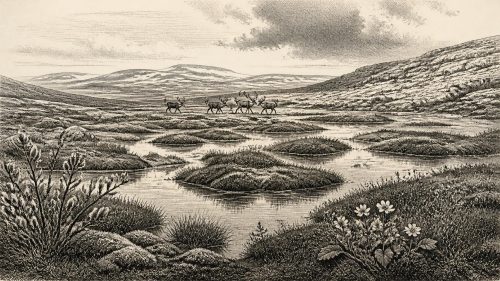
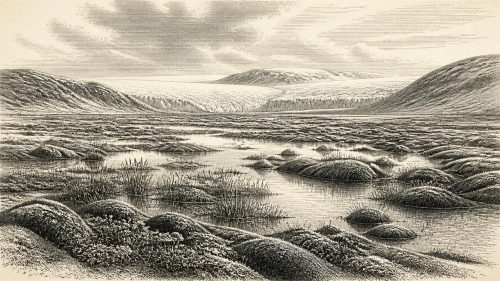
Cold, wind and seasonality were decisive facts of life for plants and animals. In open areas, the vegetation was likely a mosaic of grasses, sedges, herbs, dwarf shrubs and patches of bare ground, rather than the oak, hazel and elm woods familiar from later prehistoric Ireland. Local sheltered ground and wetlands could support different communities from exposed uplands or terrain near advancing ice. The Derryvree silts preserve the remains of a freshwater setting with a flora and fauna described as having a full-glacial character. That is evidence for a cold environment; it is not a detailed map of every valley, coast or season.
Sea level was substantially lower globally than today, so the outlines of the Irish coast and the adjoining shelf were different. Yet low sea level did not automatically create a dry, easy land bridge from Ireland to Britain or continental Europe. Ice, marine channels, changing shorelines and local topography all mattered. Any people or animals entering Ireland did so through a north-west European world whose routes shifted repeatedly. It is safer to speak of changing connections and barriers than to imagine a single permanent corridor.
Castlepook’s Animal Archive
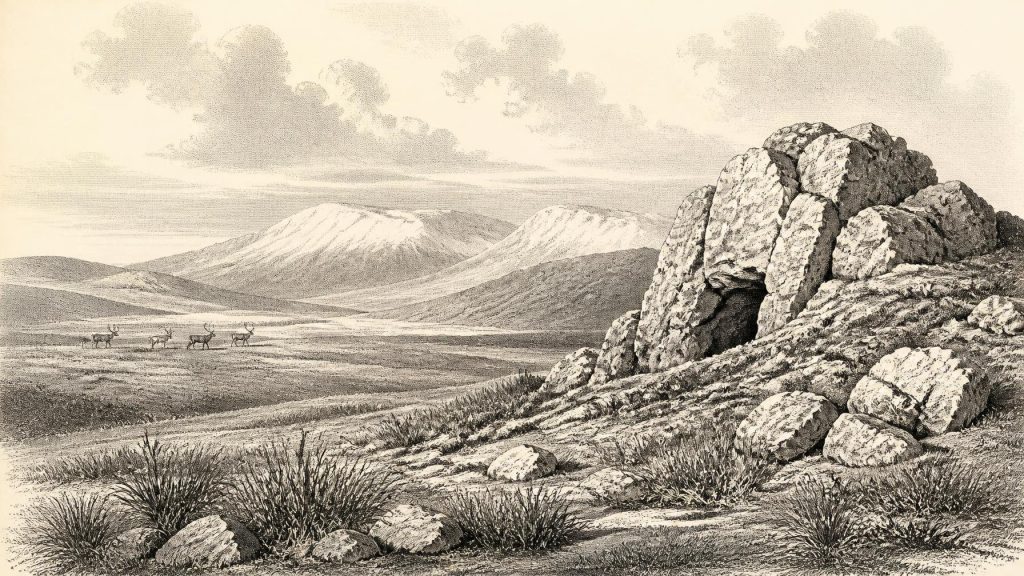
The closest archaeological evidence relevant to this era comes from Castlepook Cave near Doneraile in north County Cork, also known as Mammoth Cave. Its narrow limestone galleries and chambers yielded more than 2,000 animal bones during excavations undertaken principally between 1904 and 1918. The cave is Ireland’s richest known repository for vertebrate evidence from the period leading towards the Last Glacial Maximum. Individual specimens span a very long interval—reported by Geological Survey Ireland as roughly 45,700 to 19,950 years BP—so the collection is an archive of repeated deposition, not a single occupation layer.
The Castlepook fauna includes woolly mammoth, giant deer, reindeer, brown bear and spotted hyaena, with later material including Arctic fox, wolf and lemmings. These names establish that large herbivores and carnivores could occupy parts of Ireland during the broader Ice Age. They do not establish that every species was present together in 31,845 BCE, nor that the cave was a hunting camp. Bones can arrive in caves through carnivore activity, natural death, water movement, collapse and human excavation. Spotted hyaena in particular may have contributed to the accumulation and modification of carcass remains.
The animal evidence nevertheless makes clear that Ireland was not biologically empty. Reindeer point towards open, cold-adapted grazing country; mammoth and giant deer signal a large-herbivore landscape; hyaenas, wolves and bears show that predators and scavengers were also part of it. Herd movements may have been seasonal, but the Irish record cannot specify their routes or calendar. To call this a “reindeer landscape” is a useful shorthand only if it is remembered that it means a changing ecological zone, not an uninterrupted herd-filled plain.
The Human Question
Castlepook matters to human history because a reindeer femur fragment from its collections was reported in 2021 as bearing deep marks interpreted as stone-tool butchery. The bone was reported as about 33,000 years old, placing the claim broadly close to 31,845 BCE. If the marks are correctly identified as anthropogenic, they would represent a remarkably early trace of human activity in Ireland: evidence that one or more people processed a reindeer carcass on the island during the Upper Palaeolithic. The claim is important precisely because the evidence is so slight.
That one bone cannot demonstrate a permanent population, a village, a hunting season, a named culture or an Irish ancestry continuing to later peoples. There is no securely associated hearth, worked-stone assemblage, dwelling floor, burial, ornament, artwork or human skeleton of this age in Ireland. Nor does a radiocarbon date on an animal bone identify the exact time at which it was cut, whether the animal was hunted locally, or how long people remained nearby. At most, the femur supports a cautious possibility of brief human presence and carcass processing.
Caution is especially necessary because Castlepook’s bones were recovered by early excavators from complex cave contexts. Improved collagen pretreatment and redating have shown that a number of earlier radiocarbon determinations from Castlepook and other southern Irish caves were too young, in some cases by thousands of radiocarbon years. This is not a reason to dismiss the collection; rather, it shows why its individual bones must be reassessed with modern methods and why associations inferred from old excavation records cannot be treated as secure.
Life Without a Recorded Society
If people did reach Ireland around this time, the most plausible model is a very small and mobile Upper Palaeolithic foraging party, not a settled farming community. Reindeer could yield meat, marrow, fat, hide, sinew, antler and bone. A sharp stone edge used on a limb bone would fit the practical dismemberment of a carcass. Such an episode might have followed a hunt, opportunistic scavenging or the transport of portions of an animal to shelter. None of those possibilities can presently be distinguished in Ireland.
It is tempting to fill the gap with the richer Upper Palaeolithic evidence known elsewhere in Europe: tailored clothing, complex stone technologies, personal ornaments, cave art, burial rites and long-distance movement of materials. Those broader comparisons show what human groups in Europe could do, but they are not evidence that these practices occurred at Castlepook. No object from Ireland around 31,845 BCE yet reveals language, kinship, ritual, leadership, gender roles, teaching or artistic tradition. The absence of evidence is partly a consequence of preservation and later glacial erosion, but it remains an absence.
For the same reason, there can be no meaningful account of political affairs, diplomacy or organised conflict in Ireland in this year. States, kingdoms, borders and institutions lay tens of thousands of years in the future. There is no basis for imagining tribal territories or relations with neighbouring groups. The relevant “politics” of the period, if the word is used at all, was ecological: access to shelter, game, fresh water and safe routes through an unstable cold-world landscape.
What Can Be Said Responsibly
At the notional date of 31,845 BCE, Ireland was part of MIS 3 and moving towards a more extensive glaciation. Calibrated ranges from Fermanagh support the existence of ice-free freshwater environments within the broader period, while the Castlepook caves document an exceptionally varied Ice Age fauna in the south. A cut-marked reindeer femur offers a potentially major, but still limited, indication of human activity close to this era. It does not prove continuous settlement.
The enduring significance of this point in Ireland’s past lies in that tension: the land was ecologically inhabited, archaeologically elusive and climatically unstable. Each redated bone, preserved silt bed and carefully excavated cave deposit can refine the picture. For now, the honest history is not of an Irish society in a precise year, but of a changing Ice Age island where animals certainly ranged and where people may briefly have entered, hunted or butchered—and then left almost no trace behind.
Primary Sources
- A Reconsideration of the Radiocarbon Dating of the Marine Isotope Stage 3 Fauna from Southern Ireland
- The Irish Quaternary Fauna Project
- Castlepook Cave: Cork County Geological Site Report
- A Middle Midlandian Freshwater Series at Derryvree, Maguiresbridge, County Fermanagh, Northern Ireland
- Trimlines, Blockfields and the Vertical Extent of the Last Ice Sheet in Southern Ireland
- The Timing and Magnitude of the British–Irish Ice Sheet Between Marine Isotope Stages 5d and 2
- Growth and Retreat of the Last British–Irish Ice Sheet, 31,000 to 15,000 Years Ago: the BRITICE-CHRONO Reconstruction
- Pattern and Timing of Retreat of the Last British-Irish Ice Sheet
- Radiocarbon Constraints on the Age of the Maximum Advance of the British–Irish Ice Sheet in the Celtic Sea
- Stratigraphic and Palaeo-Geomorphological Evidence for the Glacial-Deglacial History of the Last British-Irish Ice Sheet in the North-Western Irish Sea
- The Exploration of Castlepook Cave, County Cork
- Irish Cave Exploration
- Dublin Radiocarbon Dates II
- Occurrence of Mammalia Relicts at Site Castlepook Cave
- 2022:564 – Castlepook Cave, Castlepook South, Cork
- Quaternary Geology of Ireland
- Ireland Through Geological Time
- The Geological Heritage of County Cork
- New Insights on the Fauna of Ireland’s Younger Dryas and Early Holocene from Alice & Gwendoline Cave
- The Colonization of Ireland: A Human Ecology Perspective
- The Mesolithic in Ireland: When Was It?
- The IntCal20 Northern Hemisphere Radiocarbon Age Calibration Curve (0–55 cal kBP)
- European Middle and Upper Palaeolithic Radiocarbon Dates are Often Older than They Look: Problems with Previous Dates and Some Remedies
- Reindeer Bone Found in Cork Cave Shows Human Activity in Ireland 33,000 Years Ago