Derryvree Mosses31846 BCE
The modern label 31,846 BCE denotes a broad MIS 3 Ice Age interval, not a datable Irish event. At Derryvree, County Fermanagh, buried organic silts, pollen, plants and insects record cold, treeless tundra wetlands, indicating that parts of Ireland supported freshwater habitats before major ice-sheet expansion. Castlepook Cave, County Cork, preserves disturbed but important remains of reindeer, mammoth, bears, wolves, lemmings and other fauna, though species were not necessarily contemporaneous. A cut-marked reindeer femur may indicate Upper Palaeolithic butchery around 31,000 BCE, yet cannot prove settlement. No secure tools, hearths, dwellings or human remains exist. Possible human presence remains unconfirmed.
Dateline
“31,846 BCE” is a modern label imposed on a time far beyond written records, named rulers or usable calendar years in Ireland. Archaeology cannot identify an event that happened in that particular year, nor can it securely describe a population living through it. The responsible scale is broader: this notional date falls around 33,800 calendar years before 1950, within the later part of Marine Isotope Stage 3, a volatile interval of the last Ice Age. For Ireland, the strongest evidence is environmental and faunal, with a small but important body of material raising – not finally settling – the possibility of very early human visits.
The clearest contemporary archive is not a monument or settlement but a buried deposit beneath a drumlin at Derryvree, near Maguiresbridge in County Fermanagh. Its organic silts and fine sands were laid down beside freshwater in a cold landscape, then sealed between glacial tills. A radiocarbon determination of 30,500 ± 1,170 radiocarbon years BP has been calibrated in published discussion to a broad range of roughly 36,900–31,700 calendar years BP. That range encompasses the period represented by 31,846 BCE, but it does not pinpoint a single season, generation or event.
A Cold Landscape, Not an Empty One
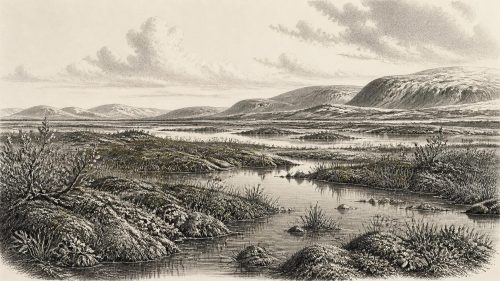
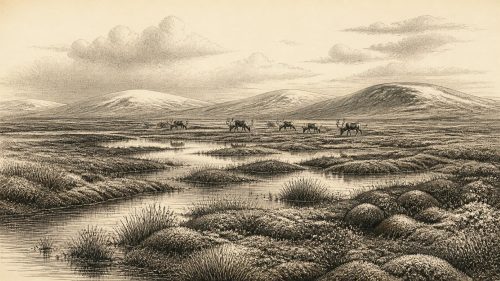
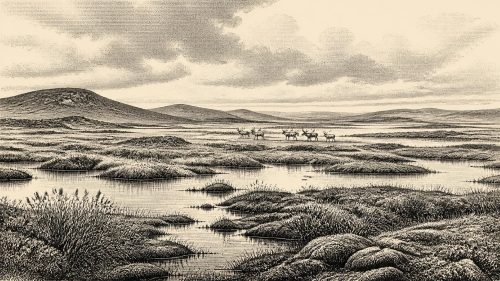
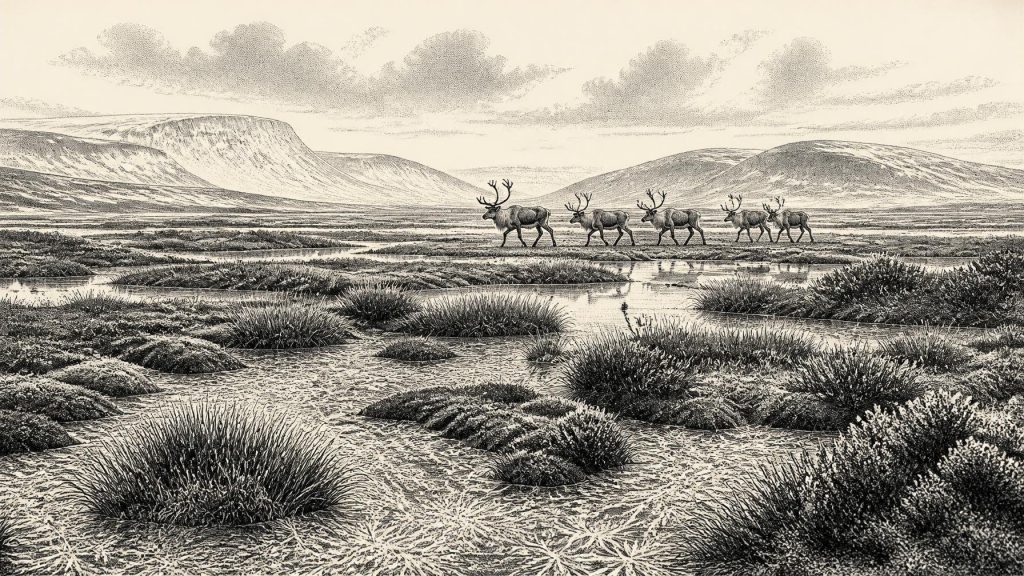
Derryvree’s pollen, plant macrofossils, mosses and insects provide a rare view of an Irish landscape before the great expansion of the last British-Irish Ice Sheet. They indicate open tundra or muskeg: wet, treeless ground with pools, sedges, grasses, herbs, mossy margins and low shrubs, rather than the oak, hazel and ash woods familiar from much later Irish prehistory. The evidence points to severe winters, short growing seasons and periglacial conditions in which frost was a major force shaping soil and watercourses.
This was not necessarily a uniform landscape across the island. Ireland’s relief, exposure to Atlantic weather, proximity to ice and drainage patterns created regional variation. Yet the Derryvree record makes one point firmly: parts of the island could sustain freshwater habitats and vegetation even in a very cold phase. It is a corrective to the idea of an entirely barren or permanently ice-covered Ireland. At the same time, its plant record is local. It should not be enlarged into a precise map of every valley, coast or upland in 31,846 BCE.
Glacial history reinforces that caution. Research on the last Irish Ice Sheet suggests that substantial areas of Ireland were ice-free until at least about 34,000 years ago, before ice expanded greatly in subsequent millennia. Other reconstructions show an exceptionally rapid growth of the wider British-Irish Ice Sheet around 31,000–30,000 years ago. Thus the period around this article’s nominal year was one of transition and uncertainty: local ice and snowfields may have been advancing, while some lowlands, caves, lakes and coastal margins still offered habitable ground for cold-adapted animals. There was no single Irish ice margin that can be drawn confidently for one calendar year.
The Animal World of Castlepook
In north County Cork, Castlepook Cave near Doneraile preserves Ireland’s most important assemblage of pre-Last Glacial Maximum animal remains. Excavations conducted mainly in the late nineteenth and early twentieth centuries recovered bones from a cave system used and re-used over a very long period. Subsequent radiocarbon programmes have shown both the potential and the difficulty of this collection: many specimens are genuinely very old, but their original positions were disturbed by carnivores, water, sediment movement and antiquarian excavation. Bones found together cannot automatically be assumed to be of the same date.
The wider Castlepook fauna nevertheless demonstrates that Ireland formed part of a connected Ice Age ecological zone. Finds attributed to the pre-glacial-maximum period include reindeer, woolly mammoth, giant deer, brown bear, wolf, Arctic fox, mountain hare, collared lemming, Norwegian lemming and spotted hyaena. The hyaena is especially striking: Castlepook is Ireland’s only known site for the species. Such a community was not a collection of exotic curiosities. Herbivores depended upon seasonal grass, sedge and herb resources; predators and scavengers followed concentrations of prey and carrion; caves could serve as dens, refuges or places where bones accumulated after animals had died elsewhere.
It would be wrong, however, to imagine all these species standing together at the cave in 31,846 BCE. Improved radiocarbon pretreatment has revised some earlier Castlepook results by thousands of years. A 2020 reassessment argued that giant deer and spotted hyaena may have disappeared locally before the Last Glacial Maximum, perhaps around 40,000 calibrated years BP. The faunal list therefore establishes the character of a wider MIS 3 world and the succession of animals through it; it does not prove a single simultaneous herd, hunt or ecosystem at the nominal date.
The Human Question
The most provocative evidence is a reindeer femur from the Castlepook collection, publicised by County Cork heritage authorities as dating to about 31,000 BCE and bearing a mark identified by zooarchaeologist Ruth Carden as having been made by a sharp stone tool during butchery. If that diagnosis and dating are sustained through further specialist study, it would be the earliest known indication of human activity in Ireland by many millennia. It would show that somebody used a cutting edge on a reindeer carcass in Ireland during the Upper Palaeolithic.
That is an important possibility, but it remains a very small one. The femur does not establish a permanent settlement, a continuous population, a named archaeological culture, a language or descent from later inhabitants. It does not tell us whether hunters killed the reindeer, found it dead, processed it in the open, or carried it to the cave. Indeed, a discarded limb bone could have been dragged into Castlepook by hyaenas or wolves. Nor have archaeologists yet published a securely associated stone-tool assemblage, hearth, built shelter, burial, human skeleton or occupation surface of this age from Ireland.
For this reason the National Museum of Ireland’s cautious position remains significant: it states that clear evidence of Palaeolithic humankind in Ireland has not yet emerged. This does not erase the Castlepook claim; rather, it marks the distinction between an exciting, potentially transformative find and a fully demonstrated archaeological occupation. Renewed fieldwork at Castlepook has sought surviving Pleistocene sediments and undisturbed contexts in which such questions can be tested. The appropriate conclusion for this period is that brief human incursions are possible, perhaps even plausible, but unproven as a settled or recurrent presence.
No Polities, No Proven Trade
There is no evidence for political affairs, kingship, diplomacy, territorial states or organised warfare in Ireland at this time. There are no known Irish graves, shrines, art panels, dwellings or tool industries that can responsibly be assigned to 31,846 BCE. Consequently, claims about religion, social rank, marriage systems, leadership or formal learning would be inventions. If people did reach the island, they would have belonged to highly mobile Upper Palaeolithic hunter-gatherer worlds known elsewhere in north-west Europe; but that comparison is a context, not evidence that Irish groups copied any particular practice.
The same restraint applies to economy and exchange. Reindeer and other animals show that biological movement into Ireland occurred, but they do not demonstrate human trade routes. Lower global sea levels exposed more continental shelf than exists today, and changing sea, ice and coastal conditions may have reduced or altered crossings between Ireland, Britain and the European mainland. Yet no secure route can be assigned to a possible Castlepook visit. Travellers might have moved over exposed coastal plains, crossed narrowed stretches of water, used seasonal ice, or combined several routes. The available evidence cannot choose between them.
What This Date Can Mean
For Ireland, the importance of this era lies in its fragile archives. Derryvree’s waterlogged silts show a cold, open, living landscape at a broad date range that includes the notional year. Castlepook’s bones show that Ice Age mammals entered and survived in parts of the island during MIS 3. The disputed or still-developing evidence of a modified reindeer bone raises the prospect that humans did too. These are substantial discoveries, but they are not the foundation for a detailed national story.
Modern radiocarbon calibration makes the limits visible. A radiocarbon age is not identical to a calendar age, and calibration curves contain uncertainty, particularly so far back in time. The date 31,846 BCE should therefore be read as a useful point within a much wider prehistoric interval, not as a day on which Irish history can be narrated. At this distance, mosses, pollen, insects, animal bones and layered sediments are the historical record. They reveal an Ireland of tundra wetlands, moving fauna and approaching ice – a place with the ecological capacity for life, but with human evidence still tantalisingly slight.
Source References
Hover over a number to see the source. Select it to open the source.

- [1] A reconsideration of the radiocarbon dating of the Marine Isotope Stage 3 fauna from southern Ireland
- [2] The Irish Quaternary Fauna Project
- [3] Growth and retreat of the last British–Irish Ice Sheet, 31,000 to 15,000 years ago: the BRITICE-CHRONO reconstruction
- [4] Trimlines, blockfields and the vertical extent of the last ice sheet in southern Ireland
- [5] The IntCal20 Northern Hemisphere Radiocarbon Age Calibration Curve (0–55 cal kBP)
- [6] Palaeoecology
- [7] The Subdivision of the Quaternary Period in Ireland
- [8] Introduction to the Late Quaternary and Holocene of Northern Ireland
- [9] Archaeological Heritage of County Cork
- [10] Heritage Artefacts of County Cork
- [11] 2022:564 – Castlepook Cave, Castlepook South, Cork
- [12] Prehistoric Details: Mell Flint Flake
- [13] Ireland’s Palaeolithic Archaeology – Fleeting Footprints in a Frozen Land
- [14] New insights on the fauna of Ireland's Younger Dryas and Early Holocene from Alice & Gwendoline Cave
- [15] Phylogeographic, ancient DNA, fossil and morphometric analyses reveal ancient and modern introductions of a large mammal: the complex case of red deer in Ireland
- [16] Insularity and Quaternary vertebrate faunas in Britain and Ireland
- [17] Pleistocene Vertebrates in the British Isles
- [18] Reindeer bone found in Cork cave shows human activity in Ireland 33,000 years ago
- [19] Irish Pleistocene Biostratigraphy
- [20] The Irish Quaternary Fauna Project
Primary Sources
- A reconsideration of the radiocarbon dating of the Marine Isotope Stage 3 fauna from southern Ireland
- The Irish Quaternary Fauna Project
- Growth and retreat of the last British–Irish Ice Sheet, 31,000 to 15,000 years ago: the BRITICE-CHRONO reconstruction
- Trimlines, blockfields and the vertical extent of the last ice sheet in southern Ireland
- The IntCal20 Northern Hemisphere Radiocarbon Age Calibration Curve (0–55 cal kBP)
- Palaeoecology
- The Subdivision of the Quaternary Period in Ireland
- Introduction to the Late Quaternary and Holocene of Northern Ireland
- Archaeological Heritage of County Cork
- Heritage Artefacts of County Cork
- 2022:564 – Castlepook Cave, Castlepook South, Cork
- Prehistoric Details: Mell Flint Flake
- Ireland’s Palaeolithic Archaeology – Fleeting Footprints in a Frozen Land
- New insights on the fauna of Ireland's Younger Dryas and Early Holocene from Alice & Gwendoline Cave
- Phylogeographic, ancient DNA, fossil and morphometric analyses reveal ancient and modern introductions of a large mammal: the complex case of red deer in Ireland
- Insularity and Quaternary vertebrate faunas in Britain and Ireland
- Pleistocene Vertebrates in the British Isles
- Reindeer bone found in Cork cave shows human activity in Ireland 33,000 years ago
- Irish Pleistocene Biostratigraphy
- The Irish Quaternary Fauna Project