Derryvree’s Frostbound Pool31844 BCE
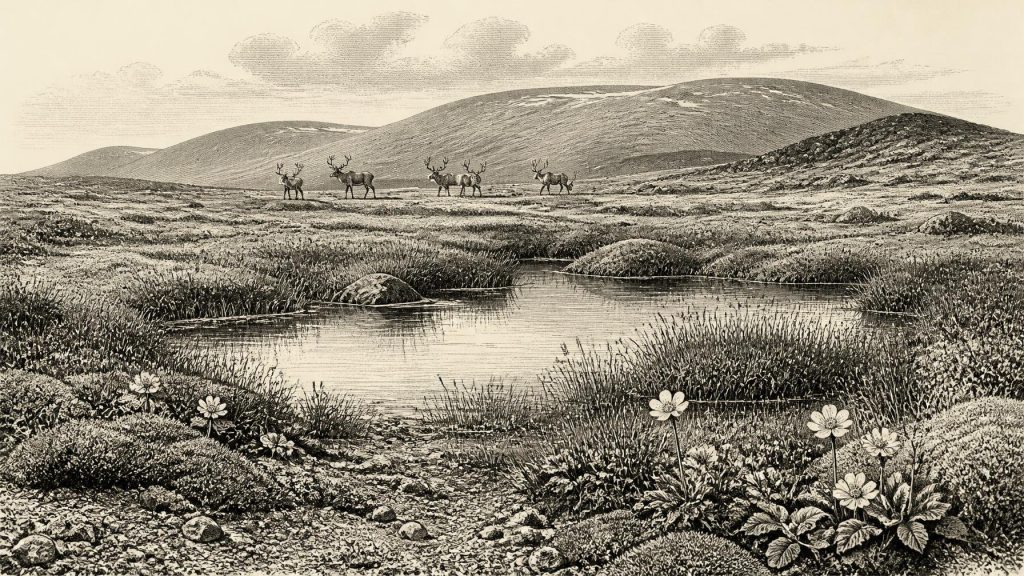
At 31,844 BCE, Ireland lacks a recoverable annual history; evidence instead describes a changing Late Pleistocene environment. Derryvree, County Fermanagh, preserves freshwater silts between glacial tills, radiocarbon-dated broadly to a range encompassing this period. Plant remains indicate cold, open tundra with wetland niches, rather than continuous ice cover. Castlepook Cave fauna demonstrate cold-stage mammals, including mammoth, reindeer and predators, although disturbed contexts limit conclusions. A possibly tool-marked reindeer bone suggests brief human presence, but remains unconfirmed. Lower sea levels and shifting ice shaped uncertain routes. Approaching later maximum glaciation erased much evidence, leaving deposits and bones as crucial scientific archives.
Dateline
31,844 BCE is not a date at which Ireland can be assigned an event, a ruler, a settlement or even a season. It is a modern calendar label projected onto a period for which no annual Irish chronology exists. In archaeological terms it falls roughly 33,800 calendar years before AD 1950, in the later part of the Late Pleistocene and Marine Isotope Stage 3. The responsible way to approach it is through broad, calibrated ranges and through the fragmentary records left by plants, animals, sediments and ice. Those records illuminate an Ireland that was cold, open, ecologically changeable and connected to a wider north-west European world, but they do not support a conventional year-by-year narrative.
The nearest particularly informative Irish evidence comes from Derryvree, near Maguiresbridge in County Fermanagh. Road-cutting in 1969 exposed organic silts and fine sands trapped between two substantial layers of glacial till inside a drumlin. The deposit produced a radiocarbon age of 30,500 years before present, with a published uncertainty of +1,170 and −1,030 years. Calibration places it broadly between about 36,900 and 31,700 calendar years before present. Thus 31,844 BCE lies near the younger end of a range that may be relevant to the deposit, rather than at a point that can be isolated within it. Derryvree is therefore a powerful environmental archive, not a diary of one year.
A Landscape Between Ice Advances
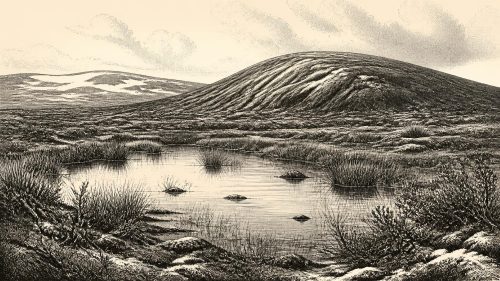
The position of the Derryvree beds is itself important. They lie between tills: sediments laid down by glaciers or ice sheets. They show that, before a later advance overrode the district, freshwater conditions existed in at least this part of Fermanagh. The discovery overturns any simple picture of Ireland as continuously entombed beneath ice throughout the whole last glacial period. Instead, the island experienced shifting arrangements of ice, bare ground, periglacial terrain, lakes, marshes and drainage channels. Precisely how much of Ireland was ice-free at any particular moment around 31,844 BCE remains uncertain, because surviving deposits are rare and later ice repeatedly eroded or buried earlier landscapes.
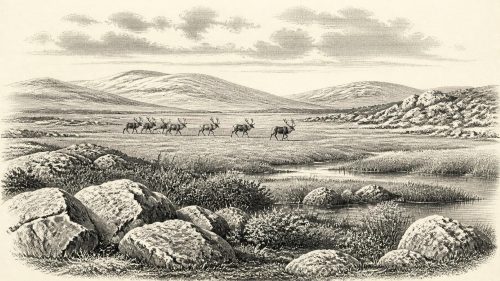
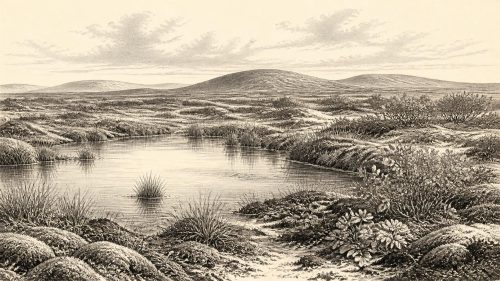
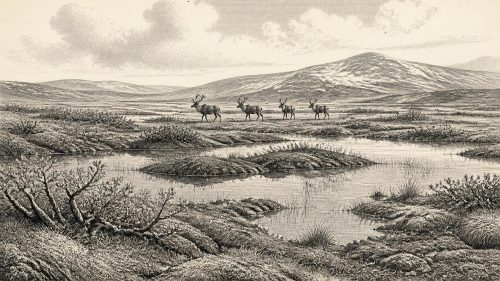
“Periglacial” does not mean a benign landscape beside a picturesque glacier. It denotes ground shaped by severe cold, repeated freezing and thawing, sparse vegetation and seasonal instability. The Derryvree silts preserve a freshwater setting in such a regime: water was present, but the wider climate was cold enough to favour tundra rather than woodland. Mosses, herb pollen and plant macrofossils provide the chief evidence. Among the reported remains are Arctic-alpine plants including mountain avens (Dryas octopetala), alongside aquatic or wet-ground species. Poor pollen preservation limits fine reconstruction, yet the combined evidence indicates open vegetation, low woody cover and local pools or slow-moving water.
That evidence should not be expanded into an imagined panorama of uniform snowfields. Tundra is varied at close quarters. A shallow pool, damp sedge-rich edge, exposed gravelly slope and sheltered hollow can sustain different plants and insects. Seasonal meltwater may have been as decisive as average temperature. In northern Ireland, drumlin country and local relief could have created patches of shelter, drainage and wet ground within a generally harsh setting. At Derryvree, the buried freshwater deposit records one such patch of life, later sealed under ice-derived sediment.
Animals on an Open Island
Animal bones from caves in southern Ireland offer another window, though one with major qualifications. Castlepook Cave, near Doneraile in north County Cork, has yielded Ireland’s best-known pre-Last Glacial Maximum assemblage. Re-dating of identified bones has demonstrated that several animals were present in Ireland during Marine Isotope Stage 3. The assemblage includes woolly mammoth, reindeer, giant deer, brown bear, wolf, fox, Arctic fox, collared lemming, Norway lemming and spotted hyaena. Not every specimen was necessarily contemporary: antiquarian excavations disturbed deposits, and cave material can be redeposited or mixed. Nevertheless, the sequence establishes that Ireland supported a richer cold-stage fauna than was once securely recognised.
For a date around 31,844 BCE, reindeer and mammoth are especially evocative but must be handled with care. Reindeer were adapted to open, cold country and could exploit lichens, sedges and other tundra resources. Mammoths required extensive forage and were not creatures of unbroken permanent ice; their presence points instead to productive open ground somewhere within their range. Giant deer, despite the later popular name “Irish elk”, was neither uniquely Irish nor an elk. Its fossils show that this great deer formed part of Ireland’s Pleistocene fauna, although recent reassessment indicates that some species, including giant deer and spotted hyaena, may have disappeared locally before the Last Glacial Maximum.
The predators matter because they complicate any easy assumption that caves were human shelters. Castlepook appears to have functioned at least in part as a carnivore den. Hyaenas and other scavengers could drag bones into its chambers; gnawing, breakage and the separation of body parts can therefore reflect animal behaviour. A cave bone is evidence of an animal’s presence in the region, but not necessarily of where it died, nor of a human occupation beside it. Wolves, bears and hyaenas belonged to the ecological story in their own right, competing for carcasses and shelter in a landscape where food, safety and movement were seasonal concerns.
The Human Question
There is no securely dated dwelling, hearth, stone-tool assemblage or cemetery in Ireland that can be assigned to 31,844 BCE. There were no states, named communities, political institutions, diplomatic relations or recorded conflicts of the kind later historical writing can describe. There is likewise no basis for discussing Irish religion, language, learning, trade or art as distinct institutions at this date. If people were present, they were mobile Upper Palaeolithic hunter-gatherers, operating in very small groups and leaving an exceptionally light archaeological signature. That is an interpretation derived from wider European evidence, not a demonstrated description of a resident Irish population.
The most provocative clue is a reindeer femur from Castlepook bearing a deep mark interpreted by its researcher as a cut or chop made with a sharp stone tool during butchery. The bone has been reported as dating to around 31,000 BCE. If both the date and human origin of the modification are sustained by further analysis, it would indicate that people reached Ireland far earlier than the traditionally recognised post-glacial settlement record. It might represent a brief hunting visit or the processing of a carcass, not a village, an enduring population or an identifiable migration. No associated Palaeolithic stone tools have yet been recovered from the cave, and the century-old excavations make the bone’s precise original context difficult to reconstruct.
This distinction is essential. A modified bone can be strong evidence for an action, but it cannot alone reveal the number of people involved, their sex or age, their route, their language, the duration of their stay or their beliefs. Nor can it establish an annual cycle of reindeer hunting in Ireland. The discovery instead directs research towards a possibility long obscured by later glaciation: that occasional human groups may have entered the island during more favourable intervals of the Ice Age. Continued investigation at Castlepook has sought surviving undisturbed sediments precisely because new, controlled evidence is needed to test that proposition.
Routes, Shores and Regional Change
At this time Ireland’s geography was not that of the modern island. Global sea level was lower during the glacial period, exposing parts of the continental shelf around north-west Europe. Yet lower sea level does not automatically prove an easy dry route from Ireland to Britain or the continent. Relative sea level depended also on the weight of nearby ice and on the rise or depression of the land. Ice margins, proglacial lakes, tidal channels and unstable coasts could obstruct travel as effectively as open sea. Later modelling suggests that Ireland remained connected to Britain until roughly 16,000 calendar years ago, but the arrangement around 33,800 years ago was more complex and is less securely resolved.
What can be said is that Ireland’s fauna was not isolated from the larger European ecosystem. Mammals had arrived by routes that changed with ice and water, and any human visitors would have faced the same regional geography. The exposed shelf may have enlarged lowland habitats in some directions while ice constrained movement in others. A journey to or from Ireland need not imply one uninterrupted land bridge; it could have involved a mosaic of terrestrial corridors, coastal margins and water crossings. The evidence does not presently allow one route to be chosen with confidence.
Economy, in the modern sense, did not exist here. There is no evidence for farming, stock-keeping, metalworking, markets, long-distance commodity exchange or permanent territorial control. Subsistence, if humans entered Ireland, would have depended on knowledge of animal movements, stone resources, weather, fuel, shelter and safe passage. Reindeer carcasses could provide meat, marrow, hide, sinew and bone, but that practical observation should not be mistaken for proof that Castlepook hunters exploited every resource in this way. It is a reasonable possibility grounded in Upper Palaeolithic practice elsewhere, not an Irish fact established for this date.
A Date Defined by Evidence Limits
The larger trajectory gives 31,844 BCE its historical significance. Ireland was approaching, but had not yet reached, the Last Glacial Maximum, when the British–Irish Ice Sheet expanded dramatically between roughly 27,000 and 23,000 years ago and covered much of the island. That later ice was an agent of destruction as well as deposition. It removed many surface traces of earlier landscapes and any ephemeral camps that may once have existed. Caves, protected sediment pockets and subglacial organic layers are consequently disproportionate witnesses to this deep past.
For this reason, Derryvree’s frostbound pool and Castlepook’s cave bones deserve more attention than any invented episode could. They show an Ireland of tundra plants, freshwater niches and cold-adapted animals, subject to climatic swings and eventual glacial transformation. They also preserve a carefully bounded human question: perhaps people briefly used or passed through this landscape, perhaps they butchered a reindeer, but the case remains incomplete. Around 31,844 BCE, Ireland has no recoverable politics or calendar history. It has instead a demanding scientific history, assembled from deposits whose dates are ranges, from bones whose contexts require scrutiny, and from landscapes that ice almost erased.
Primary Sources
- Middle Midlandian Freshwater Series at Derryvree, Maguiresbridge, County Fermanagh, Northern Ireland
- A reconsideration of the radiocarbon dating of the Marine Isotope Stage 3 fauna from southern Ireland
- The Irish Quaternary Fauna Project
- Phylogeographic, ancient DNA, fossil and morphometric analyses reveal ancient and modern introductions of a large mammal: the complex case of red deer (Cervus elaphus) in Ireland
- New insights on the fauna of Ireland's Younger Dryas and Early Holocene from Alice & Gwendoline Cave
- First evidence of a Late Upper Palaeolithic human presence in Ireland
- First Evidence of a Late Upper Palaeolithic Human Presence in Ireland
- Growth and retreat of the last British–Irish Ice Sheet, 31,000 to 15,000 years ago: the BRITICE-CHRONO reconstruction
- Pattern and timing of retreat of the last British-Irish Ice Sheet
- Maximum extent and dynamic behaviour of the last British–Irish Ice Sheet west of Ireland
- The timing and magnitude of the British–Irish Ice Sheet between Marine Isotope Stages 5d and 2: implications for glacio-isostatic adjustment, high relative sea levels and ‘giant erratic’ emplacement
- The Island of Ireland: Drowning the Myth of an Irish Land-Bridge?
- Palaeoecology: A Field Guide to the Late Quaternary Environments of North-West Ireland
- 2022:564 – Castlepook Cave, Castlepook South, Cork
- The Archaeological Heritage of County Cork
- Heritage Artefacts of County Cork
- The IntCal20 Northern Hemisphere Radiocarbon Age Calibration Curve (0–55 cal kBP)
- IntCal: International Radiocarbon Calibration
- Scientific Dating of Pleistocene Sites: Introduction
- Occurrence of mammalia relicts at site Castlepook Cave
- Dryas octopetala
- Menyanthes trifoliata