Castlepook’s Scored Femur31837 BCE
Castlepook Cave near Doneraile, County Cork, preserves a mixed Late Pleistocene animal archive spanning roughly 45,700–19,950 years BP. A directly dated reindeer femur, about 33,000 years old, bears a fresh-bone incision possibly made by a stone tool, offering tentative evidence of human butchery before the Last Glacial Maximum. Disturbed deposits and inadequate early excavation records mean it cannot prove settlement, permanent population or a specific culture. Its fauna, including mammoth, reindeer, giant deer and hyaena, indicates a cold, varied landscape. Any visitors were probably mobile hunter-gatherers. Castlepook expands Ireland’s possible human past while underscoring the need for securely stratified evidence.
Dateline
Modern calendar-year precision is not available for Ireland in 31,837 BCE. The label is a retrospective convenience, not a date that anyone then could have recognised, and it corresponds only approximately to 33,786 years before AD 1950. At this depth of time, the responsible unit is a broad calibrated interval, measured in millennia rather than seasons or years. Ireland lay within the Late Pleistocene, broadly Marine Isotope Stage 3, during an unstable later phase of the last Ice Age. The most relevant Irish evidence is not a written record, settlement plan or battlefield, but a difficult cave archive at Castlepook near Doneraile, north County Cork.
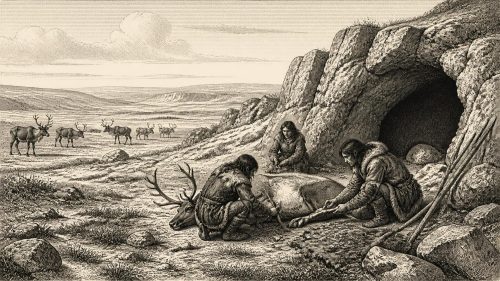
That archive makes this moment important. A reindeer femur from Castlepook has been directly radiocarbon dated to roughly 33,000 years ago and bears a deep incision interpreted by zooarchaeologist Ruth Carden as a cut or chop mark made with a sharp stone implement while the bone was fresh. If that interpretation is sustained, it is evidence that people processed an animal in Ireland during the period before the Last Glacial Maximum. It is not evidence for a town, a permanent population, a named culture or a particular hunt in 31,837 BCE. The bone comes from old, disturbed cave deposits, and no associated stone tool, hearth, dwelling or human remains has yet been recovered to demonstrate an occupation surface. The distinction is fundamental.
A Date Range, Not a Diary Entry
Radiocarbon determinations are not calendar dates in themselves. They must be calibrated against changing atmospheric carbon levels, and at more than 30,000 years ago the resulting ranges can be broad or irregular. The current IntCal20 calibration framework extends to 55,000 calendar years before present, but it does not turn a single bone into an exact annual timestamp. The Castlepook femur should therefore be understood as belonging to a period around the mid-30th millennium before present, rather than as proof that butchery occurred in this particular numbered BCE year.
The cave’s wider chronology is similarly long. Direct dates obtained from Castlepook animals extend across a substantial part of the middle and later Ice Age: Geological Survey Ireland summarises individual results spanning approximately 45,700 to 19,950 years BP. Such a spread means that the celebrated collection was accumulated through many generations of animals and changing environments. Water movement, nineteenth- and early twentieth-century excavation methods, and later disturbance have mixed or obscured relationships between bones. Castlepook is exceptionally valuable, but it is not a neatly layered campsite.
The Cave Above the Awbeg
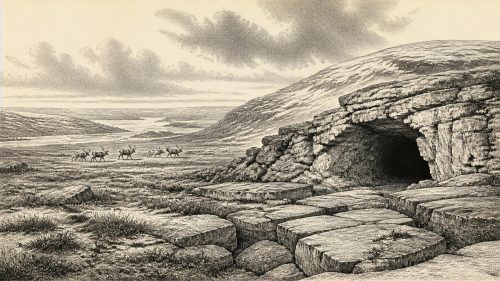
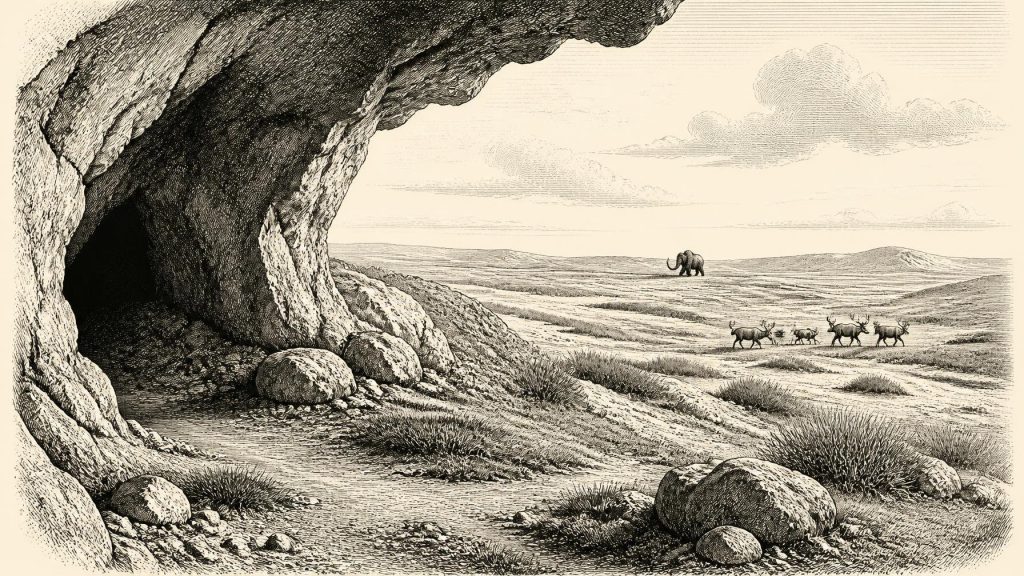
Castlepook is a limestone cave system in lowland north Cork, near the Awbeg valley. Its galleries acquired evocative names during early exploration, among them Elephant Hall and Hyaena Hall. Between 1904 and 1918, Richard J. Ussher and colleagues excavated large quantities of animal remains; later work has re-examined surviving museum collections with modern dating and zooarchaeological methods. The early excavation recovered bones in very large numbers, but it did not employ the stratigraphic recording, sieving and spatial plotting expected today. Consequently, the collection can reveal which animals reached the cave and approximately when some lived, but often cannot say exactly how each bone arrived or which specimens were contemporary.
This is why the scored reindeer femur matters so much and must be handled so carefully. Its modification is unlike a simple species list: a fresh-bone incision consistent with a stone edge raises the possibility of human butchery. Yet the interpretation remains evidence of an action, not a complete social scene. A small travelling party might have killed or found a reindeer, removed meat or divided a carcass, and left little more than one modified element. Alternatively, further analysis may refine how the mark was made. Future excavations in undisturbed parts of Castlepook are especially important because securely stratified tools, hearth residues or repeatedly modified bones could test the case directly.
Animals of a Cold Mosaic
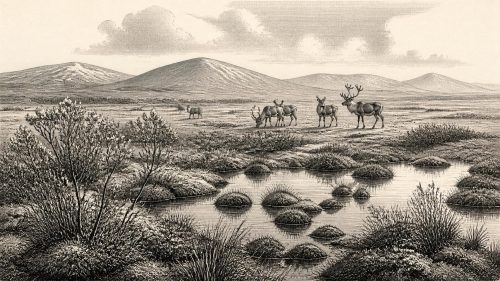
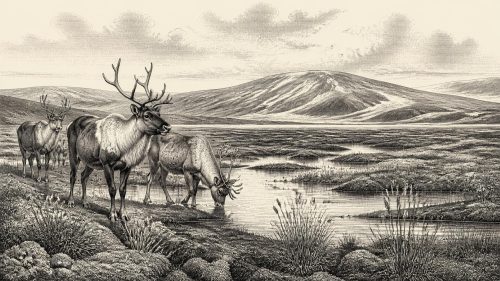
The Castlepook fauna provides the strongest picture of Ireland’s living landscape around this broad interval. It includes woolly mammoth, reindeer, giant deer, brown bear, wolf, Arctic fox, spotted hyaena, mountain hare and both Norwegian and collared lemmings. No single list proves that all these creatures shared the same valley at the same time. The cave accumulated remains over many millennia, and predators as well as water helped create the deposit. Nevertheless, the dated assemblage demonstrates that Ireland supported a far richer Pleistocene mammal community before the peak glaciation than the modern island does.
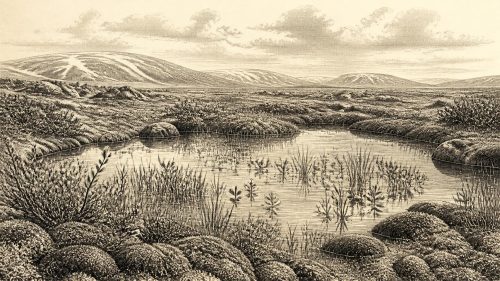
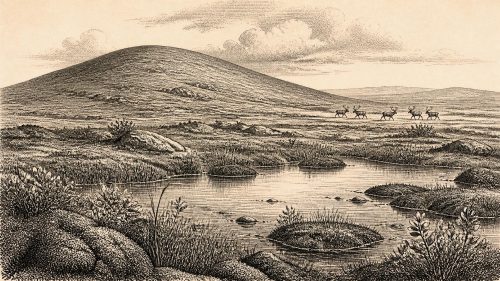
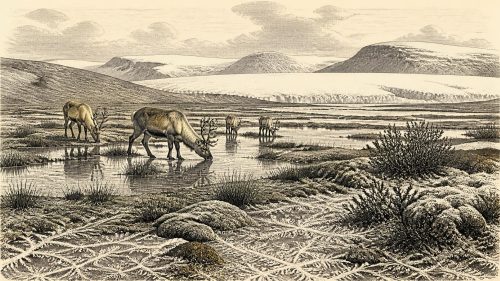
Reindeer and lemmings point towards open, cold environments, while mammoth and giant deer suggest extensive grazing opportunities. The most reasonable reconstruction is not a uniform sheet of snow or a continuous forest, but a shifting mosaic of grassland, herb-rich tundra, sedge-rich wet ground, exposed soil and scattered low shrubs. Seasonal snow cover, hard winds and marked variations in food would have structured animal movement. Carnivores followed the herbivores and, in the case of hyaenas, may have used caves as dens or feeding places. Castlepook itself may often have been more a carnivore and bone-collecting location than a human shelter.
Climate across the North Atlantic changed abruptly during Marine Isotope Stage 3. Ice-core records distinguish colder stadials from relatively milder interstadials, but translating a Greenland signal into a local Cork weather report would overstate the evidence. What can be said is that Ireland around c.34,000 calibrated years BP stood before the fullest expansion of the last British–Irish Ice Sheet. Research on ice-sheet growth indicates that northern and western sectors changed rapidly around 31,000–30,000 years ago, while evidence from southern Ireland also points to considerable regional variation in the timing and extent of ice. The future glacial maximum was approaching, but it had not yet erased the faunal world represented at Castlepook.
People at the Edge of Evidence
If the femur was butchered by people, they were almost certainly highly mobile hunter-gatherers using perishable equipment as well as stone. Their presence need not imply year-round residence. At this latitude and in this climate, small groups could have moved opportunistically through favourable terrain, tracking animal concentrations and exploiting sheltered places. Reindeer offered meat, fat, hide, sinew and bone; the mark on the femur may represent only one stage in a larger process of dismembering a carcass and carrying selected portions away.
But the evidence does not permit confident statements about houses, clothing styles, language, kinship, leadership or population size. No securely associated lithic assemblage identifies a particular Upper Palaeolithic tradition in Ireland at this date. Nor can archaeologists infer a direct ancestry between such possible visitors and the much later Mesolithic communities whose more substantial record begins after the Ice Age. Repeated ice advance, erosion, rising and falling seas, and the small number of targeted excavations all help explain why the record is so sparse. Absence of sites is not proof of absence of people, but neither is one modified bone proof of enduring colonisation.
Sea, Ice and Connection
Ireland’s position on Europe’s north-western margin shaped every possibility of movement. Lower global sea levels exposed broad continental shelves, but the Irish Sea was not automatically a simple dry land bridge. Geological studies have long questioned whether a reliable terrestrial crossing linked Ireland and Britain in the Late Quaternary; ice, sea level, isostatic change and local topography created a changing, hazardous geography. Any people reaching Cork may have travelled through landscapes and coastlines now drowned, transformed or buried beneath later glacial deposits. The route is unknown, and it should not be imagined as a settled road from Britain or mainland Europe.
Nor is there evidence for trade in the later prehistoric sense. A travelling hunting group could carry stone, skins, tools and knowledge over long distances without maintaining formal exchange networks or political ties. “Diplomacy”, tribal territories and warfare are likewise beyond the evidence. Encounters between groups may have occurred, but no Irish material from this period identifies alliances, conflicts, leaders or institutions. The most that can responsibly be said is that survival depended on social cooperation: shared knowledge of animals, weather, raw materials and safe routes would have mattered greatly to any human visitors.
No Monuments, No Recorded Belief
There are no Irish monuments, burials, artworks or written traditions attributable to this time. It would be wrong to project later Irish sacred landscapes, Celtic traditions or medieval place-names back into an Ice-Age world separated from them by tens of thousands of years. Caves can acquire ritual meanings in many human societies, but Castlepook offers no evidence that it was a shrine. Its known significance is palaeontological and archaeological: it preserves a rare, imperfect record of animals, carnivores and perhaps people living before the island was engulfed by later ice.
Learning, in the sense relevant here, was embodied expertise rather than literacy. If people did process reindeer at Castlepook, their knowledge included the practical understanding required to approach dangerous large animals, use sharp stone edges, divide a carcass efficiently and navigate a severe landscape. That is an inference from the possible butchery evidence and comparative hunter-gatherer archaeology, not a directly observed Irish tradition. No language, myth or ceremony can be recovered from the femur.
An Island Before Its Later Histories
The year 31,837 BCE therefore cannot be given a conventional annual narrative. There were no Irish kingdoms, farms, churches, ports or recorded peoples. Its historical value lies in a threshold: Castlepook shows that pre-maximum Ice-Age Ireland was not necessarily an empty, featureless margin. A diverse fauna occupied parts of the island, and one reindeer bone plausibly preserves the trace of a human tool. Yet the cave’s mixed deposits require restraint. The strongest conclusion is not that Ireland had a known permanent population, but that human presence or activity around the mid-30th millennium before present is a serious and consequential possibility awaiting firmer in-situ confirmation.
For now, Castlepook’s scored femur is best treated as both discovery and question. It pushes Irish history far beyond the conventional horizon of post-glacial settlement, while reminding us that the earliest past is reconstructed from fragments: collagen, cut surfaces, cave sediment, animal teeth and the changing edge of ice. Around this point in deep time, that is the responsible history of Ireland.
Primary Sources
- A reconsideration of the radiocarbon dating of the Marine Isotope Stage 3 fauna from southern Ireland
- The Irish Quaternary Fauna Project
- Castlepook Cave: County Geological Site Report
- The Archaeological Heritage of County Cork
- Heritage Artefacts of County Cork
- Ireland’s Palaeolithic Archaeology – Fleeting Footprints in a Frozen Land
- Occurrence of mammalia relicts at site Castlepook Cave
- Pleistocene Vertebrates in the British Isles
- Growth and retreat of the last British–Irish Ice Sheet, 31,000 to 15,000 years ago: the BRITICE-CHRONO reconstruction
- Trimlines, blockfields and the vertical extent of the last ice sheet in southern Ireland
- Stratigraphic and palaeo-geomorphological evidence for the glacial-deglacial history of the last British-Irish Ice Sheet in the north-western Irish Sea
- The timing and magnitude of the British–Irish Ice Sheet between Marine Isotope Stages 5d and 2: implications for glacio-isostatic adjustment, high relative sea levels and ‘giant erratic’ emplacement
- Maximum extent and dynamic behaviour of the last British–Irish Ice Sheet west of Ireland
- The problem of a late Quaternary landbridge between Britain and Ireland
- Deglaciation, Earth crustal behaviour and sea-level changes in the determination of insularity: A perspective from Ireland
- The colonization of Ireland: A human ecology perspective
- New insights on the fauna of Ireland's Younger Dryas and Early Holocene from Alice & Gwendoline Cave
- Ireland: Submerged Prehistoric Sites and Landscapes
- The IntCal20 Northern Hemisphere Radiocarbon Age Calibration Curve (0–55 cal kBP)
- The IntCal20 Approach to Radiocarbon Calibration Curve Construction: A New Methodology Using Bayesian Splines and Errors-in-Variables
- IntCal: Radiocarbon Dating Research
- Karst of Ireland
- Irish Quaternary Association
- Reindeer bone found in Cork cave shows human activity in Ireland 33,000 years ago