Castlepook’s Bone Chambers31838 BCE
Circa 31,838 BCE, Ireland lay within the variable, cold conditions of Marine Isotope Stage 3, before the Last Glacial Maximum. Castlepook Cave in County Cork preserves remains of mammoth, reindeer, hyaena, bear, wolf, Arctic fox, hare and lemmings, indicating open habitats supporting predators and grazing animals. Cave deposits reflect complex carnivore and natural processes. A marked reindeer femur may indicate human butchery, but lacks secure context and remains unproven. Derryvree, County Fermanagh, records ice-free tundra wetlands between glacial advances. Lower seas altered coasts, though Ireland remained separated from Britain. The evidence reveals changing landscapes, not permanent human settlement or society.
Dateline
31,838 BCE is not a year that can be recovered from Ireland’s archaeological record in the way that a medieval annalistic year can. It is a modern calendar label projected far back into the Late Pleistocene. In archaeological terms it falls roughly 33,787 calendar years before AD 1950, or about 33.8 thousand calibrated years before present (cal BP). That conversion is useful for orientation, but it must not create false precision: radiocarbon results have uncertainties, must be calibrated, and often date a bone or sediment rather than a single event. For Ireland at this depth of time, evidence illuminates broad phases, landscapes and animal communities—not a dated day, season or political episode.
The most relevant period is Marine Isotope Stage 3 (MIS 3), part of the long last glaciation, known in Irish terminology as the Midlandian. It was not a single unchanging “Ice Age”. Climate shifted abruptly between colder and relatively milder intervals, ice margins changed, and the extent of habitable ground varied from region to region. Around the nominal date, the great British–Irish Ice Sheet was approaching its later maximum expansion, rather than necessarily already covering every part of Ireland. Newer reconstructions place major ice-sheet growth after about 31,000 cal BP, with near-complete Irish coverage emerging by around 28,000 cal BP and the overall maximum later still. Those are modelled regional reconstructions, however, not a guarantee that every valley followed the same timetable.
A Country of Evidence, Not Kingdoms
There were no Irish kingdoms, chiefs, borders, treaties or named peoples that can responsibly be assigned to this date. There is no evidence for a permanent population, village, house, burial ground, shrine, tool-making floor, hearth or cultivated field in Ireland in c. 31,838 BCE. Nor can archaeology identify an Irish language, religion, artistic tradition or system of learning at this time. Such absences are historically important. They mean that political affairs, diplomacy, formal conflict, trade and institutions are not merely unknown in detail: they are unsupported categories for this particular Irish horizon.
What survives instead is a difficult archive of cave deposits, animal bones, glacial sediments, fossil insects, pollen, plant remains and landforms. These materials have their own histories. A bone in a cave can have been carried there by a carnivore, washed in by water, disturbed by later digging, or moved within the cave long after the animal died. A radiocarbon date establishes the age of the sampled organic material, not automatically the age of every mark on it or the moment it entered its final resting place. The work of Pleistocene archaeology is therefore as much about testing routes of deposition as it is about identifying species.
The Castlepook Assemblage
Castlepook Cave, also called Mammoth Cave or Doneraile Cave, in north County Cork is central to any account of Ireland around this broad period. Excavations and quarrying there produced a remarkable collection of Late Pleistocene animal remains, much of it recovered in the late nineteenth and early twentieth centuries and now principally associated with the National Museum of Ireland’s natural-history collections. Modern reassessment and improved radiocarbon pretreatment have made the cave more significant, but also more complicated: several older dates on Irish cave faunas have proved too young when re-tested.
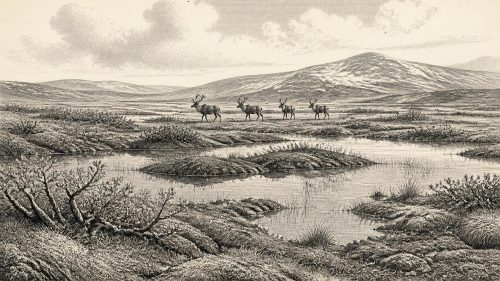
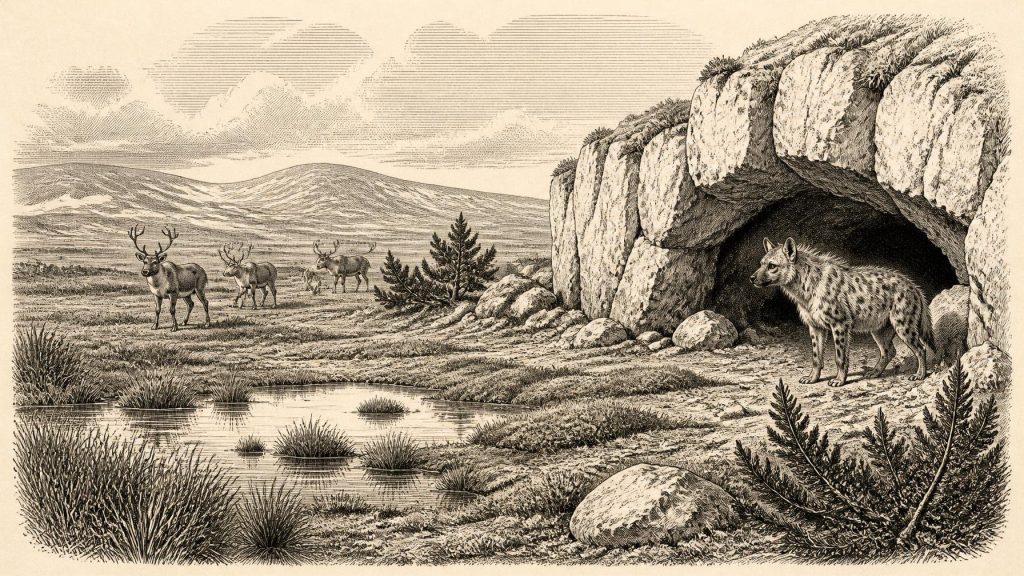
The Castlepook material demonstrates that southern Ireland supported, at intervals before the Last Glacial Maximum, a substantial cold-stage fauna. The assemblage includes woolly mammoth, reindeer, spotted hyaena, brown bear, wolf, Arctic fox, hare and lemmings, alongside giant deer in the broader Irish Pleistocene record. These animals should not be imagined as a single herd gathered together on one ordinary day. Cave assemblages accumulate over time, and different species may represent different climatic episodes or the feeding habits of predators. Nevertheless, the combination is powerful evidence for open, cold landscapes capable of sustaining grazing and browsing animals, their predators and scavengers.
Spotted hyaena is especially revealing. Its presence at Castlepook strongly suggests that caves could function as carnivore dens or scavenging places, rather than human homes. Hyaenas can transport large bones and leave tooth damage; wolves and other carnivores may also alter a carcass assemblage. Mammoth bone at the site has attracted attention partly because of apparent damage consistent with carnivore activity. This makes Castlepook a record of animal movement, predation and scavenging as well as a potential place of human interest.
The Reindeer Femur Question
A reindeer femur from Castlepook has become the most debated object associated with this era. It has been described as carrying an incision consistent with a sharp stone tool, and public heritage accounts have presented it as possible evidence that Palaeolithic hunters butchered reindeer in Ireland around 33,000 years ago. If that interpretation were confirmed through further contextual and microscopic work, it would be extraordinarily important: it would indicate a human visit to Ireland more than twenty millennia before the traditionally recognised post-glacial settlement evidence.
Yet the responsible wording is possible, not proven. No securely associated stone tool, hearth, dwelling surface, human bone, repeated kill site or clearly stratified butchered assemblage of comparable age has been recovered from Ireland. The old excavation history of Castlepook limits what can be reconstructed about the femur’s original layer and associations. The bone itself can be dated; the proposed human action depends on interpreting a single surface modification and excluding natural alternatives. It would be wrong to turn that possibility into a settled story of a resident hunting community.
Comparison sharpens the distinction. At Alice and Gwendoline Cave near Ennis, County Clare, a brown-bear kneecap with several cut marks was independently radiocarbon dated to approximately 12,810–12,590 cal BP and has been argued to provide evidence for a late Upper Palaeolithic human presence. That find is much later than 31,838 BCE, but it shows the standard required: direct dating, detailed bone-surface analysis and explicit consideration of depositional history. Castlepook may eventually enlarge Ireland’s human story, but at present it is better understood as an important research problem than as proof of a 33,000-year-old settlement.
Open Tundra and Wet Ground
Environmental evidence from Derryvree near Maguiresbridge in County Fermanagh provides another window onto the wider Midlandian world. There, organic freshwater silts and fine sands lay between two tills within a drumlin. Their radiocarbon determination of 30,500 radiocarbon years BP is not identical with the nominal date in this article; once calibrated, it represents a broad and earlier calendar range. The deposits nevertheless belong to the same late MIS 3 environmental setting and demonstrate that at least this part of Ireland was ice-free between glacial advances.
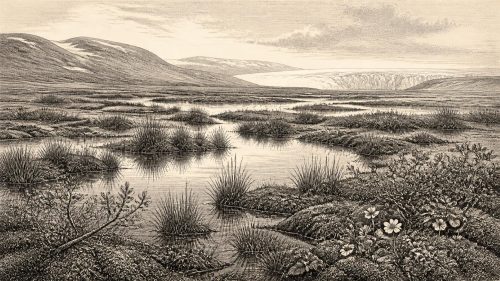
Derryvree’s plant and animal traces point to a treeless, periglacial muskeg: wet, moss-rich ground with open pools, sedges, grasses, herbs and sparse juniper or low shrub cover. Such evidence does not permit a photographic reconstruction of all Ireland. Fermanagh was not Cork, and environmental conditions changed through time. But it decisively counters the idea of an unbroken, featureless ice sheet across every Irish landscape throughout the glacial period. In suitable intervals there were wetlands, exposed ground and vegetation—enough ecological productivity to support small animals and, elsewhere, the large mammals represented at Castlepook.
The seasons would have been severe. Periglacial conditions imply long cold winters, freeze–thaw action, limited tree growth and a strongly seasonal food supply. Mammoth, reindeer and horse-like grazing animals, where present, would have depended on open vegetation; carnivores followed prey rather than political territories. Their movement across the wider north-west European world was an ecological process, not evidence for any organised Irish economy. We cannot show whether a particular reindeer passed through the Awbeg valley in this year, but we can say that the faunal and botanical record makes a cold, open and locally wet Irish landscape more plausible than a forested one.
Sea, Movement and Isolation
Lower global sea levels exposed large areas of the continental shelf, changing coastlines and widening the land available to cold-adapted animals. Ireland nevertheless remained separated from Britain by water during the Pleistocene. Any human arrival, if the Castlepook mark proves anthropogenic, would therefore have involved a sea crossing rather than an easy walk over a permanent land bridge. That inference makes the find potentially important for understanding Upper Palaeolithic mobility and watercraft, but it cannot supply evidence for regular routes, exchange networks or trade.
For the same reason, the term “settlement” needs restraint. A fleeting hunting or scavenging expedition, an unsuccessful colonising attempt, seasonal visits, or no people at all remain different possibilities. The later expansion of ice would have erased, buried or submerged much evidence, while also making sustained habitation exceptionally difficult. Archaeological silence is not proof that no person ever stood in Ireland during MIS 3; but neither is it permission to fill the silence with clans, camps and cultural identities.
What This Date Can Mean
The historical significance of c. 31,838 BCE lies in the threshold it represents. Ireland was part of a dynamic north-west European Ice-Age environment, with open habitats, wetlands, mobile animal populations and an ice sheet growing towards a later maximum. Castlepook’s bone-rich chambers preserve the strongest southern Irish faunal testimony to that world. Derryvree preserves a northern environmental archive showing ice-free, tundra-like conditions between glaciations. Together they reveal a country shaped by climate, animals and geological change long before securely documented communities.
That is a smaller story than a year of kings and battles, but not a lesser one. It is the precondition for every later Irish history: the making and remaking of the land itself, the survival of life in harsh conditions, and the fragile traces from which archaeologists must build their arguments. At this date, the most honest conclusion is also the most compelling: Ireland’s human past may have a deeper beginning than once believed, but the evidence is still asking to be tested.
Primary Sources
- A Reconsideration of the Radiocarbon Dating of the Marine Isotope Stage 3 Fauna from Southern Ireland
- The Irish Quaternary Fauna Project
- New Insights on the Fauna of Ireland's Younger Dryas and Early Holocene from Alice & Gwendoline Cave
- A Middle Midlandian Freshwater Series at Derryvree, Maguiresbridge, County Fermanagh, Northern Ireland
- Irish Pleistocene Biostratigraphy
- Palaeoecology
- Figure 6.— The Subdivision of the Quaternary Period in Ireland
- First Evidence of a Late Upper Palaeolithic Human Presence in Ireland
- The Colonization of Ireland: A Human Ecology Perspective
- Growth and Retreat of the Last British–Irish Ice Sheet, 31,000 to 15,000 Years Ago: the BRITICE-CHRONO Reconstruction
- Dimensions and Chronology of the Last Ice Sheet in Western Ireland
- Trimlines, Blockfields and the Vertical Extent of the Last Ice Sheet in Southern Ireland
- The Evolution of the Terrestrial-Terminating Irish Sea Glacier During the Last Glaciation
- Maximum Extent and Readvance Dynamics of the Irish Sea Ice Stream and Irish Sea Glacier Since the Last Glacial Maximum
- Character of Advance and Retreat of the Southwest Sector of the British-Irish Ice Sheet During the Last Glaciation
- Stratigraphic and Palaeo-Geomorphological Evidence for the Glacial-Deglacial History of the Last British-Irish Ice Sheet in the North-Western Irish Sea
- The IntCal20 Northern Hemisphere Radiocarbon Age Calibration Curve (0–55 cal kBP)
- A Stratigraphic Framework for Abrupt Climatic Changes During the Last Glacial Period Based on Three Synchronized Greenland Ice-Core Records
- Heritage Artefacts of County Cork
- Castlepook Cave, Co. Cork, 2022
- The Mesolithic in Ireland: When Was It?
- Atlas of the Irish Rural Landscape