The Awbeg Reindeer Mark31734 BCE
Dateline
Modern calendar-year precision is not available for Ireland in 31,734 BCE. The date is a retrospective label, roughly equivalent to 33,683 years before AD 1950, rather than a moment that can be isolated in an excavation layer or connected to an event remembered by anyone alive then. At this depth of time, radiocarbon measurements must be calibrated and normally produce ranges rather than a single calendar year. The responsible historical frame is therefore the later part of the Late Pleistocene, within Marine Isotope Stage 3 (MIS 3), a long and climatically unstable phase of the last Ice Age.
Ireland at this point has no known rulers, peoples, place-names, settlements or political boundaries. There is no evidence for diplomacy, organised warfare, religion, writing, trade routes or a resident society that can be described year by year. Yet Ireland was not an empty abstraction. Its caves, buried sediments, fossils and the changing footprint of ice preserve evidence for real landscapes and animals, while one controversial but important bone from north Cork raises the possibility that people may have entered this world.
A Date Measured in Millennia
“31,734 BCE” should not be read as an exact anniversary. A radiocarbon result measures the remaining carbon-14 in once-living material, not a Gregorian-style date. Calibration against independently dated archives converts such results into calendar-age probability ranges, and uncertainty becomes substantial beyond 30,000 years ago. Moreover, a date on an animal bone establishes when the animal died; it does not by itself date every scratch upon it, identify where it was killed, or prove that people lived beside it.
The climate was also far from steady. Greenland ice-core records show that the North Atlantic world of MIS 3 was punctuated by abrupt cold and milder episodes. Irish conditions did not reproduce Greenland’s record exactly, but the island stood directly within the North Atlantic climatic sphere. A landscape suitable for grazing animals during one interval could be transformed by colder conditions, changing snowfall and an advancing ice margin over a comparatively short geological span. The meaningful unit is consequently a broad interval of centuries or millennia, not this individual numbered year.
Ice, Open Ground and Uncertain Coasts
The Last Glacial Maximum, when the British–Irish Ice Sheet covered nearly all Ireland and extended onto the surrounding continental shelf, still lay ahead. Most reconstructions place its fullest extent in the broad period about 27,000–23,000 calibrated years BP, though its growth and local margins varied greatly. Around the early thirties millennium BCE, ice was already an important and dynamic force in the region, but scientists continue to debate precisely when particular sectors of the Irish ice sheet expanded, thinned or withdrew.
That uncertainty matters. Marine and coastal evidence from western Ireland has been interpreted as showing substantial ice loading during much of the period from about 40,000 to 19,000 calibrated years BP. Other records show that the dramatic maximum advance into the Celtic Sea came later. It is therefore unsafe to picture every part of Ireland in 31,734 BCE either as bare, ice-free tundra or as a single unbroken white ice cap. Conditions differed between regions and changed through time; much potentially decisive evidence has been eroded, buried beneath later till, or lies offshore.
Sea level was lower than today because large quantities of water were locked in global ice sheets, but this does not demonstrate a simple dry-land bridge from Ireland to Britain or continental Europe at this date. Changing sea level, local crustal depression under ice, channels and glacier fronts made the geography complex. Any possible human approach to Ireland remains unproven. The exposure of wider coastal plains in some places does, however, remind us that the modern shoreline is not the boundary of the Pleistocene landscape.
Castlepook’s Difficult Evidence
The most relevant Irish site is Castlepook Cave, near Doneraile in north County Cork, within the Blackwater–Awbeg drainage. Excavated principally in the early twentieth century, it yielded a remarkable but complicated collection of Ice Age animal remains. Its chambers acquired evocative names, including Mammoth Cave, Elephant Hall and Hyaena Hall, from the animals represented in the deposits. Modern re-dating has shown that some earlier determinations greatly underestimated the antiquity of material from Castlepook and nearby southern Irish caves.
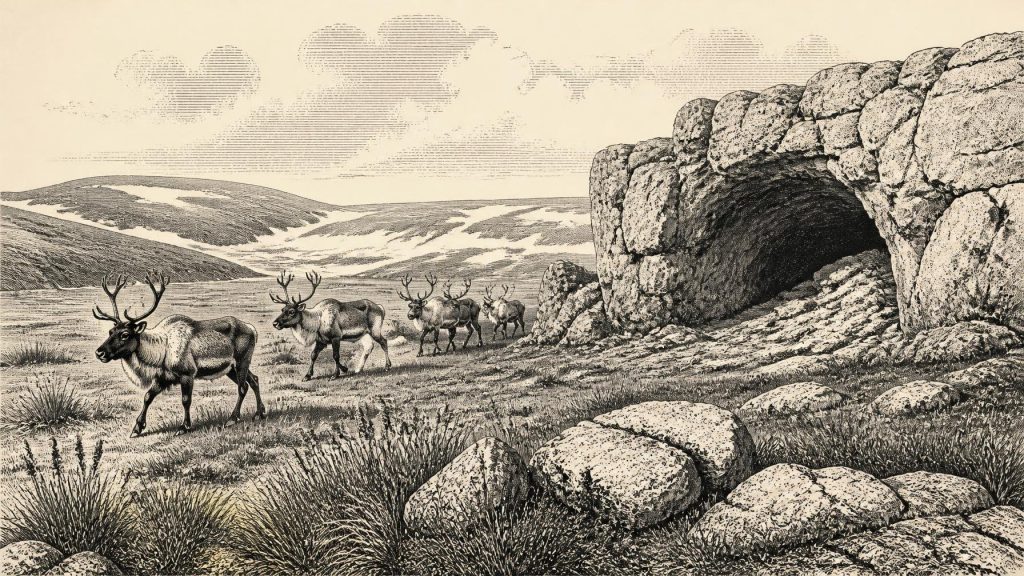
The Castlepook record demonstrates that Pleistocene animals reached Ireland during parts of MIS 3. Reindeer, giant deer, spotted hyaena and mammoth are among the animals represented in the wider cave collection, though their bones need not all be contemporary or have entered the cave in the same way. A cave can be a carnivore den, a natural trap, a place where water reworks sediment, and an archive disturbed by later digging. The assemblage is powerful evidence for changing animal communities over a long period; it is not a census of one day’s wildlife.
A reindeer hind-leg bone has given Castlepook exceptional importance. It was directly radiocarbon dated to around 33,000 years ago in reporting associated with Ruth Carden’s research, and it carries a deep linear mark interpreted as damage made by a sharp stone tool while a fresh carcass was being processed. If that interpretation is confirmed, it would be Ireland’s earliest known indication of human activity by a very large margin, potentially placing a human visit in the broad early-thirties-millennium-BCE setting.
The qualification is essential. The femur came from an old collection, not from a newly excavated, intact occupation surface. No securely associated stone-tool assemblage, hearth, dwelling floor, human remains, burial, art or repeated domestic refuse of comparable age has yet been recovered in Ireland. Nor does the bone prove continuous occupation. It is best treated as a potentially transformative trace of butchery: evidence that may indicate one or more brief visits by people, but not evidence for a known Irish population.
Animals Before Communities
The strongest picture is ecological. Reindeer suggest open terrain capable of supporting mobile grazing herds. Giant deer, where present, indicate further large-herbivore habitat, while mammoth and spotted hyaena evoke a fauna very different from modern Ireland. Predators, scavengers and caves themselves complicate the story of each bone: hyaenas could transport carcass parts, carnivores could gnaw or fracture them, and water or collapse could move them after deposition. Archaeologists must distinguish such natural modifications from marks made by people.
Plant evidence from Irish inter-till organic deposits, especially in Fermanagh, provides a broader though not year-specific guide to the sorts of landscapes that could develop during milder Pleistocene intervals. Pollen, mosses, sedges and freshwater plants point to open, treeless or sparsely wooded environments with wetlands and shallow water. They do not furnish a direct environmental photograph of Castlepook in 31,734 BCE. Nevertheless, when read alongside faunal evidence, they support a vision of cold open country with wet hollows, grass- and herb-rich patches, and only limited woody vegetation rather than the familiar oak-and-hazel Ireland of much later prehistory.
Such terrain was productive, but harsh. Winters could be severe, weather volatile and food availability seasonal. The survival of large herbivores depended on migratory movement, forage and access to shelter; carnivores followed them. For any people who may have reached Ireland, the island would have offered opportunity as well as danger: meat, marrow, hide, sinew, antler and bone from a large animal were valuable resources, but the evidence does not show how a carcass was obtained or how long anyone remained.
Human Possibility, Not a Lost Nation
Upper Palaeolithic hunter-gatherers elsewhere in north-west Europe possessed sophisticated knowledge of animals, stone technology and seasonal movement. It is reasonable to use that wider world to understand what a stone-made cut on a reindeer bone might mean. A small party could have travelled widely, stopped briefly at a favourable place and processed part of a carcass before moving on. This is interpretation by comparison, however, not a direct portrait of an Irish camp.
Nothing supports claims about language, ethnicity, kin groups, chiefs or a distinctive “Irish” culture at this time. Nor can religion be reconstructed from the Castlepook evidence. Caves can acquire ritual meanings in some later societies, but their physical usefulness to animals and people is enough to explain their archaeological importance; no ritual deposit of this age is known in Ireland. Similarly, there is no evidence for organised conflict or diplomacy. The nearest defensible social scale is a possible small, mobile hunting party, and even that remains conditional on the anthropogenic reading of the marked femur.
There is equally no demonstrated trade system. A visitor carrying a stone tool may have brought it from elsewhere, but no securely dated tool survives to identify its raw material or origin. The absence of evidence is partly a consequence of preservation: exposed camps may have been overridden by ice, destroyed by erosion or drowned beneath later seas. Yet preservation problems cannot be used to turn possibility into proof. Ireland’s record remains markedly thinner than those of several contemporaneous regions of Britain and mainland Europe.
A Landscape on the Edge
The principal development illuminated around this date is not state formation or settlement, but environmental instability at the north-western edge of Upper Palaeolithic Europe. Ireland contained, at least during parts of MIS 3, habitats that large Ice Age mammals could reach and occupy. Castlepook preserves their remains, while the scored reindeer femur poses a carefully bounded question: did people also come?
For now, the answer is “possibly, briefly, and not yet demonstrably as permanent residents”. That modest conclusion is historically significant. It moves Ireland’s deep past beyond an older assumption that human presence began only after the final retreat of the ice, while insisting that a single cave bone cannot carry the weight of an invented national origin story. Continued excavation, direct dating, microscopic study of bone surfaces and analysis of cave sediments may refine the picture. In 31,734 BCE, Ireland is best understood as a changing Ice Age landscape of animals, water, rock and ice—one in which the human trace, if genuine, is tantalisingly slight.
Primary Sources
- A Reconsideration of the Radiocarbon Dating of the Marine Isotope Stage 3 Fauna from Southern Ireland
- The Irish Quaternary Fauna Project
- Phylogeographic, Ancient DNA, Fossil and Morphometric Analyses Reveal Ancient and Modern Introductions of a Large Mammal: The Complex Case of Red Deer (Cervus elaphus) in Ireland
- First Evidence of a Late Upper Palaeolithic Human Presence in Ireland
- Growth and Retreat of the Last British–Irish Ice Sheet, 31,000 to 15,000 Years Ago: The BRITICE-CHRONO Reconstruction
- Radiocarbon Constraints on the History of the Western Irish Ice Sheet Prior to the Last Glacial Maximum
- Radiocarbon Constraints on the Age of the Maximum Advance of the British-Irish Ice Sheet in the Celtic Sea
- Late Pleistocene Chronostratigraphy and Ice Sheet Limits, Southern Ireland
- Dimensions and Chronology of the Last Ice Sheet in Western Ireland
- The Timing and Magnitude of the British–Irish Ice Sheet Between Marine Isotope Stages 5d and 2: Implications for Glacio-Isostatic Adjustment, High Relative Sea Levels and ‘Giant Erratic’ Emplacement
- Ireland: Submerged Prehistoric Sites and Landscapes
- The IntCal20 Northern Hemisphere Radiocarbon Age Calibration Curve (0–55 cal kBP)
- A Stratigraphic Framework for Abrupt Climatic Changes During the Last Glacial Period Based on Three Synchronized Greenland Ice-Core Records: Refining and Extending the INTIMATE Event Stratigraphy
- High-Resolution Record of Northern Hemisphere Climate Extending into the Last Interglacial Period
- Palaeoecology: Irish Association for Quaternary Studies Field Guide 16
- 2022:564 — Castlepook Cave, Castlepook South, Cork
- Heritage Artefacts of County Cork
- Archaeological Heritage of County Cork
- Stratigraphic and Palaeo-Geomorphological Evidence for the Glacial-Deglacial History of the Last British-Irish Ice Sheet in the North-Western Irish Sea
- Timing and Pace of Ice-Sheet Withdrawal Across the Marine–Terrestrial Transition West of Ireland During the Last Glaciation
- The Deglaciation of the Western Sector of the Irish Ice Sheet from the Inner Continental Shelf to Its Terrestrial Margin
- Advance and Retreat of the Marine-Terminating Irish Sea Ice Stream into the Celtic Sea During the Last Glacial: Timing and Maximum Extent
- New Insights on the Fauna of Ireland’s Younger Dryas