Derryvree’s Periglacial Wetland31720 BCE
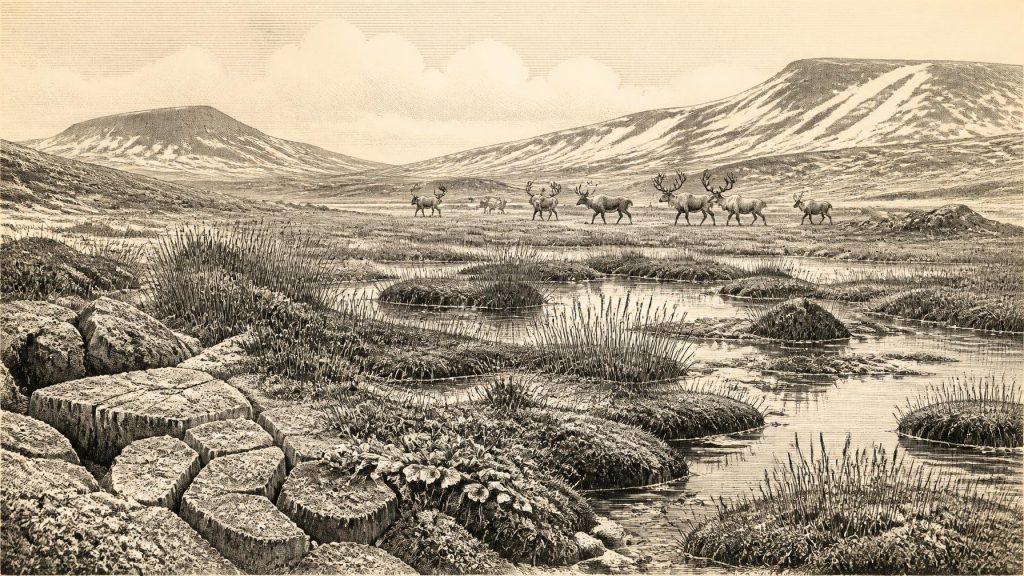
Circa 31,720 BCE, Ireland lay within the climatically unstable Middle Midlandian, when evidence records environments rather than societies. At Derryvree, County Fermanagh, organic freshwater sediments between two till sheets reveal a periglacial wetland with tundra vegetation, seasonal open water and changing ice conditions, dated broadly to c.36,900–31,700 cal BP. Castlepook Cave, County Cork, preserves diverse Ice Age fauna, including mammoth, reindeer, giant deer, predators and lemmings, accumulated over millennia. A cut-marked reindeer femur may indicate brief human butchery, but remains unconfirmed. No settlement, polity, trade or culture is evidenced. Subsequent ice-sheet expansion eroded and buried much of this deep record.
Dateline
31,720 BCE is a modern label, not a date that anybody in prehistoric Ireland could have known or recorded. Arithmetically, it lies about 33,670 years before AD 1950, but archaeology cannot distinguish events in one calendar year at this depth of time. The responsible scale is a broad calibrated range, not a date-by-date chronicle. This point belongs to the later part of the Middle Midlandian, broadly within Marine Isotope Stage 3 (MIS 3), a long and climatically unstable phase of the Last Ice Age. The evidence for Ireland is exceptionally fragmentary: buried freshwater sediments, pollen and plant remains, insect fossils, cave bones, glacial landforms and radiocarbon measurements. It tells us about environments and occasional animal presence, but not about a named people, an Irish polity or a continuous human community.
The most useful close Irish comparison is Derryvree near Maguiresbridge, County Fermanagh. Roadworks in 1969 cut through a drumlin and exposed organic silts and fine sands enclosed between two thick, distinct sheets of till. The arrangement matters. Ice had deposited one till sheet; a freshwater environment then existed long enough for sediment and organic remains to accumulate; later ice overrode and buried the deposit beneath another till. The conventional radiocarbon determination from the organic series was 30,500 +1,170/−1,030 BP. When allowance is made for uncertainty and calibration, it represents a wide calendar interval, roughly c.36,900–31,700 cal BP. The notional year 31,720 BCE falls within that broad window, but does not make Derryvree a record of that particular year.
A Freshwater Interval Beneath Ice
Derryvree is important because it preserves a local landscape rather than merely a later landform. Pollen, mosses, seeds and insect remains indicated open tundra vegetation and a periglacial climate: ground subject to intense frost, short growing seasons and severe exposure, but not necessarily permanently sealed under glacier ice. Sedges, grasses, herbs, low shrubs and mosses could occupy wet patches, lake margins and better-drained ground. Freshwater plants indicate that at least some water remained open seasonally or locally. This was not the forested island familiar from later prehistory or the present day. Nor was it simply an empty white plain. It was a heterogeneous cold environment, in which water, slope, snow cover, soils and shelter created small but significant differences in available habitat.
The wider climate was unsettled. MIS 3, conventionally placed between about 60,000 and 27,000 years ago, contained repeated abrupt shifts between colder stadials and relatively milder interstadials recorded particularly clearly in Greenland ice cores. Irish deposits cannot be matched confidently to every one of those North Atlantic oscillations, nor can they reveal a precise annual temperature. They do show why a fixed picture of Ireland as either wholly frozen or wholly hospitable is misleading. Ice margins, river systems, vegetation and animal ranges changed over millennia, and sometimes much faster, as climate altered.
At this time the geography of “Ireland” was also unlike that of the modern state or island. Lower global sea level exposed wider coastal shelves, while ice loading changed relative sea levels regionally. Yet no securely demonstrated, simple land bridge across the Irish Sea should be assumed for this horizon. The routes by which animals, and potentially people, entered or left the landmass remain questions of palaeogeography rather than facts supplied by a single fossil. Any connection may have involved changing coastal lowlands, islands, sea ice, swimming animals or crossings by people; the available Irish evidence does not decide between them.
Animals at Castlepook
The principal animal archive lies far to the south at Castlepook Cave, near Doneraile in north County Cork. Excavations begun in the early twentieth century recovered more than 2,000 bones from the cave system. Its Ice Age fauna includes woolly mammoth, giant deer, reindeer, brown bear and spotted hyaena; later cold-stage material includes Arctic fox, wolf and both collared and Norwegian lemmings. Some of these animals would have required open ground and substantial grazing, while others were predators, scavengers or shelter-users. Together, they demonstrate that Ireland supported, or intermittently received, a far richer cold-stage mammal fauna than survives today.
That list must not be converted into a single imagined herd moving across Cork on one day. Castlepook was a cave repository operating over a very long span. Geological Survey Ireland summarises dates from individual bones ranging from about 45,700 to 19,950 years BP. Water movement, carnivore activity, deaths in caves, scavenging and the disturbance caused by historic excavations all affected what survived and where it was found. A mammoth bone gnawed or transported by hyaenas, for example, records animal behaviour and cave processes as much as it records the place where the mammoth died. The faunal collection supports the existence of varied cold-stage ecosystems; it cannot prove that every recorded species lived together, or that each was present at 31,720 BCE.
For everyday life, the animals are more informative than any supposed human settlement. Reindeer, mammoth and giant deer imply food webs based on extensive vegetation, while wolves, Arctic foxes, bears and hyaenas occupied different predatory and scavenging roles. Their presence also suggests seasonality: migratory movement, breeding, winter shelter and carcass availability would have structured the landscape. But these are ecological interpretations, not direct observations. There is no excavated living surface from this date in Ireland from which to reconstruct meals, clothing, hearths or seasonal camps in the manner possible at better-preserved Upper Palaeolithic sites elsewhere in Europe.
The Human Question
Castlepook nevertheless contains the most provocative clue to human activity near this period. A reindeer femur from the old collection has been reported as dating to about 31,000 BC and bears a deep incision identified by zooarchaeologist Ruth Carden as consistent with a sharp stone tool used while the bone was fresh. County Cork heritage publications have presented it as potential evidence for Palaeolithic hunters processing a reindeer in the Doneraile area. If that judgement is confirmed, it would push evidence for human presence in Ireland far beyond the previously established Late Upper Palaeolithic bear-bone evidence from Alice and Gwendoline Cave in County Clare, dated to c.12,810–12,590 cal BP.
Its importance requires equal caution. The femur was recovered in an antiquarian cave excavation, not from a modern, sealed occupation floor with associated stone tools, charcoal, animal remains and spatially recorded features. The date establishes the age of the animal’s death, not automatically the date, location or maker of the incision. Identifying a mark as human-made is a specialist taphonomic interpretation: it must be distinguished from carnivore damage, trampling, sediment abrasion, breakage and later handling. No securely associated lithic assemblage, hearth, dwelling, burial, art or repeated domestic debris of comparable age has yet been published from Ireland. Recent work at Castlepook confirms both the site’s significance and the difficulty of recovering intact deposits after earlier investigations.
The most that can responsibly be said is conditional. The marked reindeer femur may preserve evidence that a person used a stone edge on an animal carcass in Ireland during the Upper Palaeolithic. It could represent a brief hunting or scavenging episode by a small, mobile group. It does not demonstrate permanent settlement, a stable population, uninterrupted ancestry, or an identifiable cultural tradition. It certainly does not identify a language, ethnicity or nation. “Ireland” here is only a geographical shorthand for the territory of the modern island.
No Polities, No Proven Trade
Political affairs, diplomacy and organised warfare cannot be reconstructed for 31,720 BCE because there is no evidence for states, chiefs, territories or even securely documented human groups in Ireland at this date. The conflict visible in the record is ecological: predators competed for carcasses, herbivores faced severe climates and expanding ice repeatedly altered habitable ground. It would be misleading to turn those natural pressures into human warfare.
Likewise, there is no evidence for farming, domesticated animals, fields, stores, metalworking, markets or trade networks. A possible act of reindeer butchery would concern subsistence, perhaps meat, hide, sinew, marrow or bone, rather than an economy in the later historical sense. No imported ornament, quarry source, exchange good or tool assemblage can presently map contacts between Ireland and neighbouring lands. Religion, art, formal learning and burial custom are equally beyond the evidence. The absence of such finds does not prove that no beliefs or knowledge existed among any visitors; it means that Irish archaeology cannot responsibly describe them.
Approaching Greater Glaciation
The central development was environmental change. Derryvree shows that ice-free or lightly glaciated freshwater habitats existed in at least part of Ireland during a cold interval before the full Last Glacial Maximum. Castlepook shows that cold-adapted and large mammals had occupied parts of the island over a broad period. In the millennia after this notional date, the British–Irish Ice Sheet expanded unevenly. Reconstructions place different sectors’ maximum extent between roughly 30,000 and 22,000 years ago, while evidence from the Irish and Celtic seas points to extensive ice around Ireland by the later maximum, especially c.25,000–23,000 BP.
That later glaciation helps explain the thinness of the record. Moving ice eroded soils, displaced sediments and destroyed or buried many earlier surfaces. The history of Ireland around 31,720 BCE is therefore not a story of rulers or monuments, but of a periglacial wetland beneath later ice, cave accumulations of remarkable animals, and one unresolved mark on a reindeer bone. Its uncertainty is not an inconvenience to be filled with invention. It is the most truthful feature of Ireland’s deep past.
Primary Sources
- A Middle Midlandian Freshwater Series at Derryvree, Maguiresbridge, County Fermanagh, Northern Ireland
- The Irish Quaternary Fauna Project
- Pleistocene Vertebrates in the British Isles
- Cork County Geological Site Report: Castlepook Cave
- Heritage Artefacts of County Cork
- Archaeology Research Excavation Grant 2022: Final Report
- 2022:564 – Castlepook Cave, Castlepook South, Cork
- Phylogeographic, Ancient DNA, Fossil and Morphometric Analyses Reveal Ancient and Modern Introductions of a Large Mammal: The Complex Case of Red Deer (Cervus elaphus) in Ireland
- First Evidence of a Late Upper Palaeolithic Human Presence in Ireland
- New Insights on the Fauna of Ireland’s Younger Dryas and Early Holocene from Alice & Gwendoline Cave
- Late Pleistocene Chronostratigraphy and Ice Sheet Limits, Southern Ireland
- Last Glacial Maximum Cirque Glaciation in Ireland and Implications for Reconstructions of the Irish Ice Sheet
- Trimlines, Blockfields and the Vertical Extent of the Last Ice Sheet in Southern Ireland
- Stratigraphic and Palaeo-Geomorphological Evidence for the Glacial-Deglacial History of the Last British-Irish Ice Sheet in the North-Western Irish Sea
- Growth and Retreat of the Last British–Irish Ice Sheet, 31,000 to 15,000 Years Ago: the BRITICE-CHRONO Reconstruction
- Pattern and Timing of Retreat of the Last British-Irish Ice Sheet
- The Timing and Magnitude of the British–Irish Ice Sheet Between Marine Isotope Stages 5d and 2: Implications for Glacio-Isostatic Adjustment, High Relative Sea Levels and ‘Giant Erratic’ Emplacement
- The Problem of a Late Quaternary Landbridge Between Britain and Ireland
- Ireland: Submerged Prehistoric Sites and Landscapes
- Origin of British and Irish Mammals: Disparate Post-Glacial Colonisation and Species Introductions
- The IntCal20 Northern Hemisphere Radiocarbon Age Calibration Curve (0–55 cal kBP)
- The Nature of MIS 3 Stadial–Interstadial Transitions in Europe: New Insights from Model–Data Comparisons