
Maguirebridge’s Bogbean Seed31719 BCE
31,719 BCE is a modern label within a broad, uncertain Late Pleistocene dating range, rather than a recoverable Irish year. Derryvree, County Fermanagh, preserves freshwater sediments between glacial tills, indicating cold, wet tundra-like habitats with sedges, mosses, bogbean and mountain avens during an ice-free local interval. Castlepook Cave, County Cork, contains time-mixed remains of reindeer, mammoth, giant deer, predators and other cold-adapted animals, but cannot reconstruct one contemporary fauna. A possibly tool-marked reindeer bone suggests early human visitation, yet no secure evidence proves settlement or recurrent occupation. Ireland’s landscape, access routes and ice margins remained unstable; later history is unknowable.
Dateline
31,719 BCE is a modern chronological label, not a recoverable year in Irish history. No calendar, written record, named community or annually resolved archaeological sequence allows an event to be assigned to this point in time. In archaeological terms it lies roughly 33,668 years before AD 1950, within the later part of the Late Pleistocene, broadly Marine Isotope Stage 3 (MIS 3), an unstable interval of the last Ice Age. The responsible history of Ireland at this depth of time must therefore be written through calibrated ranges, sediment layers, fossils and cautious comparison—not through kings, battles or dates of arrival.
The most illuminating Irish evidence comes from sites that are not directly synchronous with one another. A freshwater sequence at Derryvree, near Maguiresbridge in County Fermanagh, offers an unusually valuable environmental window. Castlepook Cave, near Doneraile in north County Cork, preserves an important but complicated collection of animal bones. Together they show that parts of Ireland could support life during cold phases before the expansion of the last British–Irish Ice Sheet. They do not demonstrate what occurred in a particular season of 31,719 BCE, and they cannot be treated as a complete map of the island.
A Broad Dating Window
At approximately 34,000 calendar years before present, precision is necessarily limited. Radiocarbon measures the decay of carbon-14, not a direct calendar date. Because atmospheric carbon-14 has varied over time, laboratory ages must be converted through calibration curves. IntCal20, the internationally used Northern Hemisphere curve, reaches back to 55,000 calendar years before present, but its older sections integrate evidence from several archives and retain meaningful uncertainties. A date written as 31,719 BCE should consequently be understood as a filing point within a long span, rather than as a day, year or generation that archaeology can isolate.
Derryvree makes the issue clear. Organic freshwater silts and fine sands there were discovered beneath a drumlin, sandwiched between separate layers of till, the unsorted sediment deposited by glacier ice. The sequence records an earlier ice advance, an interval in which water, plants and animals occupied the locality, and a later advance that covered and preserved the deposit. A conventional radiocarbon determination of 30,500 ± 1,170 radiocarbon years before present has been calibrated broadly to about 36,900–31,700 cal BP. The nominal year falls within that wide range, but the deposit does not date a human visit, a migration or an individual year.
This is evidence of relative sequence as much as of age. At some point during the dated interval, the Derryvree area was not overridden by glacier ice. It cannot establish that all Ireland was ice-free at once. Conditions differed according to altitude, proximity to ice margins, drainage and Atlantic exposure; glaciers themselves did not advance or retreat everywhere in unison. The later, far more extensive ice sheet would rework terrain across much of Ireland and erase or bury many earlier traces. Survival of an organic deposit below a drumlin is therefore exceptional.
Freshwater on Cold Ground
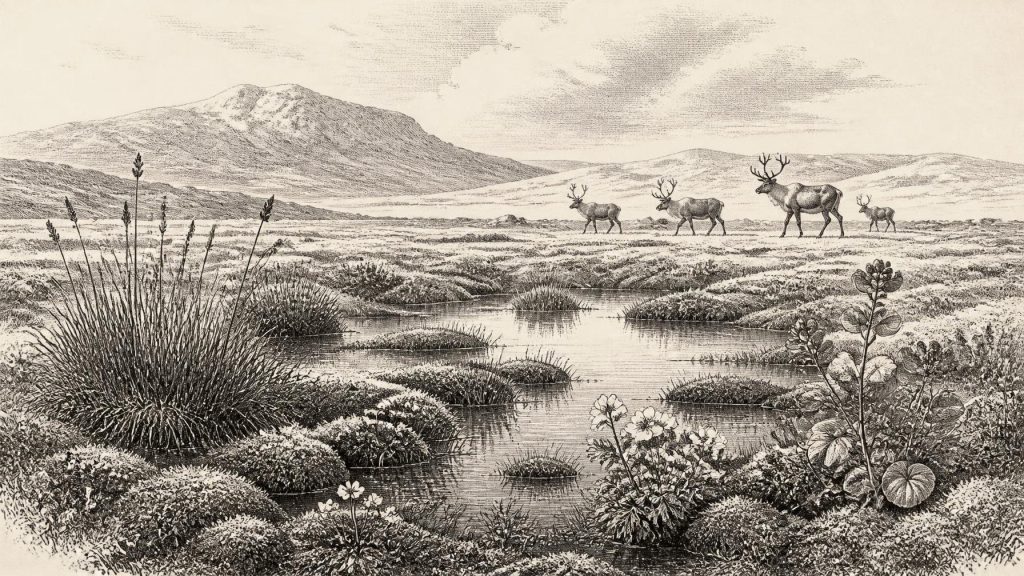
The Derryvree plants and insects indicate a cold, open and wet landscape rather than a wooded Irish countryside. Pollen, mosses, plant macrofossils and beetles point to tundra-like or muskeg conditions: sedges and grasses around pools and slow water, herb-rich ground, low shrubs and extensive mossy wetland. The fossil record includes bogbean (Menyanthes trifoliata) and mountain avens (Dryas octopetala), plants well suited to cold conditions and now familiar in Ireland chiefly from specialised habitats. Their survival in the sediment is direct evidence that vegetation grew locally or very nearby; it is not proof of a uniform island-wide plant cover.
Periglacial processes mattered as much as plants. Repeated freezing and thawing could fracture rock, disturb surface soils and alter drainage. A short growing season nevertheless supported freshwater life and ground vegetation. These were productive patches in a severe world, not a featureless snowfield. The presence of organic sediment itself implies standing or slow-moving water in which plant remains could accumulate and escape complete decay. Yet it would be misleading to turn a single Fermanagh basin into a landscape painting of every Irish region. Derryvree records one locality at one broad interval within a climatically changeable stage.
The modern Irish physical landscape had not yet acquired all its later forms. Some limestone caves, valleys and bedrock uplands already existed, but many familiar superficial features—drumlins, eskers, widespread tills and glacially modified basins—were still being made, remade or would be substantially altered by later ice. The principal regional change was the growing importance of the British–Irish Ice Sheet. Modern reconstructions show that its growth towards maximum extent was asynchronous, with different sectors advancing and reaching their maxima at different times. By the Last Glacial Maximum, after this nominal date, ice would cover almost all of Ireland and adjacent shelf areas.
Animals at Castlepook
Southern Ireland provides a contrasting archive. Castlepook Cave, also called Mammoth Cave, lies in the limestone country north of Doneraile. Excavations conducted in the early twentieth century yielded a remarkable assemblage of Late Pleistocene fauna. Reindeer, woolly mammoth, giant deer, brown bear, wolf, foxes, mountain hare, lemmings and spotted hyaena are among the animals identified from the cave system. This is firm evidence that Ireland, over the wider Late Pleistocene, was intermittently accessible to a far richer and colder-adapted fauna than its later historical animal communities.
It does not mean that all these creatures gathered outside Castlepook in 31,719 BCE. Cave deposits are accumulated histories. Carnivores can carry prey and carrion into caves; animals may die in or near entrances; water, roof falls, burrowing and excavation can redistribute bones. Moreover, Castlepook’s early excavation predates modern stratigraphic methods. The collection is immensely important, but its original contexts were incompletely recorded. Re-dating with improved bone pretreatment has also revised several ages significantly older than results obtained in the 1990s. The 2020 reassessment suggested that giant deer and spotted hyaena may have disappeared locally before the Last Glacial Maximum, perhaps around 40,000 cal BP. Species lists must therefore be read as a time-extended fauna, not as a single simultaneous ecosystem.
Reindeer remain especially relevant to the broad climatic setting. They are well adapted to open, cold country and their Irish remains accord with the picture from Derryvree of treeless, herb- and sedge-bearing habitats. Mammoth and giant deer imply substantial forage in suitable seasons; wolves and hyaenas indicate predators and scavengers following animal concentrations. The workings of this food web were ecological, not economic in the human sense. It would be anachronistic to describe herds as Irish resources unless there is secure evidence that people exploited them.
The Human Question
That question is important because one reindeer femur from Castlepook has been publicised as bearing a deep mark interpreted by zooarchaeologist Ruth Carden as a modification made by a sharp stone tool during butchery. The bone has been reported as about 33,000 years old, making it potentially close in age to the broad period represented by this article. If the interpretation and context are sustained, it would be striking evidence for a human presence in Ireland vastly earlier than the well-established later prehistoric record.
Potential is not the same as demonstration. A single modified bone, particularly one from an old cave collection, cannot establish a settlement, a continuing population, a family group or a route of migration. No securely associated stone-tool assemblage, hearth, dwelling floor, burial, human remains or occupation surface of this age has yet defined an Upper Palaeolithic community in Ireland. Bone surface modifications also require exacting analysis, because carnivore teeth, trampling, weathering, sediment movement, handling and excavation damage can produce marks that resemble human action. Renewed work at Castlepook has sought surviving deposits, but the scale and survival of undisturbed Pleistocene evidence remain limited.
The most careful conclusion is that Ireland around this broad date may have been visited by people, but permanent or recurrent human occupation has not been established. Elsewhere in north-west Europe, Upper Palaeolithic groups were mobile hunter-gatherers who made stone tools and followed seasonal landscapes. That comparison helps identify what a short Irish visit might have involved; it does not permit the importation of their camps, social identities or artistic traditions into Ireland without local evidence. There is no basis for identifying language, ethnicity, political authority, diplomacy, warfare, religion or formal learning here.
What Cannot Be Recovered
Political history is absent. No chiefdom, territory, alliance or conflict can responsibly be described for Ireland at this date. Nor can archaeology identify households, gender roles, kinship systems, food-sharing rules, belief or ritual. The caves and sediments have not produced art, ornaments, structures or funerary practice attributable to this period. There is likewise no evidence for agriculture, herding, metalworking, long-distance trade or a settled economy. Ireland’s earliest securely documented farming societies belong tens of millennia later.
Even travel requires restraint. Global sea level was lower during the Ice Age, but Ireland’s connections to Britain and the European mainland depended on shifting sea level, local uplift and subsidence, ice margins, river systems and coastal geography. It is unsafe to imagine a simple permanent land bridge, still less a known human route. Animal colonisation proves that land or ice-crossing pathways existed at some times, not that they remained continuously open or that people used them.
The most meaningful story around 31,719 BCE is thus one of environmental possibility and evidential limits. Derryvree preserves cold freshwater life between glacial episodes. Castlepook preserves the remains of animals that ranged through very different Ice-Age Ireland. One marked reindeer bone raises the prospect of human activity, but does not yet furnish a settled prehistoric society. Far from being empty, the evidence is exacting: it tells of wet tundra, mobile animals, unstable ice margins and a landscape repeatedly reshaped by climate. It also insists that the apparent precision of a modern BCE year must yield to the broader, calibrated time spans through which the distant Irish past can actually be known.
Primary Sources
- A Middle Midlandian Freshwater Series at Derryvree, Maguiresbridge, County Fermanagh, Northern Ireland
- A Middle Midlandian Freshwater Series at Derryvree, Maguiresbridge, County Fermanagh, Northern Ireland
- BSBI: Menyanthes trifoliata
- BSBI: Dryas octopetala
- A Reconsideration of the Radiocarbon Dating of the Marine Isotope Stage 3 Fauna from Southern Ireland
- The Irish Quaternary Fauna Project
- Growth and Retreat of the Last British–Irish Ice Sheet, 31,000 to 15,000 Years Ago: the BRITICE-CHRONO Reconstruction
- The IntCal20 Northern Hemisphere Radiocarbon Age Calibration Curve (0–55 cal kBP)
- New Insights on the Fauna of Ireland's Younger Dryas and Early Holocene from Alice & Gwendoline Cave
- The Last Glacial Maximum
- The Exploration of Castlepook Cave, Co. Cork. With 3 Plates.
- The Exploration of Castlepook Cave, County Cork, Being the Third Report from the Committee Appointed to Explore Irish Caves
- Occurrence of Mammalia Relicts at Site Castlepook Cave
- 2022:564 – Castlepook Cave, Castlepook South, Cork
- Archaeological Heritage of County Cork
- Ireland Through Geological Time
- Geology of Ireland
- Mammoth and Musk Ox ESR-Dated to the Early Midlandian at Aghnadarragh, County Antrim, Northern Ireland, and the Age of the Fermanagh Stadial
- Late Midlandian, Pleistocene, Northern Ireland
- References and Recommended Reading
- Ireland's Palaeolithic Archaeology – Fleeting Footprints in a Frozen Land
- Reindeer Bone Found in Cork Cave Shows Human Activity in Ireland 33,000 Years Ago