Derryvree’s Tundra Waterline31681 BCE
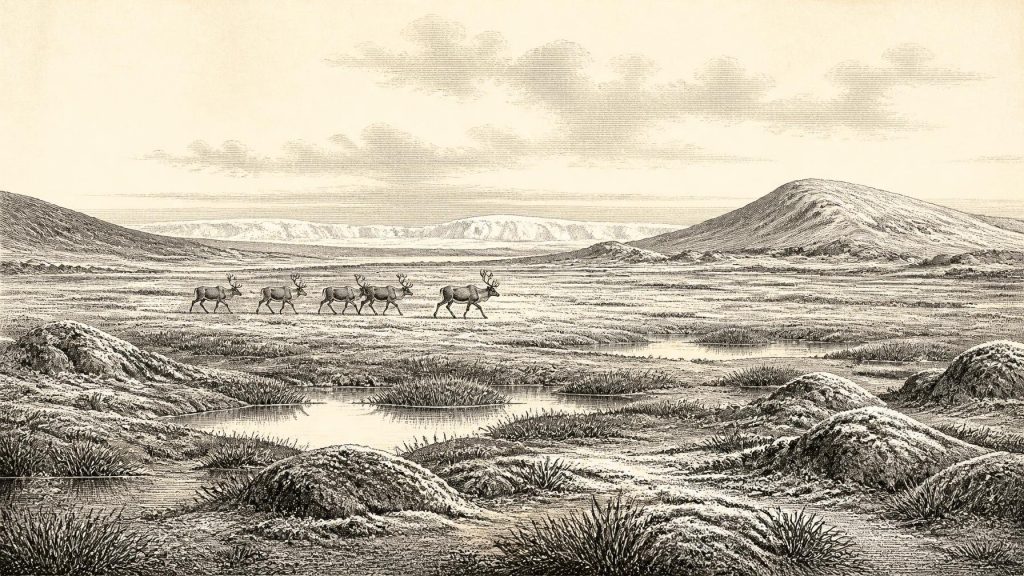
31,681 BCE is not a recoverable Irish historical date but falls within a broad Late Pleistocene, Marine Isotope Stage 3 timeframe. Derryvree, County Fermanagh, preserves freshwater sediments between tills, indicating severe periglacial yet tundra-like wetlands with sedges, dwarf shrubs and cold-adapted insects. Ireland was climatically and geographically variable before the Last Glacial Maximum, with changing ice, sea levels and access routes. Castlepook Cave, County Cork, contains fauna including mammoth, reindeer, giant deer and hyaena, accumulated over long periods. A marked reindeer bone tentatively suggests human processing, but confirms neither settlement nor continuous occupation. Evidence supports environmental history, not year-specific events.
Dateline
“31,681 BCE” is a modern label, not a date that can be recovered from the Irish archaeological record as a particular year, season or generation. No calendar, written testimony, settlement sequence or securely dated human activity allows events in Ireland to be fixed so precisely at this depth of time. The useful chronological frame is broader: approximately 33,630 calendar years before AD 1950, during the Late Pleistocene and Marine Isotope Stage 3, a climatically unstable part of the last Ice Age. Radiocarbon measurements of this age must be calibrated and normally produce ranges spanning centuries or millennia, not a single historical date.
The most illuminating evidence for Ireland around this notional point lies not in monuments or artefacts, but in sediments, pollen, insects, plants and animal bones. It describes a changing physical world in which people may have made brief incursions, but for which a settled human population remains unproven. The central Irish environmental record is at Derryvree, near Maguiresbridge in County Fermanagh, while the strongest evidence for large mammals comes from limestone caves in the south, particularly Castlepook near Doneraile in County Cork.
A Date Range Beneath a Drumlin
In 1969 roadworks cut through a drumlin at Derryvree and exposed an extraordinary sequence: freshwater silts and fine sands, rich in organic material, lying between two thick layers of till. Till is sediment deposited directly by ice. The intervening beds therefore preserve an interval when a wetland existed in a landscape later overridden or enclosed by glacial deposits. Organic material from the freshwater series returned a conventional radiocarbon age of 30,500 +1,170/−1,030 years BP. Calibration places it within a broad late-MIS 3 range, approximately 36,900–31,700 cal BP. The modern label 31,681 BCE falls within that wide span, but cannot be tied to a particular layer, day or event.
This distinction is essential. Derryvree is evidence for conditions during a long environmental interval, not for a year-specific occurrence. Its fossil record points to open, treeless ground under a severe periglacial climate. Periglacial does not mean covered by glacier: it denotes a cold environment shaped by frost, frozen ground, seasonal thaw and sparse vegetation at or near the margins of ice. The fresh-water deposits show that pools, wet ground and sedge-rich margins could exist amid that harshness.
Plant remains, pollen, mosses and insects from Derryvree indicate a tundra-like mosaic rather than forest. Sedges, dwarf shrubs and cold-adapted wetland plants occupied waterlogged patches; exposed mineral ground and frost-disturbed surfaces probably lay nearby. The evidence is local, representing vegetation around the basin and material brought into it by water and wind. It does not justify a detailed map of the whole island. Yet it firmly corrects any image of Ireland as uniformly entombed beneath ice at every moment of the late Ice Age.
An Island Before the Maximum
At this stage the Last Glacial Maximum still lay ahead. Its most extensive phase in Britain and Ireland occurred later, broadly between about 30,000 and 22,000 years ago in different sectors, with maximum overall ice volume around 23,000 years ago. The build-up was neither simple nor uniform. Ice expanded and shifted between marine and upland sectors, while the location of margins remains more securely known for some later phases than for the earlier part of the glaciation.
Consequently, Ireland around 31,681 BCE should not be pictured either as wholly ice-free or as a single uninterrupted ice sheet. The best reconstruction is one of regional variation and rapid climatic change: substantial ice masses and cold-zone landscapes existed, but some places supported exposed land, freshwater and animals. Derryvree demonstrates such an environment in Fermanagh during its dated interval. Cave and fossil records in the south show that terrestrial mammals could reach and live in Ireland during MIS 3. Whether these places were connected at exactly the same time is often uncertain, because their deposits have different dating resolutions and formation histories.
Lower global sea levels made the outlines of north-west Europe very different from those of today. Ireland was not yet the small, fully isolated Atlantic island familiar on modern maps. Broad shelves were exposed, and changing land and sea corridors affected the movements of ice, animals and potentially people. Nevertheless, no simple land bridge should be assumed across every route or throughout the entire period. Coasts, channels, sea ice and ice-sheet margins altered repeatedly, and the practical accessibility of Ireland depended on conditions that could change over generations.
Castlepook’s Animal Archive
Castlepook Cave, also known as Mammoth Cave, near Doneraile in north County Cork, provides Ireland’s richest known concentration of vertebrate remains from before and during the last cold stage. Its collections include woolly mammoth, giant deer, reindeer, brown bear, wolf, fox, Arctic fox, mountain hare, spotted hyaena and lemmings. This is a strikingly non-modern Irish fauna. It shows that, before later glaciation and post-glacial sea-level rise reshaped the island’s ecology, Ireland could support animals now associated with continental or far northern environments.
The list must not be read as a roll call from one hunting ground. Cave deposits are complicated archives. Bones may have been carried in by carnivores, washed through passages, disturbed by later animals, moved by sediment or recovered in early excavations that did not meet modern recording standards. Castlepook was a place of accumulation over long periods, not a preserved snapshot of a single community. Its species demonstrate ecological possibility and broad chronological presence; they do not prove that mammoth, hyaena, reindeer and giant deer stood together at one moment near the cave entrance.
Even so, the fauna strongly suggests open country capable of feeding large grazers and browsers, alongside carnivores able to exploit them. Reindeer were suited to seasonal, open landscapes; lemmings and Arctic fox point towards cold conditions; mammoth and giant deer imply substantial plant resources over a wider territory. Hyaenas could have hunted, scavenged and dragged carcass parts into caves. A cave full of bones therefore records animal behaviour as much as climate: predation, scavenging, denning, death and water movement all helped make the archive.
The Human Question
A reindeer femur from the Castlepook collection has been reported as approximately 33,000 years old and as bearing a deep mark interpreted by zooarchaeologist Ruth Carden as having been made by a sharp stone tool during carcass processing. If the interpretation is confirmed, it would be potentially momentous: it would indicate Upper Palaeolithic people handling a reindeer in Ireland tens of millennia before the long-recognised post-glacial record of human occupation.
But the claim requires careful wording. The bone derives from an old cave collection, rather than a modern excavation of an intact occupation floor. A radiocarbon date establishes the approximate time at which the animal died; it does not independently date the incision, the kill site or the length of any human visit. Nor has Castlepook yielded a securely associated hearth, stone-tool assemblage, dwelling surface, burial or repeated domestic refuse of comparable age. The identification of a cut or chop mark is specialist analysis, distinct from the date of the bone itself.
The responsible conclusion is therefore neither dismissal nor overstatement. A human visit to Ireland during MIS 3 is plausible and the marked reindeer bone may preserve evidence of one. Permanent settlement, continuous occupation, population size and cultural affiliation are not established. There is no basis for naming a people, reconstructing a camp, or describing a migration as though it were historical fact.
Society Without a Social Record
There is no direct evidence for political institutions, rulers, diplomacy, territorial boundaries, warfare, religion, formal learning or trade networks in Ireland at this date. Those subjects belong to later prehistoric and historic records, not to the sparse MIS 3 evidence. If people did reach the island, they would have been hunter-gatherers operating in a world where food, shelter, weather and animal movements imposed immediate constraints. That is an inference from the wider Upper Palaeolithic of north-west Europe, not a demonstrated description of an Irish community.
Likewise, no Irish art, ritual site, burial, house, textile, boat or tool industry can responsibly be assigned to 31,681 BCE. The absence of such evidence does not prove that no person ever arrived; erosion, later glaciation, sea-level change and the rarity of systematic investigation all reduce survival. But archaeology cannot fill that silence with imagined ceremonies, alliances or everyday routines. The material record currently supports an environmental history first and, at most, a tentative human possibility.
Water, Frost and Uncertainty
The enduring significance of this date lies in that combination of evidence and restraint. Derryvree preserves the waterline of a cold, open wetland beneath later glacial sediments. Castlepook preserves the bones of animals that reveal a richer Ice Age fauna than modern Ireland possesses. Together they show that late-Pleistocene Ireland was environmentally diverse, regionally variable and repeatedly altered by ice, climate and changing sea levels.
For 31,681 BCE, no year-specific Irish event can be written. What can be said is more valuable than an invented chronicle: within a broad calibrated timeframe, parts of Ireland contained periglacial wetlands and open tundra-like habitats; large mammals moved through suitable landscapes; and a single marked reindeer bone raises, but does not settle, the possibility of a very early human presence. The history of this remote Irish world survives in silts, pollen and bone, and its greatest lesson is how much precision the evidence does—and does not—permit.
Primary Sources
- A Middle Midlandian Freshwater Series at Derryvree, Maguiresbridge, County Fermanagh, Northern Ireland
- A Reconsideration of the Radiocarbon Dating of the Marine Isotope Stage 3 Fauna from Southern Ireland
- The Irish Quaternary Fauna Project
- Castlepook Cave, County Geological Site Report
- Spotted Hyena Skull
- The Irish Quaternary Fauna Project
- Irish Pleistocene Biostratigraphy
- Phylogeographic, Ancient DNA, Fossil and Morphometric Analyses Reveal Ancient and Modern Introductions of a Large Mammal: The Complex Case of Red Deer (Cervus elaphus) in Ireland
- Late Pleistocene Chronostratigraphy and Ice Sheet Limits, Southern Ireland
- Dimensions and Chronology of the Last Ice Sheet in Western Ireland
- Trimlines, Blockfields and the Vertical Extent of the Last Ice Sheet in Southern Ireland
- Last Glacial Maximum Cirque Glaciation in Ireland and Implications for Reconstructions of the Irish Ice Sheet
- Extent and Timing of the Last Glacial Maximum in Britain and Ireland: A Review
- Ice Sheet Extension to the Celtic Sea Shelf Edge at the Last Glacial Maximum
- Growth and Retreat of the Last British–Irish Ice Sheet, 31,000 to 15,000 Years Ago: The BRITICE-CHRONO Reconstruction
- The IntCal20 Northern Hemisphere Radiocarbon Age Calibration Curve (0–55 cal kBP)
- A Stratigraphic Framework for Abrupt Climatic Changes During the Last Glacial Period Based on Three Synchronized Greenland Ice-Core Records
- Equilibrium Simulations of Marine Isotope Stage 3 Climate
- New Insights on the Fauna of Ireland's Younger Dryas and Early Holocene from Alice & Gwendoline Cave
- First Evidence of a Late Upper Palaeolithic Human Presence in Ireland
- Quaternary Geology of Ireland
- Irish Quaternary Association: Outreach and Education Resources
- Mammoth Cave, Castlepook