Bogbean and Reindeer31680 BCE
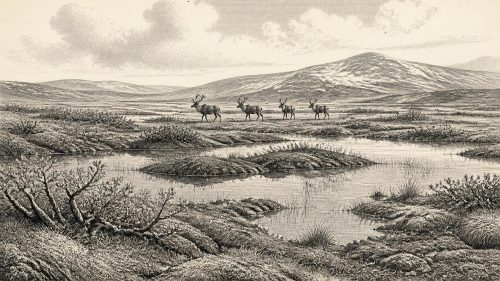
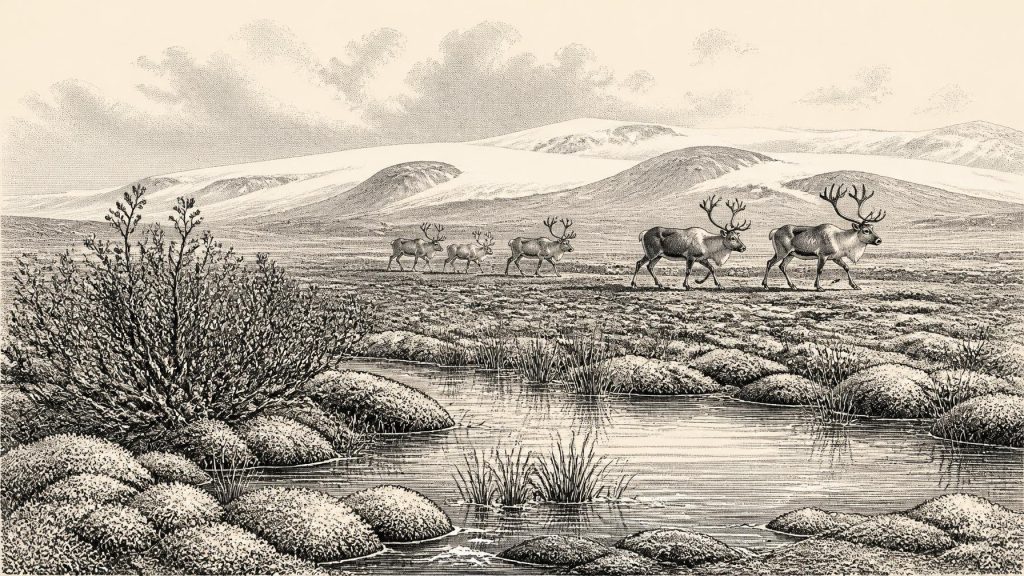
Around 31,680 BCE, Ireland lay within the climatically unstable MIS 3 cold stage, where ice margins and habitats changed repeatedly. Derryvree in Fermanagh preserves freshwater deposits indicating open, waterlogged tundra, with sedges, mosses, dwarf willow and bogbean. Castlepook Cave in Cork contains MIS 3 remains of mammoth, reindeer, giant deer, predators and cold-adapted species, showing Ireland’s place in a wider Ice-Age ecosystem. A marked reindeer femur may indicate butchery by people, but lacks secure context. No evidence establishes permanent settlement, communities, political life or cultural practices; the period’s history is chiefly environmental, fragmentary and cautiously interpreted from sparse surviving evidence.
Dateline
31,680 BCE is not a date that archaeology can resolve as a single Irish year. It is a modern calendar label for a point roughly 33,630 calendar years before 1950, conventionally written as c. 33.6 cal ka BP. At this depth of time, even radiocarbon dates come with substantial uncertainties and must be calibrated; deposits may represent many centuries or millennia rather than one season, let alone one day. The responsible subject is therefore Ireland in the later Middle Midlandian cold stage, within Marine Isotope Stage 3 (MIS 3), not an invented episode in a named community’s calendar.
There are no securely dated Irish houses, hearths, tool-making floors, burials, monuments, written records or identifiable populations for this notional year. No kingdom, tribe, leader, language, border, treaty or battle can be recovered from the evidence. “Ireland” itself is used here geographically, for the landmass of the modern island, rather than as a political or cultural unit. What survives instead is a difficult but revealing combination of buried freshwater sediments, cave bones, cave calcite, glacial landforms and laboratory dates.
A Cold, Changing Island
This was part of the last Ice Age, but not yet the fullest and best-known expansion of the British–Irish Ice Sheet. MIS 3 was climatically unstable. Across the North Atlantic, colder stadial intervals alternated with relatively milder interstadials on millennial timescales. These shifts affected snowfall, ice margins, river regimes, vegetation and the routes available to animals. Greenland ice cores provide the principal framework for recognising this abrupt variability, but their numbered Greenland events should not be treated as exact Irish weather reports. Irish deposits are too sparse, and their dating too broad, to attach a precise local climatic phase to 31,680 BCE.
Even so, the broad setting is clearer than older simple maps of a permanently ice-covered Ireland suggest. Research on the growth of the British–Irish Ice Sheet indicates dynamic advance and retreat during MIS 3. In north-central Ireland, organic deposits at Derryvree near Maguiresbridge, County Fermanagh, have a calibrated age range of approximately 36.9–31.7 cal ka BP. At Greenagho, near Belcoo in the same county, organic material beneath till has been dated to about 37.2–35.7 cal ka BP. Such ranges show that parts of the island contained ice-free terrestrial and freshwater environments during the wider period, although they cannot prove that every region was open at the same moment.
The later major build-up of Irish ice lay ahead. Evidence from southern Ireland and the adjacent Atlantic shelf indicates that ice expanded markedly after this interval, while the maximum southern extent of the last ice sheet was much later, after c. 24 ka BP. Thus the landscape around the nominal date should be envisaged neither as a settled green island nor as a uniform white cap. It was a severe, regionally varied glacial-edge world: exposed ground in some places, ice or ice-proximal terrain in others, and environments capable of altering quickly as temperature and precipitation changed.
Derryvree’s Wet Ground
Derryvree offers the most informative Irish glimpse of everyday ecology near this broad timeframe. Roadworks in 1969 cut through a drumlin and revealed freshwater silts and fine sands sandwiched between tills. The organic layers yielded pollen, plant macrofossils, mosses and insect remains, along with a conventional radiocarbon determination of 30,500 years BP, published with a wide error range. Subsequent calibrations place the deposit broadly across the interval that includes the notional date considered here.
The evidence supports a landscape of open tundra or tundra-like vegetation under periglacial conditions. It does not support later images of Ireland as a forested island of oak, hazel and pasture. Pollen was dominated by herbs, while the macrofossils included plants adapted to cold, wet or open ground. Mosses, sedges, dwarf willow, bogbean and other hardy taxa point towards waterlogged hollows, shallow freshwater, damp margins and sparse vegetation beyond them. The term muskeg, sometimes used for the Derryvree setting, conveys an uneven mosaic of saturated mossy and sedgy ground rather than a uniform marsh.
That local wetland mattered in an otherwise exposed environment. Pools and sedge beds could sustain specialised plants and invertebrates; nearby open ground offered seasonal grazing and browsing. Yet Derryvree was a small archive, not a national survey. It demonstrates what survived at one place between episodes of glaciation. It cannot tell us precisely how far such habitat extended across Ulster, much less across Munster, Connacht or Leinster.
The Castlepook Animal World
In north County Cork, Castlepook Cave near Doneraile preserves a complementary record. Long known as Mammoth Cave, it has produced one of Ireland’s most important Pleistocene faunal assemblages. Among the animals represented are woolly mammoth, reindeer, giant deer, brown bear, wolf, spotted hyaena, Arctic fox, mountain hare and lemmings. The collection was accumulated over a long period, however, and it is essential not to turn its species list into one simultaneous scene outside the cave entrance.
Direct dating has shown that elements of the Castlepook fauna belong to MIS 3, with several specimens falling broadly between c. 34,000 and 35,000 radiocarbon years ago or receiving later revised ages through improved pretreatment. Reassessment has been necessary because many bones entered museum collections through nineteenth- and early twentieth-century excavations, when stratigraphic recording was far less exacting than it is today. Cave sediments may also be disturbed by scavengers, water, collapse and later excavation. A mammoth bone, a hyaena bone and a reindeer bone from one cave need not represent the same year, generation or even climatic episode.
Nevertheless, the animal evidence decisively establishes that Ireland formed part of a wider north-west European Ice-Age ecological zone. Reindeer indicate cold, open country with seasonal forage; mammoths and giant deer imply substantial plant resources, though not necessarily in the same microhabitats. Lemmings and Arctic fox fit a northern, exposed setting. Wolves and spotted hyaenas reveal a food web in which predators and scavengers moved through the landscape and could carry bones into caves. A cave was therefore not automatically a human shelter: it could be a carnivore den, a trap, a drainage route or a long-term bone archive.
A Reindeer Bone and a Human Question
Castlepook has also become central to the question of whether people reached Ireland during this earlier part of the Upper Palaeolithic. A reindeer femur fragment, recovered from the old cave collection, has been reported as dating to around 33,000 years ago and as bearing a deep mark interpreted by zooarchaeologist Ruth Carden as consistent with butchery by a sharp stone tool. If that interpretation is confirmed, it would be highly significant evidence for a brief human presence in Ireland far earlier than the long-established post-glacial settlement record.
The finding must be framed as evidence under assessment, not as proof of a settled Palaeolithic population. The dated bone gives the age of the animal, rather than independently dating the mark, the place where it died or the length of any human visit. The specimen lacks the secure modern-excavation context that would accompany an occupation surface. No associated hearth, stone-tool assemblage, dwelling, burial, artwork or food-processing area of comparable antiquity has yet demonstrated a community at Castlepook. Bone marks must also be distinguished carefully from carnivore damage, trampling, sediment abrasion, weathering and excavation damage.
Accordingly, it is reasonable to say that people may have visited or passed through Ireland in this period, perhaps as highly mobile hunter-gatherers operating within the broader Upper Palaeolithic world of north-west Europe. It is not reasonable to describe farms, villages, clans, permanent routes, trade systems or continuous occupation. The National Museum of Ireland’s general account remains cautious about clear Palaeolithic human evidence on the island, a useful reminder that an important individual specimen does not settle every archaeological question.
What Cannot Be Claimed
Society is visible only indirectly. If people did butcher the Castlepook reindeer, the action would imply practical knowledge of carcass processing and sharp stone edges, as well as access to meat, hide, sinew, fat and bone. It does not reveal their names, numbers, kinship, language, beliefs or social authority. There is no evidence for ritual, formal religion or learning in Ireland at this date, though Upper Palaeolithic people elsewhere in Europe possessed sophisticated technical and symbolic traditions. Those continental comparisons provide context, not missing Irish facts.
There is likewise no evidence for political affairs, diplomacy or organised conflict. Animals could move during periods of lower sea level and altered coastal geography, but this does not demonstrate a reliable human land route, a trading network or regular contact. The economically important processes were ecological: plants colonising open ground, herbivores finding forage, carnivores following prey, and ice advance repeatedly remodelling the terrain. In the long view, those processes shaped the physical stage upon which much later human settlement became possible.
Ireland around 31,680 BCE was therefore not empty of history, but its history is environmental and evidential rather than narrative. The damp sedge-and-moss deposits of Fermanagh and the reindeer-rich cave record of north Cork reveal an island intermittently capable of supporting life at the edge of profound climatic change. They offer firm evidence for cold habitats and Ice-Age fauna, a plausible but still limited human question at Castlepook, and no licence to invent the people or events that the record has not preserved.
Primary Sources
- The IntCal20 Northern Hemisphere Radiocarbon Age Calibration Curve (0–55 cal kBP)
- A Stratigraphic Framework for Abrupt Climatic Changes During the Last Glacial Period Based on Three Synchronized Greenland Ice-Core Records
- Early Midlandian–Middle Midlandian, Pleistocene, Northern Ireland
- Middle Midlandian Interstadial Deposits at Greenagho, Near Belcoo, County Fermanagh, Northern Ireland
- Quaternary Deposits and Glacial Stratigraphy in Ireland
- Irish Pleistocene Biostratigraphy
- Palaeoecology
- The Irish Quaternary Fauna Project
- A Reconsideration of the Radiocarbon Dating of the Marine Isotope Stage 3 Fauna from Southern Ireland
- Episodic Speleothem Deposition Tracks the Terrestrial Impact of Millennial-Scale Last Glacial Climate Variability in SW Ireland
- The Nature and Timing of MIS 3 Interstadials: New Constraints from U-Series Dated Speleothems from Crag Cave, S.W. Ireland
- Rapid Response of Climatic Conditions During the Last Glacial: Evidence from U-Series Dated Irish Speleothems
- Trimlines, Blockfields and the Vertical Extent of the Last Ice Sheet in Southern Ireland
- Late Pleistocene Chronostratigraphy and Ice Sheet Limits, Southern Ireland
- The Timing and Magnitude of the British–Irish Ice Sheet Between Marine Isotope Stages 5d and 2
- Pattern, Style and Timing of British–Irish Ice Sheet Advance and Retreat Over the Last 45,000 Years
- Dimensions and Chronology of the Last Ice Sheet in Western Ireland
- Sedimentology and Chronology of the Advance and Retreat of the Last British-Irish Ice Sheet on the Continental Shelf West of Ireland
- Prehistoric Details
- Reindeer Bone Found in Cork Cave Shows Human Activity in Ireland 33,000 Years Ago
- What Was on the Menu in Prehistoric Ireland?
- Phylogeographic, Ancient DNA, Fossil and Morphometric Analyses Reveal Ancient and Modern Introductions of a Large Mammal: the Complex Case of Red Deer (Cervus elaphus) in Ireland
- New Insights on the Fauna of Ireland’s Younger Dryas and Early Holocene from Alice & Gwendoline Cave