The Irish Sea Threshold31675 BCE
31,675 BCE is a modern label, not a datable Irish event, representing late Pleistocene Marine Isotope Stage 3 as the British–Irish Ice Sheet began sustained growth. Ireland contained ice-free tundra, wetlands and freshwater habitats, preserved beneath glacial deposits at Derryvree and Greenagho. Castlepook Cave’s imperfect bone assemblage records reindeer, mammoth, giant deer and predators, indicating an ecologically active landscape. A cut-marked reindeer femur may signal Ireland’s earliest human activity, but cannot prove settlement, culture or continuity. Glacial erosion, uncertain radiocarbon dates and changing sea geography limit conclusions. The period is an environmental threshold, illuminated by fragmentary evidence rather than events.
Dateline
31,675 BCE is not a date at which Ireland’s archaeological record can identify a particular event. No written calendar existed, and no deposit can be tied responsibly to a named year, season, person or community. The number is a modern retrospective label, roughly 33,624 years before the conventional scientific present of AD 1950. At this depth of time, radiocarbon measurements must be calibrated and are normally expressed as ranges rather than single dates. The most responsible view is therefore of a broader interval: late Pleistocene Ireland during Marine Isotope Stage 3, close to the onset of the major growth of the last British–Irish Ice Sheet.
A Changing Ice-Age Island
In the wider North Atlantic climate sequence, this approximate point falls within a short-lived relatively mild episode known as Greenland Interstadial 6, conventionally placed at about 34.7–33.3 thousand years before 1950. Such an interval did not mean modern warmth. It meant a change within an ice-age world: temperatures, vegetation, animal ranges, snowfall and the edges of glaciers could all alter markedly across centuries and millennia. Ireland lay on the western margin of north-west Europe, exposed to Atlantic weather and to the unstable interaction of sea, ice and land.
It would be misleading to picture the whole island under the great continuous ice sheet usually associated with the Last Glacial Maximum. The best current reconstructions place the decisive, sustained build-up of the British–Irish Ice Sheet after roughly 35,000–32,000 years ago, with especially substantial expansion from about 31,000 to 26,000 years before present and its greatest overall volume later, around 23,000 years ago. Those are modelled chronological phases, not sharply dated Irish turning points. Around the notional year 31,675 BCE, parts of Ireland may have been entering a period in which snowfields and local ice masses became increasingly significant, while other districts still retained ice-free ground.
The evidence is uneven. Organic-rich sediments beneath later glacial deposits at Derryvree and Greenagho in County Fermanagh preserve traces of earlier freshwater and wetland environments. Their dated ranges show that north-central Ireland contained ice-free landscapes during parts of the long interval before the final ice-sheet expansion. They do not demonstrate what happened across all Ireland, or even in Fermanagh, in one particular calendar year. Later glaciers scoured bedrock, shifted sediment and buried older surfaces beneath till, destroying much of the evidence that might otherwise have recorded this age.
Fermanagh’s Buried Landscapes
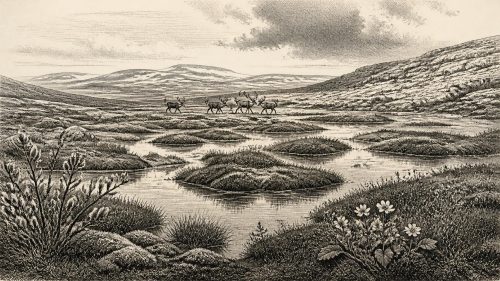
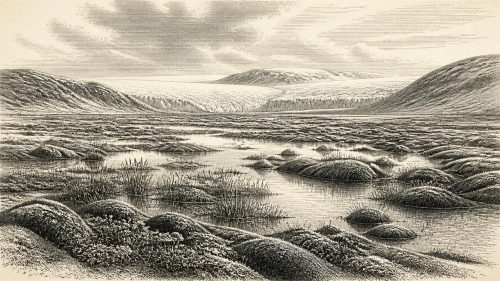
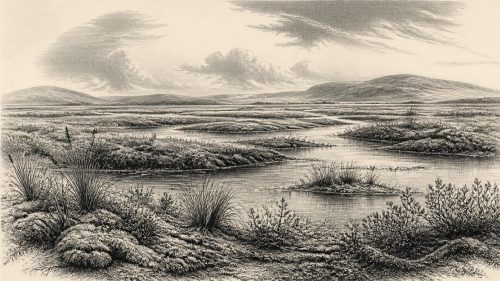
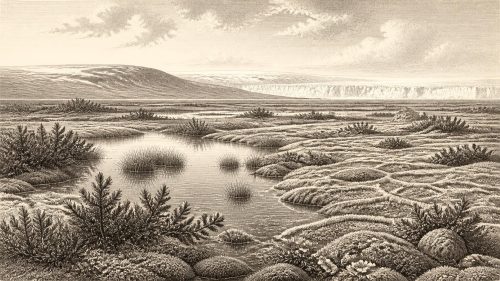
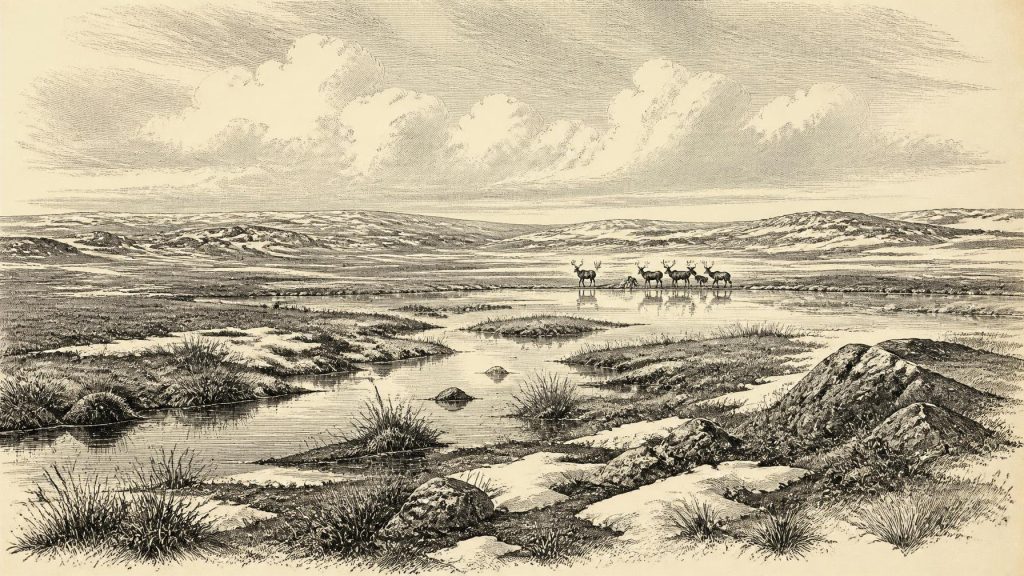
Yet the Fermanagh deposits are important precisely because they preserve what the later ice did not wholly erase. At Derryvree, plant remains and sediments between tills indicate a cold, open wetland landscape with shallow freshwater conditions. At Greenagho, organic detritus from lake deposits beneath till similarly points to an interval when water, vegetation and sediment accumulated before renewed glaciation. These archives are not snapshots. A pollen grain, seed, moss fragment or layer of silt may represent years of deposition, and each stratigraphic layer has been subject to disturbance, dating uncertainty and interpretation. Nevertheless, together they make an essential correction to the image of an eternally frozen Ireland: before maximum glaciation, parts of the island supported waterlogged, tundra-like habitats.
Treeless does not mean lifeless. Cold-stage vegetation in Ireland is reconstructed from pollen, plant macrofossils and comparison with better-preserved north-west European sequences. Sedges, grasses, dwarf shrubs, mosses and hardy flowering plants could occupy marshes, floodplains and exposed ground, varying with drainage, wind exposure and season. The ground may have been seasonally frozen in places. Meltwater and frost action continually reworked slopes and valley floors. Woodland, farming fields and familiar hedgerow landscapes lay far in the future; even the coastlines and river mouths of modern Ireland cannot simply be projected backwards onto this changing terrain.
Castlepook and the Animal Record
The richest direct evidence for Ireland’s late Pleistocene mammals comes from caves, especially Castlepook Cave near Doneraile in north County Cork. Excavations undertaken chiefly between 1904 and 1914 recovered a vast bone assemblage. Much was later lost or dispersed, and the surviving collection comes from antiquarian excavation rather than modern, fully recorded stratigraphic methods. That sharply limits what can be claimed. A cave collection is an accumulation across time, not a census of animals alive together on one day.
Even so, Castlepook demonstrates that Ireland was reached by a striking range of mammals during Marine Isotope Stage 3. The assemblage has included reindeer, woolly mammoth, giant deer, brown bear, wolf, Arctic fox, mountain hare, lemmings and spotted hyaena. These species did not necessarily share precisely the same habitat or date. Some were visitors, some prey, some predators and some may have been brought into the cave by carnivores or washed in with sediments. The presence of spotted hyaena is especially revealing: caves could serve as carnivore dens and bone-accumulation sites, not merely shelters awaiting human occupants.
For the approximate period represented by 31,675 BCE, reindeer are particularly evocative but should not be romanticised into evidence for a settled hunting society. Reindeer favour open, cold environments and their remains support the broader picture of grassland, tundra and wetland mosaics. Mammoth and giant deer indicate that sizeable herbivores could enter Ireland during suitable phases; wolves and hyaenas reveal predators within the same wider food web. The island was therefore not biologically empty. But neither does the faunal record show stable herds in every county, a reliable seasonal route through Cork, or a fixed carrying capacity for people.
The Human Question
A reindeer femur from Castlepook has made this remote period newly significant for Irish prehistory. Its radiocarbon age has been reported as approximately 33,000 years old, and a deep incision has been interpreted as consistent with a cut made by a sharp stone tool during carcass processing. If that interpretation is upheld, it may represent the earliest evidence of human activity in Ireland: a fleeting encounter between people and a reindeer in the late Pleistocene.
That possibility must remain separate from what has been demonstrated. The bone was recovered from an old cave collection, not from a sealed occupation floor. A radiocarbon result dates the animal’s death within a statistical range; it does not itself date the incision, identify where the animal was killed, or prove who brought it to the cave. Castlepook has not yielded a securely associated stone-tool assemblage, hearth, dwelling, burial, human skeleton, art panel or repeated domestic refuse of comparable age. Recent work has also shown that several radiocarbon determinations obtained from Irish cave bones in the 1990s require reassessment because improved pretreatment can produce substantially older results.
The proper conclusion is cautious but consequential. Ireland may have been visited by Upper Palaeolithic hunter-gatherers around this broad period, perhaps moving in very small groups and exploiting animal resources when local conditions permitted. It is not possible to identify their language, ancestry, social organisation or cultural tradition from the Irish evidence. Continental Europe possessed diverse Upper Palaeolithic populations and technologies, but no diagnostic Irish artefacts allow Castlepook to be assigned securely to a named archaeological culture. Nor can a single marked bone establish permanent settlement or continuous occupation.
No Polities, No Proven Trade
Political affairs, diplomacy and formal warfare cannot be recovered for Ireland at this horizon. There were no known Irish kingdoms, borders, chiefs, treaties or institutions, and no evidence for formal religion, monuments, writing or learned traditions. Nor is there evidence for farming, livestock, pottery, metalworking or trade networks within Ireland. These are not gaps to be filled with imaginative narrative; they are absences in the surviving record.
If people did make temporary incursions, everyday life would have depended on mobility, detailed environmental knowledge and access to meat, fat, hides, bone and fuel. Such statements are informed comparisons with Upper Palaeolithic hunter-gatherers elsewhere, not direct observations of an Irish camp. The sea and ice between Ireland, Britain and continental Europe also demand caution. Sea level, ice loading and crustal movement altered the geography of the Irish Sea, but there is no simple, universally accepted land-bridge map for this exact period. Any movement of animals or people occurred through a changing and poorly resolved landscape, potentially involving sea ice, islands, coastal corridors or stretches of water.
The Evidence’s Long Afterlife
The principal historical development visible around 31,675 BCE is environmental rather than political: Ireland stood near the threshold of the last great ice-sheet expansion. Its habitats were changing, its animal populations were intermittent and mobile, and the ground that might have preserved human traces was vulnerable to later glacial erosion. The caves of Cork and the buried sediments of Fermanagh provide rare, imperfect windows through that loss.
For that reason, the story of this year is not one of a known settlement, battle or ruler. It is the story of evidence at its limit. A wetland layer beneath a drumlin, a cave bone gathered by a carnivore, a radiocarbon range revised by improved chemistry, and one contested incision on a reindeer femur together illuminate an Ireland that was cold, open and ecologically active. They also set a clear standard for interpretation: fascinating possibilities are not the same thing as established history.
Primary Sources
- A reconsideration of the radiocarbon dating of the Marine Isotope Stage 3 fauna from southern Ireland
- The Irish Quaternary Fauna Project
- New insights on the fauna of Ireland's Younger Dryas and Early Holocene from Alice & Gwendoline Cave
- Growth and retreat of the last British–Irish Ice Sheet, 31,000 to 15,000 years ago: the BRITICE-CHRONO reconstruction
- Maximum extent and readvance dynamics of the Irish Sea Ice Stream and Irish Sea Glacier since the Last Glacial Maximum
- Trimlines, blockfields and the vertical extent of the last ice sheet in southern Ireland
- Extent and timing of the Last Glacial Maximum in Britain and Ireland: a review
- The timing and magnitude of the British–Irish Ice Sheet between Marine Isotope Stages 5d and 2: implications for glacio-isostatic adjustment, high relative sea levels and ‘giant erratic’ emplacement
- Deglaciation chronology of the Donegal Ice Centre, north-west Ireland
- Radiocarbon constraints on the age of the maximum advance of the British-Irish Ice Sheet in the Celtic Sea
- Stratigraphic and palaeo-geomorphological evidence for the glacial-deglacial history of the last British-Irish Ice Sheet in the north-western Irish Sea
- The IntCal20 Northern Hemisphere Radiocarbon Age Calibration Curve (0–55 cal kBP)
- IntCal Publications
- Consistently dated Atlantic sediment cores over the last 40 thousand years
- Occurrence of mammalia relicts at site Castlepook Cave
- Archaeology Research Excavation Grant 2022: Final Report
- 32564: Castlepook Cave, Castlepook South, Cork
- Archaeological Heritage of County Cork
- Heritage Artefacts of County Cork
- The problem of a late Quaternary landbridge between Britain and Ireland
- Ireland: Submerged Prehistoric Sites and Landscapes
- Relative sea-level changes and crustal movements in Britain and Ireland since the Last Glacial Maximum